
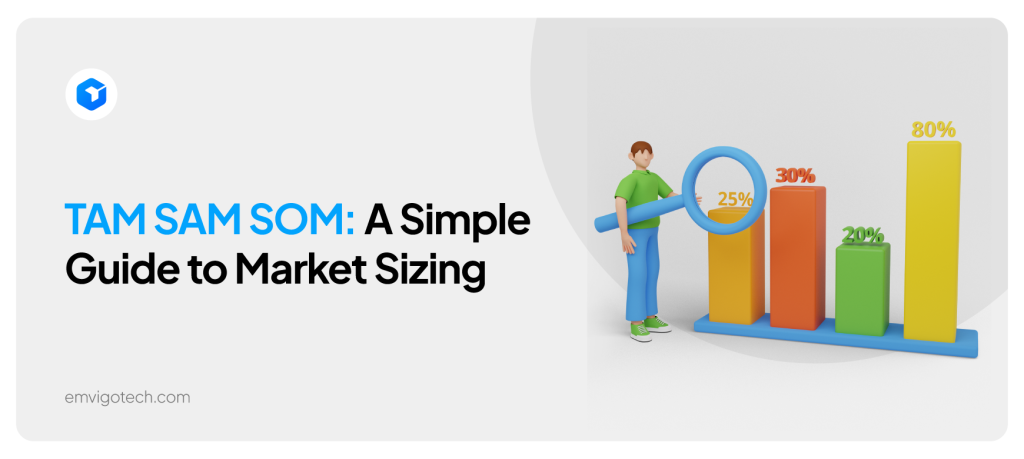
Most startups fail not because of their product, but because they misjudge the market. That’s where understanding TAM, SAM, and SOM comes in—it helps you identify your total market potential, focus on the portion you can realistically serve, and plan a strategy to capture it effectively.
Market sizing is a crucial step in understanding the potential of a business idea, and the TAM SAM SOM framework provides exactly that clarity. Whether you’re launching a new software product or seeking investment, these three metrics will shape your strategic direction.
To understand how this framework can guide your strategy, let’s break down TAM, SAM, and SOM step by step
What Does TAM SAM SOM Mean?
TAM SAM SOM represents three nested market measurements that help businesses understand their true opportunity:
-
- TAM (Total Addressable Market): The entire market opportunity if you had no competition
- SAM (Serviceable Addressable Market): The portion you can realistically target
- SOM (Serviceable Obtainable Market): What you can actually capture with your current resources
Key Insight: Venture Capitalists (VCs) typically look for a TAM of over $1B to consider the opportunity substantial, but understanding all three layers helps you build a realistic roadmap to capture that market.
TAM: Your Market’s Full Potential
TAM represents the total revenue opportunity available for a product or service in a specific market or industry. It is the maximum revenue a company could generate if it held 100% market share.
In a 2015 research report, Morgan Stanley analyst Katy Huberty projected that Apple’s total addressable market could grow from $800 billion to $3.4 trillion by 2020, driven by expansion into new markets such as the Apple Watch, Apple TV, and the anticipated Apple Car.
Example: If you’re building project management software, your TAM includes every business globally that could potentially use project management tools.
SAM: Your Realistic Target
While the TAM (Total Addressable Market) gives you the full potential of a market, SAM (Serviceable Available Market) focuses on the portion of that market you can realistically reach. SAM narrows down your TAM based on:
-
- Geographic constraints: You may initially operate only in certain regions or countries due to logistics, language, or local regulations.
- Product limitations: Your product or service may not serve all customer needs or may only be relevant to a subset of the TAM.
- Regulatory boundaries: Legal or compliance requirements can restrict the markets you can enter.
- Target customer segments: Not all customers in the TAM are ideal for your offering; SAM focuses on the segments most likely to buy and benefit from your product.
Example: Your project management software might only work for UK businesses with 50-500 employees. This geographic and size constraint defines your SAM.
Essentially, SAM helps you define a practical market focus, ensuring that your business strategy and resources are directed toward the customers and regions where you have the highest chance of success.
SOM: Your Achievable Market Share
While TAM shows the total potential and SAM narrows it down to your realistic target, SOM (Serviceable Obtainable Market) focuses on the portion of the market that your business can actually capture in the near term. It considers the practical limitations and resources of your organization, such as:
-
- Current resources: Your team size, budget, technology, and operational capabilities determine how much of the market you can realistically serve.
- Competition levels: The presence of established competitors may limit the share you can capture, especially in highly contested markets.
- Marketing reach: How effectively you can promote your product and connect with your target customers affects your achievable market share.
- Sales capacity: Your ability to close deals, onboard clients, or scale your sales operations also influences your SOM.
For example: if you’re a startup operating only in New York City, your SOM might be a smaller, realistic slice of the market, say $500 million, based on local demand, customer accessibility, and the competitive landscape.
In essence, SOM helps you set achievable goals, allocate resources efficiently, and plan growth strategies without overestimating what your business can capture in the short term.
TAM vs SAM vs SOM: A Quick Reference Guide
| Metric | Full Form | Definition | Focus | Example |
|---|---|---|---|---|
| TAM | Total Addressable Market | The total revenue opportunity if the product/service captured 100% of the market | Broad, overall market potential | All people in the UK who order food online |
| SAM | Serviceable Available Market | The portion of TAM that your business can serve based on your product/service and operational reach | Targeted, realistic market | London residents in areas your food delivery service can cover efficiently |
| SOM | Serviceable Obtainable Market | The portion of SAM that you can realistically capture in the short term given resources and competition | Achievable, first-year or early-stage market | Customers your delivery app expects to acquire in its first year |
How to Calculate TAM SAM SOM
Calculating TAM: Two Main Approaches
Top-Down Approach Start with industry research and work downwards:
-
- Find total market size from research reports
- Apply your addressable percentage
Bottom-Up Approach
Build from customer data upwards:
-
- Count total potential customers
- Multiply by average customer value
TAM is calculated by multiplying the total number of potential customers by the average revenue per customer.
Formula: TAM = (Total number of potential customers)×(Average annual revenue per customer)
Calculating SAM: Apply Your Constraints
Once you have your TAM, the next step is to identify your Serviceable Available Market (SAM) — the portion of the market you can realistically target given your business limitations. Start with your TAM, then apply realistic filters:
Formula: SAM = (Total number of potential customers in your target segment)×(Average annual revenue per customer)
OR
SAM = TAM × Percentage of the Market You Can Serve
For a UK software company targeting enterprise clients:
-
- Geographic: UK market only (reduce by global percentage)
- Segment: Enterprise only (reduce by SME percentage)
- Product: Specific industry focus (reduce by irrelevant sectors)
Calculating SOM: Your Realistic Capture
When calculating your SOM (Serviceable Obtainable Market), you need to estimate the portion of the market you can realistically capture. To do this, look at both your strengths compared to competitors and your capacity to deliver. Consider your competitive advantage and resources:
Formula: SOM = (Total number of target customers you can realistically serve)×(Average annual revenue per customer)
OR
SOM = SAM ×Your Expected Market Share
Most startups can realistically expect to capture 1-3% of their SAM within the first few years. Emvigo helps startups optimize their strategy and resources, enabling them to target the most promising market segments and increase their chances of early success.
Common TAM SAM SOM Mistakes to Avoid
Overestimating Your TAM
Don’t include customers who would never realistically buy your product. A chatbot company shouldn’t include the entire global communications market in their TAM.
Ignoring Market Constraints
Your SAM must reflect real-world limitations:
-
- Regulatory requirements
- Geographic boundaries
- Language barriers
- Cultural differences
Unrealistic SOM Projections
Targeting a large market alone is not enough, though—investors also want to see that you have a realistic plan for capturing a significant portion of that market.
Common SOM errors:
-
- Assuming you’ll capture 10%+ market share quickly
- Ignoring competitive dynamics
- Underestimating customer acquisition costs
Using Outdated Data
Market sizes change rapidly. The British software market is projected to generate €4.9 billion in revenue by 2028, a notable increase from the €4.3 billion expected in 2023. The UK software industry has experienced a steady annual growth rate of 2.4% since 2013. Always use current data sources.
TAM SAM SOM for Software Development Projects
When planning software projects, understanding market sizing becomes crucial for resource allocation. Just as predictive analytics helps businesses anticipate market changes, TAM SAM SOM analysis provides the foundation for strategic planning.
Pre-Development Planning
Before coding begins, TAM SAM SOM helps determine:
-
- Feature prioritisation based on market value
- Development timeline and resource allocation
- Go-to-market strategy
The right discovery and project planning tools become essential when your market analysis reveals significant opportunity.
Scaling Considerations
Understanding your SOM helps plan infrastructure needs. If your analysis shows potential for rapid growth, your technical architecture must accommodate that scale from day one.
For companies offering comprehensive development services, TAM SAM SOM analysis informs service portfolio decisions and resource allocation across different market segments.
Using TAM SAM SOM for Investment and Growth
Investor Presentations
Investors scrutinise market sizing carefully. Your TAM SAM SOM analysis must demonstrate:
-
- Large enough opportunity – Generally £1B+ TAM
- Realistic market capture – Achievable SOM with clear path
- Strong market understanding – Detailed SAM constraints
Strategic Planning
Use these metrics for:
-
- Product roadmap decisions
- Marketing budget allocation
- Sales team sizing
- Partnership strategies
Performance Tracking
Monitor your progress against SOM projections:
-
- Quarterly market share analysis
- Customer acquisition rate vs. targets
- Revenue per customer trends
Memorable Quote: “Your TAM gets investors excited, but your SOM gets them to write cheques. The difference between dreaming and delivering lies in understanding both.”
Advanced TAM SAM SOM Strategies
Dynamic Market Sizing
Markets evolve rapidly, especially in technology. Revisit your calculations quarterly, particularly:
-
- TAM expansion through new use cases
- SAM changes from regulatory shifts
- SOM updates based on competitive landscape
Cross-Market Analysis
For software companies, consider multiple market intersections:
-
- Industry verticals (fintech, healthtech, edtech)
- Geographic regions (UK, EU, global)
- Customer segments (enterprise, SME, consumer)
Technology Impact Modelling
Emerging technologies can dramatically shift market boundaries. AI and automation are creating entirely new market categories while disrupting existing ones.
Consider how bot development services represent a market that barely existed five years ago but now represents billions in opportunity.
Tools and Resources for Market Sizing
Research Sources
-
- Industry reports (Gartner, Forrester, IDC)
- Government statistics (ONS for UK data)
- Trade associations
- Competitor filings and reports
Calculation Tools
-
- Market sizing templates
- Industry-specific calculators
- Customer survey tools
- Analytics platforms
Validation Methods
-
- Customer interviews
- Pilot programmes
- Market surveys
- Competitive analysis
FAQ: TAM SAM SOM Market Sizing
What’s the difference between TAM SAM SOM?
TAM represents your total potential market if no competitors existed. SAM is the portion you can realistically address with your current product and business model. SOM is what you can actually capture given your resources and competitive position. Think of them as nested circles, each smaller than the last.
How do you calculate TAM?
TAM (Total Addressable Market) represents the total revenue opportunity if your product reached 100% of the market. It can be calculated using:
Formula:
TAM=Number of Potential Customers × Average Revenue per Customer
What’s a realistic SOM percentage for startups?
Most startups capture 1–3% of their SAM in 3–5 years. Anything above 10% is rare unless in a niche or with strong competitive advantages.
Can TAM SAM SOM help with pricing decisions?
Absolutely. Your SOM calculation directly informs pricing strategy. If your analysis shows limited market capture at premium pricing, consider volume-based approaches. Conversely, if SOM remains attractive at higher prices, don’t leave money on the table. Use customer value analysis within your SAM to optimise pricing tiers.
Why is TAM SAM SOM important for startups?
TAM, SAM, and SOM help startups understand their market size, focus on realistic opportunities, and plan achievable growth. They prevent wasted resources on untargeted efforts and guide strategic decisions for marketing, sales, and product development.
Can you give a simple TAM SAM SOM example?
Business: A food delivery app in London
-
- TAM: Everyone in the UK who orders food online (£10 billion)
- SAM: People in London your app can actually deliver to (£2 billion)
- SOM: Customers you can realistically get in your first year (£200 million)
Can TAM SAM SOM help with business plans and pitch decks?
Yes. They show the total market opportunity (TAM), the portion your business can target (SAM), and the realistic market you can capture initially (SOM). Including these metrics makes your business plan and pitch deck data-driven and convincing for investors.
What mistakes do founders make with TAM SAM SOM?
Common mistakes include:
-
- Overestimating TAM: Assuming you can capture the entire market without limitations.
- Ignoring SAM: Failing to focus on the portion of the market you can realistically serve.
- Being too optimistic with SOM: Setting unrealistic targets for early-stage growth.
- Using poor data: Relying on outdated or inaccurate market research.
These errors can lead to misguided strategies and wasted resources.
From Market Size to Market Success
TAM SAM SOM analysis transforms abstract market opportunities into actionable business strategies. For UK software companies operating in a £44.9bn market growing at 2.4% annually, understanding these metrics isn’t optional—it’s essential for survival and growth.
The framework provides more than numbers. It delivers strategic clarity, investment confidence, and operational focus. Your TAM inspires the vision, your SAM defines the strategy, and your SOM drives execution. With Emvigo’s expertise, businesses can leverage TAM SAM SOM insights to make smarter decisions, optimise resources, and accelerate market capture.
Final Insight: ‘Success isn’t about finding the biggest market—it’s about understanding your path through it. TAM SAM SOM doesn’t just measure opportunity; it maps your route to capturing it—and Emvigo helps guide you every step of the way.’