
Disclosure:
This guide was written and published by Emvigo. Emvigo appears first on this list as the hosting company. All other companies are included based on independently verifiable criteria — TechReviewer and Clutch ratings, documented client work, and publicly available service information.
TL;DR
Choosing the right software development company in the UK isn’t about finding the cheapest hourly rate—it’s about finding the right fit for your budget, industry, technical requirements, and long-term goals. This guide compares 10 leading UK software development companies, explains their strengths, pricing, and ideal use cases, and provides practical questions to help you evaluate vendors confidently. Whether you’re building an MVP, scaling a SaaS platform, or planning an enterprise transformation, use this comparison to create a shortlist based on expertise, compliance, delivery model, and post-launch support—not marketing claims alone
Introduction
If you’re looking for the best software development companies in the UK, you’re probably not browsing for ideas—you need a reliable partner who can deliver quality software on time and within budget.
With UK businesses continuing to invest in digital transformation and AI while facing an ongoing shortage of skilled technical talent, choosing the right software development partner has become a strategic business decision rather than just a procurement task.
This guide compares the leading UK software development companies based on their expertise, client reviews, industry experience, pricing, and delivery capabilities, helping you shortlist the right partner with confidence.
Short on time? Jump straight to the comparison table. The methodology, decision framework, and red flags are further down for anyone putting together a formal vendor shortlist.
How We Chose the Companies on This List
Every firm here went through the same filter. They had to have a genuine UK delivery presence. They needed custom software case studies we could verify. And they had to have experience working in sectors where the stakes are real: fintech, healthcare, retail, and government.
Beyond that, we looked at whether they could handle a full project lifecycle — from early discovery and architecture through to deployment and whatever comes after launch. We also checked whether their working style would actually fit a modern team, not just claim to be “agile”.
We kept 2026 in mind throughout. That meant weighting towards firms with real experience in AI integration, cloud-native builds, and scalable infrastructure — not ones that added those words to their services page six months ago.
The shortlist spans four types of partner deliberately, because the right fit depends on what you’re building:
-
- Global enterprise consultancies — for complex, large-scale transformation programmes
- Product engineering firms — for teams building scalable platforms with long roadmaps
- Mid-size agencies — for bespoke builds where you want senior attention without enterprise overhead
- Agile boutiques — for startups and scale-ups that need to move fast without burning cash
This isn’t a ranking. It’s a map. The right partner for a Series A startup looks nothing like the right partner for a FTSE 250 digital transformation — and pretending otherwise doesn’t help anyone.
The 3-Question Shortlist Filter
Before reading a single company profile, answer these three questions. They will cut most shortlists in half.
Question 1: What Is Your Realistic Budget?
Not what you’d like to spend — what you’ve actually committed to or can get approved.
Related: How Much Does Software Development Cost in the UK?– a complete guide to UK software development pricing, budget ranges, and cost factors.
Question 2: Are You in a Regulated Industry?
If you’re in fintech, healthcare, public sector, legal, or insurance — your shortlist should immediately filter to companies with documented experience in your regulatory environment. Ask specifically about FCA, PSD2, GDPR, NHS Digital, or sector-specific frameworks. Compliance familiarity isn’t a bonus; it’s a baseline requirement.
→ Related: How to choose a software development partner for regulated industries
Question 3: Do You Need Physical Proximity?
Some projects genuinely need weekly on-site presence. Others run perfectly well asynchronously. A hybrid model (UK-based strategy and account management, global engineering) suits the majority of projects and typically offers 30–50% cost savings over pure onshore delivery.
→ Read: Outsourcing vs in-house for startups — what actually makes sense in 2026
Quick Comparison Table
Note: Pricing ranges are indicative, based on publicly available data and verified third-party sources. Actual quotes will depend on scope, team composition, and delivery model.
Company Profiles
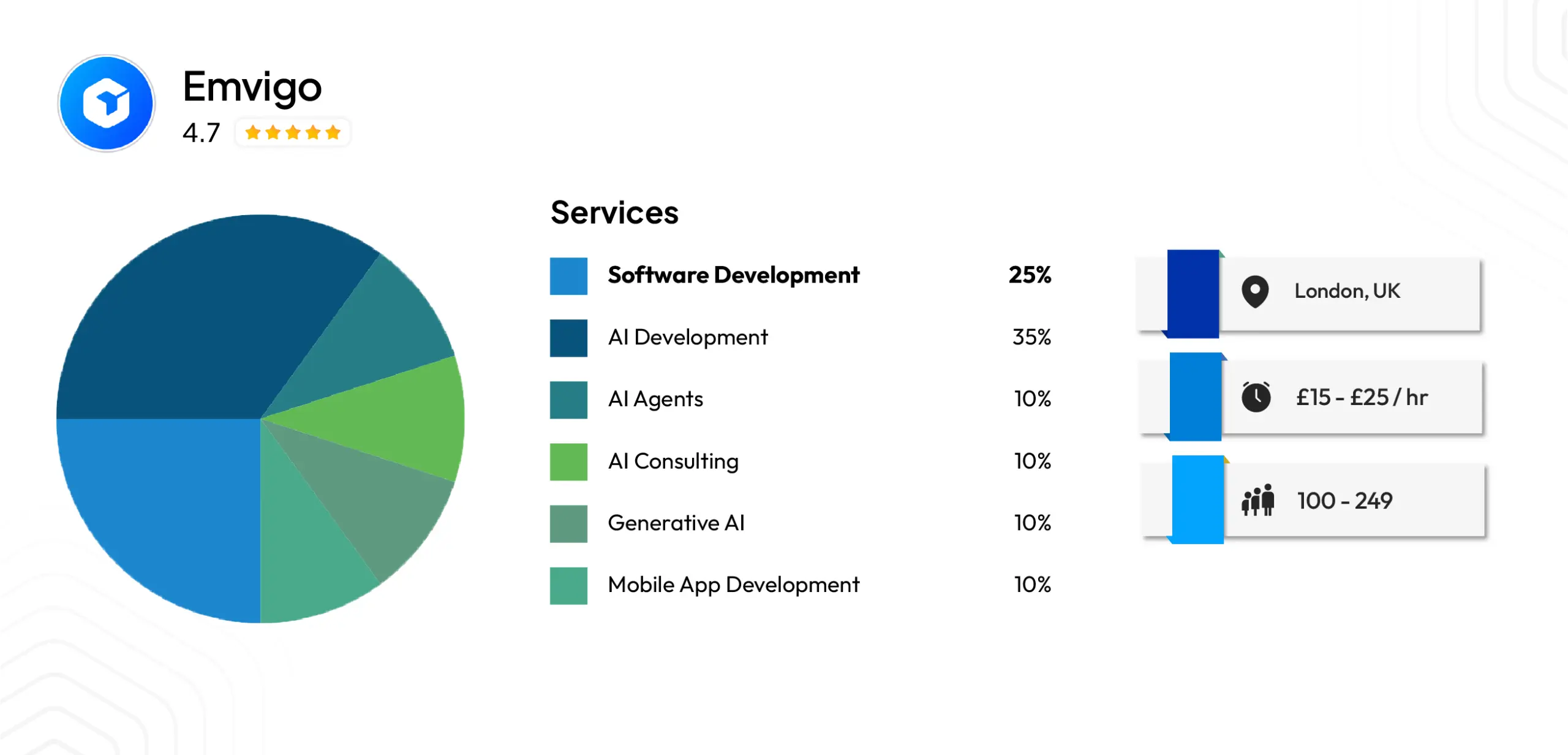
1. Emvigo — Award-Winning UK Software Development Agency
Best for: Startups, AI-driven products, mid-market SaaS platforms, UK businesses seeking a reliable hybrid delivery partner
Quick Stats
(Delivery centres in India & UAE)
Great Place to Work® Certified (2024–25)
Clutch Global & Clutch Champion
Overview
Emvigo is a London-headquartered, ISO 9001:2015-certified software development agency that has been building custom software, mobile applications, AI-powered solutions, cloud infrastructure, and digital products for over 14 years. Emvigo operates a hybrid delivery model: UK-based strategy, consulting, and client relationships — with global engineering execution that keeps costs competitive without compromising quality.
Emvigo’s portfolio spans 700+ projects across fintech, healthcare, sustainability, compliance, e-learning, energy, and real estate. Clients range from high-growth startups to established mid-market businesses requiring reliable, modern tech stacks.
Services
-
- Custom software development — end-to-end builds for startups to enterprise
- AI/ML integration and consulting — embedded in process, not bolted on
- Mobile application development (iOS, Android, cross-platform)
- Cloud advisory and infrastructure
- UI/UX design
- MVP development — 4-week sprint model available
- IT consulting and digital transformation
Why Clients Choose Emvigo
-
- Transparent communication and structured sprint-based delivery
- AI-ready development capability — not bolted on, embedded in process (see: AI automation in custom software development)
- Competitive pricing for UK-quality output via hybrid model
- Strong track record with startups who need to move quickly and SMEs who need to scale reliably
- ISO-certified quality management — verifiable, not just claimed
Case Study: Compliance Platform Revamp
Emvigo rebuilt a compliance SaaS platform resulting in 60% client growth and 30% revenue increase. Delivered enhanced risk assessment workflows, SSO integration, and centralised reporting.
Honest Trade-Off
Emvigo’s sweet spot is the £30k–£200k range. If you need a pure onshore team attending weekly in-person sessions in a city outside London, the hybrid model requires good async communication practices from both sides.
Best-fit buyer: A UK startup or growth-stage company that needs AI-integrated software, a structured delivery partner, and proven hybrid delivery at a realistic budget.
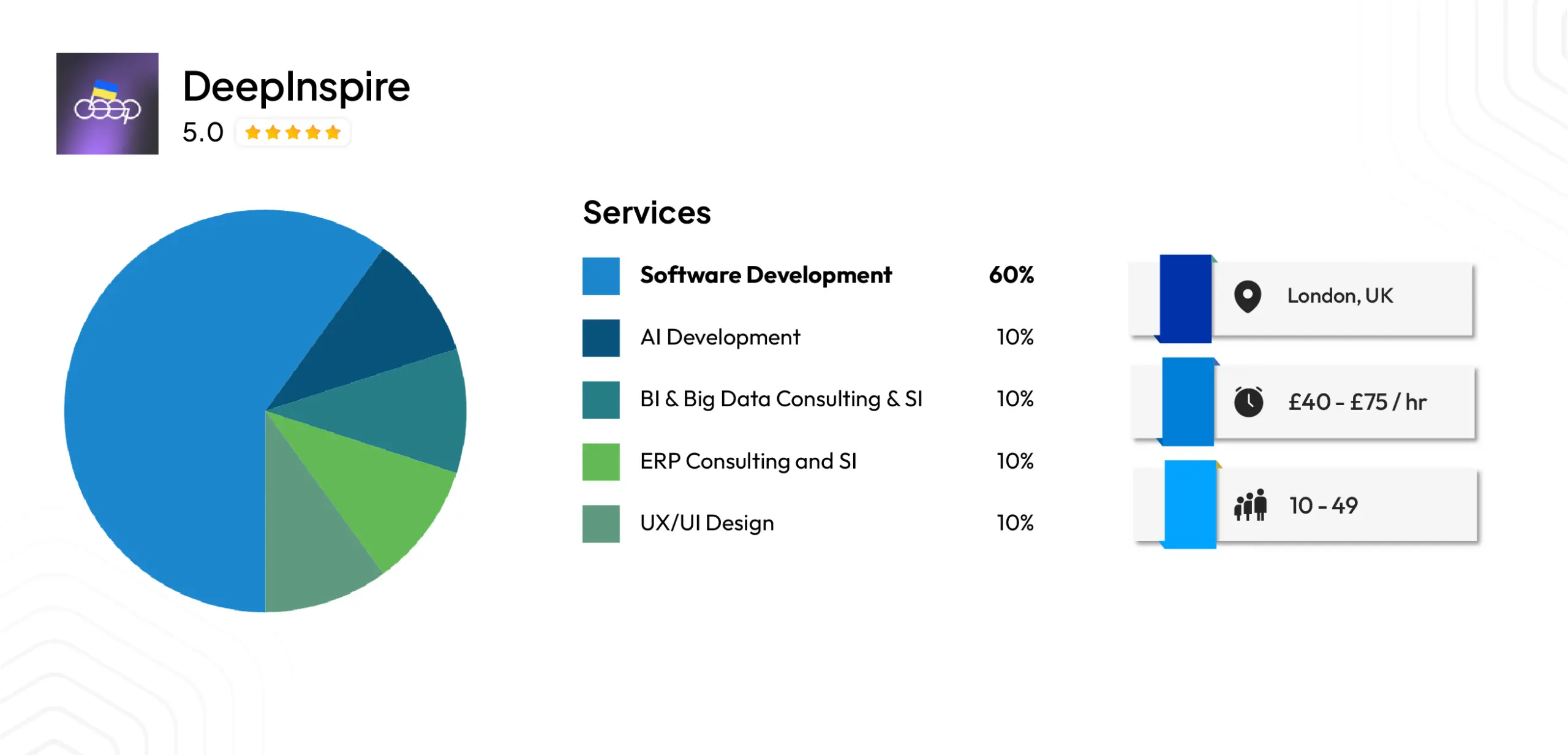
2. DeepInspire — Fintech-Focused Software Product Engineering
Best for: Fintech, investment platforms, blockchain products, regulated financial software
Quick Stats
Overview
DeepInspire is a boutique software engineering firm that has spent over two decades building almost exclusively for the financial technology sector. That level of focus is rare and consequential: they understand the regulatory frameworks, data architecture requirements, and business logic of financial products in a way that a generalist agency simply cannot replicate.
Their project portfolio includes custom trading platforms, salary advance and financial wellbeing platforms, digital banking engines, OTC trade negotiation systems, and investment management tools. They’ve integrated with GMEX (via FIX API), Copper.co, Cognito, eSignature providers, and major open banking partners — which means their engineers don’t need onboarding time on the financial systems your product needs to connect with.
Every DeepInspire engagement begins with signed NDA, MSA, and SOW — protecting your IP from day one, which is non-negotiable in regulated financial environments.
Core Services
-
- Custom fintech software development (trading platforms, digital banking, lending)
- Investment software and portfolio management platforms
- Blockchain and tokenisation development
- Payment processing and digital wallet integration
- DevOps and cloud engineering (AWS, Azure)
- API integration (FIX API, RESTful, open banking, third-party financial systems)
- Security and regulatory compliance integration (AML, KYC, PSD2)
Why Clients Choose DeepInspire
-
- Unmatched depth in fintech — not a generalist claiming financial expertise
- Clear IP protection model from project kick-off
- Senior team engagement: clients speak directly to experienced engineers, not account managers
- Documented experience with GMEX, Cognito, Copper.co, eSignature integrations
- Two decades of financial domain knowledge baked into the delivery process
Case Study: Custom Business Management Platform
DeepInspire designed and developed a bespoke cloud-based business management platform that consolidated core business operations into a single application. The solution streamlined workflows, improved collaboration across teams, and provided a scalable foundation for future growth, replacing fragmented manual processes with a centralised digital platform.
Honest Trade-Off
DeepInspire is a specialist, not a generalist. If your project sits outside fintech or investment software, other companies on this list will be a better fit. Their boutique size also means they take on a limited number of clients at any given time.
Best-fit buyer: A fintech founder or CTO who needs engineers that already speak the language of financial systems — FIX API, open banking, regulatory compliance — and can build a trading platform, digital bank, or investment tool without a lengthy domain education phase.
3. Right Tail — Product Development Pods for Speed-Focused Teams
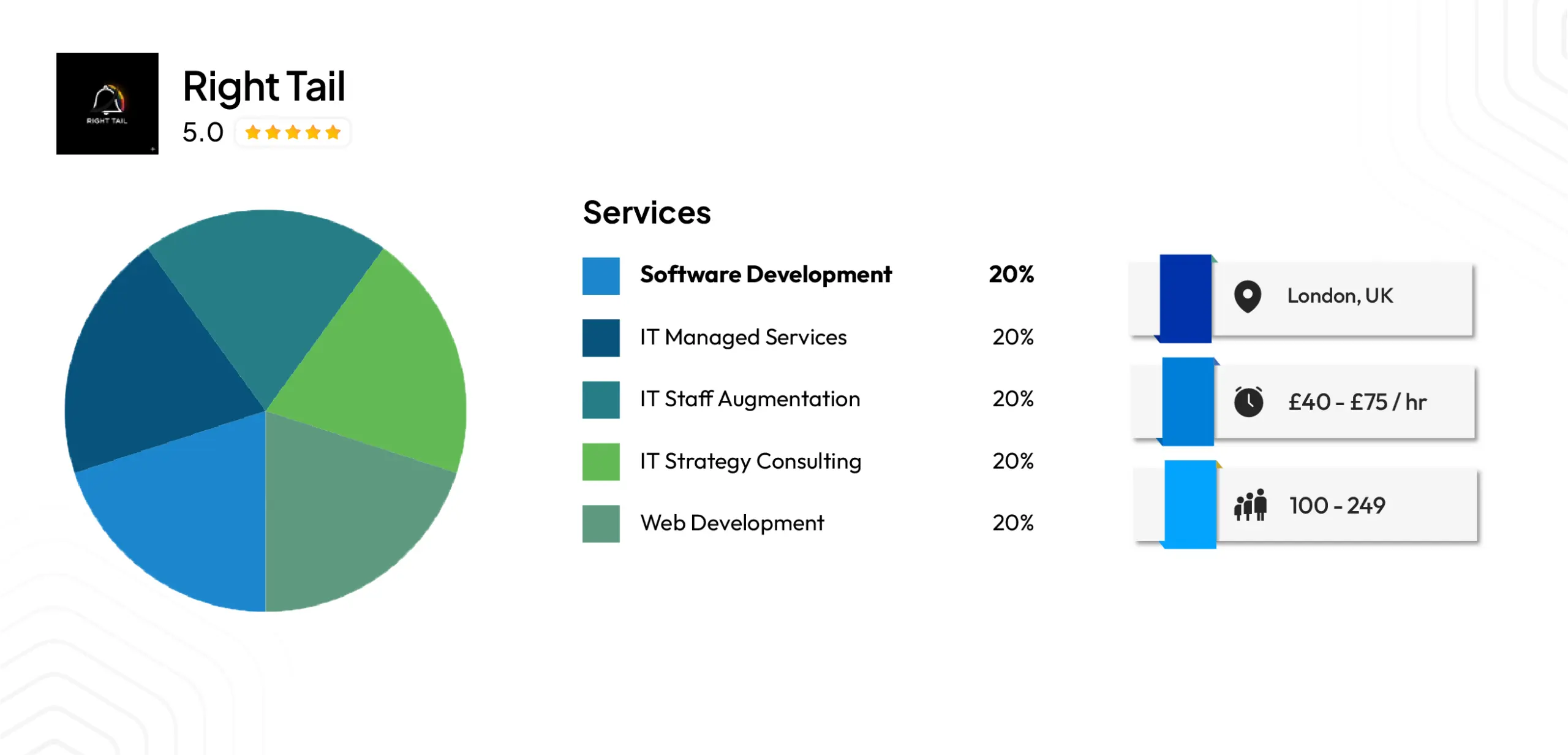
Best for: Startups needing dedicated product pods, MVPs, QA outsourcing, AI-built app testing
Quick Stats
AI-powered applications
Overview
Right Tail operates differently from traditional agencies. Rather than assigning individual contractors or running projects through a layer of account managers, they deliver through dedicated Pods — small, cross-functional product teams that include developers, designers, and QA engineers working as a unified unit.
This model suits founders and product teams who need speed and continuity without the overhead of hiring. Right Tail also offers a notable niche: QA testing and automation specifically for AI-generated codebases (Lovable, Replit, Base44) — increasingly relevant as more teams use AI coding tools but lack the internal capacity to validate the output rigorously.
→ For context on why AI-generated code needs rigorous testing: The ethical and security challenges of vibe coding
Services
-
- Full-stack web and mobile development
- Product development (end-to-end)
- UI/UX design
- QA testing and automation
- Chrome extension development
- QA for AI-generated code (Lovable, Replit, Base44)
Why Clients Choose Right Tail
-
- Pod model means your team is dedicated, not juggling five other clients
- Particularly strong for founders who’ve used AI coding tools and need rigorous QA
- Speed-focused — built for companies that need to move from concept to tested product quickly
- Transparent pricing model
Case Study: ClearProfit – Shopify Profit Analytics Platform
Right Tail designed and developed ClearProfit, a custom SaaS platform that gives Shopify merchants real-time visibility into their true profitability. The solution automatically consolidates Shopify order data, advertising spend, shipping costs, payment fees, and cost of goods into a single analytics dashboard, helping businesses make faster, data-driven decisions without relying on manual spreadsheets.
Honest Trade-Off
Right Tail’s strength is in focused, speed-oriented builds. For large-scale enterprise transformation programmes or highly complex multi-system integrations, a firm with a larger delivery infrastructure would be more appropriate.
Best-fit buyer: A startup founder or early-stage product team that needs a dedicated cross-functional pod to build, design, and QA a product — especially if using AI-generated code that needs professional testing before launch.
4. Koderly — Bespoke Software and Database Engineering
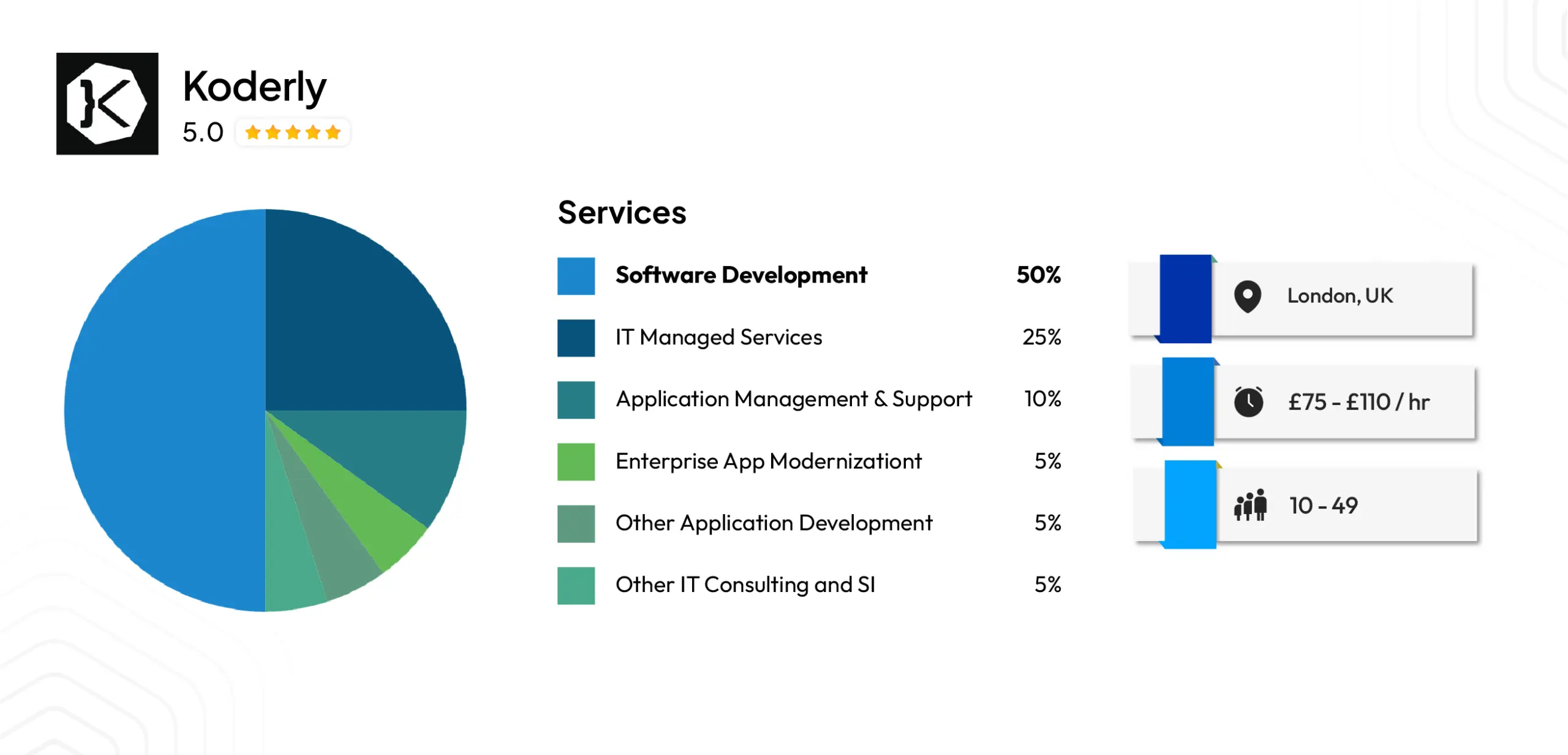
Best for: UK businesses needing bespoke software development combined with serious database engineering expertise
Quick Stats
Overview
Koderly is a Manchester-based software development company with a specific strength that most agencies lack: deep database engineering capability alongside software development. They offer SQL Server health checks, database administration, SQL Server emergency support, and ETL (Extract, Transform, Load) services — all on top of custom software development and digital transformation.
This combination matters more than it might sound. Many software agencies treat the database as an afterthought, leading to performance issues, data integrity problems, and painful migrations down the line. Koderly’s integrated approach means that the same team that builds your application understands your data architecture from day one.
Services
-
- Bespoke software development
- Digital transformation
- ETL services (data integration and pipeline management)
- SQL Server health checks and administration
- SQL Server emergency support
- Database performance optimisation
Why Clients Choose Koderly
-
- One of the few UK agencies that combines software development and database engineering under one roof
- Fully onshore Manchester team — ideal for clients who want UK-based delivery without London pricing
- Particularly strong for businesses where data integrity and database performance are mission-critical
- ETL capability means they can help businesses integrate data across systems, not just build new ones
Case Study: SQL Server Performance Optimisation
Koderly modernised a client’s SQL Server environment by identifying database bottlenecks, optimising queries, and improving overall system performance. The project resulted in a faster, more efficient database infrastructure that supported better application performance and scalability
Honest Trade-Off
Koderly’s strength is in data-intensive, enterprise-adjacent software. If you need a mobile-first consumer app or a marketing-led digital product, their profile is more technical and less design-forward than some alternatives on this list.
Best-fit buyer: A UK business or enterprise with complex data requirements, existing database infrastructure that needs attention, or a digital transformation project where database performance is a first-class concern.
5. Codal — Enterprise Design and Development Consultancy
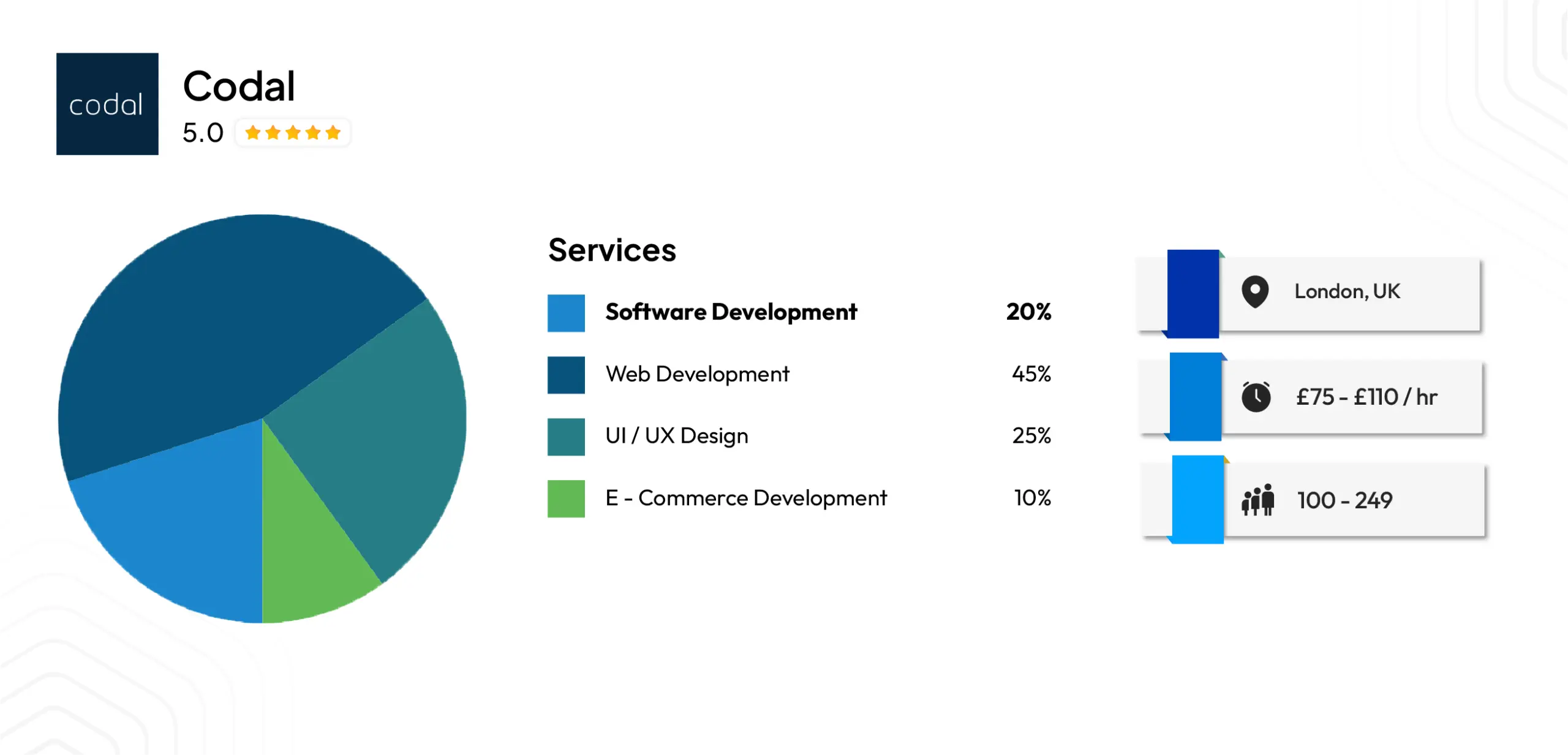
Best for: Enterprise organisations needing data-driven UX, eCommerce, and digital product transformation
Quick Stats
Overview
Codal has been building digital products since 2009, evolving from a CMS-focused agency into a global design and development consultancy with a particular strength in data-driven digital transformation for enterprise organisations. They combine UX strategy, product engineering, and analytics capability in a way that few agencies can credibly claim.
Their UK office in Lincoln serves European clients, while their global delivery model draws on expertise across the US, Canada, and India. Clients include enterprise organisations across eCommerce, healthcare, financial services, and logistics — with projects ranging from £7500 discovery engagements to £250,000+ full-platform builds.
Services
-
- UX/UI design and product strategy
- Digital transformation consulting
- eCommerce development (enterprise platforms)
- Custom software and application modernisation
- Data analytics and business intelligence
- AI integration
- Cloud architecture
- CMS implementation
Why Clients Choose Codal
-
- Unusually strong combination of UX strategy and engineering execution
- Enterprise-grade experience across regulated and complex industries
- Data-driven approach: decisions anchored in analytics, not assumptions
- Global team with UK delivery capability
- Nearly two decades of documented project history
Case Study: Simple Online Healthcare Platform
Codal designed and developed enhancements for Simple Online Healthcare’s digital platform, delivering a scalable healthcare solution with an improved user experience, streamlined patient journeys, and modern application architecture to support future growth
Honest Trade-Off
Codal’s minimum project size of £55,000+ and hourly rates of £120–£160/hr make them among the more expensive options on this list. For startups or businesses with budgets under £60k, their pricing model is not designed for you.
Best-fit buyer: An enterprise or scale-up organisation that needs sophisticated UX strategy combined with serious engineering capability — particularly for eCommerce transformation, application modernisation, or data-driven product builds.
6. Vention — Scalable Engineering Partner for Ambitious UK Businesses
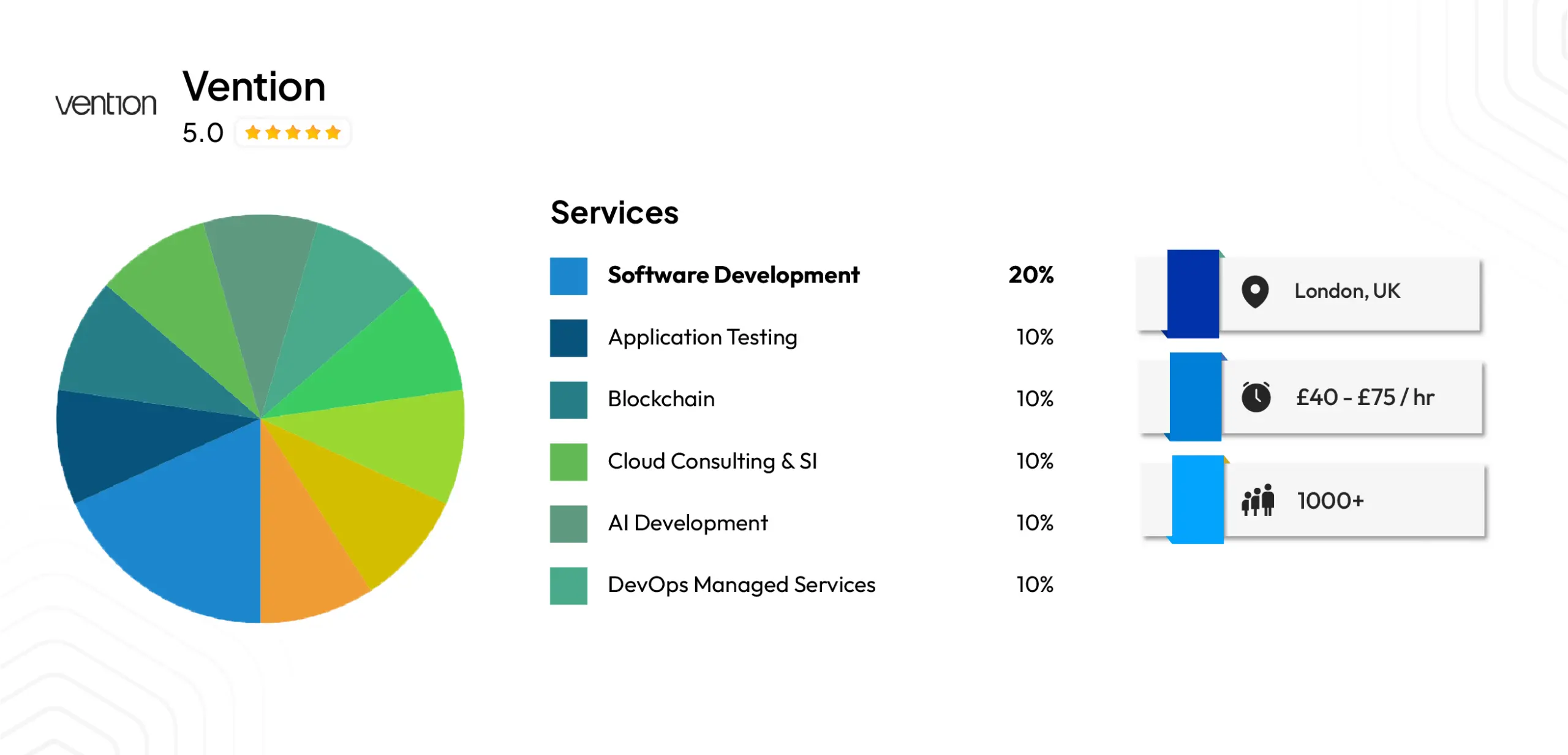
Best for: Companies that need to scale development teams rapidly, access specialist talent globally, and maintain UK-based account management
Quick Stats
Overview
Vention is one of the largest engineering-focused software development firms serving UK businesses, with over 3,000 engineers globally and a London-based team that serves as the UK account management and strategic interface. They operate across the full development spectrum — from initial product discovery to long-term platform maintenance — and are particularly strong for organisations that need to scale engineering capacity quickly without going through a lengthy hiring process.
Key differentiators include their “Peace of Mind Promise” — fast team assembly (CVs within 48 hours, teams ready within two weeks), regular quality assessments, and dedicated project advocates. Client relationships averaging 36+ months indicate strong retention, which is a more meaningful signal of quality than any award.
Their clients include PayPal, IBM, Mount Sinai, PwC, and Postman, with Vention reporting contributions to client acquisitions exceeding £11B.
Services
-
- Custom software development (end-to-end)
- IT staff augmentation and dedicated teams
- Mobile application development
- AI/ML development
- Cloud engineering
- Product discovery and strategy
- DevOps and infrastructure
- QA and testing
Why Clients Choose Vention
-
- 3,000+ engineers means rare specialisms are accessible — AI, blockchain, AR/VR, cloud
- Teams can be assembled and onboarded in under two weeks
- UK-based account management bridges the timezone and communication gap
- Vention reports that clients typically save up to £500k annually compared to building equivalent in-house capability
Case Study: Kafene AWS Platform
Vention partnered with Kafene to build and scale a cloud-native AWS platform that supported the company’s rapid growth. The team delivered backend engineering, cloud infrastructure, and system architecture improvements, creating a secure and scalable platform capable of handling increasing transaction volumes while maintaining high performance and reliability.
Honest Trade-Off
Vention’s scale is a strength, but it can also mean more process and structure than a small startup needs. If you’re running a tight MVP build with a narrow scope, a smaller boutique partner may offer more agility and direct senior involvement.
Best-fit buyer: A mid-market or enterprise business that needs to rapidly scale or specialise an engineering team, access niche technical expertise, or run parallel technology initiatives — with the confidence that a large, structured partner brings.
7. Hedgehog Lab — Enterprise Digital Product & AI Development
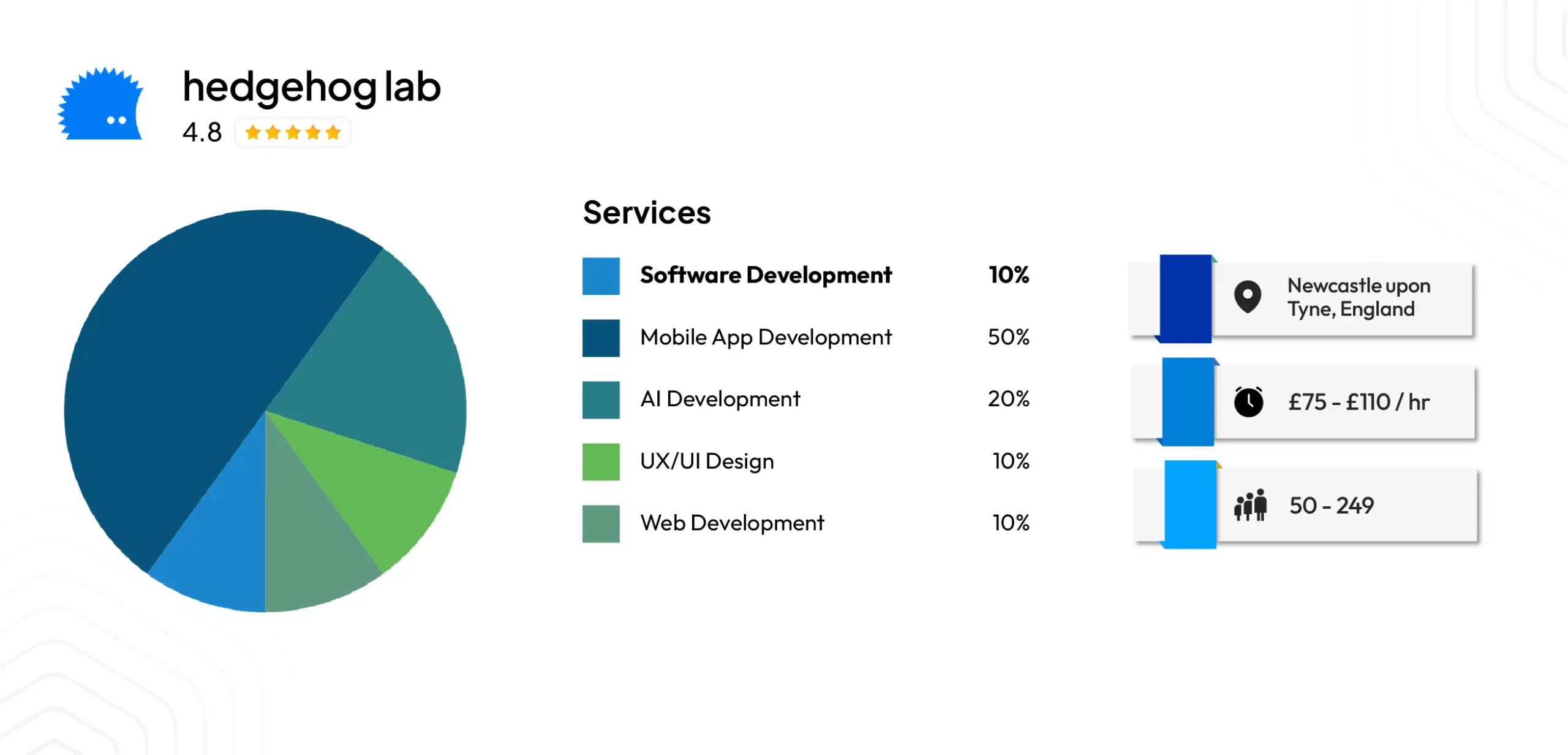
Best for: Enterprises, scale-ups, and public sector organisations building AI-powered digital products, mobile apps, and customer platforms.
Quick Stats
Overview
hedgehog lab is a UK digital product consultancy specialising in enterprise software, AI-enabled applications, and mobile experiences. With delivery teams across the UK and the US, the company works with organisations that need more than software development—they need product strategy, user research, UX design, engineering, and long-term product evolution under one partner.
Its portfolio includes projects for organisations such as Microsoft, AJ Bell, Tesco Bank, NHS organisations, and leading financial services brands. The company has particular strength in regulated sectors including healthcare, financial services, retail, and the public sector, where security, accessibility, and scalability are built into the development process from the outset.
Rather than focusing solely on software delivery, hedgehog lab combines product discovery, customer research, AI implementation, and modern engineering practices to help organisations launch and continuously improve digital products.
Services
-
- Custom software development
- Mobile app development (iOS, Android, cross-platform)
- AI strategy and implementation
- Product discovery and UX research
- UI/UX design
- Cloud-native application development
- Digital transformation consulting
Why Clients Choose hedgehog lab
-
- Strong reputation for enterprise digital product development
- Combines strategy, UX, and engineering within one delivery team
- Extensive experience across healthcare, financial services, retail, and government
- ISO 27001-certified information security management
- Proven capability delivering complex mobile and AI-enabled applications
Case Study: Dodl by AJ Bell
Hedgehog Lab partnered with AJ Bell to design and develop Dodl, a Flutter-based mobile investment app built for first-time investors. The team conducted user research, designed an intuitive user experience, and developed cross-platform iOS and Android applications that simplified investing while delivering a secure, scalable digital product. The app went on to win a BIMA 2023 Award for User Experience.
Honest Trade-Off
hedgehog lab primarily works on medium to large digital transformation projects, so its pricing and engagement model may be beyond the reach of early-stage startups or businesses looking to build a low-cost MVP. Companies with budgets below £75k are likely to find better value with smaller boutique agencies.
Best-fit buyer: A mid-market or enterprise organisation looking for an experienced UK digital product partner that can combine strategy, design, AI capability, and software engineering to deliver customer-facing applications at scale.
8. Instil — Senior-Led Software Engineering and Developer Training
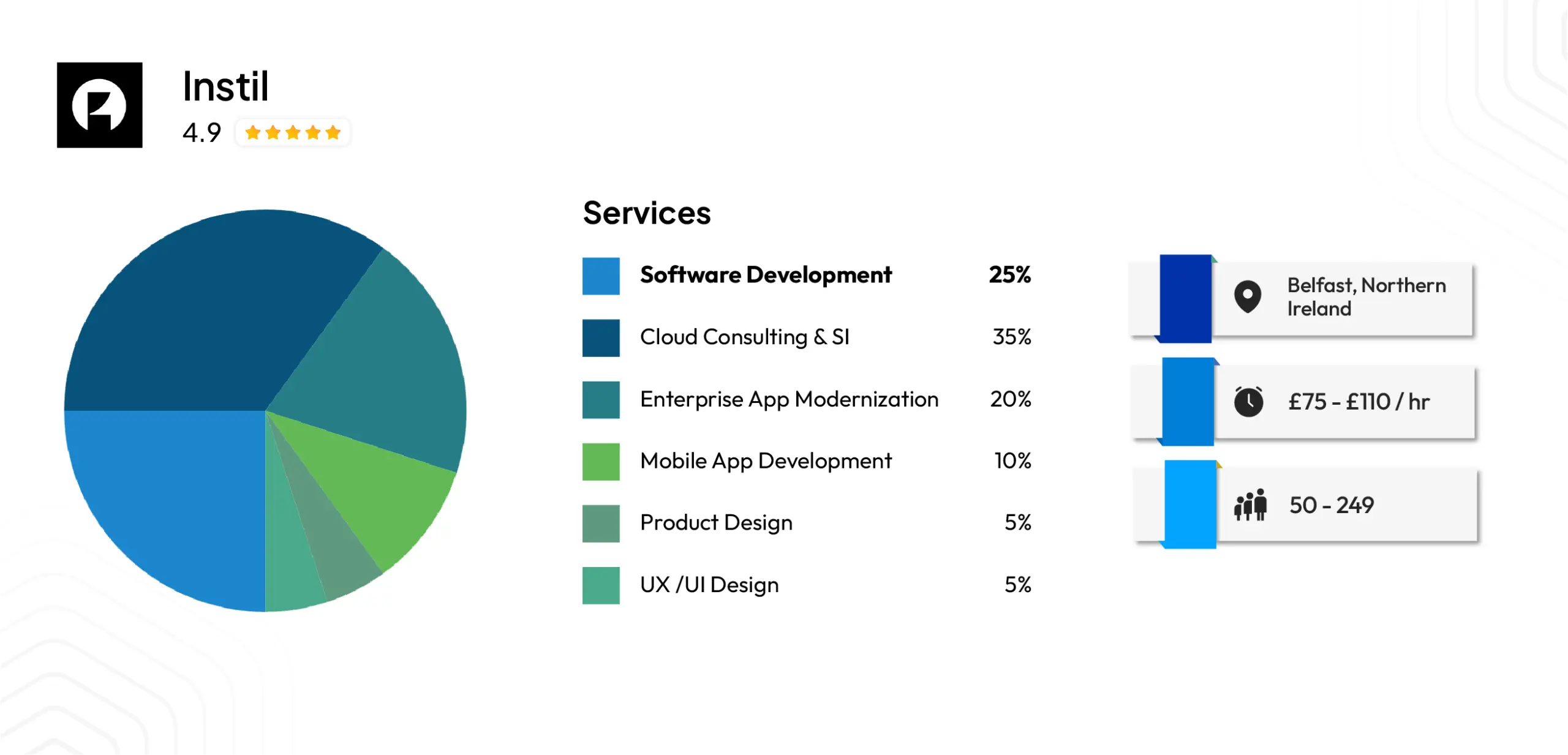
Best for: Complex modernisation projects, greenfield builds needing strong engineering practices, and teams wanting to upskill internal developers alongside delivery
Quick Stats
Overview
Instil is a Belfast-based software engineering consultancy that pairs custom product development with developer training and mentoring — a combination that sets it apart from firms purely focused on delivery. Their engineers work across JVM (Java, Kotlin), .NET, modern JavaScript/TypeScript frontends, mobile, and cloud-native architectures, and clients consistently describe Instil teams as functioning indistinguishably from in-house staff.
Their dual focus — building the product and improving the client’s own engineering capability — makes Instil a strong choice for organisations not just outsourcing a build, but trying to raise the technical bar of their permanent team in the process.
Services
-
- Custom software engineering (web, mobile, desktop, cloud)
- Cloud migration and modernisation
- JVM and .NET backend engineering
- Frontend engineering (modern JavaScript/TypeScript)
- Developer training and team upskilling
- Product engineering for greenfield and legacy rescue projects
Why Clients Choose Instil
-
- Senior-led teams that integrate seamlessly into client engineering processes
- Rare combination of delivery plus structured developer training
- Strong engineering culture with heavy emphasis on code quality and automated testing
- AWS Select Consulting Partner status alongside JetBrains training accreditation
Case Study: Agentic Engineering Transformation for a US Market Leader
Instil partnered with a leading US real estate technology company to transform its software delivery process by embedding agentic engineering practices across multiple development teams. Through hands-on engineering, AI-assisted workflows, and delivery process optimisation, Instil helped reduce software delivery timelines from months to weeks while improving engineering productivity, visibility, and scalability.
Honest Trade-Off
Instil’s senior-led, training-inclusive model commands premium rates — some clients note pricing on the higher side. If you need the lowest possible day rate rather than senior engineering depth, a more standard staff-augmentation model elsewhere on this list may suit better.
Best-fit buyer: A mid-market or enterprise organisation running a complex modernisation or greenfield build that also wants its internal engineering team to come out the other side more capable.
9. AVAMAE — Fully UK-Based Bespoke Software and App Development
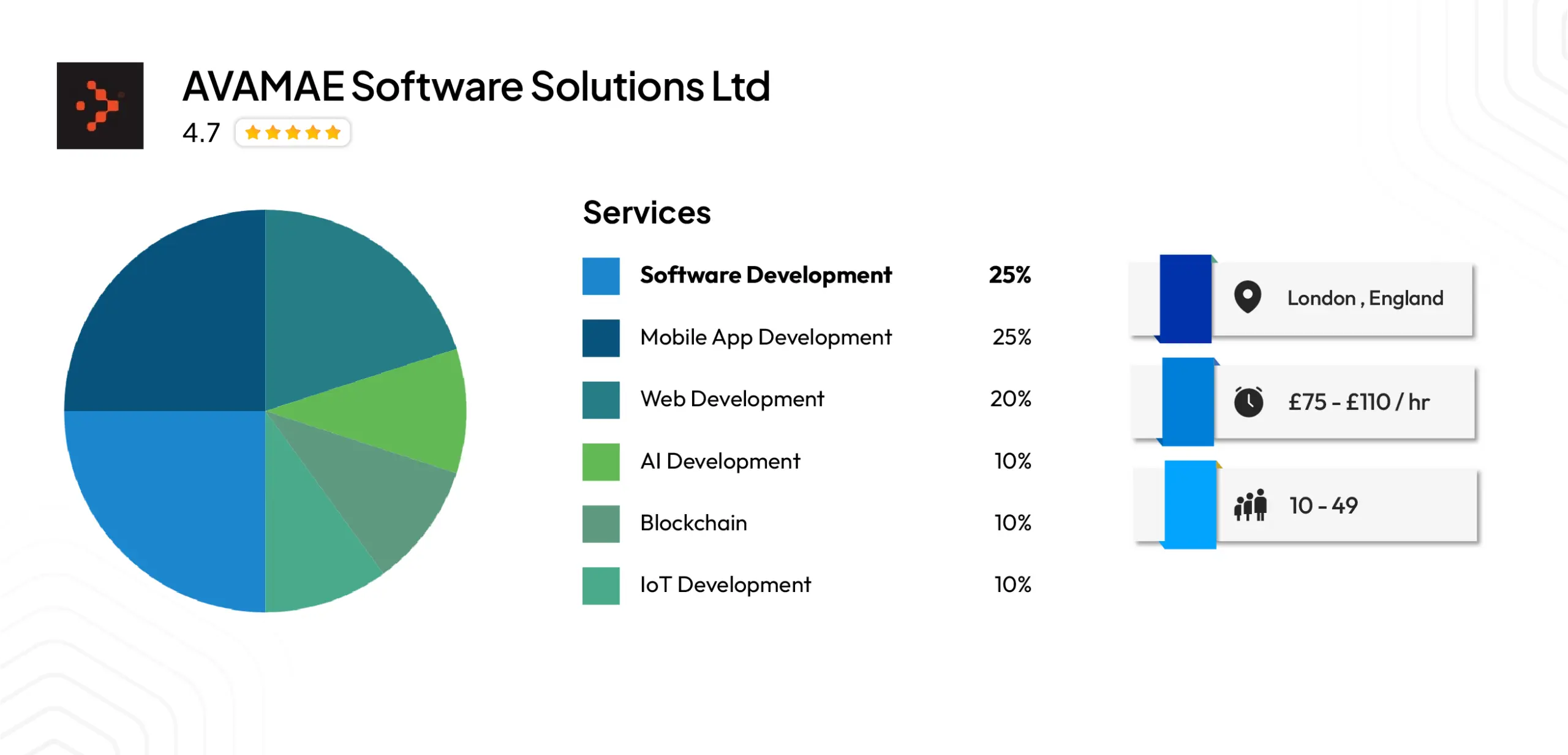
Best for: Startups and SMEs that want a local, in-person London partner for custom software, mobile apps, and SaaS platforms
Quick Stats
Overview
AVAMAE is a fully UK-based software and mobile app development agency operating out of London, offering both fixed-price quotes and a Product Development as a Service (PDaaS) model. Their work spans desktop, mobile, web, and cloud products across SaaS and PaaS, with a Microsoft-certified team supporting clients from early-stage software design through to scaling.
A recurring theme in AVAMAE’s client base is founders who specifically wanted a local partner after a poor experience with an overseas team — AVAMAE’s London office and in-person availability are a deliberate part of their positioning, not an afterthought.
Services
-
- Bespoke software development (fixed-price or PDaaS)
- Mobile app development (iOS, Android, cross-platform)
- Web and SaaS platform development
- Desktop and server software
- IoT development and cloud infrastructure (Microsoft Azure)
- UI/UX design and product strategy
Why Clients Choose AVAMAE
-
- Genuinely UK-based delivery with an in-person London office — valuable for founders who’ve been burned by overseas teams
- Triple ISO certification (security, environmental, quality) — unusual for a boutique agency
- Strong track record supporting startups through fundraising-stage product builds
- Transparent, fixed-price quoting model that reduces budget surprises
Honest Trade-Off
AVAMAE’s boutique size and in-person model suit startups and SMEs well, but for large-scale enterprise transformation with multi-system integrations, a larger delivery infrastructure (like Vention or Codal) will be a better technical and operational fit.
Best-fit buyer: A London-based or UK startup/SME founder who wants a local, in-person, ISO-certified software partner to build and scale a SaaS platform or mobile app from early stage through fundraising.
10. Light IT Global — UK-Registered Software and AI Development with Healthtech Depth
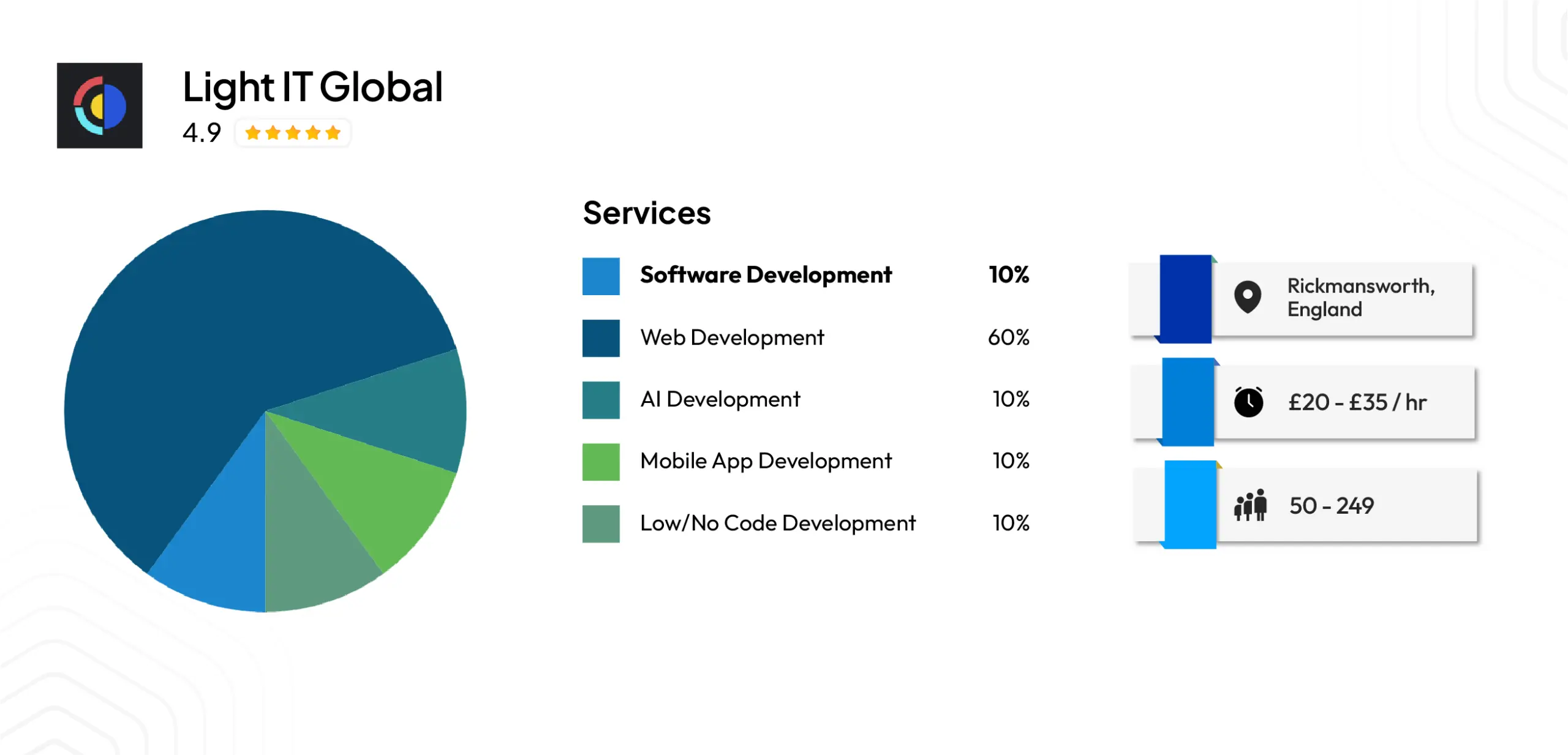
Best for: Regulated industry builds (healthcare, fintech) needing HIPAA/GDPR-compliant software, AI/ML integration, and dedicated team augmentation
Quick Stats
Overview
Light IT Global is a UK-registered software development company headquartered in Kensington, London, with delivery centres spanning Europe and the UK. Founded in 2006, the firm has built a particular reputation in healthtech and fintech, delivering HIPAA- and GDPR-compliant software for clients including medical device and digital health companies, alongside broader web, mobile, and AI/ML development work.
Their recognition in IAOP’s Global Outsourcing 100 for three consecutive years and dual ISO certification (quality and security) signal a level of process maturity that smaller boutique competitors on this list don’t always match, while still operating at accessible project sizes for SMEs and scale-ups.
Services
-
- Custom software development (web, mobile, desktop)
- AI/ML development and consulting
- Healthtech and HIPAA-compliant software builds
- Fintech and GDPR-compliant platform development
- Dedicated team augmentation and staff extension
- DevOps and cloud infrastructure (AWS, Azure)
Why Clients Choose Light IT Global
-
- Specific, documented experience in regulated industries (HIPAA, GDPR) rather than generic compliance claims
- Dual ISO 9001:2015 and ISO 27001 certification
- Three consecutive years in IAOP’s Global Outsourcing 100
- Strong AI/ML integration capability layered onto core software development
Case Study: Cancer Genomics Platform
Light IT Global partnered with a Swedish health-tech startup to develop a cloud-based platform for cancer genomics analysis and expert consultations. The team built a secure, scalable web application with role-based access, payment integration, booking functionality, and support for next-generation sequencing (NGS) workflows, enabling researchers and clinicians to analyse complex genomic data more efficiently while meeting healthcare compliance requirements
Honest Trade-Off
Light IT Global’s delivery model spans UK and European centres rather than being a purely onshore team — if weekly in-person collaboration in a specific UK city is a hard requirement, confirm which delivery centre would be staffed on your project before committing.
Best-fit buyer: A healthtech, fintech, or other regulated-industry founder or CTO who needs HIPAA/GDPR-compliant custom software or AI/ML integration from a UK-registered, dual-ISO-certified partner.
How to Evaluate a Software Development Company: Green Flags and Red Flags
Most vendor selection mistakes happen not from bad luck but from ignoring signals that were present from the first conversation.
Green Flags — Signs of a Trustworthy Partner
-
- Names specific past clients in your industry — not just “a leading fintech client”
- Proactively discusses architecture trade-offs — not just which features they can build
- QA is itemised separately in the proposal — not buried in a vague “development” line item
- Asks about your post-launch plans before scoping the build — signals thinking about the full lifecycle
- Offers to connect you with a past client — and actually follows through
- The person you meet in sales is the same person managing your project — or they clearly introduce you to the delivery lead before you sign
Red Flags — Walk Away From These
Bait-and-switch: Selling with senior engineers in the pitch, delivering with juniors on the project. Ask directly: who will be doing the day-to-day work, and can you meet them before signing?
No clearly defined testing phase in the proposal. QA is expensive and easy to cut to win a proposal on price. If testing isn’t explicitly itemised and budgeted, assume it isn’t happening.
Reluctance to discuss past project failures. Every real project has problems. An agency presenting a flawless history either hasn’t done much work or isn’t being honest with you. Ask directly: what went wrong on a recent project, and how did you handle it?
Pressure to sign quickly or lock in a “limited availability” slot. Legitimate agencies plan capacity with lead time. Urgency tactics in a sales process are a red flag.
Vague or missing contract terms around IP ownership, termination rights, and dispute resolution. A contract that protects only the agency is not worth signing.
Hourly rate is the only metric they lead with. Lower quotes become expensive if systems require rework. The conversation should start with outcomes, not rates.
Security and Compliance: What to Ask Every Vendor
This is the section almost no comparison guide covers — and it’s the one that matters most if you’re building in a regulated industry.
The context: In 2026, security is no longer a compliance checkpoint — it is an architectural constraint that shapes backend design, data flows, and system observability from day one. Practices like DevSecOps (integrating security testing directly into CI/CD pipelines) are now procurement requirements for regulated industries, not optional extras.
Questions to Ask Every Vendor About Security
-
- Do you follow DevSecOps practices? Can they describe, specifically, where security testing occurs in their development pipeline?
- What certifications does your organisation hold? ISO 27001 (information security management) and SOC 2 are the standard benchmarks for enterprise-grade engagements. ISO 9001 covers quality management.
- Do you produce Software Bill of Materials (SBOM) documentation? For enterprise and regulated industry clients, SBOM is becoming a standard requirement — it documents every component in your software so vulnerabilities can be identified and patched systematically.
- How do you handle security in third-party integrations? Payment APIs, open banking connections, and CRM integrations are common attack vectors.
- What is your data breach notification protocol? Any GDPR-compliant partner should have a documented incident response process.
Questions to Ask on Discovery Calls
Before you spend weeks evaluating proposals, these 12 questions will tell you most of what you need to know. Take them into every vendor call.
-
- Can you show me a case study in my specific industry? Not a general portfolio — a documented example with outcomes, not just outputs.
- Who will be my day-to-day contact — and are they a PM or a senior engineer? The answer reveals how much direct access you’ll have to technical decision-makers.
- What does your QA process look like, and is it itemised in the proposal? If they can’t describe it clearly, it probably isn’t happening properly.
- How do you handle scope changes mid-project? Ask for the actual process — change request templates, approval thresholds, how they affect timelines and cost.
- What is your post-launch support model? Specifically: what’s included, what costs extra, and what happens if a critical bug appears six months after launch?
- Who owns the IP after delivery? The answer should be unambiguous: you own the code, the data, and all derivative works.
- Have you worked within [your specific regulatory framework — FCA, GDPR, NHS Digital, ISO 27001]? Don’t accept “yes” without a specific example.
- What went wrong on a recent project — and how did you handle it? The quality of this answer tells you more than any award or testimonial.
- What is your typical team structure for a project of our size? Roles, seniority, time allocation — ask for specifics.
- What does offboarding look like if we choose to move on? A trustworthy agency has a clear, client-friendly process. An agency that makes this hard at the start will make it harder later.
- How do you handle knowledge transfer within your team? What happens if the lead engineer leaves mid-project?
- Can you connect me with a past client at a similar stage to ours? And actually follow through on it.
Ready to Build Something That Actually Works?
Most vendor selection mistakes come down to the same three things: choosing on rate alone, skipping the hard questions on the discovery call, and never asking to speak with a past client. The companies that get shortlisted in this guide give you a verified starting point — what you do with that shortlist determines the outcome.
Before you send your first RFP, be clear on your budget tier, your regulatory constraints, and your working model preference. Those three filters alone will cut most shortlists to two or three credible names.
Use the discovery call questions in this guide on every vendor conversation. The agencies that answer them honestly — especially the one about what went wrong on a recent project — are the ones worth your time.
Frequently Asked Questions
What is the difference between a software house, an agency, and a consultancy?
The terms are often used interchangeably but signal different priorities. A software house focuses on engineering execution — they build what you specify. An agency typically combines design and development and often leads on creative or product direction. A consultancy engages at the strategic level first — advising on what to build before beginning to build it. In practice, most companies on this list do all three; the question is where their primary strength lies.
What is a software development company in the UK?
A UK software development company is a firm that designs, builds, and maintains custom digital products and systems — typically covering web applications, mobile apps, SaaS platforms, AI integrations, and enterprise software. “UK” signals a UK-based legal entity, regulatory alignment (GDPR compliance, UK employment law), and usually either a fully onshore team or a hybrid model with UK client management and offshore engineering execution.
What are the top IT companies in the UK?
The UK has a rich landscape of IT and software companies — from global enterprises like Sage, Micro Focus, and Arm Holdings to specialist software development agencies. For organisations commissioning custom software builds, the firms that consistently deliver for growth-stage and mid-market businesses are specialist agencies and product engineering firms such as Emvigo, hedgehog lab, Vention, Codal, Instil, and Light IT Global
How do I know if an agency is quoting honestly or padding estimates?
Ask them to break the estimate into phases and activities — not just a single number. A detailed proposal should show discovery, architecture, development (front-end and back-end separately), QA, deployment, and documentation as separate line items. Compare the breakdown with what a comparable project has cost in published case studies. If an agency refuses to show the breakdown, treat that as a red flag.
Should I choose a London-based company, or does location not matter?
For most projects in 2026, physical location matters far less than it did five years ago. Async communication tools, cloud-based development environments, and hybrid working have made geography largely irrelevant to delivery quality. Where location matters: highly regulated projects requiring regular on-site security reviews, public sector contracts that specify UK-based delivery, or clients who genuinely need weekly in-person workshops.
What certifications should I look for in a regulated industry?
Fintech and financial services: ISO 27001, SOC 2, FCA compliance awareness
Healthcare: NHS Digital DSPT, potentially ISO 13485 for medical devices
Public sector: Cyber Essentials or Cyber Essentials Plus, GDS alignment
Any organisation: ISO 9001:2015 as a baseline quality management signal
Is it better to outsource to a UK software development company or use an offshore team?
Neither is categorically better. The most effective model for most mid-market businesses is hybrid: UK-based strategy, consulting, and account management, with offshore or nearshore engineering execution. This balances communication quality, regulatory alignment, and cost efficiency.
How long does it take to build custom software in the UK?
MVPs typically take 3–5 months for a focused, well-defined product. Full SaaS platforms take 6–12 months depending on complexity and team size. Enterprise systems generally require 12 months or longer. A discovery phase of 2–6 weeks before development begins almost always reduces total project time and cost.
What questions should I ask about post-launch support before signing?
Ask: What’s included in the handover? What does bug fix SLA look like — response time, resolution time? Is there a dedicated support engineer or a shared ticket queue? What does it cost to add a feature after launch? Who do I call at 2am if the system goes down? A partner who can answer these questions clearly before the contract is signed is far more likely to be there for you after launch.
How do I protect my IP when working with an external development company?
Get an NDA signed before any substantive conversation begins. Ensure your contract states explicitly that all code, data models, designs, and derivative works produced during the engagement are assigned to you upon payment. Avoid “work for hire” ambiguity — the contract should use the word “assign,” not just “license.” Check that the contract addresses what happens to IP in the event of early termination.
What’s the difference between custom software and SaaS?
Custom software is built specifically for your business, your processes, and your users. SaaS (Software as a Service) is a pre-built platform you subscribe to and configure. The right choice depends on your workflow complexity, compliance requirements, and long-term roadmap.