

Amazon’s AI recruiting tool once had a problem. It rejected female candidates. Not because of a bug, but because it learned from decades of biased hiring data. The project was then scrapped entirely.
This wasn’t really a technology failure. It was an AI governance failure.
An AI governance framework is like a constitution for artificial intelligence. Yet 73% of organisations deploy AI without proper governance frameworks. This leaves them vulnerable to bias, compliance violations, and reputational damage.
Let’s explore how to build your AI’s constitution before you need it, not after
What is an AI Governance Framework and Why is it Critical?
An AI governance framework is your comprehensive rulebook for managing AI throughout its entire lifecycle. It’s the bridge between ambitious AI strategies and responsible implementation.
Think of it as your AI’s co-pilot. It does not control the journey, but ensures you stay on course and avoid dangerous terrain.
At its core, AI governance encompasses three fundamental elements:
- Strategic oversight: Who makes decisions about AI initiatives, and how are they held accountable?
- Technical safeguards: What processes ensure your AI systems are secure, fair, and explainable?
- Regulatory compliance: How do you meet evolving legal requirements while maintaining innovation velocity?
Without this framework, you’re in fact flying blind. Your AI might perform well in testing. But it will be prone to fail catastrophically in the real world.
The critical nature becomes clearer when considering the consequences of getting it wrong.
What is an Example of an Ethical Framework in AI?
Let’s examine a practical framework that works. Microsoft’s Responsible AI framework provides an excellent blueprint that balances innovation with responsibility.
Their approach centres on six key principles that form the backbone of ethical AI deployment:
Principles of Ethical AI at a Glance:
-
- Fairness: AI systems should treat all people equitably. It should avoid bias that could disadvantage specific groups
- Reliability and Safety: AI should perform consistently and safely. It has to be equipped with robust failsafes for unexpected scenarios
- Privacy and Security: Personal data must be protected throughout the AI lifecycle
- Inclusiveness: AI should benefit everyone and be accessible to people with diverse abilities
- Transparency: Users should understand how AI systems work and make decisions
- Accountability: Clear responsibility chains ensure humans remain in control of AI outcomes
Each principle translates into specific policies, technical requirements, and governance processes. For example, the fairness principle might require bias testing at multiple stages of model development. Transparency demands explainable AI techniques that users can understand.
The beauty of this approach lies in its adaptability. You need not copy Microsoft’s framework as a whole. You can still use its structure to build something that meets your organisation’s specific needs and risk profile.
What Are the Pillars of AI Governance and AI Ethics?
Your AI governance framework stands on four foundational pillars. Each pillar supports the others, creating a stable structure for ethical AI deployment.
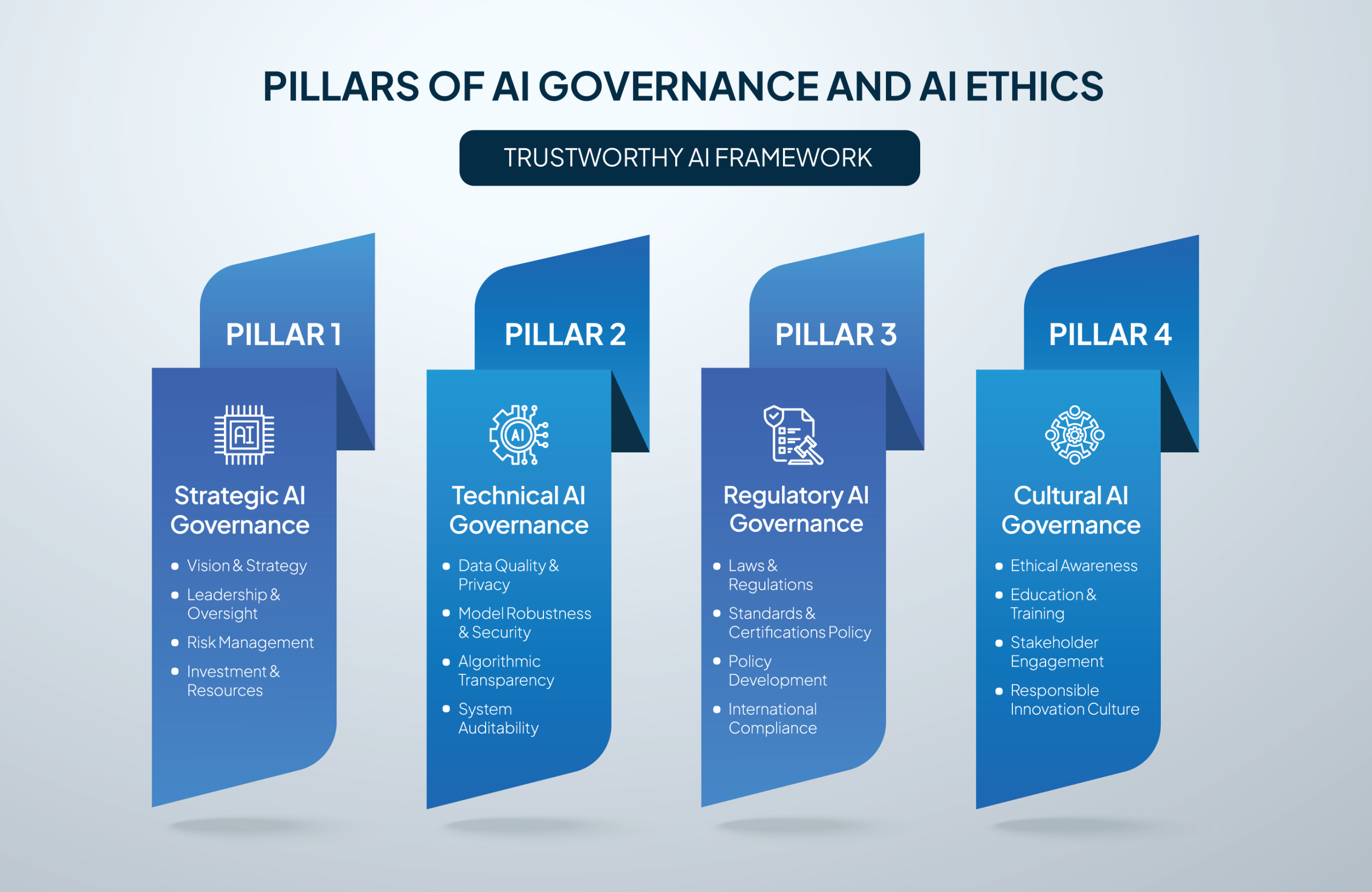
Pillar 1: Strategic AI Governance
This is your executive layer. The decision-makers who set direction and accept ultimate responsibility for AI outcomes.
Strategic governance establishes an AI steering committee with cross-functional representation. This isn’t just the IT department making decisions in isolation. You need voices from legal, compliance, operations, and business units.
Key components include:
-
- Clear AI strategy aligned with business objectives
- Defined roles and accountability structures
- Resource allocation decisions
- Risk appetite statements
- Performance metrics and success criteria
Pillar 2: Technical AI Governance
Here’s where policies become practice. Technical governance ensures your AI systems are built, deployed, and maintained according to established standards.
Critical elements include:
-
- Data quality and lineage tracking
- Model explainability and interpretability
- Continuous monitoring and performance assessment
- Security protocols and access controls
- Version control and audit trails
This pillar transforms abstract ethical principles into concrete technical requirements. For example, your fairness principle becomes mandatory bias testing protocols. At the same time, transparency requirements drive investment in explainable AI technologies.
Pillar 3: Regulatory AI Governance
With regulations like the EU AI Act, it is existential. This pillar ensures your AI initiatives meet current and anticipated regulatory requirements.
The regulatory pillar addresses:
-
- Risk classification according to regulatory frameworks
- Documentation requirements for high-risk AI systems
- Conformity assessment processes
- Post-market monitoring obligations
- Incident reporting procedures
Pillar 4: Cultural AI Governance
Technology is only as good as the people using it. Cultural governance ensures your organisation develops the mindset and capabilities needed for responsible AI deployment.
This encompasses:
-
- AI literacy programmes for all stakeholders
- Ethical decision-making training
- Clear escalation procedures for AI concerns
- Regular communication about AI principles and expectations
- Incentive structures that reward responsible AI practices
Don’t navigate compliance complexities alone. Emvigo’s AI specialists help you construct frameworks that protect your business. Book your free AI governance consultation today!
What Regulatory Framework Defines 4 Levels of Risk for AI Systems?
The EU AI Act introduces a risk-based approach that’s reshaping how organisations think about AI governance. This isn’t just European legislation. It’s becoming the global standard for AI risk management.
Understanding the EU AI Act: The AI Risk Pyramid
The Act classifies AI systems into four distinct risk categories:
-
- Unacceptable Risk
AI applications that threaten fundamental rights or safety. These include social scoring systems and real-time biometric identification in public spaces. Simply put: these are banned. - High Risk
AI systems that significantly impact health, safety, or fundamental rights. Examples include AI in medical devices, critical infrastructure, or employment decisions. These require conformity assessments, extensive documentation, and ongoing monitoring. - Limited Risk
AI systems with specific transparency obligations. Chatbots and deepfake generators fall here – users must know they’re interacting with AI. - Minimal Risk
Most other AI applications have few regulatory constraints, though general product safety rules still apply.
- Unacceptable Risk
This pyramid approach offers clarity in an otherwise complex regulatory landscape. Instead of wondering whether your AI project needs compliance measures. You can classify your system and understand exactly what’s required.
The practical implications are significant. High-risk AI systems need comprehensive risk management systems, detailed documentation, and post-market monitoring. Limited-risk systems need clear user disclosure. Even minimal-risk systems benefit from proactive governance to avoid future reclassification.
How Does Emvigo Help You Build Your AI Governance Framework?
Building effective AI governance requires more than good intentions. It demands expertise, experience, and a deep understanding of both technology and regulation.
Emvigo’s approach combines strategic thinking with practical implementation. We don’t just hand you a generic framework and wish you luck. We work alongside your teams to build governance structures for your specific industry, risk profile, and business objectives.
Our AI governance consultation process includes:
-
- Governance Assessment
We evaluate your current AI initiatives first. Then we identify gaps and map regulatory requirements specific to your use cases. - Framework Design
Together, we build custom governance structures that balance compliance with innovation velocity. - Implementation Support
Our teams help you operationalise governance. This is through technical safeguards, process improvements, and training programmes. - Ongoing Monitoring
Governance isn’t a one-time project. We provide continuous support to ensure that frameworks evolve with changing regulations and business needs.
- Governance Assessment
Which Framework is Often Used to Evaluate Ethical AI?
The OECD AI Principles have emerged as the gold standard for ethical AI evaluation. It is being adopted by 42 countries. These principles provide an internationally recognised framework for responsible AI development.
The five key principles are:
- AI should benefit people and the planet
AI development should prioritise human welfare and environmental sustainability. - AI should be designed to respect the rule of law, human rights, and democratic values
This includes privacy, dignity, freedom, and equality. - AI systems should be transparent and explainable
Users should understand how AI systems work and make decisions affecting them. - AI systems should function reliably and safely
Throughout their lifecycle, AI systems should operate as intended without causing unintended harm. - Organisations should be accountable for AI systems
Clear accountability structures ensure responsible deployment and use.
These principles translate into practical evaluation criteria. When assessing ethical AI deployment, organisations examine:
-
- Transparency measures
- Bias testing results
- Privacy safeguards
- Accountability structures
The framework provides both strategic direction and operational guidance.
What makes the OECD principles particularly valuable is their global acceptance. Unlike proprietary frameworks, these principles align with international standards. This makes them ideal for organisations operating across multiple jurisdictions.
Looking for a guide on implementing these frameworks within your broader AI strategy? Explore our complete resource: The Complete Guide to AI Implementation: From Strategy to Scale.
What is the Difference Between AI Governance and Data Governance?
This question comes up in every governance discussion, and the confusion is understandable. Both are essential, but they serve different purposes in your technology ecosystem.
Data governance
It focuses on the quality, security, and lifecycle of data itself. It answers questions like:
-
- Is our data accurate?
- Who can access it?
- How long do we retain it?
Think of data governance as managing the raw materials of your digital operations.
AI governance
It encompasses data governance but goes much further. It addresses the ethical, legal, and operational oversight of your AI model’s entire lifecycle. AI governance asks:
-
- Is our AI fair?
- Can we explain its decisions?
- Does it comply with regulations?
Here’s a practical comparison:
| Aspect | Data Governance | AI Governance |
| Primary Focus | Data quality and security | AI system behaviour and outcomes |
| Key Concerns | Access, privacy, retention | Fairness, explainability, accountability |
| Regulatory Focus | GDPR, data protection laws | EU AI Act, AI-specific regulations |
| Stakeholders | IT, legal, data teams | Cross-functional, including ethics boards |
The relationship is symbiotic. You cannot have effective AI governance without robust data governance. Poor data quality leads to poor AI decisions, regardless of how sophisticated your ethical frameworks might be.
However, excellent data governance alone doesn’t guarantee ethical AI. Your data might be perfectly clean and secure. But what if your AI model exhibits bias or lacks explainability? Then you still face significant governance challenges.
Why is AI Governance Not a Roadblock to Innovation?
Let’s address the elephant in the room. Many fear that AI governance will slow down innovation, create bureaucratic bottlenecks, and stifle creativity.
This fear is understandable but misguided.
Think of AI governance as guardrails on a race track. Without them, drivers would be too cautious to reach top speeds, constantly worried about veering off course. With proper guardrails, drivers can push their limits confidently. They move knowing the boundaries are clearly defined.
The same principle applies to AI innovation. Without governance frameworks, teams move cautiously. Second-guessing decisions and avoiding ambitious projects due to uncertainty about acceptable practices. This cautious approach actually slows innovation.
With clear governance frameworks, teams understand exactly what’s acceptable, what’s required, and what’s prohibited. This clarity accelerates decision-making and enables teams to pursue innovative solutions confidently.
Proactive governance prevents the costly rework that occurs when compliance issues surface late in development. It’s far more efficient to build ethical considerations into the initial design than to retrofit them after deployment.
Who is Responsible for AI Governance within an Organisation?
AI governance isn’t the responsibility of a single department. It’s a collective effort requiring coordination across multiple functions.
-
- Executive Steering Committee
Provides strategic oversight and final decision-making authority. This includes the CEO, CTO, Chief Risk Officer, and other C-level executives. They can make resource allocation decisions and accept accountability for AI outcomes. - AI Ethics Board
Reviews individual AI projects for ethical considerations and compliance requirements. This cross-functional team includes representatives from legal, compliance, operations, and often external subject matter experts. - Technical Teams
Implement the technical safeguards that make governance policies operational. Data scientists, ML engineers, and DevOps teams translate ethical principles into code, monitoring systems, and deployment procedures. - Legal and Compliance
Ensure adherence to current and emerging AI regulations. They interpret legal requirements and translate them into actionable policies and procedures. - Business Units
Own the AI applications within their domains. They are responsible for ensuring governance compliance in day-to-day operations.
- Executive Steering Committee
The key to successful AI governance is clear communication between these groups. Technical teams need to understand legal requirements.
Legal teams need to appreciate technical constraints. Executive leadership needs visibility into both perspectives to make informed decisions.
Many organisations establish a Chief AI Officer or AI Governance Manager. This is to coordinate these efforts and ensure nothing falls through organisational cracks.
What Are the First Steps in MLOps for AI Governance?
MLOps is the operational layer of AI deployment. This is where governance principles become tangible practices. Without proper MLOps, even the most thoughtful governance framework remains theoretical.
Your first MLOps steps should focus on creating visibility and control:
-
- Automate Data Quality Checks
Implement automated validation to ensure training data meets quality standards. This prevents bias and performance issues that could violate governance policies. - Establish Model Versioning and Audit Trails
Every model change should be tracked, documented, and attributable. This creates the accountability foundation required by most governance frameworks. - Implement Continuous Monitoring
Deploy systems that continuously assess model performance, detect bias drift, and identify potential fairness issues. Governance requires ongoing vigilance, not just initial compliance. - Create Explainability Pipelines
Build technical capabilities that can generate explanations for model decisions. This addresses transparency requirements and builds stakeholder confidence. - Establish Automated Compliance Reporting
Create systems that automatically generate compliance documentation. It has to alert stakeholders to potential governance violations.
- Automate Data Quality Checks
These technical foundations make governance scalable. Instead of manual reviews for every decision, automated systems handle routine compliance checks. They can flag exceptional situations for human review.
This approach makes governance easier rather than harder. Well-designed MLOps systems reduce the manual effort required for compliance. This provides better visibility into AI system behaviour.
Frequently Asked Questions on AI Governance
Why is an AI governance framework essential for business?
An AI governance framework is essential because it mitigates legal and reputational risks and ensures regulatory compliance. AI governance builds customer trust by demonstrating your commitment to responsible and ethical AI deployment.
What is the main purpose of ethical AI guidelines?
Ethical AI guidelines ensure that AI systems are developed and deployed in fair, transparent, and beneficial ways for society. They provide a moral compass that guides responsible technology creation and help organisations balance innovation with societal responsibility.
What are the main components of an AI governance framework?
An AI governance framework typically includes four main components:
-
- Ethical principles (fairness, transparency, accountability)
- Technical policies for data and model management
- Clearly defined roles and responsibilities with accountability structures
- Systematic processes for risk assessment, monitoring, and auditing
How does AI governance address AI risk management?
AI governance provides a structured approach to identify, evaluate, and mitigate risks associated with AI deployment. This includes:
-
- Bias detection and correction
- Security vulnerability assessment
- Transparency and explainability requirements
- Continuous monitoring systems
Can an AI governance framework help with regulatory compliance?
A well-designed AI governance framework is your most effective tool for regulatory compliance. It provides the policies, documentation, audit trails, and monitoring systems necessary to meet requirements from emerging regulations like the EU AI Act. It also protects your business from legal penalties and reputational damage.
Building Your AI’s Constitution for Tomorrow’s Success
By 2027, 78% of enterprise AI procurement decisions will be influenced by governance maturity. Companies with AI governance frameworks are becoming the preferred partners for risk-conscious enterprises. They are attracting premium valuations from investors who recognise the strategic value of responsible AI.
Organisations with mature AI governance frameworks report:
-
- 34% faster AI project deployment due to clear decision-making frameworks
- 43% fewer production incidents requiring emergency intervention
- 28% lower costs related to compliance violations and remediation
- 67% higher customer satisfaction scores for AI-powered services
Your journey to trusted, compliant, and innovative AI deployment starts with a single conversation. Emvigo’s AI specialists have helped organisations to build frameworks that balance innovation with responsibility. We build operational systems that make governance seamless and scalable.
Transform your AI strategy with expert governance consulting – Schedule your strategic review today.
Your AI’s constitution awaits. The only question is: who will write it?