

Last quarter, a CTO shared something uncomfortable with us.
Their company had spent £1.8 million on AI pilots over 18 months. The demos impressed the board. The dashboards looked promising. The data scientists were confident.
But not a single model had reached production.
The models worked fine in controlled environments. The problem was AI implementation, or more precisely, the lack of a real strategy for it.
This pattern plays out across industries more than most leaders want to admit. Companies invest heavily in AI experimentation, yet struggle to turn those experiments into systems that actually run the business.
This guide breaks down what separates experimental AI projects from AI implementation that scales. You’ll get a practical roadmap covering strategy, costs, team structure, infrastructure readiness, and governance without the jargon.
TL;DR
-
- More than 80% of AI pilots never reach production. The bottleneck is rarely the algorithm.
- Data preparation alone consumes 60–80% of most AI implementation budgets not software licences.
- The “build in-house vs outsource” debate misses the point. Most enterprises succeed with a hybrid model that combines internal ownership with external expertise.
- AI governance isn’t a compliance task. It’s a competitive asset, especially with EU AI Act enforcement underway.
- Moving from pilot to production requires a different infrastructure mindset, not just more developer hours.
- Companies succeeding at enterprise AI are building better implementation systems.
What Is AI Implementation in a Business Context?
Let’s get specific here, because this term gets used loosely.
AI implementation means adding AI models, data pipelines, infrastructure, and governance to real business work. It helps deliver measurable value, not just demo results.
AI implementation is different from AI experimentation. Experimentation proves a concept. Implementation puts that concept to work inside your actual systems, with real users, real data, and real accountability.
AI implementation vs AI experimentation
Think of AI pilots as concept cars. They look impressive at conferences. Very few ever reach the road.
That’s not a technology problem but an implementation problem. Deploying models from pilot to production requires data infrastructure, organisational processes, compliance frameworks, and change management. These are areas that a pilot doesn’t typically test.
Why AI adaptation matters as much as the technology itself
Even well-built AI systems fail when organisations aren’t ready to absorb them. AI adaptation means helping your teams, workflows, and culture work well with intelligent systems. It matters as much as the technical build.
Most enterprises underestimate this. And it’s usually why otherwise promising implementations quietly stall.
Why Does AI Implementation Fail in Most Organisations?
According to the RAND Corporation’s 2024 research, more than 80% of AI projects fail to reach meaningful production deployment. This is roughly twice the failure rate of traditional IT projects. A separate 2025 S&P Global survey found that 42% of companies abandoned most AI initiatives that year, up from just 17% in 2024.
That’s a failure rate for something organisations are investing so heavily in.
So what’s going wrong?
Lack of a clear AI implementation strategy
Many organisations start with a use case instead of a strategy. They pick a problem, build a model, and assume deployment will sort itself out. It doesn’t. Without a defined implementation strategy – covering objectives, success metrics, infrastructure requirements, and change management – even technically sound projects fall apart.
Poor data readiness
This one surprises people every time. Most organisations assume their data is AI-ready. In reality, it rarely is. Data sitting in different systems, formatted inconsistently, will undermine any model you build on top of it. Getting data ready often takes longer than building the AI itself.
Organisational resistance to AI adaptation
People fear what they don’t understand. If your teams haven’t been brought along on the AI journey, if they see it as a threat rather than a tool, then adoption suffers. And an AI system that nobody actually uses delivers zero ROI, no matter how technically impressive it is.
Before building any AI system, validate your data assumptions. The AI MVP Questionnaire covers the non-negotiable checks for data readiness.
What Should an Effective AI Implementation Strategy Include?
A good AI implementation strategy isn’t a technology plan. It’s a business transformation plan that happens to involve technology.
Business problem definition
Start with specifics. Not “improve customer service” but “reduce average response time by 60% while maintaining a 95% satisfaction score.” Vague goals produce vague results.
Use case prioritisation
Not all AI use cases are equal. Prioritise based on potential business impact, data availability, and implementation complexity. Quick wins build internal confidence. Strategic bets drive long-term advantage.
ROI modelling
Map out expected benefits like cost reductions, revenue impact, and efficiency gains alongside realistic costs.
McKinsey’s 2025 State of AI research found that organisations achieving meaningful returns from AI are three times more likely to have strong senior leadership ownership of AI initiatives. It also states that it is 3.6 times more likely to be pursuing transformative change rather than incremental productivity gains. Clarity on ROI is part of what creates that clarity.
AI adaptation roadmap
Plan how your organisation will change alongside the technology. Who needs retraining? Which processes will be redesigned? Which teams need new roles? This roadmap runs parallel to the technical build, not after it.
Thinking about where to start with your AI strategy?
How Do Companies Start AI Implementation Successfully?
AI readiness assessment
This is a structured evaluation across four dimensions:
-
- technical infrastructure
- organisational capability
- data maturity
- financial preparedness
It tells you whether you’re ready to proceed or where you need to build foundations first.
Rushing into AI implementation without an AI readiness assessment is, in our experience at Emvigo, the fastest route to project failure.
Data infrastructure evaluation
Before selecting models or platforms, audit your data. Ask: Is it complete? Is it consistent across systems? Is it accessible in the format AI workloads require? Is there enough historical data to train meaningful models?
Most organisations discover gaps that they didn’t know existed.
Pilot use case selection
Choose your first use case carefully. It should be genuinely impactful, bounded in scope, and possible to measure clearly. A well-chosen pilot builds internal confidence and generates the organisational learning you’ll need to scale.
What Does AI Implementation Actually Cost for Businesses?
This is where most plans go wrong. Organisations budget for the visible costs and get blindsided by the hidden ones.
The visible costs
-
- Software licences and platforms
- Initial development and consulting
- Basic infrastructure setup
The hidden costs
-
- Data preparation and cleaning alone can consume 60–80% of project time and budget
- Ongoing model maintenance and retraining
- Infrastructure scaling
- Security and compliance implementation
- Change management and team training
- Integration with legacy systems
Gartner’s 2024 research warns that without a clear view of how GenAI costs scale, organisations may miscalculate costs by 500–1,000%. This is a far larger gap than most budget sign-offs account for.
The main culprit? Organisations don’t budget for data work. They assume the data is ready. It seldom is.
The talent cost reality
Senior ML engineers in the UK command £80,000–£120,000 per year. Consultancy rates can reach £1,200 per day (as of 2025, based on UK industry benchmarks). Factor this in early, or you’ll be making compromises on the build that cost you more later.
Compliance and governance costs
With the EU AI Act now in force, governance is mandatory. Legal reviews, audit processes, and compliance frameworks are real budget line items.
The solution isn’t to avoid these costs. It’s to plan for them with eyes open.
What Skills and Team Structure Does AI Implementation Require?
The AI talent shortage is real. LinkedIn data shows AI job postings have increased 78% year-over-year. The qualified talent pool grew just 24% – a supply-demand gap that shows no sign of closing. The World Economic Forum projects AI specialist roles will grow 40% annually through 2030.
So how do you build a team that can actually deliver?
The three-model approach
In-house team building gives you deep domain knowledge and long-term commitment, but acquisition is slow and expensive. Best suited to large enterprises with sustained AI investment.
Outsourced AI development gives you immediate expertise and cost efficiency, but you lose ownership and context. Best for bounded projects with clear deliverables.
Hybrid model combines internal strategic ownership with external technical expertise. This is where most organisations find the best balance. It’s the model that tends to perform well across different scales of AI implementation.
The core roles your AI implementation needs
-
- AI Strategist – aligns initiatives with business objectives
- Data Engineers – build and maintain data pipelines
- Data Scientists – develop and optimise models
- ML Engineers – get models into production
- MLOps Specialists – keep production systems running and improving
- Domain Experts – provide business context that prevents technically impressive but practically useless outputs
Struggling to build the right team?
Many organisations discover mid-project that they lack the internal expertise to carry AI implementation through to production. Emvigo works with teams to fill exactly those gaps – whether you need a full AI build team or targeted support at a specific stage.
How Do Organisations Move AI Implementation from Pilot to Production?
This is the hardest part. And it’s where the failure rate comes from.
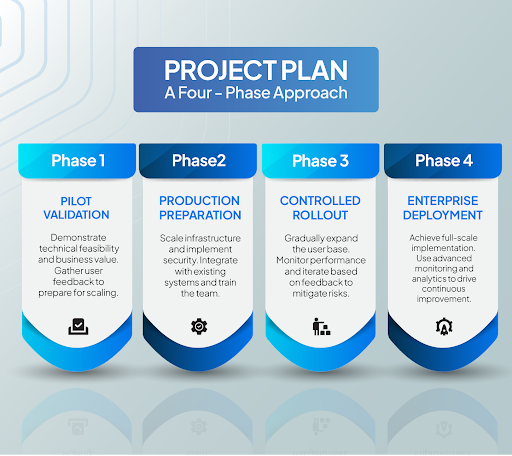
Production environments demand robustness, scalability, and reliability that controlled pilots simply don’t test. Here’s a phased approach that reduces the risk.
Phase 1: Pilot Validation (Months 1–3)
Demonstrate technical feasibility. Validate the business value hypothesis. Gather real user feedback. Identify what you’ll need to scale.
Phase 2: Production Preparation (Months 3–6)
Scale the infrastructure. Implement security and compliance controls. Integrate with existing systems. Train teams and manage the change.
Phase 3: Controlled Rollout (Months 6–9)
Expand gradually. Monitor performance closely. Collect feedback and iterate. Have contingency plans in place.
Phase 4: Enterprise Deployment (Months 9–12)
Full-scale implementation. Advanced monitoring. Continuous improvement frameworks. Clear success metrics and reporting.
Each phase creates a checkpoint to catch problems before they become expensive failures.
What is MLOps and why does it matter here?
MLOps applies DevOps principles to machine learning. Without it, even successful pilots become operational nightmares in production.
The specific challenges AI adds over traditional software deployment include model drift, where performance drops as data patterns change. They also include version control across models and datasets, ongoing retraining needs, and compliance needs for explainability.
A structured MLOps roadmap sets the foundation, automation, and governance. It makes the difference between a reliable AI system and one that slowly degrades. The system may degrade until someone finally notices.
Why Is AI Governance Critical in the AI Implementation Process?
The EU AI Act is now in force. For many AI applications, compliance isn’t a choice.
But beyond regulation, AI governance builds something harder to put a number on: trust. Stakeholders, whether customers, regulators, or your own board, need to know that your AI systems are transparent, fair, and accountable.
The four pillars of AI governance
Ethical AI development – bias detection, fairness monitoring, inclusive development processes.
Risk management – comprehensive risk assessment, mitigation strategies, and incident response.
Regulatory compliance – GDPR requirements, EU AI Act obligations, industry-specific regulations for sectors like financial services and healthcare.
Transparency and explainability – can your AI system explain its decisions in terms humans understand? If not, that’s both a governance risk and an operational one.
Build governance into your AI implementation from day one.
Organisations that keep governance on at the end pay for it in rework, delays, and legal exposure. The ones getting this right add governance checkpoints to every phase of the implementation lifecycle. This runs from use case selection to production monitoring.
When the EU AI Act enforcement bites, these organisations will be compliant by design. Others will be scrambling.
How Does AI Adaptation Change Organisational Culture?
Here’s something that doesn’t get enough attention: AI implementation is also a people project.
AI training and skills development
Not everyone needs to become a data scientist. But teams working alongside AI systems need to understand what they’re working with. They need to know their capabilities, limitations, and how to interpret their outputs critically.
Workflow transformation
AI doesn’t just automate tasks. It changes how decisions get made. Finance teams using AI for forecasting need new workflows around how they review, challenge, and act on model outputs. Customer service teams using AI for response suggestions need protocols for when to follow the AI and when to override it.
Change management
The organisations that handle this well communicate early and often. They involve teams in the process rather than presenting AI as something happening to them. They address the fear of automation rather than dismissing it. And they create clear pathways for people to develop skills that work alongside AI rather than compete with it.
What Are the Most Common Questions About AI Implementation?
What is AI implementation?
AI implementation is the process of integrating AI systems, models, data pipelines, and governance into real business operations so they deliver ongoing, measurable value. It goes well beyond building a model. It includes infrastructure, deployment, and organisational change.
What are the primary steps in successful AI implementation?
The primary steps in successful AI implementation involve:
-
- Defining a clear strategy
- Ensuring data and infrastructure readiness
- Building a skilled AI team
- Developing and testing models
- Scaling and governing AI solutions for production
How long does AI implementation take?
A focused pilot typically takes one to three months. Moving that pilot into full production across an enterprise usually takes nine to twelve months. The timeline depends heavily on data readiness, infrastructure maturity, and the complexity of existing systems.
What industries benefit most from AI implementation?
Financial services, retail, healthcare, logistics, and manufacturing are seeing the strongest returns currently – because they have the data volumes and operational complexity that AI handles well. That said, almost any industry with structured data and repetitive decision-making can benefit.
How can businesses measure the ROI of AI implementation?
Businesses can measure the ROI of AI implementation by tracking benefits like:
-
- Cost reduction (automated tasks)
- Revenue increase (personalised recommendations)
- Efficiency gains
- Customer satisfaction
- Enhanced decision-making
What is the biggest risk in AI implementation?
Poor data quality, closely followed by inadequate governance. Technical failure rates are actually relatively low when organisations invest in proper infrastructure. Most implementation failures trace back to data that wasn’t ready or governance that wasn’t in place.
Is generative AI implementation different from traditional AI implementation?
Yes, generative AI implementation shares core AI implementation principles but has unique considerations. These include managing:
-
- Model hallucinations
- Intellectual property risks
- Higher computational demands
- Specific ethical guidelines related to content generation.
What Separates the 20% Who Scale AI Successfully?
Every month you delay scaling your AI implementation costs more than money. It will cost you your market position.
Our analysis reveals three critical success factors that distinguish winners:
-
- Technical Architecture Mastery
Winners built modular systems that integrate new AI models without platform reconstruction. They anticipated GPT evolution, regulatory changes, and scaling demands from day one. - Regulatory Foresight
They implemented AI governance frameworks before compliance became mandatory. When the EU AI Act takes full effect, they’ll maintain competitive velocity while others pause for legal reviews. - Partnership Intelligence
They identified AI specialists who understood their industry constraints, not just their technical requirements. These strategic relationships provided exclusive access to emerging capabilities and rapid deployment expertise.
- Technical Architecture Mastery
Time For Some Honest Reflection
Pick the one that stings the most:
-
- You’ve run at least one AI pilot in the last 18 months. Do you know, specifically, why it hasn’t scaled yet?
- If someone asked your team today, “Is our data AI-ready?” – could anyone give a confident answer?
- Are you building an AI strategy around what’s possible, or around what looks good in the next board deck?
- When your competitors go live with production AI next year, will your organisation be ready to respond or still in the planning phase?
The Window Is Open. It Won’t Stay That Way.
Most companies will read an article like this, nod along, and do nothing differently this quarter.
A smaller group will use it as the trigger to finally get serious about implementation.
If you’re in that second group or want to be, the next move is simple: get a clear-eyed view of where your organisation actually stands before committing another pound or another month to AI experimentation.
Start your AI Implementation Review with Emvigo
A structured conversation with people who’ve helped organisations move from stalled pilots to production AI and who’ll tell you honestly what you need to hear, not just what you want to.
The window for early-mover advantage in enterprise AI is still open.
But it’s closing faster than most teams realise.