
Every business leader talks about digital transformation.
But what they actually want are outcomes — faster time to market, lower operational friction, and technology that scales without chaos.
That’s where the real difference between Infosys and Cognizant shows up. Both companies can deliver impressive results on paper. Both have global reach, cloud capability, and AI expertise. But how they get there — and how fast — couldn’t be more different.
Infosys builds transformation like an architect — precise, process-led, and deeply documented. Every phase is structured, measured, and governed. That’s why it works well for organizations that prioritize control and consistency over speed.
Cognizant, meanwhile, behaves more like a product company — adaptive, design-first, and customer-obsessed. Its model focuses on agility, shorter delivery cycles, and closer collaboration. You see value faster, but it demands greater involvement from your side.
So if Infosys gives you predictability, Cognizant gives you momentum.
The right choice depends on what kind of progress your business needs next — steady evolution or rapid acceleration.
Understanding Infosys and Cognizant: A Quick Overview
Before we pit Infosys against Cognizant, let’s establish who these players really are.
Infosys: Precision, Process, and Predictability
Founded in 1981 in Pune, India, Infosys has grown into a global consulting and IT services powerhouse.
With over 345,000 employees across 56 countries, Infosys specialises in digital transformation, cloud services, AI integration, and enterprise application development. They’re known for their engineering-first approach and strong focus on innovation through their Infosys Nia AI platform and EdgeVerve products.
If your business values order, documentation, and long-term stability, Infosys is the kind of partner that feels reassuring. Every project starts with deep discovery, detailed planning, and layered governance. Nothing moves until it’s mapped — and that’s exactly what some enterprises need.
Infosys isn’t built for chaos; it’s built for control. Its consulting-led model ensures every change aligns with larger business strategy. The trade-off? You don’t get speed overnight — but you do get consistency and scalability that lasts.
Where Infosys shines is in enterprise modernization — transforming legacy systems, building hybrid cloud environments, or executing multi-year automation programs. Its frameworks like Topaz (AI and automation), Cobalt (cloud), and Finacle (banking platform) are mature, proven, and backed by a global delivery engine trusted by Fortune 500 companies.
If you’re a large or growing enterprise with compliance-heavy processes or global operations, Infosys gives you something rare in tech partnerships — predictable excellence.
Key Facts:
-
- Headquarters: Bangalore, India
- Revenue: $18.2 billion (FY 2024)
- Primary Markets: Banking, insurance, retail, manufacturing
- Notable Clients: BP, Daimler, Volkswagen
What Is Cognizant?
Established in 1994 as the technology arm of Dun & Bradstreet, Cognizant became an independent company in 1996.
Today, with approximately 347,000 employees worldwide, Cognizant operates as a professional services company delivering IT services, consulting, and business process outsourcing. They’re particularly strong in healthcare, financial services, and life sciences sectors.
Cognizant takes the opposite route — it’s designed for movement. It’s the partner you choose when speed to market matters more than perfect documentation.
Cognizant’s culture is rooted in agility and co-creation. Instead of long strategy decks, you’ll often find its teams prototyping solutions alongside yours — fast feedback, fast iterations, fast results. It’s less about big blueprints and more about building, testing, improving.
This approach makes Cognizant especially strong in digital experience, cloud migration, product engineering, and data modernization. Its digital business segment accounts for over half its revenue, driven by demand for cloud-native development, UX design, and analytics-driven decision-making.
But with speed comes trade-offs — governance can feel lighter, and processes can vary by region or team. Cognizant fits best for organizations that are comfortable with a little ambiguity in exchange for faster ROI and flexible delivery.
If you want a partner that behaves more like a startup but delivers at enterprise scale, Cognizant fits the bill.
Key Facts:
-
- Headquarters: Teaneck, New Jersey, USA
- Revenue: $19.4 billion (FY 2023)
- Primary Markets: Healthcare, banking, insurance, retail
- Notable Clients: Johnson & Johnson, American Express, Pfizer
The cognizant vs infosys debate often centres on their geographical heritage and cultural approaches. Infosys brings Indian engineering excellence with global delivery, while Cognizant offers American business sensibility with offshore execution capabilities.
Infosys vs Cognizant: Core Service Offerings Comparison
Both companies offer similar services on paper, but the devil is in the details.
Infosys Service Portfolio
Infosys structures its offerings around three core pillars:
Digital Services:
-
- Cloud migration and management (AWS, Azure, Google Cloud)
- AI and automation solutions through Infosys Nia
- Data analytics and business intelligence
- Cybersecurity and compliance
Consulting Services:
-
- Business process redesign
- Technology strategy and roadmapping
- Change management
- Enterprise architecture
Application Services:
-
- Custom software development
- Legacy modernisation
- SAP, Oracle, and Salesforce implementation
- Application maintenance and support
Infosys has invested heavily in its proprietary platforms. Their Infosys Cobalt cloud framework and Infosys Nia AI platform give them unique capabilities that clients can’t get elsewhere.
Cognizant Service Portfolio
Cognizant organises its services differently, focusing on industry-specific solutions:
Technology Services:
-
- Application development and modernisation
- Cloud infrastructure and services
- Quality engineering and testing
- Cybersecurity solutions
Consulting Services:
-
- Digital business strategy
- Customer experience design
- Data and intelligence
- IoT and engineering services
Operations Services:
-
- Business process outsourcing (BPO)
- IT infrastructure management
- Platform operations
- Finance and accounting services
The key differentiator for Cognizant is their deep industry expertise. When you work with Cognizant on a healthcare project, you’re getting teams who’ve spent years in healthcare, not just general IT consultants learning your sector.
Where They Actually Differ
The infosys cognizant comparison reveals subtle but important distinctions:
Infosys excels at large-scale transformation programmes requiring deep technical expertise. If you’re migrating 200+ applications to the cloud or implementing AI across your enterprise, Infosys brings the engineering muscle.
Cognizant shines in projects requiring industry knowledge and process optimisation. If you need someone who understands healthcare compliance while modernising your systems, Cognizant’s industry-specific approach pays off.
Neither is objectively better — they’re optimised for different scenarios.
The Core Difference: Infosys and Cognizant at a Glance
When considering a major IT services provider, you’re looking for stability, scale, and specific expertise. Both Infosys and Cognizant deliver on scale, but their fundamental philosophies and operating models are where the distinction truly lies.
Infosys: The Scale and Legacy of Global Consulting
Infosys is often seen as the more traditional, long-standing IT consulting giant. They’re heavily focused on large-scale, complex digital transformation projects and deep-rooted legacy modernisation.
-
- Strong Focus Area: Digital Transformation and core systems modernisation, particularly within large enterprises and financial services.
- Approach: Tends to take a methodical, long-term, and slightly more premium approach to projects, often positioning themselves closer to strategic consulting firms.
Cognizant: The Nimble, Customer-Centric Operator
Cognizant is known for its aggressive growth strategy and for being particularly responsive to market changes and client demands. They carved out their space by excelling in application development, maintenance, and BPO (Business Process Outsourcing).
-
- Strong Focus Area: Application services, cloud migration, and industry-specific solutions, especially in the healthcare and life sciences sectors.
- Approach: Often seen as a more flexible and cost-effective delivery engine, focusing on efficiency and speed in project execution.
Infosys vs Cognizant: Detailed Comparison Table
Let’s break down the key differences in a clear, side-by-side format:
| Criteria | Infosys | Cognizant |
| Founded | 1981 | 1994 |
| Headquarters | Bangalore, India | Teaneck, New Jersey, USA |
| Employees | 345,000+ | 347,000+ |
| Annual Revenue | $18.2 billion | $19.4 billion |
| Primary Focus | Digital transformation, AI, cloud | Industry-specific solutions, BPO |
| Strongest Industries | Banking, retail, manufacturing | Healthcare, life sciences, financial services |
| Delivery Model | Global delivery centres, heavy offshore | Hybrid onshore-offshore, stronger US presence |
| Innovation Focus | Proprietary platforms (Nia, Cobalt) | Industry solutions and frameworks |
| Consulting Strength | Technology-led consulting | Business process consulting |
| Cloud Expertise | All major cloud platforms, strong in migration | AWS and Azure focus, strong in management |
| Pricing Model | Competitive offshore rates | Premium pricing with more onshore resources |
| Client Engagement | Large enterprise transformations | Mid to large enterprise, stronger mid-market |
| Partnership Ecosystem | Strong partnerships with SAP, Microsoft, Oracle | Deep partnerships in healthcare, finance tech |
| Cultural Approach | Engineering-first, process-driven | Business-outcome focused, client-centric |
| Average Project Size | $5M – $50M+ | $2M – $30M |
This comparison shows that the infosys vs cognizant decision isn’t about better or worse — it’s about fit.
Core Strengths and Areas for Improvement
No company is perfect. Before you choose, you need to understand where each firm truly excels and where they might fall short. This provides critical context for your long-term partnership with either Cognizant vs Infosys.
Infosys’s Strong Focus Areas
-
- Large-Scale Digital Transformation: Infosys is a go-to for massive, multi-year projects that require overhauling an entire digital infrastructure. They have a proven record of managing risk in complex engagements.
- Product & Platform Development: They invest heavily in creating proprietary software platforms and reusable frameworks, which can speed up development for certain types of projects.
- Global Consulting Credibility: The company often competes directly with the likes of IBM and Accenture, offering strategic guidance alongside technology execution.
Infosys’s Weak Areas (Areas for Improvement)
-
- Agility on Smaller Projects: Their large, process-heavy structure can sometimes make them less agile or cost-effective for smaller, rapid-development Minimum Viable Product (MVP) projects.
- Pricing: Their strategic, consulting-led approach can sometimes result in higher overall costs compared to competitors focused solely on execution.
Cognizant’s Strong Focus Areas
-
- Healthcare and Life Sciences: Cognizant has built a deep, industry-specific knowledge base in these regulated sectors, making them a very strong contender for medical or pharmaceutical tech projects.
- Operational Efficiency & Maintenance: They are exceptionally strong at managing and maintaining existing IT landscapes and application portfolios, offering robust BPO services.
- Quick Scaling: Cognizant is often very efficient at quickly scaling up large teams for new projects due to their strong resource management.
Cognizant’s Weak Areas (Areas for Improvement)
-
- Talent Retention: They sometimes face higher rates of employee attrition, which can occasionally lead to team instability on long-running projects.
- Innovation Perception: While highly competent, they are sometimes perceived as more of an execution-focused partner rather than a strategic innovation partner compared to Infosys.
A Look at Real-World Application
To bring the Infosys vs Cognizant debate into focus, let’s look at the kinds of projects each company is typically known for.
Infosys Case Study Examples (Hypothetical but Realistic)
-
- Major Global Bank Core Banking System Modernisation: Infosys would take on a multi-year project to replace a bank’s decades-old mainframe with a modern, cloud-native core banking system, encompassing everything from security to regulatory compliance. This is their bread and butter.
- New Digital E-commerce Platform for a Retail Giant: Building a high-performance, scalable e-commerce platform that integrates AI-powered features for a major retail chain. (Internal link opportunity: E-commerce Optimization: A Guide to Maximum Conversions)
Cognizant Case Study Examples (Hypothetical but Realistic)
-
- Pharmaceutical R&D Data Management System: Designing and implementing a new, compliant data warehouse and analytics platform to manage clinical trial data for a major pharmaceutical company.
- Large-Scale Application Maintenance and Support: Taking over the 24/7 support, maintenance, and incremental feature development for a multinational insurer’s entire customer-facing application suite.
Key Strategic Considerations and Pricing Models
Understanding the business model behind the service is essential. The cost structure and long-term partnership strategy for Infosys cognizant are very different.
What Drives Pricing?
Both companies use standard models (Fixed Price, Time & Materials, Managed Services), but their inherent costs differ:
-
- Infosys: Often includes a higher percentage of senior consultants and architects in the early phases. You are paying for their deep intellectual property and strategic risk management. This can result in a higher upfront cost, or a higher blended rate across the entire project.
- Cognizant: Tends to leverage its global delivery model for cost efficiency, offering more competitive rates for labour-intensive services like application maintenance and testing. They are frequently a top choice for projects where cost optimisation is the primary goal.
Pricing Models: Infosys vs Cognizant Cost Comparison
Money talks. Let’s break down what you’ll actually pay.
Infosys Pricing Structure
Infosys typically offers three pricing models:
Time and Material (T&M):
-
- Offshore developer rates: $25-45 per hour
- Onshore developer rates: $75-125 per hour
- Best for: Projects with evolving scope
Fixed Price:
-
- Typically 10-20% premium over T&M estimates
- Includes risk buffer for scope management
- Best for: Well-defined projects with clear requirements
Outcome-Based Pricing:
-
- Payment tied to specific business outcomes
- Risk-sharing model with potential savings
- Best for: Large transformation programmes
Typical Project Costs:
-
- Small project (3-6 months, 5-8 resources): $200K – $500K
- Medium project (6-12 months, 10-20 resources): $1M – $3M
- Large transformation (12-24 months, 30+ resources): $5M – $20M+
Cognizant Pricing Structure
Cognizant’s pricing reflects their hybrid delivery and industry expertise:
Time and Material:
-
- Offshore developer rates: $30-50 per hour
- Onshore developer rates: $85-145 per hour
- Best for: Flexible, collaborative engagements
Fixed Price:
-
- Premium of 15-25% over T&M
- Includes change management buffer
- Best for: Defined scope with industry-specific requirements
Managed Services:
-
- Monthly retainer for ongoing services
- Typically starts at $50K+ per month
- Best for: Long-term operational support
Typical Project Costs:
-
- Small project: $250K – $600K
- Medium project: $1.2M – $3.5M
- Large transformation: $4M – $25M+
The Real Cost Difference
The cognizant vs infosys pricing gap isn’t as simple as “Cognizant costs more.”
For offshore-heavy projects: Infosys typically offers 10-20% cost savings
For onshore-required projects: The gap narrows to 5-10%
For industry-specific solutions: Cognizant’s pre-built assets can reduce total cost by 20-30% despite higher hourly rates
For complex technical projects: Infosys’ platforms can accelerate delivery, offsetting their rates
The custom software development cost goes beyond hourly rates. Consider total cost of ownership, including:
-
- Time to delivery
- Quality and rework costs
- Post-implementation support
- Knowledge transfer and training
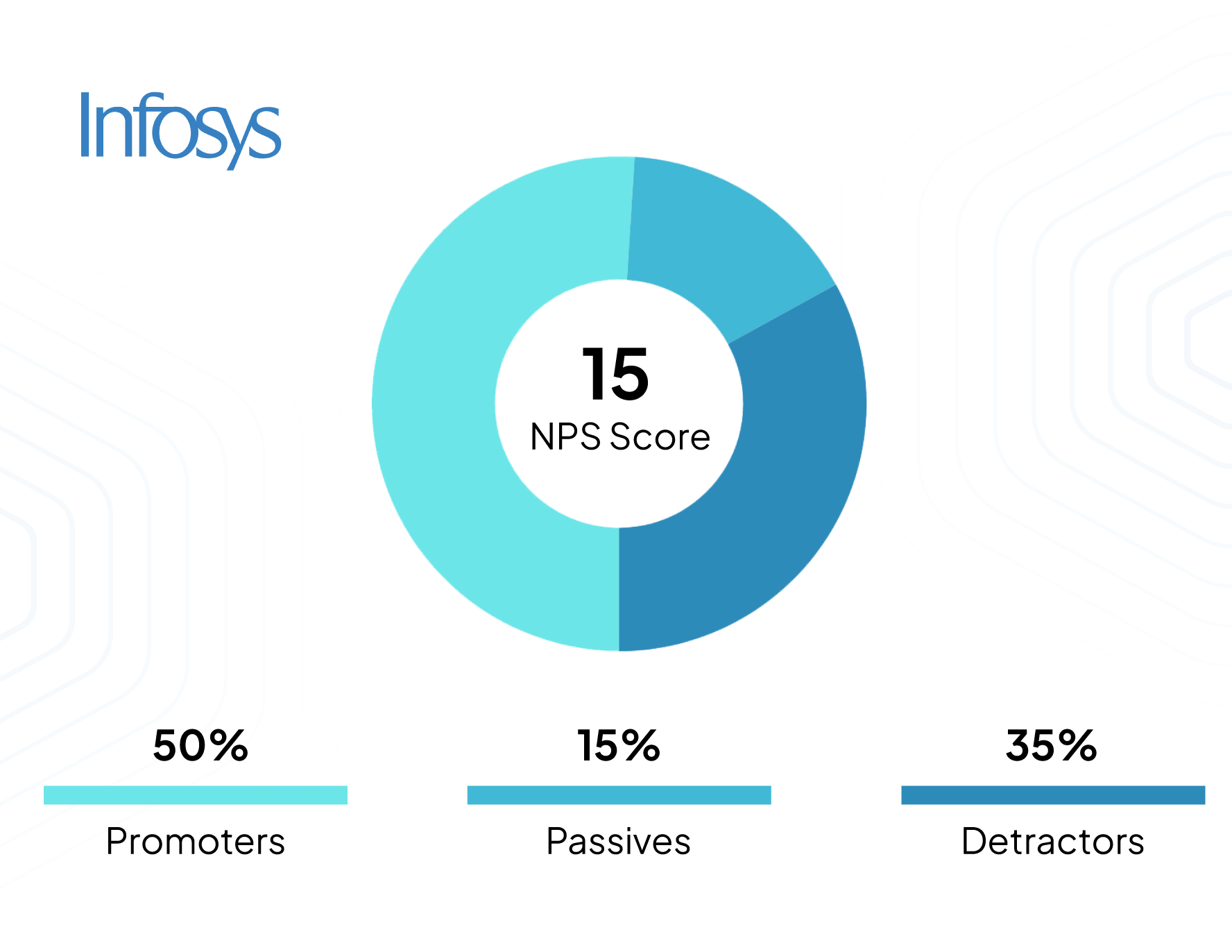
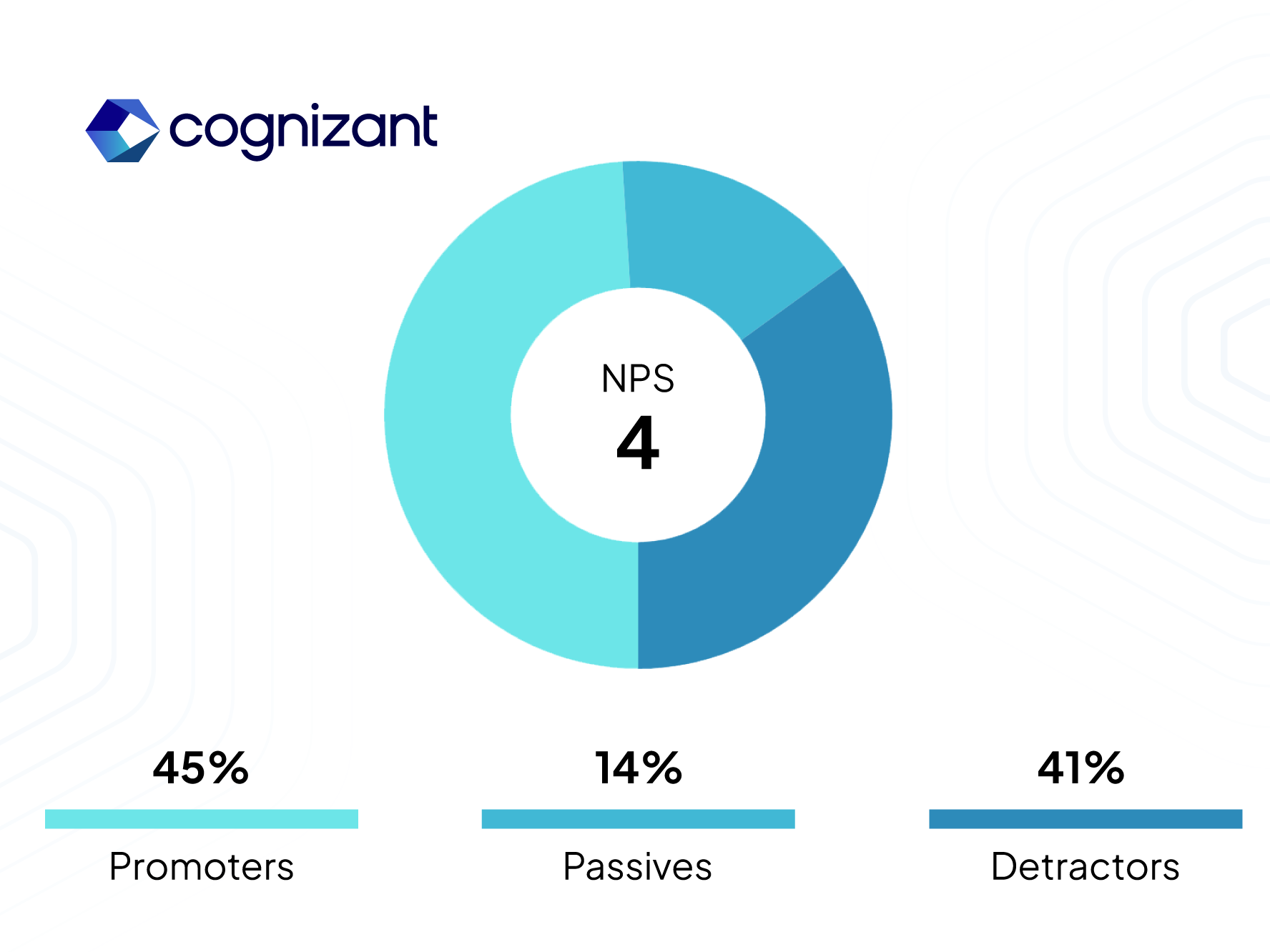
Infosys vs Cognizant: NPS (Net Promoter Score) Comparison
Infosys NPS Score:
Cognizant NPS Score:
Current Capabilities and Future Direction
Where are these companies headed? Understanding their strategic direction helps you assess long-term partnership viability.
Infosys: Current State and Future Focus
Current Capabilities:
Infosys is pushing hard into AI-first transformation. Their $1.5 billion investment in AI capabilities over the next three years signals serious commitment.
They’ve launched Topaz, their AI-first offering that combines Infosys Nia with generative AI capabilities. Early clients report 20-40% productivity gains in software development and business processes.
Their cloud business continues growing at 30%+ annually, with Cobalt cloud services now contributing over 20% of total revenue.
Future Direction:
Infosys is betting on:
-
- Generative AI Integration: Embedding AI across every service line, not just as a separate offering
- Industry Cloud Solutions: Pre-configured cloud environments for specific industries
- Sustainability Services: Helping clients achieve carbon neutrality goals
- Edge Computing: IoT and edge solutions for manufacturing and retail
They’re also expanding their nearshore presence in Eastern Europe and Latin America to offer delivery options beyond India.
Cognizant: Current State and Future Direction
Current Capabilities:
Cognizant completed a major restructuring in 2023, streamlining operations and refocusing on higher-margin digital services.
Their acquisition strategy targets companies with strong IP in healthcare, data, and digital engineering. Recent acquisitions like Belcorp and Tin Roof Software strengthen their industry-specific capabilities.
They’re investing heavily in automation, with their Cognizant Neuro AI platform now deployed across 300+ client engagements.
Future Direction:
Cognizant’s roadmap emphasises:
-
- Healthcare Dominance: Expanding their healthcare software and services footprint
- Data and Analytics: Building out their data modernisation and AI/ML capabilities
- Customer Experience: Strengthening their digital experience and design services
- Hybrid Work Solutions: Workplace transformation services for the remote-first era
They’re also reshaping their delivery model with more automation and AI, targeting 40% of projects to be AI-augmented by 2025.
Technology Trends Both Are Embracing
The infosys cognizant comparison shows convergence on several fronts:
Both companies recognise that AI implementation isn’t optional anymore — it’s core to every digital transformation.
Both are moving away from pure labour arbitrage toward value-based pricing and outcome-focused engagements.
Both are investing in sustainable IT practices and helping clients achieve environmental goals.
The real question isn’t whether they’re keeping up with trends, but whether their specific approach aligns with your needs.
Questions to Ask Before Choosing Between Infosys and Cognizant
Making the right choice requires asking tough questions. Here’s your evaluation framework.
Questions About Your Project
Scope and Complexity:
-
- Is this primarily a technical challenge or a business process problem?
- Do we need deep industry expertise or broad technical capabilities?
- How well-defined is our scope, and how much might it change?
Timeline and Scale:
-
- What’s our deadline, and is it flexible?
- How large is the project in terms of budget and team size?
- Are we looking for a quick win or a multi-year transformation?
Technical Requirements:
-
- Do we need cutting-edge technology or proven, stable solutions?
- Are we implementing existing platforms or building custom solutions?
- How important is technical innovation versus reliable delivery?
Questions to Ask Infosys
When evaluating Infosys for your project:
-
- “What percentage of our team will be onshore versus offshore, and can we meet key team members before signing?”
- “Show us three similar projects you’ve delivered in our industry. What were the outcomes?”
- “How do you handle scope changes and project governance?”
- “What proprietary platforms or accelerators would you use on our project, and what’s the evidence they work?”
- “What’s your team stability? How do you prevent knowledge loss from turnover?”
- “Can you provide references from clients with similar complexity and size?”
- “What’s your approach to AI vs automation, and how do you decide which to apply?”
Questions to Ask Cognizant
When considering Cognizant:
-
- “What industry-specific IP or frameworks would you bring to our project?”
- “How do you balance onshore and offshore resources, and what roles stay onshore?”
- “What’s your pricing structure, and are there volume discounts or outcome-based options?”
- “Show us case studies from our specific industry vertical. What business outcomes did you achieve?”
- “How do you integrate with our existing teams and processes?”
- “What’s your approach to knowledge transfer and ensuring we can maintain solutions after go-live?”
- “How do you measure and report project success beyond on-time, on-budget delivery?”
Questions About Long-Term Partnership
Beyond the immediate project:
Strategic Alignment:
-
- Will this partner grow with us as our needs evolve?
- Can they support our global expansion plans?
- Do they have capabilities in emerging technologies we might need in 2-3 years?
Cultural Fit:
-
- Do their working style and communication preferences match ours?
- How do they handle disagreements and project challenges?
- What’s their approach to innovation and continuous improvement?
Support and Evolution:
-
- What does post-implementation support look like?
- How do they handle updates, enhancements, and ongoing maintenance?
- What’s their approach to scaling from MVP to full product?
Infosys vs Cognizant: How Emvigo Provides a Better Alternative
Choosing a massive global company like Infosys or Cognizant often means accepting long project lead times, a lot of internal process, and a lack of direct, personal access to the senior experts running your project. For UK businesses and SMEs, especially those focused on innovation and rapid digital change, a more nimble, expert-led partnership is often the smart choice.
At Emvigo, we’ve built our model to directly address the common frustrations of working with IT giants. We don’t just execute; we partner. Our focus is on providing high-quality, scalable software development and technology consulting without the overhead and rigidity of the global monoliths.
Why Choose Emvigo Over Infosys or Cognizant?
-
- Expert-Led UK Engagement, Global Delivery: We offer you the best of both worlds. All our client strategy and relationship management is handled by UK-based senior consultants who understand the local business landscape and speak your language, ensuring clear communication and genuine partnership.
- Focus on Custom, High-Value Solutions: While the giants focus on massive enterprise systems, we excel in building custom software solutions, Minimum Viable Products (MVPs), and advanced AI-powered applications that give you a competitive advantage. We’re small enough to care deeply about your success, but scaled to deliver complex projects.
- Better Post-Deployment Service: Our commitment doesn’t end when the code is deployed. We offer genuinely responsive and comprehensive post-deployment support and maintenance. This includes a dedicated support team, rapid bug fixing, and structured plans for future feature development and scaling. This level of personalised, ongoing service is often diluted or extremely expensive with larger firms.
- Transparent and Flexible Pricing: Unlike the often-opaque project accounting of global firms, we offer straightforward, flexible pricing models. We work with you to find a model—be it Fixed Price, Time & Materials, or a Retainer—that aligns with your business goals and budget from the start.
- Free Demo Call & Consultation Offer: We believe in proving our value before you commit a penny. We invite you to a free, no-obligation demo consultation call with one of our senior technology strategists. We will review your project needs and show you exactly how our expert teams and processes can accelerate your goals more effectively than a generic engagement with a mega-corp.
Cut the complexity. Accelerate your goals. Why wait months with a giant IT firm when Emvigo can deliver faster, smarter, and more personal results? Book your free demo call now—and see if waiting is really worth it.
Making Your Final Decision: Infosys vs Cognizant Selection Framework
Let’s bring everything together with a practical decision framework.
Choose Infosys If:
-
- Your project is primarily a technical challenge requiring deep engineering expertise
- You need cutting-edge AI, cloud, or automation capabilities with proprietary platforms
- Scale matters — you’re migrating hundreds of applications or transforming large enterprise systems
- You’re implementing major enterprise platforms like SAP, Oracle, or complex cloud architectures
- Cost optimisation is critical and you’re comfortable with offshore-heavy delivery
- You value process and methodology over flexibility and speed
- You have strong internal project management to coordinate with offshore teams
Choose Cognizant If:
-
- Industry expertise is essential — especially in healthcare, life sciences, or financial services
- You need pre-built industry solutions rather than custom development from scratch
- Onshore presence matters for regulatory, security, or collaboration reasons
- Business process transformation is as important as technology implementation
- You’re in a highly regulated industry requiring specific compliance knowledge
- You value business outcome focus over pure technical excellence
- You need hybrid services including BPO and managed services alongside technology
Consider Emvigo Instead If:
-
- Your project is £500K – £5M — too small for big consultancies’ A-teams but too important to compromise
- Speed and agility matter more than corporate processes
- You want senior people actually working on your project, not managing offshore teams
- Direct communication with technical decision-makers is important
- Post-deployment support and evolution are as important as initial delivery
- You value transparency in pricing, progress, and challenges
- You’re looking for a long-term partner, not just a vendor
Red Flags to Watch For
Regardless of which provider you choose, watch for these warning signs:
From Any Provider:
-
- Reluctance to provide client references in your industry
- Vague answers about team composition and location
- Unwillingness to commit to specific team members
- No clear KPIs or success metrics
- Lack of transparency around change management process
- No post-deployment support plan
Specific to Large Consultancies:
-
- You’re talking to sales people, not technical people
- They can’t show you similar-sized projects (only much larger ones)
- The price seems too good to be true (likely loss leader with change orders coming)
- They’re unwilling to let you meet the actual team before signing
Frequently Asked Questions (FAQs)
Here are the answers to the most common questions about selecting a large-scale IT partner.
Q1: Is Infosys a bigger company than Cognizant?
Yes, Infosys generally has a larger market cap and global workforce. However, company size doesn’t guarantee project success—what matters more is the expertise of the team assigned to your project.
Q2: Which company focuses more on AI and future tech?
Infosys leads with heavy investment in proprietary AI platforms like Topaz, while Cognizant advances through strategic tech partnerships and acquisitions to enhance business applications.
Q3: Which is better for small to medium-sized UK businesses?
Both Infosys and Cognizant cater mainly to large enterprises. For SMEs, mid-sized firms like Emvigo often offer more agile, cost-effective, and personalised solutions.
Q4: Does their geographical focus affect project outcomes?
Yes. Cognizant is stronger in the North American market, especially in healthcare, while Infosys offers broader global coverage—ideal for multi-country projects.
Q5: What’s the key difference in their service approach?
Infosys focuses on consulting and digital transformation, whereas Cognizant emphasises application services and business process outsourcing for operational efficiency.
Conclusion: Making Your Strategic Decision
The comparison between Infosys vs Cognizant isn’t a simple ‘better or worse’ argument. Both companies are world-class, multi-billion-pound organisations with deep expertise.
-
- Choose Infosys if your primary need is a high-cost, high-stakes digital transformation of a core enterprise system, and you value a partner with deep consulting credibility.
- Choose Cognizant if your priority is cost efficiency, strong operational execution, especially in application maintenance, and your business is in the healthcare or retail space.
However, for most ambitious, growing UK businesses seeking speed, value, genuine partnership, and custom innovation, a massive global partner simply isn’t the most effective choice. They often provide generic solutions to unique problems.
Don’t settle for the generic service of an IT giant.
If you’re looking for the speed, expertise, and dedication of a focused software development company that will treat your project as its highest priority, it’s time to speak to Emvigo. Get the global quality you expect, delivered with the personal partnership you deserve.
Ready for a Technology Partner That Delivers Custom Excellence?
Contact Emvigo for a Free Consultation and Demo Today! Let’s discuss your project and show you the Emvigo difference.