

Choosing the right technology stack can feel overwhelming. On one side, you have .NET, Microsoft’s versatile framework that has grown far beyond its Windows roots to support cross-platform development. On the other, there’s Java, the time-tested “write once, run anywhere” language trusted by developers for decades.
Both are powerful, both are widely used—and both can deliver outstanding applications. The real challenge isn’t deciding which is better overall, but which is better for your specific project. In this guide, we’ll break down their differences, strengths, and ideal use cases so you can make a confident, well-informed choice.
What Makes .NET and Java Tick?
Understanding .NET: More Than Just Windows
Let’s clear something up straight away, .NET isn’t just for Windows anymore. This open-source framework has grown into a cross-platform powerhouse that runs on Windows, macOS, and Linux.
Think of .NET as a complete toolkit. It’s like having a Swiss Army knife for software development. You can build web applications, mobile apps, desktop software, and even games using this single framework.
Key .NET Features:
-
- Cross-platform compatibility
- Language flexibility (C#, F#, VB.NET)
- Strong security features
- Excellent performance
- Rich ecosystem of libraries
Java: The Platform-Independent Champion
Java takes a different approach. It’s a programming language and platform rolled into one. The magic happens with the Java Virtual Machine (JVM) – think of it as a translator that makes your Java code run on any device.
Java’s motto “write once, run anywhere” isn’t just marketing speak. It genuinely works across different operating systems without changing your code.
Key Java Features:
-
- True platform independence
- Robust memory management
- Strong community support
- Enterprise-ready capabilities
- Extensive documentation
Where They Meet: Common Ground Between .NET and Java
Before diving into differences, let’s acknowledge where these technologies align:
.NET vs Java — Quick Comparison
The Main Event: Key Differences That Matter
1. Platform Support and Flexibility
Java Takes the Crown Here
From your smartphone to the massive servers powering Netflix, Java applications work consistently across platforms and Netflix still relies heavily on Java to power its backend services across all devices The JVM handles all the heavy lifting of making your code work on different systems.
.NET has caught up significantly. The introduction of .NET Core (now simply .NET 5+) made Microsoft’s framework truly cross-platform. However, you’ll still find more Java applications in non-Windows environments.
.NET vs Java — Platform Support
2. Performance: Speed vs Optimisation
.NET Often Wins the Speed Race
Here’s where things get interesting. .NET applications typically run faster because they compile to native code. This means your computer can understand and execute .NET code more directly.
Java applications run on the JVM, which adds a layer between your code and the system. However, Java’s performance has improved dramatically with recent optimisations. The difference in real-world applications is often negligible.
Performance Comparison:
-
- .NET: Faster startup times, lower memory usage
- Java: Better long-running application performance, excellent garbage collection
3. Development Experience and Tools
Different Philosophies, Different Experiences
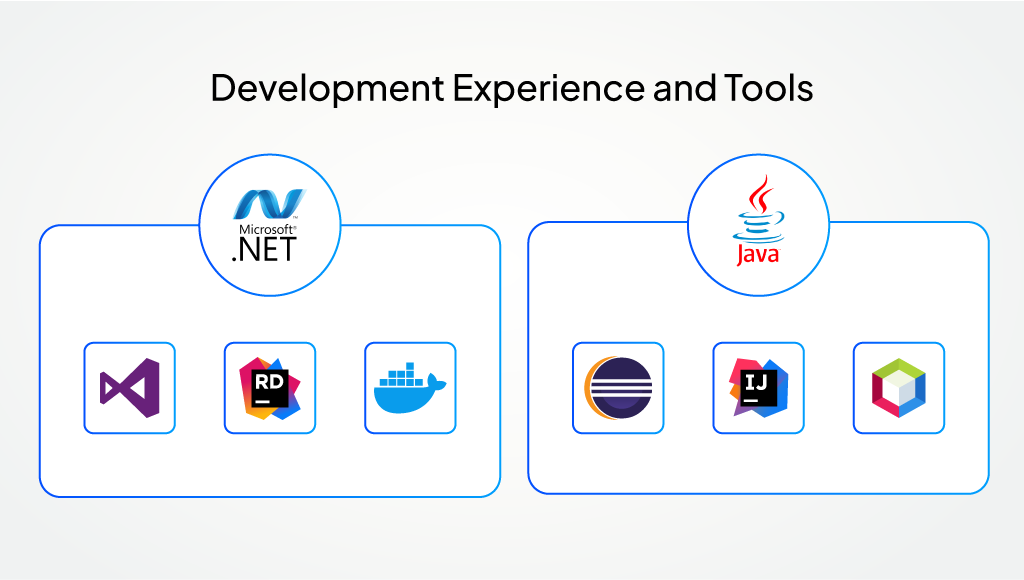
.NET developers typically use Visual Studio – Microsoft’s flagship IDE, Rider, Docker . It’s a comprehensive environment that handles everything from coding to deployment. Think of it as having a luxury car with all features included.
Java developers have choices. Eclipse, IntelliJ IDEA, NetBeans – each offers different advantages. This flexibility is brilliant, but it can overwhelm beginners.
4. Language Flexibility
.NET Offers More Language Options
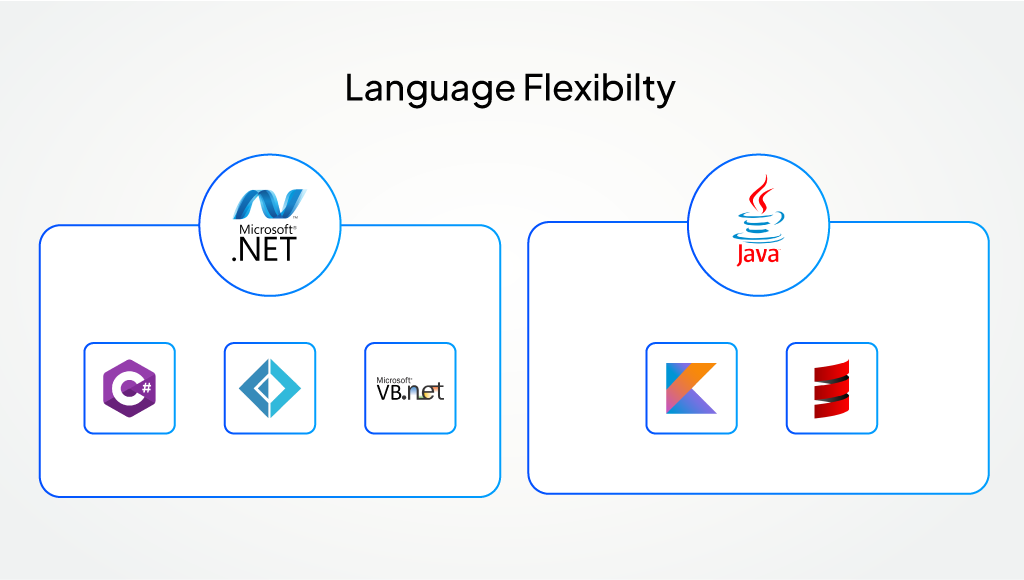
With .NET, you can code in C#, F#, or VB.NET, all within the same project. This flexibility means teams with different language expertise can work together seamlessly.
Java is primarily… well, Java. While the JVM supports other languages like Kotlin and Scala, the ecosystem revolves around Java itself.
5. Learning Curve and Community
Java Has More Learning Resources
Java’s been around longer, which means more tutorials, books, and Stack Overflow answers. The community is massive and helpful.
.NET’s community is growing rapidly, especially since Microsoft embraced open-source development. However, you might find fewer resources compared to Java.
| Aspect | Java | .NET |
|---|---|---|
| Learning Resources | Java has more tutorials, books, and online guides thanks to its long history. | .NET resources are growing rapidly, especially since Microsoft embraced open-source. |
| Community | Massive, active open-source community with strong support on Stack Overflow. | Growing community backed by Microsoft ecosystem and open-source contributors. |
Cloud-Native Development: Modern Deployment Strategies
.NET in the Cloud Era
Microsoft has positioned .NET as a cloud-first platform:
Azure Integration:
-
- Native support for Azure Functions (serverless computing)
- Seamless deployment to Azure Container Instances
- Built-in monitoring with Application Insights
- Integration with Azure DevOps for CI/CD
Container Support: .NET applications create smaller container images compared to many Java applications, leading to faster deployment and scaling.
Java’s Cloud Versatility
Java’s platform independence shines in cloud environments:
Multi-Cloud Flexibility:
-
- Runs identically across AWS, Google Cloud, and Azure
- Extensive support for Kubernetes orchestration
- Rich ecosystem of cloud-native frameworks (Spring Boot, Micronaut, Quarkus)
Microservices Excellence: Java frameworks like Spring Boot have become synonymous with microservices architecture, offering features like:
-
- Embedded web servers
- Auto-configuration
- Production-ready metrics and health checks
Cost Analysis: Total Ownership Considerations
.NET Total Cost of Ownership
| Aspect | Open Source .NET | Enterprise Considerations |
|---|---|---|
| Development Tools | Free (VS Code, VS Community) | Visual Studio Professional / Enterprise |
| Runtime Licensing | Free | Free |
| Hosting | Linux / Windows options | Windows Server licensing |
| Third-party Tools | Many free options | Commercial tools for enterprise features |
Java Cost Structure
| Aspect | Standard Java | Enterprise Considerations |
|---|---|---|
| Development Tools | Many free options | IntelliJ Ultimate, enterprise IDEs |
| Runtime Licensing | OpenJDK free | Oracle JDK licensing changes |
| Application Servers | Free options (Tomcat, Jetty) | Commercial servers (WebLogic, WebSphere) |
| Support | Community support | Commercial support contracts |
Understanding these cost implications becomes crucial when planning your development budget. Proper custom software development cost analysis should include both direct and indirect expenses.
Developer Productivity: Real-World Impact
Rapid Application Development with .NET
.NET’s tooling focuses on getting developers productive quickly:
Code Generation: Visual Studio can scaffold entire applications with database integration, authentication, and API endpoints in minutes.
Hot Reload: Edit your code while the application is running and see changes immediately without restarting.
Integrated Testing: Built-in support for unit testing, integration testing, and UI testing within the same development environment.
Java’s Mature Development Practices
Java development emphasises established patterns and practices:
Framework Maturity: Frameworks like Spring have been refined over decades, offering solutions for almost every enterprise requirement.
Code Quality Tools: Extensive static analysis tools (SonarQube, SpotBugs, PMD) help maintain high code quality across large teams.
Dependency Injection: Mature dependency injection containers promote loose coupling and testable code.
Real-World Applications: Who Uses What?
.NET in Action
Microsoft’s own products showcase .NET’s capabilities:
-
- Stack Overflow: Built with ASP.NET, handles millions of daily users
- Microsoft Office 365: Web components powered by .NET
Java Success Stories
Java powers some of the world’s most demanding applications:
Making the Right Choice: A Decision Framework
Choosing between .NET and Java isn’t about finding the “best” technology – it’s about finding the right fit for your specific needs.
Choose .NET When:
-
- You’re building Windows-first applications
- Your team knows C# or other .NET languages
- You need rapid development cycles
- You’re already in the Microsoft ecosystem
- Performance is critical (especially for web applications)
Choose Java When:
-
- Cross-platform compatibility is essential
- You’re building large-scale enterprise applications
- You need maximum flexibility in hosting environments
- Your team has Java expertise
- You’re working with existing Java infrastructure
Scaling Your Application: From MVP to Enterprise
Whether you choose .NET or Java, you’ll eventually face scaling challenges. The good news is both platforms excel at handling growth.
For .NET applications, Microsoft’s Azure cloud platform offers seamless scaling options. Java applications can leverage various cloud providers and benefit from mature scaling patterns.
If you’re starting with a minimum viable product, consider how each platform handles growth. Scaling from MVP to a full product requires careful planning, regardless of your chosen technology.
The Development Team Factor
Your choice might ultimately depend on your development team’s expertise and preferences. Both platforms require skilled developers, but the availability and cost of talent can vary.
When building your team, consider whether you’ll develop in-house or work with external partners. Choosing the right software development partner becomes crucial for project success.
Modern Development Practices
Both .NET and Java embrace modern development methodologies. Agile development, DevOps practices, and continuous integration work well with both platforms.
The tooling ecosystem has evolved to support rapid development cycles. Modern agile software development tools integrate seamlessly with both .NET and Java workflows.
Security Considerations
Security shouldn’t be an afterthought in your platform choice. Both .NET and Java offer robust security features, but they approach security differently.
.NET Security Strengths:
-
- Built-in Windows authentication
- Strong type safety
- Comprehensive security model
- Regular security updates from Microsoft
Java Security Strengths:
-
- Mature security APIs
- Strong community-driven security practices
- Platform-independent security model
- Extensive security libraries
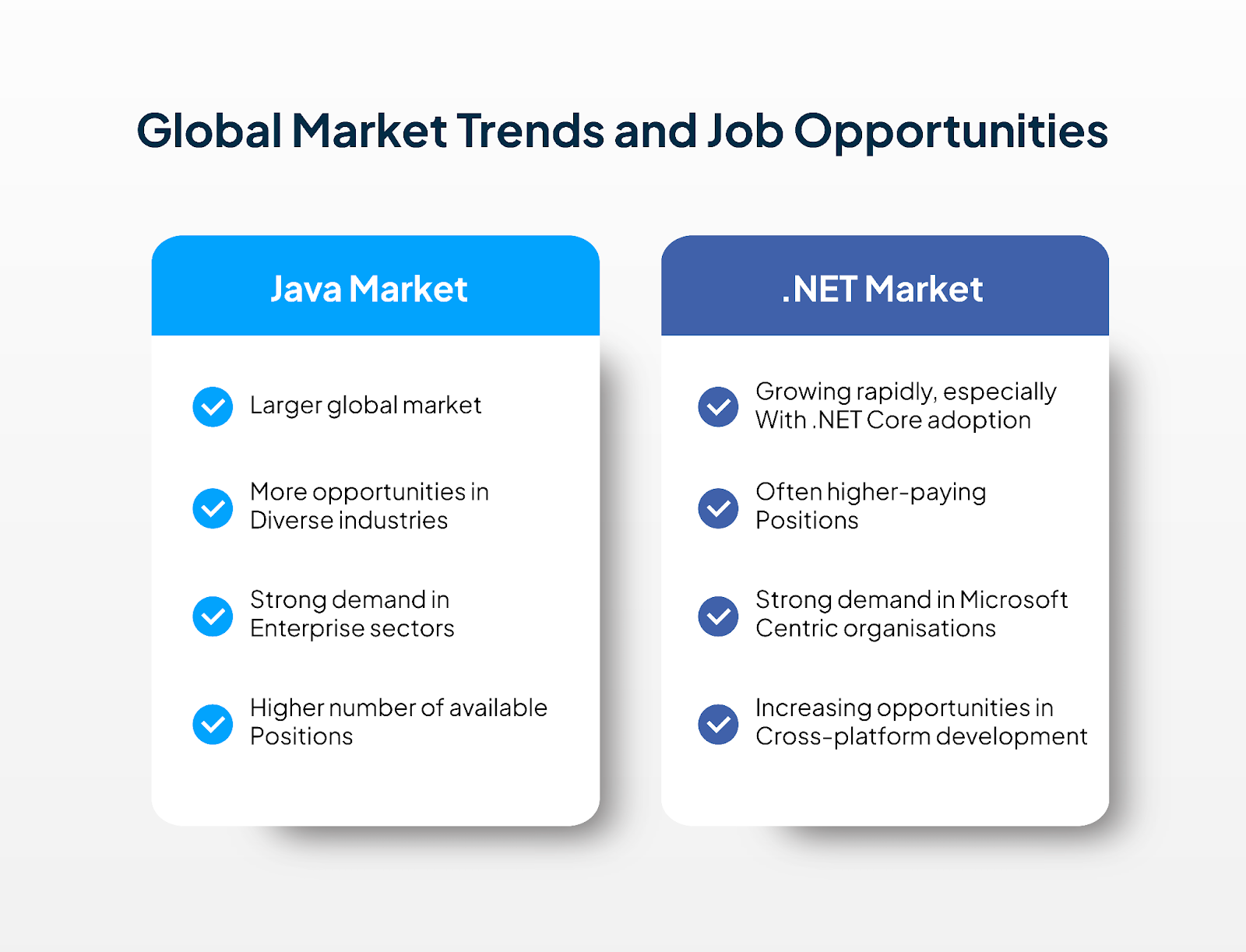
Global Market Trends and Job Opportunities
The job market for both technologies remains strong, but with different characteristics:
Performance Benchmarks: Real Numbers
Let’s look at some concrete performance comparisons based on community benchmarks:
| Metric | .NET Core | Java |
|---|---|---|
| Startup Time | ~50–100 ms | ~200–500 ms |
| Memory Usage | Lower baseline | Higher baseline, better under load |
| Throughput | Higher for web applications | Excellent for long-running processes |
| CPU Usage | Generally lower | Optimises well over time |
Remember, real-world performance depends heavily on your specific application and how well it’s optimised.
Future-Proofing Your Choice
Technology evolves rapidly. Both .NET and Java continue to innovate:
.NET Future:
-
- Unified platform (.NET 5+)
- Enhanced cloud-native capabilities
- Better performance optimisations
- Expanded cross-platform support
Java Future:
-
- Project Loom for better concurrency
- Ongoing JVM improvements
- Enhanced security features
- Better cloud integration
Outsourcing Considerations
If you’re considering outsourcing development, both .NET and Java have strong global talent pools. However, the geographical distribution differs.
Java developers are more evenly distributed globally, while .NET expertise is often concentrated in regions with strong Microsoft presence. Understanding software development outsourcing dynamics can help you make informed decisions about team location and expertise.
When to Seek Professional Help
Sometimes the choice between .NET and Java requires expert guidance. Consider consulting with experienced developers or development agencies who can assess your specific requirements.
Professional development services can help evaluate your needs, consider your existing infrastructure, and recommend the best path forward. Whether you need web development services, mobile app development, or custom software solutions, choosing the right technology foundation is crucial.
Conclusion
The .NET vs Java debate doesn’t have a universal winner. Both platforms offer excellent capabilities for building modern applications. Your choice should align with your project requirements, team expertise, and long-term goals.
.NET shines when you need rapid development, excellent performance, and are comfortable within the Microsoft ecosystem. Java excels when cross-platform compatibility, enterprise scalability, and platform independence are priorities.
Remember, the best technology is the one that helps you build great software efficiently. Focus on your project’s specific needs, your team’s strengths, and your organisation’s goals rather than getting caught up in technology debates.
Whatever you choose, both .NET and Java will continue evolving and serving developers well for years to come.
Frequently Asked Questions
Is .NET or Java better for beginners?
Both platforms are beginner-friendly, but in different ways. .NET might be easier to start with due to Visual Studio’s excellent tooling and IntelliSense features. Java has more learning resources available online, which can help beginners find answers to their questions more easily.
Which platform is more cost-effective for small businesses?
Both platforms are free to use for development. The costs come from hosting, tools, and team expertise. .NET might have lower initial costs if you’re already using Windows infrastructure, while Java might be more cost-effective if you’re using Linux servers or need maximum hosting flexibility.
Can I switch from Java to .NET (or vice versa) easily?
While the core programming concepts transfer well, each platform has its own ecosystem and best practices. Experienced developers can usually make the switch within a few months, but expect a learning curve for platform-specific features and tooling.
Which platform is better for mobile development?
For Android development, Java (or Kotlin) is the native choice. For cross-platform mobile development, .NET offers Xamarin, which allows you to build iOS and Android apps with shared code. Both approaches have their merits depending on your specific requirements.
How do .NET and Java handle modern development practices like DevOps?
Both platforms excel with modern DevOps practices. .NET integrates well with Azure DevOps and GitHub Actions, while Java works with various CI/CD tools like Jenkins, GitLab CI, and others. Both support containerisation with Docker and orchestration with Kubernetes.
Which platform has better long-term job prospects?
Both platforms offer strong career prospects. Java has a larger global market with more opportunities, while .NET positions often command higher salaries. The choice should align with your career goals and the types of companies you want to work for.
Which platform is more secure?
Both platforms offer robust security features. .NET benefits from Microsoft’s security expertise and regular updates, while Java has a mature security model backed by extensive community testing. Security ultimately depends more on how you implement and configure your applications than on the platform choice.