
Have you noticed how fast AI is changing things?
It feels like one minute we’re all playing with ChatGPT, and the next, there’s a whole new term on the tip of every tech leader’s tongue: Agentic AI.
If you’re wondering how this new development stacks up against the already mind-blowing power of Generative AI, you’re not alone. The shift from a smart tool to a truly independent system is the next major step in technology.
This isn’t just about buzzwords. For any business, understanding the difference between Agentic AI vs Generative AI is crucial. It’s the difference between asking an assistant to write an email and having that assistant independently manage an entire project, from planning to execution.
We’re going to break down these two concepts in simple words, look at where we are now, and explore what the future holds. This is the definitive guide for separating the hype from the genuine innovation in the world of intelligent systems.
Understanding the AI Landscape: Traditional AI, Generative AI, and Agentic AI
Before we compare agentic AI and generative AI, let’s clarify what we’re actually talking about. The AI space has evolved significantly, and terminology matters.
What is Traditional AI?
Traditional AI refers to rule-based systems and machine learning models designed to perform specific, predefined tasks. Think of spam filters, recommendation engines, or fraud detection systems. These systems follow set patterns and rules to make predictions or classifications.
Traditional AI excels at:
-
- Processing structured data
- Following predetermined logic
- Making predictions based on historical patterns
- Performing repetitive analytical tasks
The key limitation? Traditional AI can’t create new content or take autonomous actions beyond its programming.
Generative AI: The Creative Powerhouse
What is Generative AI (Gen AI)?
When people talk about gen ai, they are usually referring to a category of AI models that learn the patterns and structure of their input training data and then generate new, original content that has similar characteristics. It is, fundamentally, a content creation machine.
The Role of Large Language Models (LLM) in Generative AI
The power of generative ai is built on foundation models, particularly LLMs. These are the tools that make the generation of human-quality text possible.
-
- Generation Focus: Creating new data instances (e.g., writing a report, drafting marketing copy, summarising a document).
- Input-Output Loop: It’s a direct response to a human query. The system doesn’t initiate tasks; a user must prompt it.
- Lack of Memory/Planning: Standard generative ai is stateless between requests. It doesn’t remember previous interactions to inform a multi-step plan unless the user continually feeds it the full context.
In essence, generative ai means ‘content creation on demand.’ If you’ve used a service to write an article or create an image from scratch, you’ve experienced the core capability of genai.
What is Agentic AI (Agentive AI)?
An agentic AI is not just a model; it’s a complete, goal-oriented system built around an LLM (or other AI models). The agentic definition hinges on its ability to perceive its environment, formulate a plan, execute actions to achieve a goal, and reflect on the outcome to improve its performance.
The Core Components of an Agentic System
To be a true agentic ai, the system needs several key features that separate it from simple generative ai:
-
- Goal Setting: The ability to understand a high-level goal (e.g., “Increase website conversion rate”).
- Planning: Breaking the goal into smaller, manageable, and executable steps (e.g., ‘1. Research competitors’ CTAs. 2. Draft new landing page copy. 3. A/B test the new copy.’).
- Tool Use: The ability to use external tools like a web browser, a database query tool, or a payment processor to complete its tasks.
- Memory: A sophisticated memory (or state) that allows it to remember the steps it has taken, the outcomes, and the overall context of the long-running task. This gives it agentic behaviour.
- Self-Correction/Reflection: The crucial agentic meaning—the system can evaluate if a step failed and autonomously adjust its plan to try a different approach.
If Generative AI is the writer, then Agentic AI is the project manager, capable of planning, delegating (to its tools), and reporting back on the full lifecycle of a task. The term agentive ai is often used interchangeably with agentic ai.
Agentic AI vs Generative AI: The Core Differences
Let’s get to the heart of the matter: agentic AI vs generative AI. What’s the actual difference?
Purpose and Function
Generative AI is fundamentally about creation. Its primary function is to produce new content based on patterns it’s learned. It’s reactive—you give it a prompt, and it generates an output.
Agentic AI, however, is about action and decision-making. It’s proactive—it can identify what needs to be done and execute tasks across multiple steps without waiting for constant instructions.
The difference between generative AI and AI that’s agentic is like comparing a skilled artist (who creates when asked) to a project manager (who plans, coordinates, and executes).
Autonomy Level
This is where gen AI vs AI that’s agentic really diverges.
Generative AI autonomy:
-
- Responds to prompts
- Generates content within defined parameters
- Requires human direction for each task
- Stops after completing the requested output
Agentic AI autonomy:
-
- Initiates actions based on goals
- Breaks down complex objectives into steps
- Executes multi-step workflows independently
- Monitors progress and adjusts strategies
- Operates continuously until goals are achieved
Think of generative AI agents (which do exist) versus true agentic AI. Generative agents might create content in a workflow, but agentic AI orchestrates the entire workflow.
Decision-Making Capability
What is the difference between AI and generative AI when it comes to decisions?
Generative AI makes creative choices (which words to use, which style to apply) but doesn’t make strategic business decisions.
Agentic AI evaluates options, weighs trade-offs, and makes decisions that affect outcomes—like prioritising tasks, allocating resources, or adjusting strategies based on results.
Integration and Action
Difference between AI and genai becomes clearer when you consider integration.
Generative AI typically works within a single interface. You ask, it answers. You might copy-paste the output elsewhere.
Agentic AI integrates with multiple systems. It can:
-
- Pull data from your CRM
- Update your project management tool
- Send emails on your behalf
- Schedule meetings
- Execute code
- Make API calls
This is what makes generative AI unique but also what limits it compared to agentic systems.
Use Case Orientation
Generative AI excels at:
-
- Content creation and marketing
- Code generation and documentation
- Design and creative work
- Data summarisation
- Customer support responses
Agentic AI excels at:
-
- Workflow automation and orchestration
- Complex problem-solving
- Multi-step task execution
- Autonomous business process management
- Real-time adaptive decision-making
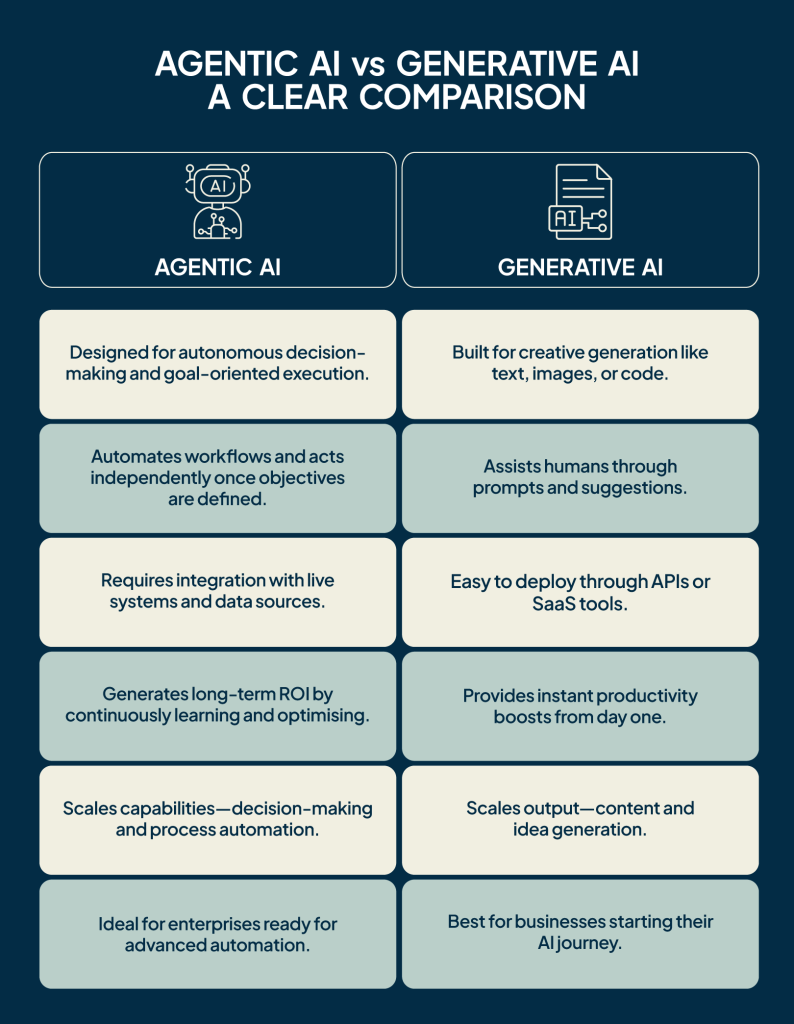
Agentic AI vs Generative AI: A Clear Comparison
Understanding the difference between generative ai and ai that is truly autonomous is key for businesses planning their digital strategy.
Generative AI vs Traditional AI: Where Does It Fit?
Before agentic AI, the main comparison was generative AI vs traditional AI. Understanding this helps contextualize where we are now.
Traditional AI vs Generative AI: The Evolution
Traditional AI:
-
- Rule-based decision trees
- Predictive analytics
- Pattern recognition
- Classification and regression
- Supervised and unsupervised learning
Generative AI vs traditional AI:
-
- Creates new content vs analyses existing data
- Understands context vs follows rules
- Flexible outputs vs fixed predictions
- Natural language interaction vs technical interfaces
The opposite of generative AI isn’t necessarily traditional AI—it’s more accurate to say deterministic or analytical AI sits on one end of the spectrum, while generative AI sits on the creative end.
What Makes Generative AI Unique?
When people ask what makes generative AI unique, several factors stand out:
-
- Content synthesis: Combines learned patterns to create original outputs
- Natural language understanding: Interprets context and nuance
- Multimodal capabilities: Works across text, images, audio, and video
- Few-shot learning: Performs tasks with minimal examples
- Contextual adaptation: Adjusts tone, style, and approach based on prompts
These capabilities represent a significant leap from traditional AI, but they’re still fundamentally different from agentic AI’s autonomous operation.
Types of AI: Generative vs Traditional vs Agentic
Let’s organise this clearly. Here’s how these types of AI generative vs traditional vs agentic compare:
Comparison Table: AI System Types
| Feature | Traditional AI | Generative AI | Agentic AI |
| Primary Function | Analyse and predict | Create content | Act and execute |
| Autonomy Level | Low (rule-based) | Medium (prompt-driven) | High (goal-driven) |
| Decision-Making | Predefined logic | Creative choices | Strategic decisions |
| Output Type | Classifications, predictions | Content, media | Actions, results |
| Human Involvement | Setup and monitoring | Prompt engineering | Goal setting |
| Learning Approach | Supervised/unsupervised ML | Deep learning, transformers | Reinforcement learning, planning |
| Business Value | Efficiency in analysis | Creative productivity | Autonomous execution |
| Examples | Spam filters, fraud detection | ChatGPT, DALL-E | AutoGPT, business process agents |
| Integration | Single-purpose systems | API-based tools | Multi-system orchestration |
| Adaptability | Limited to training data | Creative within learned patterns | Dynamic strategy adjustment |
This table clarifies types of AI generative vs other forms and helps you see where each technology fits in your business stack.
Current Trends: Why Agentic AI is the New Frontier
The initial explosion of generative ai was all about speed and creativity. We learned that an LLM can write an article in seconds. Now, the market is maturing, and the focus is shifting from “what can it create?” to “what can it do?”
This push towards capability is driving the massive investment in agentic ai. This category represents a major leap past traditional ai vs generative ai differences because it introduces true operational autonomy.
1. From Chatbots to AI Agents
Traditional chatbots, even advanced ones built on generative ai, are largely reactive. They answer a question and wait for the next one.
The current trend sees these evolving into generative ai agents or generative agents—systems that can manage an entire customer support lifecycle:
-
- Diagnosing an issue from a customer’s initial message.
- Querying the internal database for a solution.
- Initiating an action (e.g., processing a refund via an external API).
- Communicating the resolution back to the customer.
This is a single-thread example of agentic behaviour that provides an immediate ROI for businesses.
2. Autonomous Software Development
One of the most exciting areas is in software engineering. While generative ai is great for writing code snippets, an agentic ai can now handle entire development cycles:
-
- Understanding a feature request from a user story.
- Scaffolding the project structure.
- Writing the code.
- Running the tests (and fixing errors detected in the tests).
- Submitting a pull request.
Companies are starting to use these systems to accelerate development time, making the difference between ai and generative ai highly practical. We’ve been using advanced tools to reduce development time by 40% with smart coding practices, and agentic systems are the next evolution of this efficiency.
3. Personalised Business Operations
The future of business is less about one-size-fits-all software and more about highly intelligent, self-optimising systems.
-
- Marketing: An agentic ai system could monitor ad campaign performance, identify an underperforming ad, generate five new copy variations (using its internal generative ai model), deploy them, and kill the original ad—all within minutes, without human intervention.
- Finance: It could monitor market data, automatically flag a potential compliance issue, cross-reference it with regulatory documents, and draft the necessary internal report for the compliance team.
This level of goal-driven action is what makes generative ai unique when paired with an agentic architecture.
The Future of Intelligent Systems: Beyond Generative AI
We are rapidly moving toward a world where systems are defined by their capability for continuous, long-term operation, not just single-prompt creativity. The conversation is shifting from Generative AI versus AI to the symbiosis between them.
The next generation of enterprise software will be AI-first, integrating agentic capabilities right into the core of how a business operates.
Core Areas of Focus for Next-Gen AI
For UK businesses, focusing on these areas will ensure they are ready for the shift to agentic ai:
1. Data Infrastructure and Readiness
An agentic ai system is useless without the right data and the ability to interact with it securely and efficiently.
-
- Real-time Access: Agents need up-to-the-minute data to make decisions.
- API Ecosystem: The agent’s ‘tools’ are APIs. Businesses need a clean, well-documented set of APIs that the agent can reliably call.
- Security: Giving an autonomous system the ability to execute actions means security must be watertight. You can’t let an unsupervised agent access sensitive systems without robust safeguards.
If your data is messy or siloed, your agentic ai will fail its tasks. Getting your house in order with an AI Readiness Assessment is the first step.
2. The Ethical and Governance Framework
As the autonomy of the system increases, so does the risk. The shift from generative ai vs traditional ai to agentic ai creates a new set of ethical challenges.
-
- Accountability: If an agentive ai makes a financial or legal mistake, who is responsible? The developer, the business, or the system itself?
- Bias Propagation: The more an agent learns from its environment, the more likely it is to perpetuate biases in its decision-making. Continuous monitoring and testing are non-negotiable.
- Transparency: Users and stakeholders need to understand why the agent took a specific action. The agentic ai system must have a robust logging and ‘reasoning trace’ capability.
You can learn more about managing these critical considerations by reviewing the larger ethical framework of AI.
3. Building Agentic Teams
Deploying and maintaining agentic ai requires a different kind of expertise than simply using a generative ai tool. You need engineers who understand systems architecture, security, and complex feedback loops.
Whether you’re looking at outsourced vs in-house or a hybrid team, the skillset must include:
-
- Prompt Engineering for Agents: Writing prompts that define a goal, a set of tools, and an environment, not just generating an output.
- Tool/API Integration: Connecting the LLM core to external business systems.
- Monitoring and Safety: Implementing safeguards like a “Supervisor AI” that oversees the agent’s actions and can halt them if necessary.
The decision on how to staff this vital function is one of the most important a CEO can make right now.
Real-World Examples: Generative AI versus Agentic AI in Action
To truly appreciate the difference between ai and generative ai, it helps to look at real-world scenarios. These are not case studies, but practical illustrations of how a system moves from a smart assistant to an autonomous agent.
Example 1: Creating a New Product Description
| Scenario | Generative AI (Gen AI) | Agentic AI (Agentive AI) |
| Goal | Create a product description for a new waterproof jacket. | Launch a new waterproof jacket on the website, fully optimised for SEO. |
| Steps | 1. User Prompt: “Write a product description for our new waterproof jacket. It needs to be 300 words, formal tone, focusing on durability.”
2. Gen AI: Generates the text. 3. Human Action: Human copies, pastes, and uploads the text. |
1. Agent Receives Goal: Launch new jacket (Product ID 555).
2. Planning: Breaks it down: research competitor pricing, generate five SEO-optimised titles, write the description, generate a social media post, and push all to the CMS. 3. Execution: Uses a search API to check competitor prices. Uses its internal Generative AI model to write the text and titles. Uses the CMS API to upload everything. 4. Reflection: Confirms the product is live and sends an email report to the marketing manager. |
| Outcome | A single piece of content. | A complete, multi-step process achieving a business outcome. |
Example 2: Managing a Legacy System Upgrade
| Scenario | Traditional AI (Traditional AI) | Agentic AI (Agentive AI) |
| Goal | Identify outdated code in a legacy platform. | Plan and manage the first phase of migrating a legacy platform. |
| Steps | 1. Traditional AI: Runs a static analysis tool on the code to find specific deprecated functions.
2. Human Action: A developer reviews the list and decides which to fix first. |
1. Agent Receives Goal: Upgrade payment module from Legacy version to v5.
2. Planning: Identifies dependencies, searches internal documentation for migration guides, generates a compatibility patch using its gen ai vs ai code generation model, and sets up a staging environment. 3. Execution: Applies the patch, runs unit tests, and—if tests pass—schedules a review from a human QA engineer. 4. Reflection: If tests fail, it re-reads the error logs and iterates on the patch. |
| Outcome | Data for a human decision. | An autonomous, self-correcting process. |
Pricing Landscape: What Does AI Implementation Cost?
Understanding capabilities is important. Understanding costs is essential.
Generative AI Pricing Models
API-Based Services (ChatGPT, Claude, etc.):
-
- Pay-per-token pricing
- Typically £15-50 per million tokens
- Entry plans: £15-25/month for individual users
- Enterprise plans: £25-70/user/month with volume discounts
Fine-Tuned Models:
-
- Training costs: £2,000-15,000+ depending on data volume
- Ongoing inference costs similar to standard APIs
- Best for companies needing specialised, branded AI
Self-Hosted Models:
-
- Infrastructure costs: £500-5,000+/month depending on scale
- Initial setup: £10,000-50,000 for implementation
- Lower per-use costs but higher fixed costs
- Suitable for high-volume, privacy-sensitive applications
Agentic AI Pricing Models
Agentic AI pricing is less standardized as the technology is newer.
Platform-Based Agents:
-
- Monthly subscriptions: £100-1,000/agent depending on complexity
- Usage-based fees: £0.10-2.00 per task executed
- Integration costs: £500-5,000 per system connected
Custom Development:
-
- Development costs: £25,000-150,000+ for sophisticated agents
- Maintenance: 15-20% of development cost annually
- Best for unique business processes requiring specialised logic
Hybrid Solutions:
-
- Base platform + customisation: £10,000-40,000 initial setup
- Monthly fees: £500-3,000 depending on usage
- Balances flexibility and cost-effectiveness
Cost Comparison: Traditional Development vs AI Solutions
Building custom software traditionally:
-
- Development: £50,000-200,000+
- Timeline: 6-18 months
- Maintenance: 20-25% annually
Implementing AI solutions:
-
- Setup: £10,000-50,000
- Timeline: 1-4 months
- Ongoing costs: £500-5,000/month
The total cost of ownership often favours AI solutions, particularly for tasks involving content creation, data analysis, or routine decision-making.
Red Flags: When AI Implementation Goes Wrong
Not all AI projects succeed. Watch for these warning signs.
Over-Promising Capabilities
Red Flag: Vendors claim their AI can “do everything” or “completely replace your team.”
Reality: Current AI excels at specific tasks but struggles with others. No AI system eliminates the need for human judgment, creativity, and strategic thinking.
If a vendor promises unrealistic capabilities, they’re either uninformed or dishonest.
Lack of Transparency
Red Flag: The AI is a “black box” with no visibility into how decisions are made.
Reality: While AI models are complex, reputable providers explain their logic, provide confidence scores, and enable auditing.
For business-critical decisions, transparency isn’t optional—it’s essential.
Insufficient Data Security
Red Flag: Unclear data handling policies or vague security standards.
Reality: Your data trains or informs the AI. Without proper security, you risk data breaches, IP theft, or regulatory violations.
Always verify:
No Human Oversight
Red Flag: Fully autonomous systems with no human checkpoints for important decisions.
Reality: Even the best AI makes mistakes. Critical decisions—especially those involving significant money, legal implications, or customer relationships—should include human review.
Responsible AI implementation includes appropriate guardrails.
Vendor Lock-In
Red Flag: Proprietary systems that make switching providers nearly impossible.
Reality: The AI landscape evolves rapidly. You should be able to migrate to better solutions as they emerge.
Look for:
-
- Standard APIs and data formats
- Export capabilities
- Clear migration paths
Ignoring Change Management
Red Flag: Technology-first implementation with no consideration for people and processes.
Reality: AI adoption fails more often from organizational resistance than technical limitations.
Successful implementations include:
-
- Team training and support
- Clear communication about AI’s role
- Processes for humans and AI to collaborate
- Ongoing feedback mechanisms
Emvigo: Your Partner in Agentic AI vs Generative AI Implementation
The future of business is about more than content creation—it’s about AI that executes strategy. At Emvigo, we build AI solutions that go beyond simple generative AI, delivering true agentic behaviour to actively drive your business goals.
As a UK-based software development company, we engineer AI systems that integrate seamlessly into your existing infrastructure, ensuring maximum value, security, and efficiency.
Why Choose Emvigo?
-
- Lean & Cost-Effective – Agile development cycles and a global talent pool let us deliver sophisticated AI solutions at a competitive price.
- 24/7 Post-Deployment Support – Continuous monitoring, rapid bug fixes, and performance optimisation keep your AI agents running smoothly.
- Free Demo & Consultation – Understand exactly how a custom-built AI system can solve your challenges and deliver autonomous action.
- Focused Expertise – From custom enterprise AI to NLP agents and secure integrations, we specialise in the most complex, high-value AI solutions.
- Always On – Our team supports your AI infrastructure around the clock, ensuring reliability across time zones.
- Lean & Cost-Effective – Agile development cycles and a global talent pool let us deliver sophisticated AI solutions at a competitive price.
Move beyond basic generative AI and deploy a system that plans, acts, and achieves results.
Contact Emvigo today for a free demo
and see how autonomous AI can transform your UK business.
FAQ: Key Questions on Agentic AI vs Generative AI
Q1: What is the main difference between Agentic AI and Generative AI?
The main difference between Agentic AI vs Generative AI is that Generative AI is a passive content creator—it writes text, code, or images based on a prompt. Agentic AI is an active, goal-oriented system that can plan, execute multi-step actions using external tools, and self-correct to achieve a complex, long-term objective.
Q2: Is Agentic AI the ‘opposite of generative ai’?
No, Agentic AI is not the opposite of generative ai; it’s an evolution of it. The Agentic system often uses a generative ai model (like an LLM) as its ‘brain’ for planning and reasoning. The generative model handles the creation and thinking, and the rest of the agentic framework handles the acting.
Q3: Which is better for my business: Agentic AI or Generative AI?
The question isn’t which is “better,” but which is right for your goal. If your goal is content creation (e.g., generating marketing copy, summarising documents), then generative ai is sufficient. If your goal is process automation, independent problem-solving, and continuous goal achievement (e.g., automating lead follow-up, self-fixing code errors), then you need the capabilities of Agentic AI.
Q4: Can I build an Agentic AI system using existing Generative AI tools?
Yes, you can. You can use large language models (LLMs) which are the core of generative ai, and wrap them in a custom framework. This framework needs to include planning modules, memory/state management, and connectors (APIs) to allow the generative ai agent to interact with the external world and take action. This is precisely the kind of system development Emvigo specialises in.
Q5: What is the difference between AI and Gen AI, and where does Agentic AI fit?
AI (Artificial Intelligence) is the broad field of creating machines that mimic human intelligence. Gen AI (Generative AI) is a subcategory of AI focused specifically on content creation. Agentic AI is an advanced application of both, representing an autonomous system that uses Generative AI for its intelligence (reasoning and planning) while taking actions to achieve a goal, making it the most complex and capable form of intelligent system available today.
Conclusion: Choosing Your AI Path Forward
Understanding agentic AI vs generative AI isn’t about picking a winner. It’s about matching capabilities to needs.
Generative AI transforms creative work, content production, and communication. It’s the right choice when you need to create more, faster, without sacrificing quality.
Agentic AI transforms operations, decision-making, and workflow orchestration. It’s the right choice when you need continuous, autonomous execution of complex processes.
Traditional AI still has its place in prediction, classification, and analysis. Don’t dismiss it in the rush toward newer technologies.
The difference between AI and generative AI and agentic AI matters because choosing the wrong approach wastes time, money, and momentum. Choosing the right approach accelerates your business, reduces costs, and creates competitive advantages.
As we move through 2026 and beyond, expect these technologies to converge. The future isn’t generative OR agentic—it’s intelligent systems that create, decide, and act in coordinated ways we’re only beginning to imagine.
The question isn’t whether to adopt AI. That ship has sailed. The question is how to adopt it strategically, with the right partner, for the right reasons.
If you’re ready to explore what makes generative AI unique for your business, or to implement agentic AI that actually delivers value, Emvigo is here to help. We’ve guided dozens of companies through this exact journey.
Let’s build something intelligent together.
for your free consultation and proof of concept. No sales pressure. Just honest conversation about what AI can do for your business—and what it can’t.