
That enormous digital transformation budget of yours? It demands the right partner.
Choosing a global IT consultant—a massive decision often boiled down to two names: Accenture vs. Cognizant. Both firms are giants, offering vast resources and global reach. But when it comes to securing the best Return on Investment (ROI) for your specific, often UK-based, digital goals, the difference between these two global entities, or even considering smaller, more focused software development companies, is substantial.
Every business wants transformation. But behind the shiny words lies a tougher truth — transformation is messy, political, and expensive.
The partner you choose can either make it smoother… or painfully slow.
That’s why the Accenture vs Cognizant question isn’t just about choosing a vendor. It’s about choosing how your company will evolve.
Accenture walks in with frameworks, deep consulting power, and an army of strategists who can reshape enterprise DNA.
Cognizant, meanwhile, moves fast — smaller teams, sharper execution, and a knack for turning ideas into working systems before the next quarter ends.
So, if you’re comparing them, don’t just look at their size or clients.
Ask this instead: Do you need precision or speed? Structure or momentum?
Because the better ROI doesn’t always come from who’s more experienced — it comes from who fits your rhythm of change.
The Big Picture: Understanding Accenture and Cognizant
Before we dive into the nitty-gritty of why you might choose one over the other, it helps to understand their fundamental identity. Both are multinational companies that provide IT services, consulting, and business process outsourcing, yet they approach the market from slightly different angles. Understanding this is key to evaluating their services.
Accenture: The Strategy-First Giant
Accenture is often viewed as the premium, strategy-first consulting firm. Their brand is built around high-level business transformation and management consulting, typically engaging with C-suite executives on strategic, large-scale projects. Their consulting arm is their strongest suit, often leading to subsequent technology and outsourcing work. They focus heavily on future-proofing businesses, including things like AI implementation.
Cognizant: The IT-Operations Powerhouse
Cognizant, on the other hand, established its reputation by focusing keenly on IT operations, maintenance, and robust software development services. They’re known for their strong execution capabilities and for taking on large-scale outsourcing projects, making them a major player in the global delivery model. If your needs are heavily focused on application development, maintenance, and large operational efficiency gains, Cognizant is a strong contender. Their cognizant or accenture comparison often comes down to their respective strengths in strategy versus execution.
Comparison Table: Accenture vs Cognizant at a Glance
| Factor | Accenture | Cognizant |
| Company Size | 738,000+ employees | 350,000+ employees |
| Founded | 1989 | 1994 |
| Headquarters | Dublin, Ireland | Teaneck, New Jersey, US |
| Primary Focus | Strategy + Technology | Technology + Digital Engineering |
| Pricing | Premium (£80–£300/hour) | Competitive (£50–£180/hour) |
| Best For | Enterprise-wide transformation | Technical implementation at scale |
| Industry Expertise | Broad across sectors | Strong in healthcare, BFSI |
| Post-Deployment Support | Available but expensive | More accessible support models |
| Innovation Labs | Multiple global innovation hubs | Strong R&D in digital engineering |
| Cultural Fit | Corporate, formal | More agile, tech-focused |
Accenture vs. Cognizant: Core Offerings Comparison
When comparing accenture technologies cognizant offerings, it helps to break down where their primary focus lies, particularly for businesses in the UK seeking a powerful digital transformation partner.
Accenture’s Core Strengths
-
- Management & Strategy Consulting: This is their undisputed forte. They help define what to transform before deciding how.
- Large-Scale System Integration: Excellent at integrating complex, often legacy, systems with new cloud and digital platforms.
- Cutting-Edge Technology Adoption: Significant investment in Accenture technologies around AI, Generative AI, and cybersecurity, often securing early partnerships with major tech vendors. If you’re considering AI-first development teams they’re often a front-runner.
Cognizant’s Core Strengths
-
- Application Development and Maintenance (ADM): Known globally for reliable, scalable ADM and legacy application modernisation.
- Business Process Outsourcing (BPO): A formidable force in handling large-volume, repeatable business processes efficiently.
- Digital Engineering: Strong teams for mobile and web development, and cloud migration, often offering a more cost-effective model than Accenture.
- Global Delivery Model: Their ability to leverage global teams for round-the-clock development and support is exceptional.
Accenture vs Cognizant: Head-to-Head Comparison
Let’s look at how Accenture and Cognizant stack up across key factors that matter for digital transformation ROI.
Service Offerings
Accenture:
-
- Strategy and Consulting
- Technology Services (Accenture Song for creative/marketing)
- Operations (including BPO)
- AI and Intelligent Automation
- Cloud Migration and Management
- Cybersecurity
- Enterprise Software Implementation (SAP, Oracle, Salesforce)
Cognizant:
-
- Digital Engineering
- Cloud Services and Infrastructure
- Data and AI Services
- IoT Solutions
- Business Process Services
- Application Development and Modernisation
- Quality Engineering and Assurance
Both Accenture Cognizant partnerships with major tech vendors (Microsoft, AWS, Google Cloud, SAP) give them access to cutting-edge tools. However, Accenture tends to lead with strategy-first consulting, while Cognizant often starts with the technical build and execution.
Industries and Specialisations
Accenture’s Strength Areas:
-
- Financial Services (particularly banking and insurance)
- Healthcare and Life Sciences
- Retail and Consumer Goods
- Communications and Media
- Public Sector and Government
Cognizant’s Strength Areas:
-
- Healthcare (especially US healthcare systems)
- Banking and Financial Services
- Retail and eCommerce
- Manufacturing and Logistics
- Life Sciences
When weighing Cognizant or Accenture for healthcare, Cognizant has a slight edge with deep domain expertise and decades of experience with US healthcare providers. For broader strategic transformation involving multiple business units, Accenture’s consulting heritage often wins out.
Comparing Key Services: Accenture Technologies vs Cognizant
When eyeing cognizant vs accenture, services are key. Both cover consulting, AI, cloud, and more, but let’s stack them up.
| Aspect | Accenture | Cognizant |
| Core Services | AI scaling, cybersecurity, data analytics, operating model shifts | Tech modernisation, process reimagination, experience transformation |
| AI Focus | Generative AI for workflows, human-AI collaboration | AI-driven automation, customer insights |
| Industries Served | Banking, telecom, retail, healthcare | Healthcare, consumer goods, insurance |
| Global Reach | 200,000+ employees, strong in Europe including UK | 300,000+ employees, key US and India hubs with UK presence |
| Innovation Edge | Edge platforms, real-time insights | Rapid ERP transformations, gen AI deployments |
This table shows accenture technologies cognizant overlap in AI and cloud, but Accenture leans broader, while Cognizant targets quick, targeted fixes. For ROI, think about your needs—if you want end-to-end reinvention, Accenture might suit; for agile process tweaks, Cognizant could deliver faster returns.
Both firms link up with giants like AWS and Google Cloud for stronger offerings.
Strong Focus Areas: Where Each Company Excels
Accenture’s Strong Points
-
- Strategic Consulting Depth Accenture’s roots in management consulting mean they excel at connecting technology initiatives to business outcomes. If your digital transformation involves restructuring operations, changing business models, or navigating complex organisational politics, Accenture’s consultants bring real value.
- Global Delivery Network With presence in 120+ countries, Accenture can deploy teams globally and manage complex, multi-region implementations. Their project management frameworks and governance structures are battle-tested across thousands of engagements.
- Industry Partnerships Accenture’s partnerships with Microsoft, SAP, Salesforce, AWS, and Google Cloud are among the deepest in the industry. They have dedicated practices for each major platform and can tap into co-innovation programmes.
- Innovation and Research Accenture invests heavily in R&D through Accenture Labs. They publish influential research (like the Technology Vision report) and have strong thought leadership in emerging tech like quantum computing and generative AI.
Cognizant’s Strong Points
-
- Technical Execution Excellence Cognizant’s engineering teams are known for delivering complex technical implementations on time and within budget. Their QA capabilities and software development practices are industry-leading.
- Domain Expertise in Healthcare If you’re in healthcare, Cognizant’s decades of experience with US healthcare systems, HL7 standards, Epic implementations, and healthcare interoperability make them hard to beat.
- Cost Efficiency Cognizant’s global delivery model (with major centres in India) allows them to offer competitive pricing without compromising on quality. This makes them attractive for organisations with tighter budgets.
- Agility and Speed Compared to Accenture, Cognizant often moves faster in execution. Their decision-making processes are less bureaucratic, which can accelerate project timelines.
Weak Areas: Where Each Company Falls Short
Accenture’s Weak Points
-
- Premium Pricing Accenture’s rates put them out of reach for many mid-sized companies. Even when offshore resources are used, the Accenture brand commands a premium that may not always translate to proportional value.
- Potential for Overengineering Accenture’s consulting-led approach sometimes results in overly complex solutions. Their preference for standardised frameworks can lead to solutions that feel bloated or harder to maintain.
- Post-Deployment Support Once the main project ends, ongoing support from Accenture can be expensive and sometimes less responsive than expected. Many clients report that Accenture excels at transformation but struggles with day-to-day operational support.
- Cultural Formality Accenture’s corporate culture and hierarchical structure can feel rigid. Smaller, more agile clients sometimes find it challenging to work with Accenture’s processes and governance requirements.
Cognizant’s Weak Points
-
- Less Strategic Consulting Depth While Cognizant has built up its consulting capabilities, they still lag behind Accenture in strategic advisory. If you need help defining your digital strategy from scratch, Cognizant may not provide the same level of insight.
- Occasional Communication Challenges With heavy reliance on offshore delivery centres, some clients report communication gaps or misunderstandings during requirements gathering, especially on complex projects.
- Brand Perception Fair or not, Cognizant is sometimes perceived as a “cheaper alternative” rather than a premium brand. This perception can affect stakeholder buy-in internally, especially in large enterprises where brand matters politically.
- Limited Innovation Visibility Compared to Accenture’s high-profile innovation labs and research publications, Cognizant’s innovation efforts are less visible and less marketed. This doesn’t mean they’re less capable, but they’re not as well-known for thought leadership.
NPS Comparison: Accenture vs. Cognizant – How Do Clients Really Rate Them?
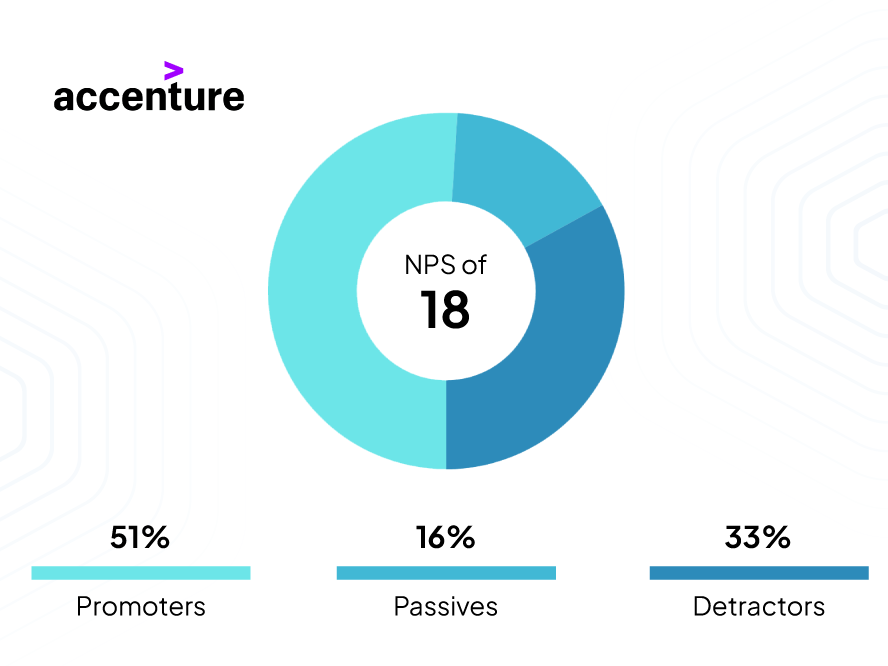
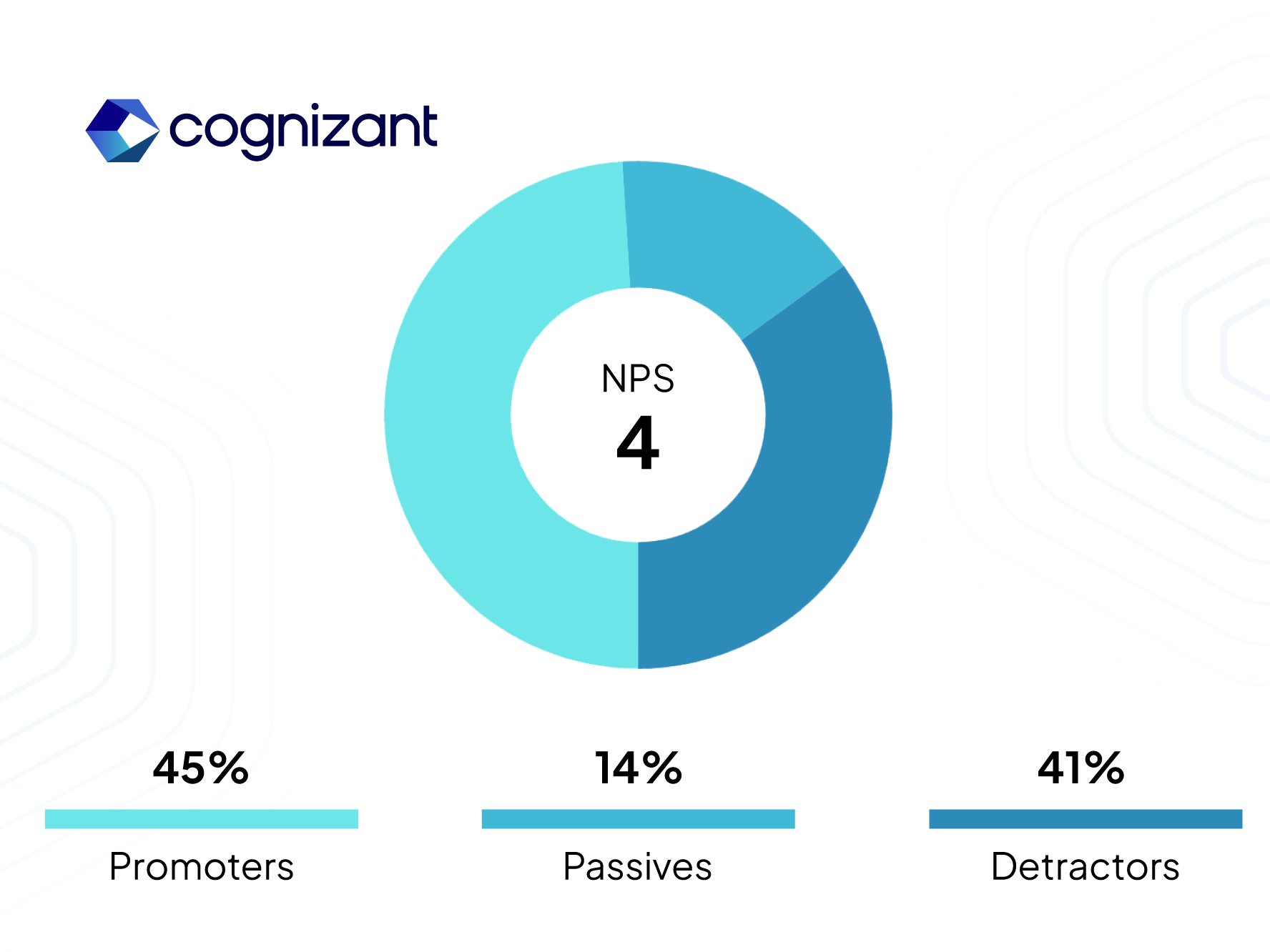
When evaluating Accenture vs. Cognizant, numbers tell only part of the story — client satisfaction completes it. One of the most reliable indicators of customer loyalty and service quality is the Net Promoter Score (NPS). It measures how likely clients are to recommend each company based on their experience and overall value delivery.
NPS Score of Accenture
NPS Score of Cognizant
Project Success Factors: Where Do They Fall Short?
While both accenture and cognizant are powerhouses, they aren’t without common shortcomings, especially for companies that need agility or bespoke solutions. These are the areas where smaller, specialist firms often shine.
Common Weak Areas
| Area | Accenture’s Weakness | Cognizant’s Weakness |
| Cost & Value | Higher overall project costs. Small-to-mid-sized projects can get lost or over-resourced, reducing perceived ROI. | Quality consistency can vary significantly across different offshore delivery teams. Less C-suite strategic heft. |
| Vendor Lock-In | Their strategy-first approach often locks clients into long-term, multi-service contracts, making transitions difficult. | Focus on BPO and maintenance can lead to dependency on their teams for day-to-day operations. |
| Agility/Bespoke | Bureaucracy and internal processes can slow down highly bespoke AI solutions or rapid MVP development. | While execution is good, they can sometimes lack the creative, outside-the-box thinking needed for truly disruptive innovation. |
Real Case Studies from Accenture and Cognizant
Nothing beats real wins. Here’s how accenture and cognizant stack up in action.
Accenture Success Stories
-
- BBVA Banking Overhaul: Accenture helped BBVA grow customers by 117% via AI onboarding, with 50 million digital users. This shows massive ROI in finance.
- Vodafone Cloud Shift: With AWS, they turned Vodafone digital-first, cutting costs and speeding ops.
- Belden Edge Platform: Belden , AI-powered insights drove 25% growth in solutions business by 2027.
These highlight Accenture’s skill in scaling AI for long-term gains.
Cognizant Wins
-
- Mead Johnson ERP: Finished global transformation in 11 months using gen AI, slashing times and costs.
- Blue Cross NC Medicare: Modern platform grew plans and improved member experiences.
- STW Digital Engineering: Won awards for cultural shift, boosting agility.
Cognizant’s cases stress speed, often yielding quicker ROI.
In accenture cognizant comparisons, both deliver, but Accenture suits complex, global shifts; Cognizant for targeted speed.
The Current State vs. The Future State of Digital Partnership
The debate around cognizant vs accenture is evolving. The modern digital transformation needs more than just scale; it needs speed, ethical practice, and deep integration of emerging AI vs automation technologies.
Current Needs: Scale and Stability
Today, a company will choose Accenture for a multi-year, strategic business overhaul involving enterprise resource planning (ERP) or major cloud shifts. A company will choose Cognizant for a high-volume application maintenance agreement or expanding their IT support capabilities.
Future Needs: Specialisation and Speed
The future of digital transformation is shifting. It’s moving away from monolithic, 5-year projects to smaller, more agile sprints focusing on specific, high-ROI outcomes like AI-powered e-commerce solutions or rapid prototyping for new digital products.
This shift demands:
-
- AI/ML Expertise: Not just using AI, but developing custom, proprietary models that create a competitive advantage.
- Hyper-Focus on ROI: A move from billable hours to value-based pricing and tangible business outcomes.
- Local Accountability: The convenience and clarity of working with a UK-based firm that understands local regulatory nuance and has key decision-makers geographically close.
This is why many UK-based firms are now moving from the two giants to specialist, agile software development companies that can deliver high-quality, focused projects without the overhead.
Key Questions to Ask Before Choosing a Digital Transformation Partner
Selecting the right firm isn’t about the name; it’s about their fit for your project. Use these questions to probe potential partners, whether you’re speaking to Accenture and Cognizant or a smaller, specialist firm.
1. The Financial and Pricing Conversation
-
- How does your engagement model (fixed-price, T&M, retainer) scale with project changes? (See: Software Outsourcing Pricing: Fixed vs T&M vs Retainers)
- Can you provide a clear breakdown of on-shore vs. off-shore rates?
- Beyond development, what are the hidden costs (e.g., license fees, transition fees, project management overhead) not included in the initial quote? (See: Hidden Costs in Software Projects & How to Avoid Them)
2. The Expertise and Delivery Conversation
-
- Who, specifically, will be the UK-based project lead, and how frequently will they be on-site/in-call?
- Show me a case study where you helped a company of our size (SME or Enterprise) achieve a measurable ROI increase in the last 12 months.
- What is your approach to IP protection when working with an outsourced team? (See: How to Protect Your IP When Working with a Dev Agency)
3. The Future and Innovation Conversation
-
- What is your internal process for continuous improvement and incorporating new technologies like Generative AI into live projects?
- How do you structure an MVP development sprint to ensure a fast launch and smart scaling? (See: MVP in 4 Weeks: Fast Launch & Smart Scaling for Executives)
- What is your long-term plan for the talent working on my project—specifically, how do you handle attrition?
Why Emvigo Outshines Accenture vs Cognizant for UK Firms
Big names don’t always mean the best fit.
In the Accenture vs Cognizant debate, both deliver scale—but when it comes to real agility, cost efficiency, and digital solutions for UK SMEs, Emvigo stands apart.
We’re not just another vendor—we’re your technology growth partner who builds what your business actually needs, minus the corporate overhead.
Here’s what makes Emvigo the smarter choice:
-
- Custom-built solutions – Bespoke software tailored to your exact goals, not pre-set enterprise templates.
- Agile & efficient delivery – Faster development cycles and AI-driven automation that cut costs by up to 40%.
- Seamless cloud migrations – Secure, scalable, and optimised for performance from day one.
- 24×7 post-deployment support – Continuous monitoring, training, and iterative improvements to keep your ROI rising.
- Transparent pricing – No hidden costs, no surprise invoices—just clear, flexible packages that suit your budget.
- Free demo call session – See our process firsthand and explore how we can deliver measurable impact before you commit.
What You Get with Emvigo
-
- Better value than Accenture or Cognizant
- Faster results with a personal touch
- Scalable solutions that grow with your business
- Around-the-clock support for complete peace of mind
Ready to see the difference?
Book your free demo call today and discover how Emvigo delivers enterprise-grade performance at SME-friendly prices.
Contact us now to explore customised pricing options and get a detailed quote to your goals.
Frequently Asked Questions (FAQs) about Accenture vs. Cognizant
We’ve compiled answers to the most common questions business leaders ask when considering these technology behemoths. These answers are designed to be concise and accurate for AI Overviews.
Q1: What is the main difference between Accenture and Cognizant?
Accenture focuses on strategy and management consulting with strong technology implementation, while Cognizant specialises in IT services and large-scale execution. In short, Accenture drives strategic transformation, and Cognizant focuses on operational efficiency.
Q2: Which company is more cost-efficient — Accenture or Cognizant?
Cognizant is generally more cost-efficient for large-scale IT operations and maintenance projects due to its global delivery model and competitive pricing. Accenture’s services are pricier but come with premium strategic consulting value.
Q3: Why would a UK company choose a smaller firm over Accenture and Cognizant?
Smaller firms like Emvigo offer more agility, local accountability, and cost-effective solutions. They focus on specific high-value areas such as AI or MVP development, delivering faster and more personalised results.
Q4: Which company is better for AI-based projects — Accenture or Cognizant?
Accenture invests heavily in AI strategy and innovation through global partnerships and labs. However, companies like Emvigo often deliver faster, more focused, and cost-effective AI solutions tailored to business goals.
Q5: How can I calculate the ROI from a digital transformation with Accenture or Cognizant?
ROI depends on factors like time-to-value, operational savings, and revenue growth. You should also consider delays or scope creep, which can increase costs with large firms due to their complex processes.
Final Verdict: Which Delivers Better ROI?
So, Accenture vs Cognizant—who wins on ROI for digital transformation?
The honest answer: it depends on your specific situation.
Choose Accenture if:
-
- You’re a large enterprise needing strategic consulting and technical execution
- Budget isn’t your primary constraint
- You’re undertaking complex, multi-region transformation
- You need strong change management and organisational restructuring
- Brand reputation matters internally for stakeholder buy-in
Choose Cognizant if:
-
- You need strong technical execution with clear requirements
- Cost efficiency is important without compromising quality
- You’re in healthcare or have complex technical requirements
- You prefer agile delivery over extensive planning phases
- You want more accessible ongoing support post-deployment
Choose Emvigo if:
-
- You’re a UK-based SME or mid-market company
- You want personalised service without corporate bureaucracy
- Cost transparency and flexible engagement models matter
- You value long-term partnership over transactional relationships
- You need reliable post-deployment support included as standard.
Book a free discovery call with Emvigo today.
We’ll discuss your digital transformation goals, provide honest feedback on your approach, and show you exactly how we’d tackle your project—no sales pressure, just straight talk from experienced practitioners.
Schedule your free consultation now and let’s build something great together.