
There’s a quiet moment every CTO recognises.
It’s not launch day or demo day.
It’s six months after launch. Traffic doubles. Integrations pile up. Compliance questions arrive. The architecture either holds or cracks.
That moment is why choosing the right product development companies matters. Not because they can ship an MVP. Many can. But because only a handful of product design and development companies build for scale, governance, and long-term resilience.
If you’re a CTO, Product Director, or founder in a funded SaaS, FinTech, healthcare tech, or B2B platform business, your risk isn’t just delayed delivery. It’s technical debt, vendor lock-in, missed market timing, and security exposure.
This guide reviews top UK product development companies with a commercial focus. It covers strengths, weaknesses, costs, delivery models, and best fit. No hype. Just clear facts.
Disclosure: This guide is published by Emvigo, a UK-based digital product development company. We’ve aimed to provide an objective and useful comparison. Readers should consider this context when evaluating the assessments above.
TL;DR – What You Need to Know in 90 Seconds
-
- Who this guide is for: CTOs, product directors, and founders at funded startups and mid-market B2B firms
- What separates great product development companies from expensive ones: Architecture thinking before execution, not after
- 10 companies covered: Emvigo, Duck.Design, Momentum Design Lab, Elsewhen, Ofspace, LION+MASON, 3 Sided Cube, Apadmi, Ustwo, Plug & Play
- Budget reality: MVPs start from £25,000; enterprise-grade systems run £200,000–£500,000+
- Biggest risk most founders ignore: Choosing a vendor based on delivery speed rather than architectural scalability
- If your roadmap includes integrations, funding rounds, or regulatory exposure, prioritise architectural maturity over visual polish.
- What to do after reading this: Use the comparison table and decision framework to shortlist two or three product design and development companies.
What Do Product Development Companies Actually Deliver?
They design, build, test, and scale digital products, from early product ideas to live launch, updates, and long-term growth.
But “build software” barely scratches the surface.
The best software product development companies work across six interconnected disciplines simultaneously. The quality of their work in each one determines whether your product survives contact with real users.
Discovery & Product Strategy
This is where most engagements succeed or fail before coding. Strong product development companies run structured discovery phases. They map user needs, technical constraints, business objectives, and architectural requirements into a coherent product brief. Weak firms skip this and go straight to wireframes.
UX Research & Interface Design
Good UX isn’t about making things look nice. It’s about designing decision flows that match how real users think. This is especially true in B2B, where the person paying for the software is rarely the person who has to use it every day.
Engineering & System Architecture
This is the layer that determines your product’s future. Decisions made here about infrastructure, data modelling, API design, and service boundaries will either support your growth or constrain it.
DevOps, Cloud Infrastructure & CI/CD
How your product gets deployed, monitored, and updated matters as much as how it’s built. Continuous integration, automated testing, and cloud-native infrastructure are no longer optional for any product expecting to scale.
QA & Security Testing
Testing isn’t a phase at the end. It’s a discipline woven through every sprint. And for B2B products handling sensitive data, particularly in FinTech, HealthTech, or legal tech, security testing is integral.
Post-Launch Support & Iterative Development
The launch is not the finish line. Product development companies that treat it as one will leave you without support the moment something breaks in production. The best firms build ongoing support, SLAs, and iterative development into the engagement model from day one.
How Do You Evaluate Product Development Companies in the UK?
Look past the portfolio and assess architecture maturity, discovery quality, delivery model fit, and post-launch accountability in that exact order.
Most vendor evaluation processes are backwards. They start with “show me what you’ve built”, when they should start with “show me how you think.”
Here’s a sharper framework that actually works.
Technical Due Diligence – Ask the Uncomfortable Questions
Ask them to walk you through the messiest architectural decision they’ve made on a recent project, the hardest one. How they respond tells you everything.
Strong product design and development companies will talk about trade-offs, constraints, and what they’d do differently. Weak ones will pivot back to their case study deck.
Specific questions worth asking:
-
- How do you handle database scaling when user volume spikes unexpectedly?
- What’s your approach to API versioning across a multi-tenant SaaS product?
- Can you show us a codebase you’re not proud of – and explain why?
Discovery Process Quality
Does the firm separate discovery from delivery? Do they charge for it separately? If they’re offering “free discovery” bundled into a fixed-price quote, they’re not doing real discovery. Instead, they’re doing scope estimation. Real discovery takes weeks, involves user research, architecture mapping, and technical risk assessment.
Get to know more about an actual discovery phase here: What Is the Project Discovery Phase and Why It Matters
Delivery Model Alignment
Embedded teams, dedicated squads, sprint-based delivery, or time-and-materials – no model is wrong. But misalignment between how a product development company works and how your organisation makes decisions will cause friction every single week. Be honest about your own internal processes before evaluating theirs.
Pricing Transparency and Contract Structure
Beware of firms that quote a fixed price on complex builds without a discovery phase. The best product development companies in the UK will tell you: “We can’t price the build accurately until we understand the architecture.” That’s honesty, not uncertainty, and it’s what you want to hear.
Post-Launch Accountability
Ask them directly: what happens the morning after you go live, and something breaks? Who owns it? What’s the SLA? If they don’t have a clear, written answer, that’s your answer.
At-a-Glance: Your Shortlist of the Best Product Development Companies in the UK
Before we go deep on each firm, here’s your quick-reference overview. Use this table to narrow your shortlist before reading the full profiles.
Leading Product Development Companies: Quick Overview
| Company | Best For | Key Strength | Limitation | Pricing Range | Stage Fit |
| Emvigo | SaaS, FinTech, HealthTech scale-ups | Architecture-first delivery, compliance-aware builds | Not the fastest route to a bare MVP. The discovery phase adds 3–5 weeks before the build begins. | £30K–£300K | 🟡 Growth |
| Duck.Design | Design-first startups | Retainer UX model, continuous design output | Design-only scope means you’ll need a separate development partner; coordination overhead falls entirely on the client. | £5K/month retainer | 🟢 Startup |
| Momentum Design Lab | Enterprise B2B UX | Research-heavy discovery, complex workflow design | Onboarding and research phases typically run 6–10 weeks before design output begins; not suited for budgets under £40,000 | £40K–£200K | 🔵 Enterprise |
| Elsewhen | VC-backed SaaS, FinTech, enterprise platforms | Strategy-to-engineering delivery, FT1000-recognised, AI-native capability | Senior team means capacity is selective; not suited to large multi-squad enterprise programmes | £50K–£400K+ | 🟡 Growth |
| Ofspace | Early-stage startups | Fast delivery, full-service, accessible pricing | Architecture defaults are optimised for speed, not compliance; FinTech or HealthTech builds will likely require external architecture review | £15K–£100K | 🟢 Startup |
| LION+MASON | Premium consumer brands | Brand-experience-led digital products | Projects requiring complex microservices architecture or real-time data processing are typically declined at the briefing. | £30K–£150K | 🟡 Growth |
| 3 Sided Cube | Social impact, public sector | Mission-driven, emergency/health sector expertise | Engagements outside the public sector, health, or social impact remit are unlikely to receive full strategic investment from the team. | £50K–£400K | 🔵 Enterprise |
| Apadmi | Enterprise mobile products | Large-scale mobile, robust governance | Minimum viable engagement typically starts at £75,000; procurement and governance requirements add onboarding time for leaner organisations | £75K–£500K+ | 🔵 Enterprise |
| Ustwo | Category-defining ventures | Strategic product partnership, elite craft | Client intake is highly selective; briefs without genuine category ambition are unlikely to progress past the initial conversation | £100K–£1M+ | 🔵 Enterprise |
| Plug & Play | Growth-stage digital businesses | Efficient delivery, predictable milestones | Stack and process defaults are optimised for standard SaaS and ecommerce builds; complex multi-system integrations or compliance layers will need additional architectural oversight. | £25K–£200K | 🟡 Growth |
Which Product Development Companies in the UK Stand Out in 2026?
Here are the 10 product development companies worth serious consideration. They are assessed with genuine depth on technology, team, delivery model, and the things that actually determine whether a partnership works.
1. Emvigo – Architecture-First Product Development for Firms That Can’t Afford to Rebuild
Years in Operation: 14+ years
Total Projects Delivered: 700+
Pricing: £30,000–£300,000
Delivery Model: Embedded agile teams + strategic architecture consulting
Best For: SaaS, FinTech, HealthTech, and B2B digital platforms requiring scalable, compliant architecture
Typical Project Size: £30,000 – £300,000
Overview
Emvigo is a UK-based digital product development company built around the belief that most software failures are architecture problems in disguise. Their core offering isn’t just development! It’s structured, strategy-led product building that starts well before the first sprint and extends well past launch.
Founded over a decade ago, Emvigo has delivered 700+ digital products across SaaS, FinTech, healthcare technology, and enterprise platforms.
What distinguishes them from the majority of software product development companies in the UK is where they invest attention: the decisions made before the build begins.
Technology Stack & Technical Capabilities
Emvigo operates across a mature, modern technology stack suited to complex B2B product requirements:
-
- Frontend: React, Next.js, Vue.js, React Native for cross-platform mobile
- Backend: Node.js, Python (Django/FastAPI), .NET Core, Java Spring Boot
- Cloud & Infrastructure: AWS, Azure, GCP – with cloud-native architecture and containerisation via Docker and Kubernetes
- Data & AI: PostgreSQL, MongoDB, Redis, with growing capability in LLM integration, RAG pipelines, and AI-assisted product features
- DevOps: CI/CD via GitHub Actions, Jenkins, and CircleCI; infrastructure-as-code using Terraform
- Security & Compliance: GDPR-compliant data architectures, SOC 2 awareness, OWASP security standards
This breadth matters. Many digital product development companies are strong on one layer of the stack and weak on others. Emvigo has a multi-disciplinary technical depth. This means you’re not managing handoffs between frontend specialists, backend engineers, and DevOps contractors – it’s one integrated team.
Delivery Approach
Emvigo runs a structured engagement model with three distinct phases: discovery, delivery, and optimisation. Discovery isn’t bundled into the build quote – it’s a separate, standalone service. That discipline tends to save significantly more than it costs.
Their squads are mostly composed of a product architect, a UX lead, two to three engineers, a QA specialist, and a delivery manager.
What They’re Best Known For
Emvigo’s strongest reputation is in building products that scale without requiring a structural rebuild at growth milestones. Their SaaS clients in particular cite the quality of their multi-tenant architecture as a standout. It is the kind of infrastructure decision that only proves its value 18 months after launch, when competitors are paying to rebuild.
2. Duck.Design – UX Without the Overhead of a Full Agency
Years in Operation: 8+ years
Total Projects Delivered: 150+
Pricing: Monthly retainer from £5,000/month
Delivery Model: Dedicated design team on rolling retainer
Best For: Startups and growth-stage SaaS needing continuous design output
Typical Project Size: £15,000 – £60,000
Overview
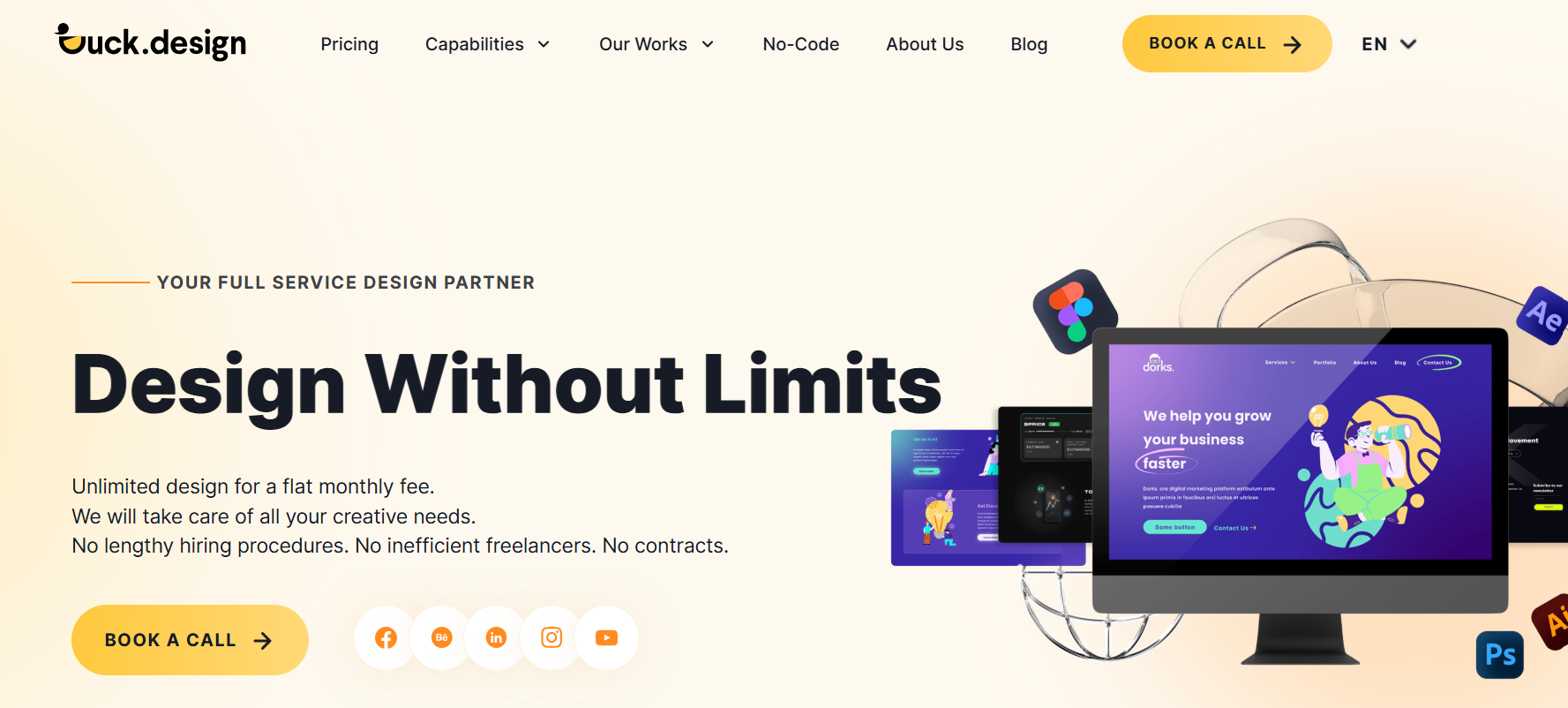
Duck.Design’s model is unusual in the product design and development companies’ space. And that’s exactly what makes them worth considering for the right situation. Rather than a project-based engagement, they operate as an embedded design partner. You subscribe to a dedicated team every month, and they become your product design function.
This works particularly well for early-stage companies that have engineering capability in-house but lack strong UX leadership. Hiring a senior UX lead can cost £80,000 – £100,000 per year, including benefits, management overhead, and onboarding. With them, you get a specialist team for a fraction of that, with no recruitment risk.
Technology Stack & Design Capabilities
Duck.Design works primarily in the design layer:
Figma for UI and prototyping
Maze and Hotjar for user research and testing
Lottie for motion and micro-interaction design
They produce design systems and component libraries that integrate into React, Vue, and Flutter development environments.
What They’re Best Known For
Responsiveness and volume. For product teams iterating quickly across multiple features simultaneously, Duck.Design’s retainer model means design capacity scales with your sprint cadence.
Clients consistently note that the turnaround time on design iterations is faster.
Their portfolio leans towards B2C-adjacent SaaS, mobile-first products, and marketplace platforms. These are interfaces where conversion optimisation and emotional design carry genuine commercial weight.
Team Structure
A typical Duck.Design retainer includes a dedicated UX lead, a visual designer, and a UX researcher rotating in as needed. The team stays consistent month-to-month – not a rotating pool of freelancers. This means they build meaningful product context over time.
Limitations
Duck.Design is a design company, not a digital product development company in the full-stack sense. If you need engineering, architecture, or DevOps alongside your UX work, you’ll manage a separate development partner. For teams without strong internal engineering leadership, that coordination overhead can outweigh the design efficiency gains.
3. Momentum Design Lab – Research-Driven Design for Complex Enterprise Products
Years in Operation: 15+ years
Total Projects Delivered: 300+
Pricing: Project-based; £40,000–£200,000
Delivery Model: Discovery-led, design-first engagements
Best For: Enterprise B2B software, internal tooling, complex UX challenges
Typical Project Size: £60,000–£200,000
Overview
Momentum Design Lab has been in the product design and development space long enough. They have developed a genuine methodology for one of the most difficult design challenges: making complex enterprise software usable by humans.
Their sweet spot is internal enterprise tools. It is the kind of dashboards, workflow platforms, and operational systems that employees use every day and that most design agencies either oversimplify or over-engineer. They’ve delivered projects for clients in financial services, healthcare operations, logistics, and enterprise SaaS.
Technical & Design Capabilities
Momentum works across Figma, Adobe XD, and ProtoPie for design and prototyping. They have strong UX research practices built around contextual inquiry, usability testing, and ethnographic research methods. Their research findings are presented in formats designed for C-suite consumption and not just design teams. This matters when you need stakeholder alignment before a build begins.
They also have experience integrating UX work with development teams using Design System principles, accessibility standards (WCAG 2.1 AA), and responsive design frameworks.
What They’re Best Known For
The quality of their research outputs and the rigour of their discovery process. Clients who build products with complex user behaviour get real value from Momentum’s research phase. These products may include multi-step workflows. They may also include decision-heavy interfaces. They may include data-dense dashboards. It often reshapes the product brief entirely.
Notable work includes enterprise platform redesigns for Fortune 500 companies, healthcare operations tooling, and financial services workflow applications.
Limitations
Momentum’s process-heavy approach is a strength in the right context and a constraint in the wrong one. For startups that need to build, test, and iterate quickly, their methodology can feel slow and expensive. Their pricing reflects their enterprise positioning, and they’re not suited for companies with budgets below £40,000.
4. Elsewhen – Strategy-Led Digital Product Consultancy for Growth-Stage and Enterprise Firms
Years in Operation: 13+ years (founded 2011)
Total Projects Delivered: 200+
Pricing: £50,000 – £400,000+
Delivery Model: Full-service product consultancy – strategy, design, engineering, and AI
Best For: VC-backed SaaS, FinTech, enterprise platforms, and organisations embedding AI into core products
Typical Project Size: £75,000–£300,000
Overview
Elsewhen is a London-based digital product consultancy with a team of 100+ strategists, designers, and engineers. They operate on the principle that strategy, design, and engineering should run as one integrated practice and not be handed off between separate teams. Their clients include Google, Spotify, Mastercard, WPP, and Bupa. Not just that, but they’ve been named one of the Financial Times 1000 fastest-growing companies in Europe.
Their portfolio spans financial services, enterprise SaaS, media, and regulated sector digital transformation, with a growing body of work in AI-native product development.
Technology Stack
Elsewhen works primarily with React and TypeScript on the frontend, Node.js and Python on the backend, and Google Cloud Platform and AWS for infrastructure. They are backed by a formal Google Cloud partnership. They have strong AI engineering capability covering LLM integration, RAG systems, and agentic workflow design, which they build alongside core product delivery rather than as a separate offering.
Their engineering standards include WCAG-compliant UX, component-driven design systems, CI/CD automation, and architecture review embedded throughout delivery milestones.
What They’re Best Known For
The depth of thinking they bring before a line of code is written. Elsewhen regularly reframes briefs, challenges product assumptions, and helps clients arrive at more structurally sound product decisions. Spotify’s Global Head of Design Operations has publicly called them the best consultancy they’ve worked with. Their track record is strongest in products where the architecture and the user experience both need to be right – financial platforms, enterprise tooling, and AI-integrated digital products.
Limitations
A senior-heavy team means capacity is selective and lead times can stretch. Not suited to large parallel workstream delivery or multi-squad programme management. Budgets below £50,000 are unlikely to be a fit.
5. Ofspace – Accessible Full-Service Product Development for Early-Stage Companies
Years in Operation: 7+ years
Total Projects Delivered: 120+
Pricing: £15,000–£100,000
Delivery Model: Sprint-based design and development
Best For: Seed-to-Series A startups, SMEs, fast-validation MVPs
Typical Project Size: £20,000–£80,000
Overview
Ofspace occupies full-service product development that doesn’t require a seven-figure budget or a six-month onboarding process. For founders who raised their first round, need to build fast, and want one team, Ofspace is a practical option.
It combines design, development, and DevOps in one place.
Their portfolio covers web application development, mobile app builds, and early-stage SaaS platforms. The work quality is solid for the price tier, and their sprint-based delivery model suits founders who want frequent checkpoints and the ability to course-correct without penalty.
Technology Stack
Ofspace works across:
React, Vue.js, and Flutter on the frontend
Node.js and Laravel on the backend
MySQL and MongoDB for data
AWS for hosting and deployment
Their stack choices prioritise speed of delivery and developer availability. These are all sensible choices for MVP-stage products.
What They’re Best Known For
Getting products to market efficiently without unnecessary complexity. Clients praise their communication rhythms and the clarity of their sprint outputs. They are said to display a willingness to work iteratively rather than holding clients to a locked scope.
Limitations
Ofspace is well-suited for the MVP and early-growth phases. However, for products that need to scale into regulated markets, their architecture defaults may need revisiting.
6. LION+MASON – Where Brand Strategy Meets Digital Product Craft
Years in Operation: 9+ years
Total Projects Delivered: 80+
Pricing: £30,000–£150,000
Delivery Model: Brand-led product design and development
Best For: Premium consumer brands, luxury ecommerce, brand-experience platforms
Typical Project Size: £40,000–£120,000
Overview
LION+MASON doesn’t sit neatly in the software product development companies category, and that’s intentional. They’re a creative technology studio that builds digital products from a brand perspective first and an engineering perspective second. For most B2B software builds, that’s the wrong priority order. For premium consumer brands where the digital product is an expression of the brand identity, it’s exactly right.
Their work spans luxury ecommerce, high-end consumer apps, brand campaign platforms, and experiential digital products. The aesthetic quality of their output is consistently high, not just functional, but genuinely beautiful.
Technical & Creative Capabilities
LION+MASON works across Figma and Webflow for design, with development in React, custom WordPress builds, and Shopify Plus for e-commerce. Their motion design and interaction design capabilities are particularly strong. It is the kind of micro-animation and scroll behaviour that makes a premium digital experience feel premium.
What They’re Best Known For
Creating digital experiences that carry the full weight of a brand. For companies where product presentation matters as much as product function, they deliver.
This includes luxury retail, premium memberships, and high-end B2C. They deliver at a level most digital product development companies don’t even try.
Limitations
LION+MASON’s focus is firmly on experience and design quality. They’re not the right choice for backend-intensive products, data-heavy platforms, or anything requiring complex system architecture. If your primary requirement is scalable engineering, look elsewhere. If your primary requirement is a digital experience that makes people stop scrolling, they’re worth a serious conversation.
7. 3 Sided Cube – Mission-Critical Apps Built for Moments That Matter
Years in Operation: 13+ years
Total Projects Delivered: 200+
Pricing: £50,000–£400,000
Delivery Model: End-to-end product development
Best For: Public sector, charities, health organisations, emergency services, technology
Typical Project Size: £75,000–£300,000
Overview
3 Sided Cube is one of the most distinctive product development companies in the UK. That’s not because of their size or their client list, but because of what they’ve chosen to build and why. They specialise in technology that operates in high-stakes, life-critical environments. Their apps have been used by first responders, distributed by the Red Cross, and embedded in NHS-adjacent health behaviour platforms.
This focus shapes everything about how they work. Reliability, accessibility, offline functionality, and performance under pressure are their core engineering requirements baked into every product they ship.
Technology Stack
3 Sided Cube builds across:
React Native for cross-platform mobile (critical for apps that need to work on any device, in any condition)
Node.js and Python backends
AWS with specific attention to offline-first architecture patterns and resilience design
Accessibility is embedded into their development process, not appended at the end. WCAG 2.1 AA compliance is standard, with some projects requiring AAA levels.
What They’re Best Known For
Building apps that work when everything else is failing. Their emergency preparedness apps, disaster response tools, and health behaviour change platforms are some of the most technically rigorous mobile products built in the UK. Apple and Google have awarded them for their work and have built a global reputation in the humanitarian technology space.
Limitations
3 Sided Cube’s specialist focus is a strength in the right context and a mismatch for commercial SaaS products, B2B platforms, or anything outside their core domain. If your product doesn’t have a public benefit or mission dimension, you’re unlikely to get their best work or their full attention.
8. Apadmi – Enterprise Mobile Products at Genuine Scale
Years in Operation: 14+ years
Total Projects Delivered: 300+
Pricing: £75,000–£500,000+
Delivery Model: Enterprise agile delivery with dedicated programme management
Best For: Large enterprises, retail, transport, broadcasting, and financial services
Typical Project Size£100,000–£400,000
Overview
Apadmi is one of the UK’s most established enterprise mobile product development companies. They are also one of the few that can genuinely operate at the scale that household-name enterprises require. They’ve built digital products for major UK retailers, broadcasters, transport networks, and financial services companies. Their client list reads like an FTSE 250 index.
What distinguishes Apadmi isn’t just the names they’ve worked with. It’s the engineering standards and governance models they’ve built to serve those clients.
Technology Stack
Apadmi works primarily in:
iOS (Swift) and Android (Kotlin) for premium mobile experiences
React Native for cross-platform builds where appropriate
Backend services are delivered in Java, Kotlin, and Node.js
Microservices architecture on AWS and Azure
Their data engineering capability includes real-time analytics, recommendation engines, and integration with complex ERP and CRM systems.
Team & Delivery Model
Apadmi runs programme-level delivery and not just project delivery. For large enterprises, this means dedicated programme managers, architecture oversight boards, and quality governance frameworks that satisfy procurement and compliance requirements. Their team structures scale with the engagement. A mid-size project might involve eight to twelve people, and large enterprise programmes can involve dedicated multi-squad delivery.
What They’re Best Known For
Enterprise mobile reliability. Apps that work for millions of users, handle peak load events, integrate with complex legacy systems, and meet enterprise security and accessibility standards. Their track record in retail, media, and transport is particularly strong.
Limitations
Apadmi’s enterprise positioning means their pricing and process reflect that. For companies with budgets below £75,000 or without enterprise procurement infrastructure, they’re not the right fit. Their governance requirements can feel heavy for leaner organisations.
9. Ustwo – The Studio That Doesn’t Just Build Products, It Builds Categories
Years in Operation: 20+ years
Total Projects Delivered: 150+ (selective client intake)
Pricing: £100,000–£1,000,000+
Delivery Model: Strategic product partnership
Best For: Innovation labs, ambitious digital ventures, category-defining product builds
Typical Project Size: £200,000 – £800,000
Overview
Ustwo made Monument Valley. If you know what that product represents in terms of craft, intention, and technical artistry, you already understand what kind of product development company Ustwo is. If you don’t, it’s worth five minutes of research, because it will tell you more about their culture and standards than any case study deck could.
Beyond their landmark consumer work, Ustwo has built a serious B2B and innovation practice. They’ve partnered with Google on experimental interfaces, with automotive manufacturers on in-car digital experience design, and with the NHS on patient-facing health platforms. They don’t take every client; they take clients who want to build something genuinely new.
Technology Stack & Capabilities
Ustwo operates across the full product stack. Swift and Kotlin for native mobile, React and TypeScript for web applications, and cloud infrastructure on GCP and AWS. Their industrial design and physical-digital integration capability set them apart. Ustwo Auto, their automotive digital experience practice, is one of the most specialised capability areas of any product development company in Europe.
What They’re Best Known For
Creating digital products that define what’s possible, not just what’s practical. When a company wants to be genuinely first rather than competitively adequate, Ustwo is the partner that operates at that level.
Limitations
Selective. Expensive. Long lead times. Ustwo is not accessible to most organisations, and they don’t position themselves to be. If your brief isn’t ambitious, you won’t get past the initial conversation. If budget, timeline, or risk appetite are primary constraints, look at other product development companies on this list.
10. Plug & Play – Efficient, Predictable Product Delivery for Growing Digital Businesses
Years in Operation: 10+ years
Total Projects Delivered: 180+
Pricing: £25,000–£200,000
Delivery Model: Agile sprints with fixed milestones and clear sign-off gates
Best For: Growth-stage digital businesses, ecommerce platforms, SaaS MVPs
Typical Project Size: £30,000–£120,000
Overview
Plug & Play London occupies the no-nonsense end of the product development companies market, and that’s a compliment. They don’t over-engineer the conversation. They work with companies that know what they want to build and have a reasonable budget.
Their portfolio covers SaaS platforms, e-commerce builds, digital marketplaces, and web applications across multiple sectors. They’re particularly effective for growth-stage companies that are past the idea stage but not yet at a scale that demands enterprise-level governance.
Technology Stack
Plug & Play works across React and Next.js for frontend, Node.js and PHP (Laravel) for backend, and Shopify and WooCommerce for ecommerce projects. They host primarily on AWS and use standard CI/CD tooling to maintain deployment quality.
What They’re Best Known For
Predictability. Clear milestone-based delivery, structured sprint reviews, and transparent communication about scope changes. For founders who’ve been burned by agencies that disappeared after the deposit, Plug & Play’s delivery rigour feels genuinely refreshing. They deliver what they quote, which, in this industry, is less common than it should be.
Limitations
For products that require deep custom architecture, complex multi-system integrations, or regulatory compliance layers, Plug & Play’s stack and process defaults may not be sufficient. They are excellent at building products efficiently. But for products that must be built in a specific, structurally sound way, an architecture-led partner is a stronger choice.
Choosing From the Best Isn’t Easy: Here’s How to Actually Shortlist
This list contained ten genuinely capable product development companies. The difficulty isn’t finding good options – it’s that the right choice is deeply specific to your situation.
The Three Questions That Actually Determine Your Shortlist
- What does your product need to be in two years, not just now?
- What’s the highest-risk decision in your product build?
- How will you know if the engagement is working at week six?
Three-Step Vendor Shortlisting Framework for Making the Final Call
A fast, structured filter for CTOs and product leaders.
| Step | What You Do | What to Assess | Red Flag Signals | Output |
| Step 1: Define Your 24-Month Architecture Vision | Map where the product needs to be in two years — scale, integrations, compliance, performance, AI, data. | Clarity on scalability model (monolith vs microservices), expected user growth, regulatory exposure, and technical debt tolerance. | Vague growth assumptions, no performance benchmarks, “we’ll figure it out later” thinking. | Clear architecture brief + non-negotiable technical requirements. |
| Step 2: Match Vendor Domain & Technical Depth | Compare your requirements against vendor case studies, stack expertise, certifications, and architecture maturity. | Proven delivery in a similar scale/sector, security posture, DevOps maturity, and integration complexity handled before. | Generic portfolios, no regulated-sector examples (if required), overreliance on buzzwords. | Shortlist of 2–3 technically aligned vendors. |
| Step 3: Run a Structured Discovery Conversation | Conduct a paid or structured workshop. Evaluate how they think — not just what they present. | Quality of questioning, ability to challenge assumptions, architectural foresight, risk awareness. | Immediate solution pitching, lack of probing questions, and no risk modelling. | Confidence score based on strategic depth, not sales polish. |
How to Use This Card
-
- Eliminate vendors who fail Step 1 alignment before discussing cost.
- Weight Step 3 quality of challenge is higher than proposal aesthetics.
- The best partner often reveals risks you hadn’t considered, not just solutions you expected.
Work through this for each firm you’re considering:
-
- Have they built a product in your complexity tier, not just your sector?
- Can they explain their post-launch support model clearly and contractually?
- Do they ask hard questions in the initial conversation, or do they agree with everything you say?
- Are senior engineers involved in delivery, or just in the pitch?
- Can they show you an architecture decision they’d make differently today?
How Much Do Product Development Companies in the UK Charge and What Are You Actually Paying For?
UK-based product development companies typically charge between £25,000 for a focused MVP and £500,000+ for enterprise-grade system builds.
Let’s break this down properly.
What Drives the Cost of Product Development?
Before you look at any price range, understand the six variables that determine what you’ll actually spend:
- Scope Complexity
A product with five core user journeys and three API integrations costs differently from one with twenty user journeys, real-time data processing, and enterprise SSO requirements. “We want something like Airbnb but simpler” is not a scope. Getting to a real scope is what a proper discovery phase produces.
- Architecture Requirements
A product that needs to handle 100 users is architecturally different from one that needs to handle 100,000. Multi-tenancy, distributed services, caching layers, and queue-based processing add engineering complexity and cost. Building for scale you don’t yet need is wasteful. Building without considering the scale you’ll eventually need is more expensive.
- Regulatory and Compliance Requirements
All platforms with data residency requirements carry compliance engineering costs that don’t appear in generic price quotes. If your sector is regulated, budget 20–30% more than a comparable unregulated product.
- Integration Complexity
The more external systems your product needs to connect to, the more engineering time goes into integration, error handling, and testing. Assume integrations take twice as long as your first estimate.
- UX Research Investment
Companies that skip UX research to save money consistently spend more on redesign six months after launch. A proper research phase with user interviews, usability testing, and journey mapping costs £5,000–£15,000 and saves multiples of that in avoidable rework.
- Post-Launch Support Model
Many project quotes stop at launch. The cost of ongoing support, bug resolution, performance monitoring, and iterative development determines whether your product improves after launch or slowly degrades. Budget at least 20% of the build cost per year for post-launch support.
The Honest Cost Breakdown by Product Type
| Stage | Budget | Includes | Not Included |
| Prototype | £10k–£25k | UI mockups
Core user flow Light validation build |
QA rigour
Security hardening Scalable backend |
| Focused MVP | £25k–£75k | Core features
Basic architecture Primary user journeys |
Advanced integrations
Load testing Ongoing support |
| Growth Platform | £75k–£200k | Full product
Scalable infra UX research + QA |
Enterprise compliance
Full DevOps automation |
| Mid-Market Product | £150k–£350k | Scale-ready architecture
Integrations Security + analytics |
Enterprise SSO
Multi-tenant admin Advanced reporting |
| Enterprise System | £300k–£500k+ | Compliance architecture
Enterprise integrations Multi-region infra Full DevOps |
Production-grade, end-to-end build |
What UK Day Rates Look Like in 2026
For time-and-materials engagements, UK-based product development companies typically charge:
-
- Junior developer: £350–£500/day
- Mid-level engineer: £500–£700/day
- Senior engineer / architect: £700–£1,000/day
- UX lead: £550–£800/day
- Product manager: £500–£750/day
- QA specialist: £400–£600/day
Offshore-augmented delivery models are often led from the UK. Delivery teams are based in South Asia or Eastern Europe. These models often have blended day rates of £300–£500. Quality usually stays high when the UK team manages architecture oversight and communication.
The Hidden Cost Nobody Quotes For
Technical debt. Every shortcut taken to save budget in the build phase creates debt that compounds.
A product built for £60,000 with significant technical debt can cost £120,000 to refactor two years later. The product development company that saved you £20,000 upfront may have cost you £80,000 in total.
What Are the Most Asked Questions About Product Development Companies?
How do I choose the right product development company for my business?
Start with your architecture requirements and two-year product roadmap, not your immediate feature list. The right product development company will ask harder questions than you’ve thought to ask yourself; treat that as a positive signal. Evaluate technical depth through a structured discovery conversation, not a portfolio review or a pitch call.
How long does it take product development companies to build an MVP?
A well-scoped MVP with proper discovery typically takes 14–20 weeks with an experienced product development company. Timeline depends on integration complexity, UX research investment, and the speed of internal decision-making on the client side. That said, timelines can compress significantly when scope is defined with precision from day one. Emvigo delivered a fully functional creator monetisation platform, complete with rights management, dual-audience dashboards, and live Stripe integration, in 4 weeks.
See how it was done → Full Case Study.
Are UK-based product development companies better than offshore alternatives?
Not categorically, but UK firms provide timezone alignment, FCA and GDPR familiarity, and stronger contractual accountability. The strongest delivery model is often a UK-led architecture and strategy team with offshore engineering capacity for specific sprints.
What should be written into a contract with a product development company?
IP ownership (you should own the code on delivery), milestone-based payment terms tied to working software, architecture documentation requirements, post-launch SLA terms, scope change management process, and clear exit provisions. If a product development company resists writing these in, that tells you something important.
What type of companies is Emvigo best suited for?
Emvigo is best suited for funded startups and mid-market B2B firms – particularly in SaaS, FinTech, and HealthTech. If your product needs to scale significantly within 18–24 months, handle sensitive data, or survive a technical audit, Emvigo’s architecture-first delivery model is built for exactly that context.
Your Architecture Is Either an Asset or a Time Bomb – Product Development Companies That Know the Difference
There’s a pattern visible across the strongest digital platforms built in the last five years.
They weren’t rushed.
Most of them weren’t overloaded with features.
They weren’t assembled from the cheapest available teams.
The products were engineered with restraint.
In 2026, AI-assisted coding will make shipping faster. Low-code platforms will make prototypes easier. Automation will shorten sprint cycles.
But none of that replaces architectural judgement.
And that’s the quiet truth most CTOs already know: You’re not hiring a team to write code. You’re choosing the engineering philosophy that will shape your company’s next three years.
Some product design and development companies optimise for speed. Some optimise for visual craft, while others optimise for process.
The ones that matter optimise for durability.
Before You Commit Budget, Do This Instead
Don’t book a demo. Don’t request another capability deck.
Instead:
Stress-test your architecture.
Ask for a structured Product Architecture Review. Not to switch vendors. Not to restart your process.
But to validate whether your current roadmap survives scale.
Because the real cost of choosing the wrong product development companies isn’t the invoice, it’s the rebuild you didn’t budget for.