

AI is rapidly becoming a competitive advantage for businesses. Companies now use AI to automate workflows, personalise customer experiences, forecast demand, detect fraud, and power entirely new products.
But one question comes up in almost every executive meeting:
What is the real AI development cost?
In 2026, the cost of AI development typically ranges from $20,000 for simple AI solutions to $500,000+ for complex, enterprise-grade systems. The final number depends on scope, data readiness, infrastructure, integration complexity, compliance needs, and long-term scalability.
Global spending on artificial intelligence is projected to exceed $2 trillion in 2026, according to Gartner, driven by enterprise adoption across software, infrastructure, and services. Yet many companies struggle to estimate the true AI development cost because pricing varies dramatically depending on data readiness, model complexity, and infrastructure requirements.
Some businesses deploy simple AI automation tools for under $30,000, while others invest millions in enterprise AI platforms.
By the end of this article, you’ll understand:
-
- The realistic cost of AI development in 2026
- A full AI project cost breakdown
- What drives custom AI development cost up or down
- Hidden costs most vendors don’t mention
- Whether to build in-house or partner with an AI development company
- How to reduce AI app development cost without sacrificing quality
Let’s start with the big picture.
AI software development cost depends heavily on complexity. Not all AI projects are equal. A chatbot is not a computer vision system. A recommendation engine is not an enterprise AI ecosystem. To simplify planning, we break AI development cost into three tiers.
How Much Does AI Development Cost in 2026?
In 2026, AI development cost typically ranges from $20,000 to $500,000+, depending on scope and complexity.
For large-scale platforms with custom training, enterprise integrations, and long-term infrastructure, total investment over 2–3 years can exceed $750,000 to $1M+.
The exact AI software development cost depends on model complexity, data readiness, integration scope, compliance requirements, infrastructure scale, and long-term maintenance.
To simplify planning, we break AI development cost into three practical tiers.
A. Simple AI Solutions
Estimated cost range: $20,000 – $60,000
Typical timeline: 4 – 12 weeks
Complexity level: Low to moderate
Examples
-
- AI chatbots for customer support
- Internal workflow automation
- Basic document classification
- Email sorting or response automation
- FAQ bots using pre-trained LLM APIs
What’s Included at This Level
-
- Basic UI (if customer-facing)
- Integration with one or two systems (e.g., CRM or website)
- Pre-trained model usage (via APIs like OpenAI, Anthropic, etc.)
- Light customisation
- Cloud hosting setup
- Basic monitoring
Most simple AI solutions rely on existing pre-trained models. That significantly reduces custom AI development cost because you’re not training models from scratch.
However, costs increase if:
-
- Your data is messy or unstructured
- You require strict compliance
- You need multi-system integration
If you’re exploring AI automation for your business, start by defining the exact workflow you want to improve. A focused scope can keep your AI project cost under control from day one.
B. Mid-Level AI Applications
Estimated cost: $60,000 – $200,000
Timeline: 3 – 6 months
Complexity: Moderate to high
Typical Use Cases
-
- Recommendation engines
- Predictive analytics systems
- AI-powered dashboards
- NLP tools
- Intelligent search systems
- Demand forecasting
At this level, the system is personalised to your internal data and workflows rather than being plug-and-play.
Projects in this tier often require deeper customisation, validation, and performance testing.
For a detailed breakdown of cost drivers such as data pipelines, integration scope, and model configuration, refer to the Key Factors section below.
Before investing $100,000+ in AI, validate the business case with a proof-of-concept. A small feasibility study can save six figures in misdirected spending. Schedule a call with Emvigo to get a clear AI feasibility assessment, realistic cost estimate, and defined next steps before you commit a budget.
C. Advanced AI Systems
Estimated cost range: $200,000 – $500,000+
Typical timeline: 6 – 12+ months
Complexity level: High to enterprise
Examples
-
- Custom LLM-based platforms
- AI SaaS products
- Computer vision systems
- Enterprise AI ecosystems
- Autonomous decision systems
- AI-driven supply chain optimization
These projects often involve:
-
- Custom model training
- Fine-tuning large language models
- Multi-cloud architecture
- High-performance GPU clusters
- Security and compliance engineering
- Continuous model monitoring and retraining
Infrastructure Requirements
Advanced AI systems often require:
-
- Dedicated cloud GPU instances ($2,000–$15,000+ per month depending on scale)
- Scalable storage for training datasets
- Model serving infrastructure
- Load balancing and failover systems
- Enterprise-grade security layers
Long-Term Costs
Enterprise AI projects rarely end at launch. Ongoing expenses include:
-
- Model retraining
- Monitoring for drift
- API usage fees
- Cloud compute scaling
- Security updates
Many enterprise AI platforms exceed $500,000 total investment over the first 2–3 years when infrastructure and maintenance are included.
AI Development Cost Breakdown by Project Tier
Key Factors That Influence AI Development Cost
Accurate budgeting requires understanding what actually drives AI development cost. The table below summarizes the most important cost factors.
1. Data Requirements (The Largest Cost Variable)
In most AI projects, data preparation consumes more effort than model development.
Common cost areas include:
-
- Cleaning inconsistent datasets
- Labeling training data
- Building structured data pipelines
- Storage and governance controls
Cleaning large, unstructured datasets can add $10,000–$50,000+.
Enterprise-grade data pipelines may exceed $100,000.
If your data is incomplete or poorly structured, your AI project cost increases immediately — regardless of model choice.
2. Model Choice: API vs Fine-Tuning vs Custom Training
The type of model you choose directly impacts custom AI development cost.
-
- Pre-trained API models: Lower upfront cost, ongoing usage fees
- Fine-tuned models: Higher setup cost, better accuracy
- Training from scratch: Often $100,000–$250,000+
Most businesses do not need fully custom models. Choosing the wrong approach can double your budget unnecessarily.
Selecting the right model strategy early can reduce total cost by 30–50%.
3. Maintenance & Scaling (The Hidden Long-Term Cost)
AI systems require ongoing upkeep.
Annual maintenance typically runs 15–25% of initial development cost and includes:
-
- Model retraining
- Monitoring performance
- Infrastructure scaling
- Security updates
Many companies underestimate this phase, which leads to underbudgeting over a 2–3 year horizon.
Hidden Costs of AI Development
Most pricing discussions focus on build cost. The real expenses often appear later.
1. Data Preparation Delays
Teams frequently underestimate how long it takes to clean and structure real-world data. In many projects, preparing usable datasets can delay development by 1–3 months and add $10K–$50K in additional engineering effort.
2. Scope Creep
AI systems evolve quickly once stakeholders see early results. Adding “just one more feature” often expands model complexity, testing cycles, and integration work, which can significantly increase the total project cost.
3. API Usage Scaling
Generative AI APIs are inexpensive during early testing but can become costly at scale.
Typical usage costs:
-
- $1,000 per month at low usage
- $20,000+ per month for enterprise-scale applications
Without usage monitoring, API costs can grow faster than expected.
4. Vendor Lock-In
Switching AI providers or infrastructure later can require retraining models, rewriting integrations, and migrating data pipelines. This can turn into a major redesign effort if not planned early.
5. Prompt Engineering Iteration
LLM-based systems often require weeks of prompt testing and refinement to achieve reliable outputs. This iteration phase is rarely included in initial cost estimates but is essential for production-quality results.
6. Internal Training
Once the system is deployed, internal teams need training to use AI tools effectively. This includes operational workflows, monitoring dashboards, and decision processes.
7. Ongoing Monitoring
AI models degrade over time due to model drift, changing data patterns, and user behaviour. Continuous monitoring and periodic retraining are required to maintain accuracy and reliability.
Transparency around these hidden factors helps companies create more realistic AI budgets and avoid surprises during deployment.
In-House vs AI Development Company: Cost Comparison
Many companies assume building internally is cheaper. It’s often not.
In-House Team Costs (Annual)
-
- AI Engineer: $130,000 – $180,000
- ML Engineer: $120,000 – $170,000
- Data Scientist: $110,000 – $160,000
- DevOps Engineer: $110,000 – $150,000
Additional costs:
-
- 20–30% overhead (benefits, taxes, equipment)
- Hiring and recruiter fees
- 3–6 month recruitment timeline
Total annual team cost: $500,000 – $900,000+
The Honest Advantage of In-House
In-house teams develop deep institutional knowledge and can iterate faster on domain-specific problems once established.
The trade-off is the 3–6 month hiring timeline and $500K+ annual commitment before any production-ready system is delivered.
Partnering With an AI Development Company
-
- Project-based pricing
- Cross-functional expertise included
- Faster go-to-market
- No long-term payroll overhead
Typical project investment:
$40,000 – $300,000 depending on scope
Cost Comparison Table
For most mid-sized companies, partnering reduces risk and total AI development cost — especially when speed and capital efficiency matter.
AI Development Cost by Industry
AI development cost varies significantly by industry because of regulatory requirements, data complexity, and system integration needs. Below is a breakdown of what drives pricing in each sector.
Healthcare
Typical Cost: $100,000 – $500,000+
Healthcare AI projects are expensive primarily due to compliance and data complexity.
HIPAA compliance alone can add $15,000–$50,000 in audit logging, encryption, access control engineering, and secure hosting requirements. Beyond compliance, clinical data is often unstructured — doctor’s notes, diagnostic imaging, lab reports — which increases data cleaning and preparation costs significantly.
If medical imaging or predictive diagnostics are involved, infrastructure requirements rise further due to storage and GPU compute needs.
Fintech
Typical Cost: $120,000 – $600,000+
Fintech AI systems must operate in highly regulated environments while maintaining real-time accuracy.
Fraud detection, risk scoring, and transaction monitoring systems require large volumes of structured data and constant retraining. Regulatory compliance (KYC, AML, GDPR) adds engineering layers such as audit trails and explainability features.
Because errors can directly impact financial risk, testing and validation cycles are longer, increasing overall AI software development cost.
E-commerce
Typical Cost: $40,000 – $250,000
E-commerce AI is often focused on revenue optimization through recommendation engines, personalization, and demand forecasting.
Costs depend heavily on traffic volume and product catalog size. Large datasets require scalable infrastructure, especially for real-time recommendations. Integration with inventory systems, CRM platforms, and marketing automation tools can also increase AI app development cost.
However, this sector typically has fewer regulatory burdens, which keeps compliance costs lower than healthcare or fintech.
SaaS
Typical Cost: $50,000 – $300,000
For SaaS companies, AI is often embedded as a product feature rather than a standalone tool.
Costs increase due to multi-tenant architecture requirements, user-based scaling, and API rate management. AI features must integrate seamlessly into existing product workflows, which raises development complexity.
SaaS platforms also require ongoing optimization to maintain performance across growing user bases, increasing long-term maintenance costs.
Logistics
Typical Cost: $80,000 – $400,000
Logistics AI focuses on route optimization, fleet management, and demand forecasting.
These systems often integrate with multiple operational platforms, including ERP, warehouse management systems, and GPS tracking infrastructure. Real-time data processing requirements can increase infrastructure costs significantly.
Accuracy is critical, as small prediction errors can affect supply chain efficiency and margins.
Regulatory, integration, and data complexity are the three main reasons AI project cost varies by industry. In regulated sectors like healthcare and fintech, compliance and audit requirements alone can increase total development cost by 20–40%.
How to Reduce AI Development Cost Without Compromising Quality
AI projects become expensive when scope expands too quickly or when technical decisions are made without validation. Experienced teams control costs by focusing on practical implementation strategies.
1. Start With an MVP
Instead of building a full-scale AI platform immediately, start with a Minimum Viable Product (MVP) that delivers a single high-value capability. For example, a customer support AI might begin with automated FAQ responses before expanding into advanced intent detection or multilingual support. This approach reduces initial investment and allows teams to validate real-world performance before scaling.
2. Use Pre-Trained Models
Training AI models from scratch requires large datasets, expensive GPU infrastructure, and extensive experimentation. In many cases, businesses can significantly reduce custom AI development cost by fine-tuning existing pre-trained models. These models already understand language, images, or patterns, which shortens development time and lowers infrastructure costs.
3. Choose the Right Tech Stack
Overengineering is one of the fastest ways to inflate AI project budgets. Selecting a practical tech stack—appropriate frameworks, cloud services, and deployment tools—helps control both development and infrastructure costs. Experienced teams design systems that can scale gradually rather than building complex architecture on day one.
4. Focus on High-ROI Use Cases
Not every AI idea delivers measurable value. The most successful projects start with use cases that directly impact revenue, cost savings, or operational efficiency. Examples include customer support automation, demand forecasting, and fraud detection. Prioritizing these high-impact areas ensures that AI investment produces clear business returns.
5. Validate With a Proof-of-Concept
A proof-of-concept (PoC) allows teams to test whether an AI approach actually works with real data before committing to full development. This small validation phase can reveal data limitations, integration challenges, or accuracy issues early. Catching these problems upfront can prevent costly redesigns later in the project.
6. Work With Experienced AI Partners
AI systems involve multiple disciplines—data engineering, model development, infrastructure, and integration. Companies building their first AI product often underestimate this complexity. Working with experienced AI development partners helps avoid architectural mistakes, unrealistic timelines, and budget overruns.
This is where a strategic AI partner can make a measurable financial difference.
AI Development Cost Calculator (Get a Custom Estimate)
Every AI project is different. But most AI budgets follow a predictable structure.
You can estimate your AI development cost using five major components:
Typical AI Budget Allocation
How to Use This Framework
If you’re planning a:
-
- $50,000 AI project, expect:
- $10K–$20K for data
- $12K–$18K for model work
- $5K–$12K for infrastructure and integrations
- $50,000 AI project, expect:
-
- $200,000 AI project, expect:
- $40K–$80K for data preparation
- $50K–$70K for model development
- $30K–$60K for infrastructure and integration combined
- $200,000 AI project, expect:
The biggest mistake companies make is underestimating data preparation and long-term maintenance.
Simple AI Cost Estimation Formula
A basic formula for estimating AI software development cost looks like this:
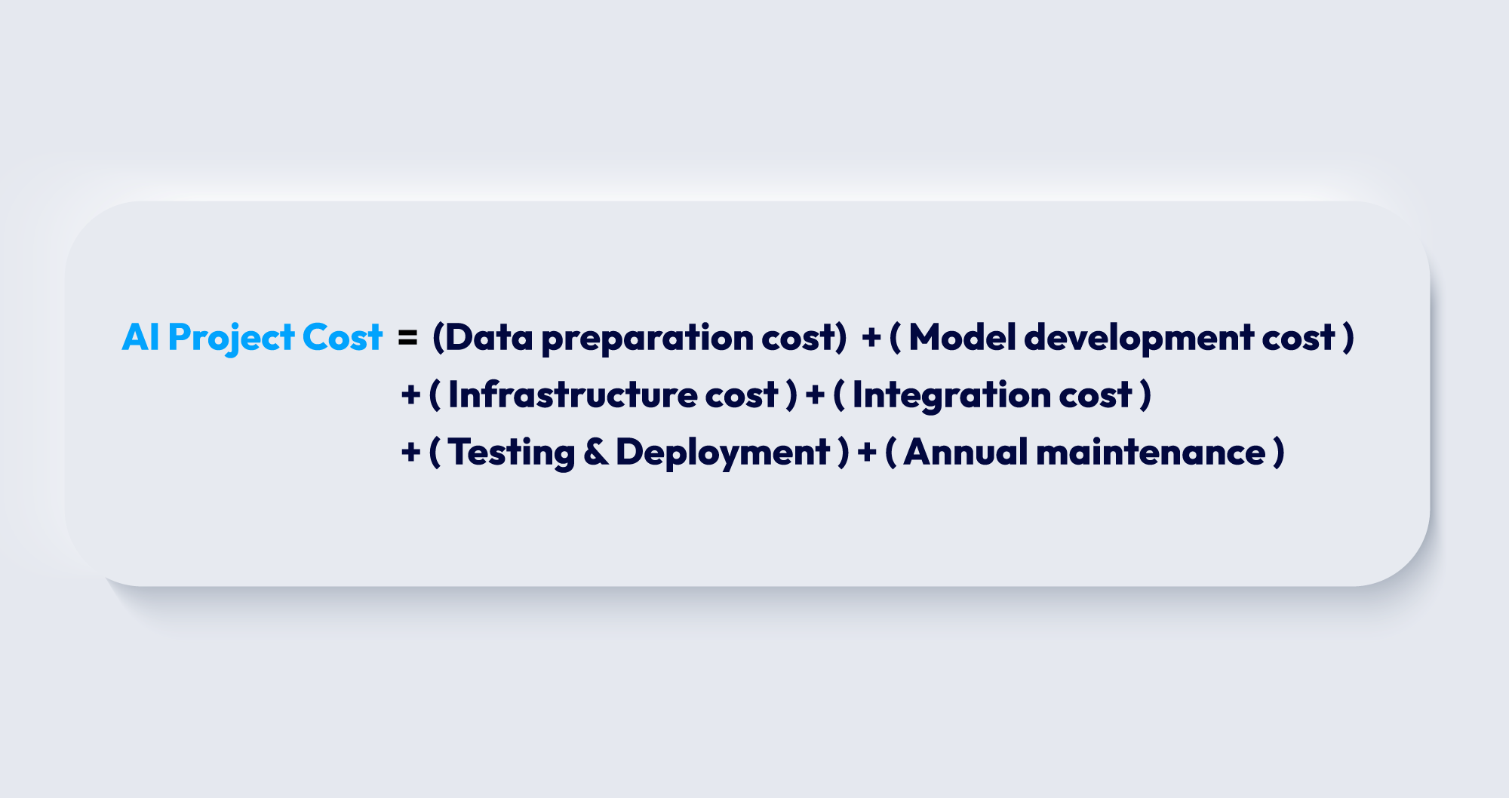
Most AI projects fall somewhere within this structure.
If you’re considering AI implementation in 2026, request a custom estimate based on your business objectives. Schedule a consultation to receive a detailed AI project cost estimate.
FAQ: AI Development Cost
How much does AI development cost?
AI development cost typically ranges from $20,000 for basic AI tools to over $500,000 for enterprise systems. Pricing depends on data preparation, model complexity, infrastructure requirements, and system integrations.
What is the cost of generative AI development?
The cost of generative AI development typically ranges from $40,000 to $300,000+, depending on complexity. Simple applications using APIs from providers like OpenAI or Anthropic may cost $40K–$80K, while advanced platforms with custom model fine-tuning, integrations, and scalable infrastructure can exceed $200K.
How much does it cost to integrate AI into existing software?
Integrating AI into existing software usually costs $10,000 to $80,000+ depending on system complexity. The price depends on API integrations, data pipelines, legacy system compatibility, and testing requirements. Simple integrations using pre-trained AI services can be completed quickly, while enterprise integrations often require custom development and architecture changes.
Can AI be built under $10,000?
Yes, small AI solutions can sometimes be built for under $10,000 by using pre-trained models and low-code tools. Examples include basic chatbots, document classification tools, or simple automation systems. However, most production-ready AI applications require $20,000 or more for reliable development, testing, and deployment.
Is AI development expensive for startups?
Not necessarily. AI app development cost for startups can start at $20,000–$50,000 when focused on a single validated use case. The key is starting with an MVP that tests one hypothesis rather than building a full-featured platform. Startups that use pre-trained models (GPT, Claude, open-source LLMs) and limit integrations to one or two core systems can reach production in 6–12 weeks at the lower end of that range. The biggest cost mistake startups make is overbuilding before validating product-market fit.
Can small businesses afford AI?
Yes. Small businesses can implement production-ready AI for under $50,000 by focusing on a specific, high-impact workflow — such as automating customer support enquiries, classifying documents, or generating personalised recommendations. Using pre-trained models via API eliminates the need for expensive custom training. The ongoing cost is typically $500–$2,000 per month for API usage and hosting. For many small businesses, a $25,000–$40,000 AI investment pays for itself within 6–12 months through reduced manual workload.
What factors increase AI project cost the most?
AI project costs typically rise due to:
-
- Poor data quality – Cleaning and structuring data can consume most of the development effort.
- Complex integrations – Connecting to CRMs, ERPs, or legacy systems adds significant time and cost.
- Custom model training – Building models from scratch is far more expensive than using pre-trained ones.
- Compliance requirements – Security and regulatory standards increase engineering effort.
- Scaling infrastructure – High-usage systems require ongoing cloud and compute investment.
Clear scoping early in the project is the best way to control AI development cost.
Final Thoughts: Plan Your AI Investment the Right Way
The AI development cost varies widely depending on project complexity, infrastructure needs, and integration requirements. Businesses can reduce costs significantly by starting with a focused MVP, using pre-trained models, and partnering with experienced AI development teams.
The biggest mistake companies make is underestimating scope or overengineering early.
If you’re planning an AI initiative, start with clarity. Define the business outcome. Validate the data. Scope carefully. Build iteratively.
Book a 45-minute AI feasibility call with Emvigo. Within one week, you’ll receive a realistic cost estimate, a recommended architecture approach, and a defined build-or-buy recommendation — before you commit a single dollar to development.