
Choosing the right IT consulting partner is critical for enterprises and growth-stage businesses. According to McKinsey, nearly 70% of digital transformation initiatives fail, not due to technology, but because of poor execution, unclear ownership, and weak post-deployment support.
That’s why the Capgemini vs Infosys debate matters. Both promise digital transformation, cloud modernisation, and long-term value, but their approaches differ in consulting depth, execution scale, and post-deployment focus.
This guide provides a comprehensive, side-by-side look at Capgemini and Infosys, so decision-makers can choose with confidence.
TL;DR: Capgemini vs Infosys Key Takeaways
-
- Capgemini focuses on consulting depth and innovation.
- Infosys excels at large-scale execution and cost efficiency.
- Capgemini suits enterprises evolving their digital strategy.
- Infosys fits stable, cost-focused programmes with fixed roadmaps.
- Long-term ROI depends on post-deployment support and adaptability, not just headline cost.
Capgemini: Digital Transformation and Enterprise Services
Introduction to Capgemini
Capgemini is a global leader in digital transformation services, operating in over 50 countries with partnerships across cloud and AI platforms. It combines deep industry expertise with a consultative approach, helping enterprises modernise systems, optimise operations, and drive innovation. Capgemini’s approach ensures transformation initiatives are practical, sustainable, and aligned with business outcomes.
Capgemini Services and Strengths
Strong consulting foundation: Capgemini starts with strategy, business alignment, and architecture planning.
This reduces misalignment in complex transformations.
Industry-specific expertise: Deep experience in banking, healthcare, and manufacturing helps manage compliance and operational risk.
Innovation and design focus : Integrates design thinking, AI use cases, and cloud-native planning early, enhancing customer experience and operational agility.
Cloud strategy and AI implementation
-
- Cloud: Designs architecture around business challenges with flexibility over standardisation.
- AI: Focuses on analytics, decision support, and customer experience innovation.
Capgemini Pricing and ROI
Pricing expectations :Higher upfront consulting costs due to strategy and design involvement , Reduces rework and long-term risk.
Estimated Pricing Table
| Engagement Area | Capgemini Pricing |
| Digital consulting monthly | $120K to $250K |
| Enterprise cloud migration | $500K to $2M+ |
| AI and data platforms | $300K to $1.5M |
| Managed services annual | $250K to $1M+ |
| Scope changes | Flexible, premium |
ROI perspective : Higher ROI for evolving transformation programmes; value grows through adaptability and optimisation.
Capgemini Pros and Cons
Pros:
-
- Strong strategy focus, providing deep guidance on digital transformation.
- Design-led innovation integrated into projects from the start.
- Flexible pricing models to suit business needs.
- Adaptive approach that adjusts to changing business requirements.
- Continuous optimisation and post-deployment guidance.
Cons:
-
- Higher upfront cost due to consultative engagement.
- Slower scale-up for large programmes compared to execution-focused firms.
- Premium consulting costs may increase initial investment.
- Requires active involvement from enterprise teams.
- Higher ongoing cost for extended support and consulting.
Infosys: Enterprise Solutions and Services
Introduction to Infosys
Infosys is a global leader in enterprise solutions, renowned for large-scale delivery and operational efficiency. With extensive industry experience and a strong offshore delivery network, Infosys helps enterprises execute complex programmes consistently while controlling costs. Its structured approach ensures predictable outcomes for organisations with well-defined digital transformation goals.
Infosys Services and Strengths
Scalable execution model : Excels at executing large, clearly defined programmes for global rollouts and multi-region delivery.
Cost efficiency : Offshore delivery model optimises long-term costs for predictable enterprise spending.
Process-driven delivery : Structured governance and escalation frameworks reduce ambiguity and ensure reliable execution.
Cloud strategy and AI implementation
-
- Cloud: Focuses on scaling cloud platforms efficiently across large organisations.
- AI: Prioritises automation and operational efficiency.
Infosys Pricing and ROI
Pricing expectations : Predictable and cost-efficient for long-term programmes; best for fixed-scope enterprise delivery.
Estimated Pricing Table
| Engagement Area | Infosys Pricing |
| Digital consulting monthly | $70K to $140K |
| Enterprise cloud migration | $400K to $1.5M |
| AI and data platforms | $250K to $1.2M |
| Managed services annual | $200K to $900K |
| Scope changes | Structured, cost-added |
ROI perspective : Strong ROI in stable, execution-heavy environments; cost control and efficiency are key drivers.
Infosys Pros and Cons
Pros:
-
- Structured advisory for predictable and consistent guidance.
- Strong automation capabilities across enterprise processes.
- Cost-efficient delivery models for long-term programmes.
- Predictable execution that suits large, stable projects.
- Stable managed services with defined SLAs.
Cons:
-
- Less flexible compared to consultative models.
- Limited customisation for unique business requirements.
- Rigid change pricing can increase costs for adjustments.
- Slower to adapt mid-course during project execution.
- Less adaptive support for evolving business needs.
Capgemini Case Studies: Real-World Impact
Capgemini has delivered measurable enterprise transformation across industries, with a focus on strategic redesign, automation, and innovation-led solutions. Here are notable examples:
1. Global Operations Transformation for a Fortune 100 Consumer Goods Company
Challenge: Fragmented global operations, inconsistent processes, and high operational costs.
Solution: Capgemini redesigned the operating model, standardised over 130 processes, and implemented 90+ automation bots using its Automation Drive platform.
Outcome:
-
- 38% reduction in global operational costs over three years
- First-time-right rates increased from 63% to 98.2%
- 99.7% SLA adherence across operations
Key Takeaway: Capgemini’s consultative approach goes beyond technology, integrating process and organisational redesign for long-term transformation.
2. Digital Modernisation for a Global Bank
Challenge: Legacy systems and slow customer onboarding processes.
Solution: Capgemini implemented cloud-native platforms, AI-powered analytics, and process automation to streamline banking operations.
Outcome:
-
- Reduced customer onboarding time by 40%
- Improved operational compliance and reporting accuracy
- Enhanced customer experience with faster service delivery
Key Takeaway: Capgemini blends technology with strategy and innovation, ideal for enterprises seeking adaptive, business-aligned digital transformation.
Infosys Case Studies: Real-World Impact
Infosys focuses on large-scale enterprise execution, operational efficiency, and automation, delivering consistent results across sectors. Notable case studies include:
1. Fraud Prevention for adidas (ISG Digital Case Study Award 2021)
Challenge: Detect and prevent fraudulent transactions across global operations.
Solution: Infosys established a Centre of Excellence for risk management, analysing transaction data and identifying patterns.
Outcome:
-
- USD 2.5 million in suspicious transactions identified
- Reduced revenue leakage
- Strengthened operational risk controls
Key Takeaway: Infosys excels in data-driven risk management and operational automation at scale.
2. Finance & Accounting Automation for Philips
Challenge: Large, repetitive finance operations causing inefficiency.
Solution: Deployment of 500 digital workers (bots) to automate key finance processes.
Outcome:
-
- Over 1 million hours of manual effort eliminated
- Increased productivity and process consistency
- Global F&A operations streamlined and more resilient
Key Takeaway: Infosys’s approach demonstrates how automation at scale drives measurable cost savings and operational excellence.
3. Digital Transformation with Microsoft Azure
Challenge: Need for real-time analytics and AI-driven decision-making in the F&B sector.
Solution: Infosys leveraged Azure Data Factories and ML workspaces to enable near real-time analytics.
Outcome:
-
- Analysis cycles reduced from months to hours at 80%+ accuracy
- Faster, data-driven decision-making across business units
- Improved business intelligence and strategic insights
Key Takeaway: Infosys combines cloud and analytics capabilities to accelerate enterprise transformation while enabling operational efficiency.
Summary for Decision-Makers:
-
- Capgemini: Best for enterprises seeking consulting-led transformation, process redesign, and innovation-driven solutions.
- Infosys: Ideal for execution-heavy, automation-focused programmes, delivering efficiency, scalability, and measurable ROI.
Customer Satisfaction Insights: NPS Score Comparison
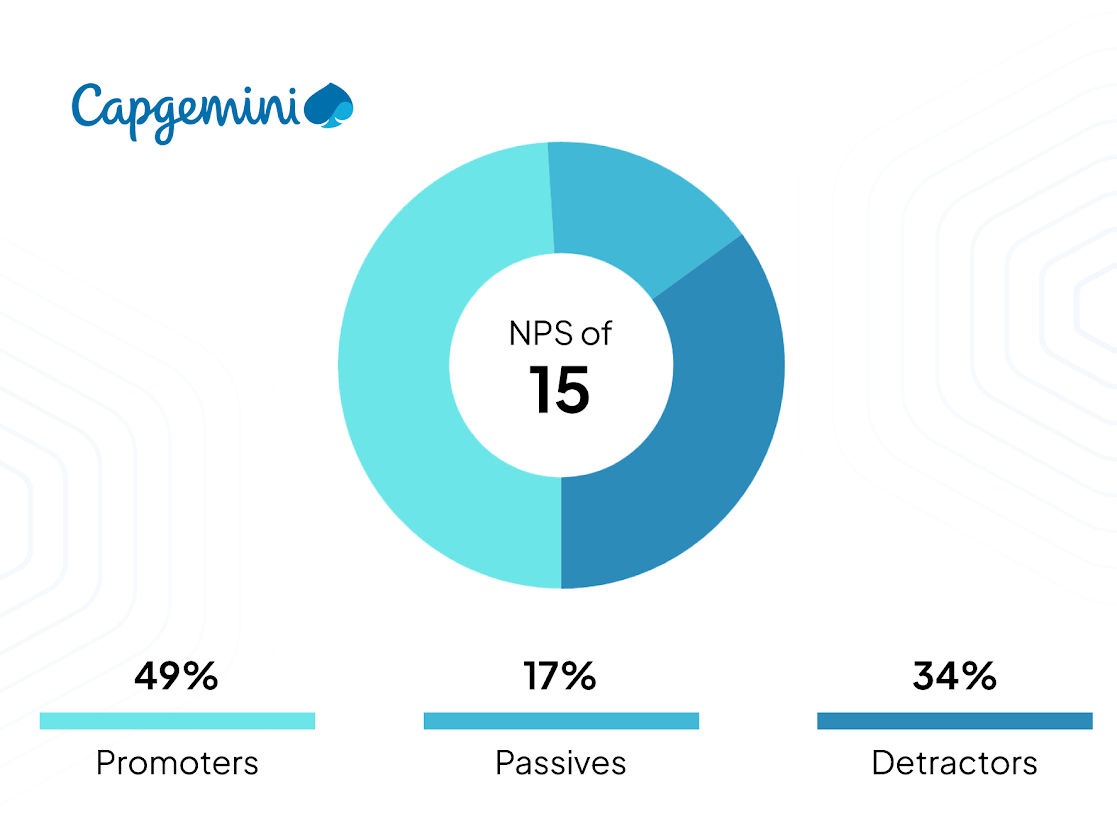
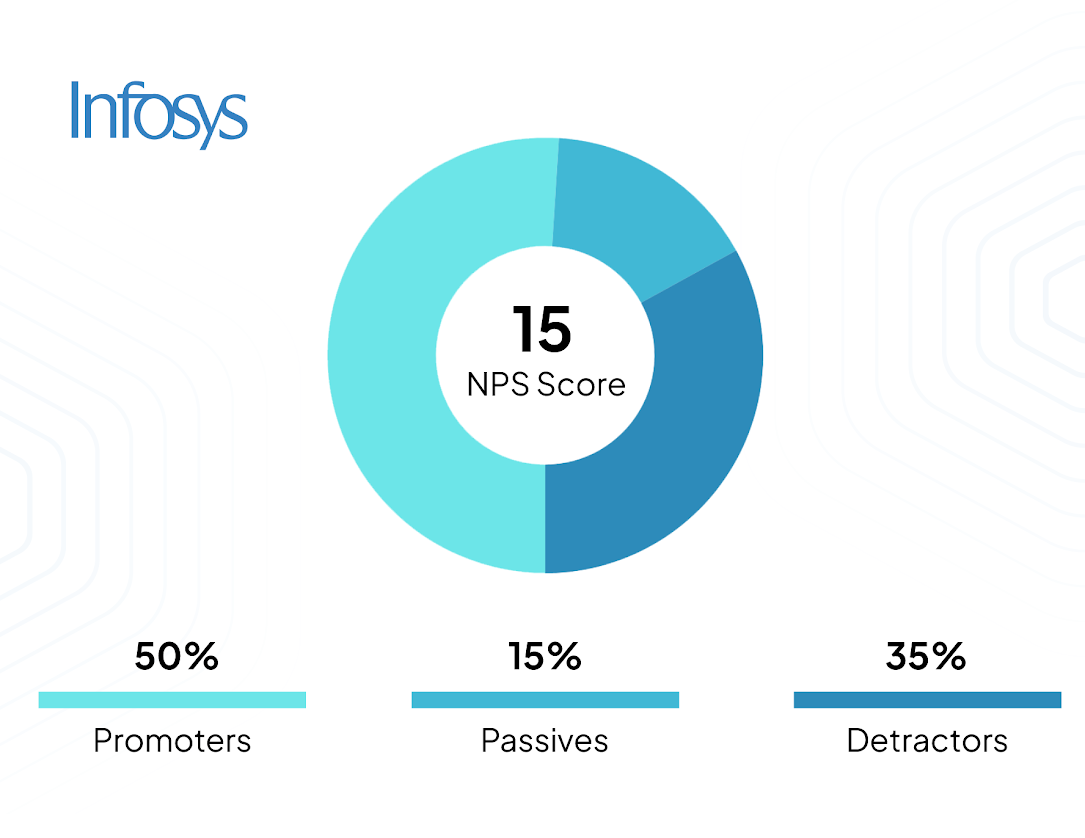
Customer experience and loyalty are critical when choosing between Capgemini vs Infosys. One quantitative metric often used is the Net Promoter Score (NPS), which measures how likely clients are to recommend a company.
Capgemini NPS Score
Infosys NPS Score
Capgemini vs Infosys: Who Should Choose Which?
When deciding between Capgemini vs Infosys, the right choice often depends on specific business needs:
-
- Strategy still evolving: Capgemini is ideal for organisations that are still shaping their digital vision and need consultative guidance. Infosys is less suited for this scenario, as it focuses more on execution-ready programmes.
- Fixed enterprise roadmap: Infosys is better for companies with a well-defined roadmap, offering predictable delivery and structured execution. Capgemini may be less optimal here due to its consultative, flexible approach.
- Innovation focus: Capgemini is a strong fit for enterprises prioritising innovation and design-led transformation. Infosys supports innovation moderately, but its strength lies in automation and efficiency.
- Cost predictability: Infosys provides high cost predictability through structured delivery models. Capgemini offers moderate predictability, as its consultative and flexible approach can sometimes increase initial investment.
- Long-term flexibility: Capgemini excels in providing long-term adaptability, supporting evolving business needs and changing priorities. Infosys offers limited flexibility, focusing more on stable, repeatable processes.
Questions to Ask Before Choosing Capgemini vs Infosys
When comparing Capgemini vs Infosys, decision-makers should go beyond proposals and examine critical factors that affect long-term success:
-
- Who owns optimisation after launch?
Understand which party is responsible for refining processes, updating systems, and ensuring continuous improvement post-deployment. Clear ownership avoids gaps in accountability. - How flexible is the delivery model?
Check whether the consulting partner can adapt to changing business priorities, scope adjustments, or evolving technology needs without causing delays or extra costs. - How transparent are change costs?
Ensure that any additional costs for modifications, enhancements, or unforeseen requirements are clearly outlined upfront to prevent budget surprises. - What post-launch reporting exists?
Review how progress, performance, and ROI are tracked after implementation. Regular reporting helps leadership make informed decisions and quickly address issues. - How is long-term success measured?
Determine the metrics and KPIs used to evaluate whether the engagement delivers business value, operational efficiency, and sustained digital transformation results.
- Who owns optimisation after launch?
These questions help reduce future risk, ensure smooth delivery, and guarantee alignment with your strategic goals.
A Smarter Alternative for Enterprises
While Capgemini and Infosys excel in predictable, large-scale programmes, growing or innovation-focused enterprises often need more hands-on support, agility, and flexibility:
-
- Long-term post-deployment support
Emvigo ensures systems evolve with business needs, reducing disruption and maintaining performance. - Clear ownership after launch
Responsibility for optimisation and issue resolution is clearly defined, giving leadership confidence in ongoing operations. - Free demo and strategy calls
Potential clients can explore solutions, clarify doubts, and assess fit without upfront commitment. - Transparent delivery and customer-first engagement
Emvigo emphasises clarity in pricing, timelines, and deliverables while keeping client priorities central.
- Long-term post-deployment support
For enterprises evaluating Capgemini vs Infosys for long-term IT partnerships, Emvigo provides a more adaptable, practical, and personalised approach.
Book a free consultation today to explore the right-fit strategy for your business.
Quick Answers: Capgemini vs Infosys FAQs
Is Capgemini better than Infosys for digital transformation?
Capgemini suits enterprises shaping their digital strategy, offering consultative guidance, innovation, and long-term flexibility. Infosys is ideal for organisations with a fixed roadmap, prioritising predictable execution and efficiency.
Infosys vs Capgemini – which is better for cloud strategy?
Capgemini provides flexible cloud architecture tailored to business outcomes. Infosys excels in scaling cloud platforms across large organisations for efficiency and repeatability.
What are the differences in pricing between Capgemini and Infosys?
Capgemini has higher upfront consulting costs due to strategy and design involvement but delivers long-term ROI through optimisation. Infosys offers more predictable, cost-efficient long-term programmes suitable for stable enterprises.
Capgemini vs Infosys – which is better for AI implementation?
Capgemini focuses on AI-driven insights, analytics, and enhancing customer experience. Infosys emphasises automation at scale to improve operational efficiency across enterprise processes.
How do Capgemini and Infosys support enterprises post-deployment?
Capgemini offers consultative post-deployment support for evolving business needs. Infosys provides SLA-driven managed services, ensuring stable operations but with less flexibility to adapt.
Capgemini vs Infosys – which is better for a long-term IT partnership?
Capgemini is ideal for enterprises needing innovation and adaptability. Infosys works best for businesses valuing predictable costs, structured execution, and operational stability.
Which are the other alternatives to Capgemini and Infosys?
Emvigo is a strong alternative for hands-on IT support, alongside TCS, Wipro, Cognizant, and Accenture.