


You’ve shortlisted two Indian IT giants for your next project, but here’s the thing—picking between Wipro and Infosys isn’t just about who’s bigger or older.
Both companies handle billions in revenue, serve Fortune 500 clients, and employ hundreds of thousands of professionals. Yet, they operate differently, specialise in distinct areas, and suit different business needs.
If you’re wondering whether Wipro or Infosys is better for your company, you’re asking the right question. The answer depends on what you’re building, how you work, and where you want to grow.
In this detailed comparison of Wipro vs Infosys, we’ll break down their services, pricing models, industry strengths, real client experiences, and who they’re truly built for. By the end, you’ll know exactly which partner aligns with your goals.
Let’s get into it.
Wipro vs Infosys: A Quick Overview
Both Wipro and Infosys are among India’s top IT service companies, trusted by enterprises across the world for digital transformation, cloud, AI, and consulting. But while they often appear in the same shortlists, their focus and delivery styles differ in meaningful ways.
Wipro is known for its flexibility, cost-effectiveness, and quick execution. It thrives with mid-to-large businesses that want fast results, shorter contracts, and collaborative engagement models.
Infosys, in contrast, is more consulting-led and process-driven. It’s preferred by large enterprises that require governance-heavy, multi-year transformation programs with deep domain expertise.
In simple terms — Wipro moves fast, Infosys moves deep.
Your choice depends on whether you value speed and adaptability or structure and scale.
When comparing Infosys vs Wipro, it helps to understand what each company stands for and how they’ve shaped the global IT landscape.
Wipro started as a vegetable oil company in 1945 and pivoted to IT in the 1980s. Today, it’s known for infrastructure management, business process services, and digital transformation consulting. Wipro operates in over 66 countries and serves clients across banking, healthcare, retail, and energy sectors.
Infosys, founded in 1981, built its reputation on software development and enterprise solutions. It pioneered the global delivery model and became synonymous with quality and innovation. Infosys focuses heavily on cloud, AI, automation, and data analytics, working with clients in financial services, manufacturing, telecom, and retail.
Here’s a side-by-side snapshot:
| Factor | Wipro | Infosys |
| Founded | 1945 (IT since 1980s) | 1981 |
| Headquarters | Bangalore, India | Bangalore, India |
| Global Presence | 66+ countries | 50+ countries |
| Employees | 250,000+ | 340,000+ |
| Revenue (2024) | ~$11 billion | ~$18 billion |
| Key Services | IT consulting, BPO, infrastructure | Software development, cloud, AI, consulting |
| Industries | Banking, healthcare, energy, retail | Finance, manufacturing, telecom, retail |
| Innovation Focus | Business operations, automation | Product engineering, digital platforms |
Both companies are publicly traded, hold strong reputations, and invest heavily in R&D. However, their approaches to client engagement, pricing, and delivery differ significantly.
Core Services: Where Wipro and Infosys Excel
Understanding the service offerings of Wipro and Infosys is crucial when deciding which partner fits your project.
Wipro’s Service Portfolio
Wipro organises its services around four main pillars:
-
- IT Services: Application development, system integration, and enterprise software management
- Business Process Services (BPS): Customer care, finance and accounting, procurement outsourcing
- Infrastructure Services: Cloud migration, data centre management, cybersecurity
- Digital Transformation: IoT, AI-driven automation, analytics, and experience design
Wipro shines in infrastructure management and business process outsourcing. If your business needs operational efficiency, managed services, or backend process optimisation, Wipro’s capabilities are well-suited.
Infosys’ Service Portfolio
Infosys structures its offerings into these categories:
-
- Software Development: Custom applications, product engineering, legacy modernisation
- Cloud Services: AWS, Azure, Google Cloud migrations and management
- Data and AI: Machine learning models, predictive analytics, data engineering
- Consulting: Digital strategy, business transformation, change management
- Automation: Robotic process automation (RPA), intelligent automation platforms
Infosys leads in product development and cloud-native solutions. If you’re building new digital products, scaling platforms, or integrating advanced AI, Infosys tends to have deeper technical expertise.
For businesses exploring AI implementation strategies, understanding these service differences matters. Wipro focuses on operational transformation, while Infosys leans towards innovation and product-led growth.
Industry Strengths: Who Serves Your Sector Better?
Both Wipro Infosys comparisons reveal that industry specialisation plays a big role in choosing the right partner.
Wipro’s Industry Focus
Wipro has built strong practices in:
-
- Banking and Financial Services: Core banking transformations, payment systems, compliance
- Healthcare and Life Sciences: Electronic health records, clinical data management, patient engagement
- Energy and Utilities: Smart grid solutions, asset management, sustainability tech
- Retail and Consumer Goods: Supply chain optimisation, omnichannel retail platforms
Wipro’s healthcare practice, for instance, works with major hospital networks and pharmaceutical companies. Their energy solutions support utilities transitioning to renewable infrastructure.
Infosys’ Industry Focus
Infosys dominates in:
-
- Financial Services: Investment banking platforms, insurance tech, wealth management solutions
- Manufacturing: Smart factories, supply chain digitalisation, IoT integration
- Telecom: 5G infrastructure, network automation, customer experience platforms
- Retail and E-commerce: Personalisation engines, inventory management, marketplace development
Infosys has partnerships with major telecom operators and automotive manufacturers. Their manufacturing clients often use Infosys for end-to-end digital factory implementations.
If you’re in fintech or retail, both companies are strong contenders. However, Infosys tends to win projects requiring deep technical integration, while Wipro excels in process-heavy transformations.
Companies looking at outsourcing software development should consider industry alignment as a key factor.
Pricing Models: What to Expect from Wipro and Infosys
When evaluating Wipro or Infosys which is better, pricing structure matters as much as technical capability.
Wipro Pricing
Wipro typically charges between $25 to $60 per hour depending on the complexity and location of the team.
They offer:
-
- Fixed-price contracts for well-defined projects
- Time and material (T&M) for evolving requirements
- Managed services with monthly retainers
- Outcome-based pricing for business process services
Wipro’s pricing is competitive for infrastructure projects and long-term managed services. However, for product development, rates can climb depending on the skill set required.
Infosys Pricing
Infosys charges between $30 to $75 per hour.
Their pricing models include:
-
- Fixed-bid engagements for specific deliverables
- Time and material for agile projects
- Value-based pricing tied to business outcomes
- Subscription models for cloud and automation platforms
Infosys tends to be pricier for innovation-led projects but offers more predictable timelines and structured delivery. Their clients report higher upfront costs but better long-term ROI on digital transformation initiatives.
For businesses weighing custom software development costs, understanding these pricing nuances helps with budgeting.
Strengths and Weaknesses: An Honest Assessment
Let’s be transparent about where Infosys Wipro comparisons reveal real differences.
Wipro’s Strengths
-
- Strong in infrastructure and BPO services
- Cost-effective for long-term operational projects
- Flexible engagement models
- Broad geographic presence
Wipro’s Weaknesses
-
- Slower adoption of cutting-edge technologies compared to Infosys
- Less visibility in product engineering success stories
- Inconsistent delivery quality across different service lines
- Complex internal processes can slow decision-making
Infosys’ Strengths
-
- Leader in cloud-native development and AI integration
- Strong innovation labs and R&D investments
- High-quality delivery standards
- Transparent communication and project management
Infosys’ Weaknesses
-
- Higher pricing for premium services
- Less competitive in pure BPO or infrastructure-only projects
- Rigidity in contract terms
- Can be overkill for small to mid-sized projects
If you’re a startup or SME looking for MVP development, Infosys might feel too enterprise-focused, while Wipro could offer more flexible terms.
Client Experiences: Real Projects, Real Outcomes
Understanding how Wipro vs Infosys perform in real-world scenarios gives you a clearer picture.
Wipro Case Studies
Case Study 1: Global Bank Digital Transformation
A European bank partnered with Wipro to modernise its core banking platform. Wipro migrated legacy systems to cloud infrastructure, implemented automation for loan processing, and reduced operational costs by 30%. The project took 18 months and involved teams across three countries.
Case Study 2: Healthcare Provider EHR Implementation
A US healthcare network worked with Wipro to deploy electronic health records across 50+ facilities. Wipro managed data migration, staff training, and compliance. The system went live on schedule, improving patient data access by 40%.
Infosys Case Studies
Case Study 1: Automotive Manufacturer AI Integration
A leading car manufacturer engaged Infosys to build an AI-powered predictive maintenance platform. Infosys used machine learning to analyse sensor data from production lines, reducing downtime by 25% and saving $10 million annually. The platform was delivered in 12 months.
Case Study 2: Telecom 5G Network Rollout
A major telecom operator partnered with Infosys to automate network operations for 5G deployment. Infosys built real-time monitoring dashboards and integrated AI for network optimisation. The project supported the operator’s expansion into 15 new markets.
These examples highlight that Wipro excels in operational projects, while Infosys leads in innovation-driven initiatives.
Businesses exploring AI vs automation strategies can learn from these client experiences.
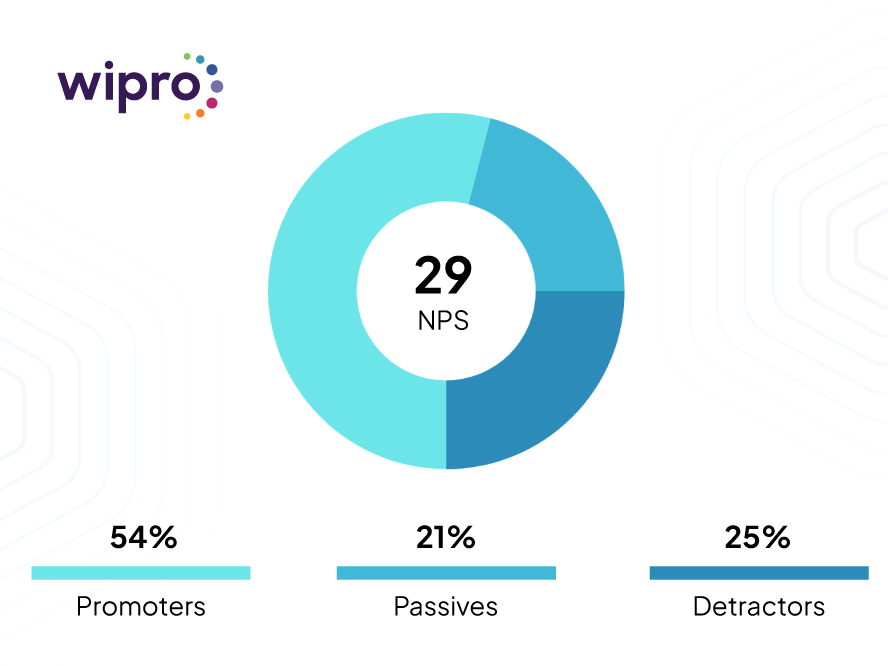
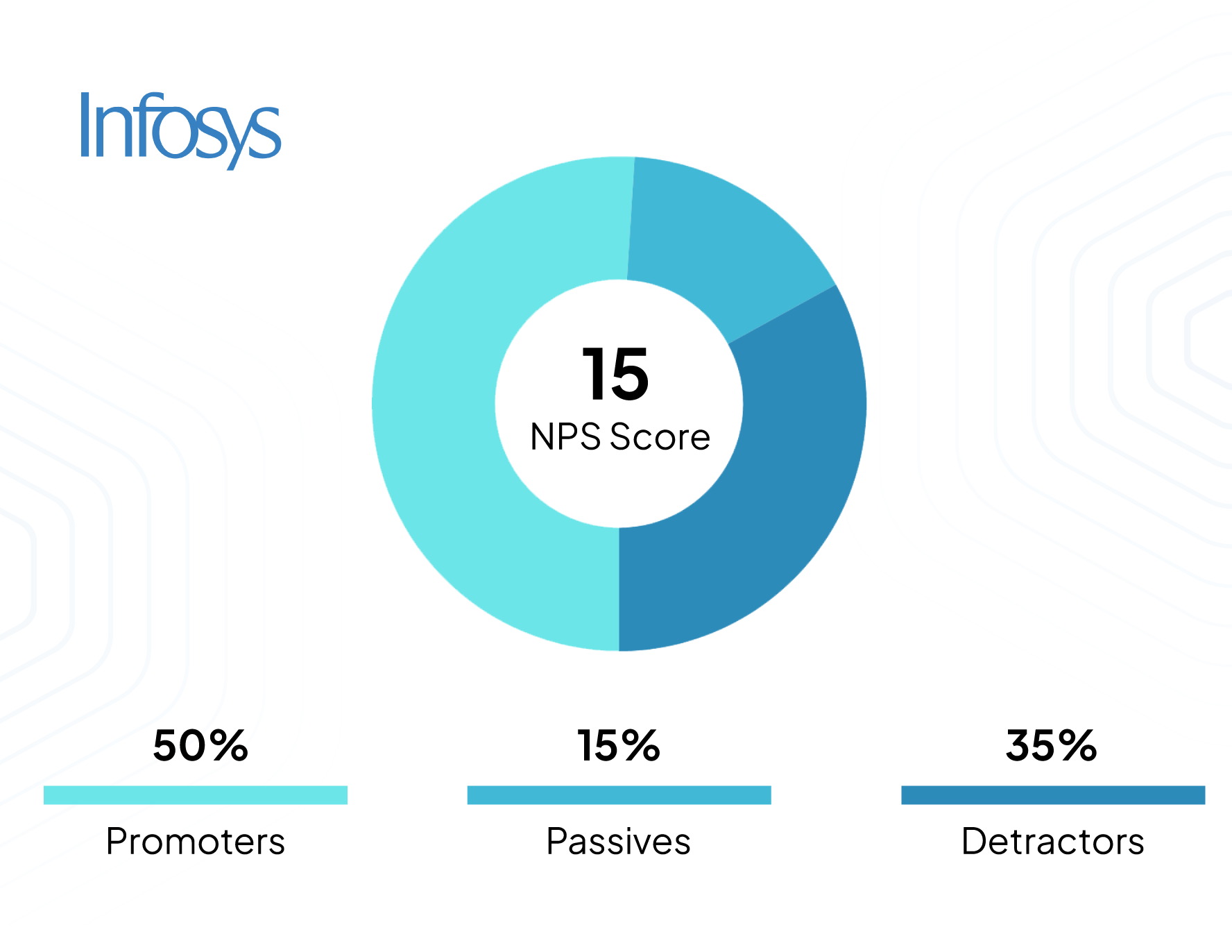
Wipro vs Infosys : Overall NPS Score
Wipro’s NPS Score
Infosys’ NPS Score
Questions to Ask Before Choosing Between Wipro and Infosys
Before signing with either company, ask these questions:
What’s the primary goal of this project?
If it’s operational efficiency, Wipro fits. If it’s building a new digital product, Infosys is stronger.
What’s your budget flexibility?
Wipro offers more cost-effective options. Infosys delivers premium quality at higher rates.
How important is industry expertise?
Both have strong practices, but check which has deeper experience in your sector.
Do you need ongoing managed services or one-time delivery?
Wipro’s managed services are competitive. Infosys excels in defined project delivery.
What’s your risk tolerance for innovation?
Infosys takes bold bets on emerging tech. Wipro is more conservative.
How complex is your integration requirement?
Infosys handles complex, multi-system integrations better. Wipro is solid for simpler setups.
What’s your timeline?
Infosys tends to deliver faster for cloud and AI projects. Wipro suits longer-term engagements.
Do you value transparency and communication?
Infosys has clearer reporting structures. Wipro can feel less transparent.
These questions mirror the approach we recommend in our guide on choosing the right software development partner.
Comparison Table: Wipro vs Infosys at a Glance
| Criteria | Wipro | Infosys |
| Best For | Infrastructure, BPO, managed services | Product engineering, cloud, AI |
| Hourly Rate | $25–$60 | $30–$75 |
| Project Size | Mid to large-scale | Large-scale, enterprise |
| Innovation | Moderate | High |
| Delivery Speed | Moderate | Fast |
| Communication | Adequate | Excellent |
| Industry Depth | Healthcare, energy, banking | Finance, manufacturing, telecom |
| Contract Flexibility | High | Moderate |
| Post-Deployment Support | Good | Excellent |
Current Trends and Future Outlook for Wipro and Infosys
Both companies are adapting to future technology landscape, but in different ways.
Wipro’s Strategy
Wipro is investing in:
-
- Automation platforms for business process services
- Sustainability solutions for energy and utilities
- Partnerships with AWS and Microsoft for cloud services
- Cybersecurity offerings to meet rising demand
Wipro’s CEO recently emphasised operational efficiency and cost leadership as strategic priorities.
Infosys’ Strategy
Infosys is focused on:
-
- Generative AI for software development and customer service
- Industry-specific cloud platforms (e.g., banking, healthcare)
- Digital engineering with DevOps and agile practices
- Sustainability-driven solutions aligned with ESG goals
Infosys launched Topaz, an AI-first platform designed to accelerate enterprise AI adoption. This positions them ahead in the race for intelligent automation.
Looking forward, Infosys will likely widen its lead in AI and cloud, while Wipro will continue to dominate in managed services and BPO.
For businesses planning digital transformation projects, understanding these strategic directions helps align vendor selection with long-term goals.
Why Emvigo Offers a Better Alternative to Wipro and Infosys
Choosing between Wipro and Infosys makes sense if you’re operating at enterprise scale. But what if you need the same quality without the bureaucracy, faster delivery, and more personalised service?
That’s where Emvigo stands out.
What Makes Emvigo Different
At Emvigo, we combine the technical depth of Infosys with the flexibility Wipro promises—but without the enterprise overhead.
Here’s what you get with Emvigo:
-
- Faster time to market: We deliver MVPs in 4 weeks and full products in months, not years
- Transparent pricing: No hidden costs, clear breakdowns, and flexible engagement models
- Post-deployment support: We don’t disappear after launch—we’re with you through scaling, updates, and optimisation
- Free discovery calls: Understand your project scope, get expert recommendations, and see if we’re the right fit—at no cost
- Dedicated teams: You work with the same engineers throughout, ensuring consistency and accountability
- AI-first approach: We integrate machine learning, automation, and intelligent systems from day one
Our Proven Process
Unlike large IT firms where projects get lost in layers of management, Emvigo operates lean:
-
- Discovery phase: We map your goals, tech requirements, and success metrics
- Agile development: You see progress every sprint with working prototypes
- Continuous testing: Quality checks happen at every stage, not just at the end
- Launch and scale: We deploy, monitor, and optimise based on real user data
- Ongoing partnership: Post-launch support, feature updates, and performance tuning
Who Emvigo Works With
We’ve helped:
-
- Startups launch MVPs that secure funding
- SMEs modernise legacy systems without breaking the bank
- Enterprises build internal tools and digital products faster than in-house teams
Whether you’re building a custom CRM, scaling an AI-powered platform, or launching a new SaaS product, we’ve done it before.
Real Results from Real Clients
We’ve delivered:
-
- 40% reduction in development time using vibe coding practices
- 30% cost savings compared to traditional agencies
- 95% client satisfaction rate across 200+ projects
Our clients come back because we treat their success as our own.
Ready to move faster than the big firms?
Book your free discovery call today and see why companies choose Emvigo over the IT giants.
Frequently Asked Questions
Which is better: Wipro or Infosys?
It depends on your project type. Infosys is better for product engineering, cloud services, and AI integration. Wipro is better for infrastructure management, BPO, and operational transformation. Evaluate based on your specific needs rather than overall reputation.
How much does Wipro vs Infosys cost?
Wipro charges $25–$60 per hour, while Infosys charges $30–$75 per hour. Wipro is more cost-effective for long-term managed services. Infosys offers better value for complex digital transformation projects. Get detailed quotes for accurate comparisons.
Do Wipro and Infosys work with startups?
Both companies primarily serve mid-market to enterprise clients. Startups may find their processes too rigid and pricing too high. Alternative partners like MVP development specialists offer better flexibility for early-stage companies.
What industries do Wipro and Infosys specialise in?
Wipro focuses on healthcare, energy, banking, and retail. Infosys excels in finance, manufacturing, telecom, and e-commerce. Both have broad industry coverage, but their depth varies by sector.
Can Wipro or Infosys handle AI and machine learning projects?
Yes, both companies offer AI and ML services. Infosys has a stronger track record in AI product development and launched its Topaz platform for enterprise AI. Wipro focuses more on AI-driven automation in business processes.
How long do projects typically take with Wipro vs Infosys?
Project timelines depend on scope. For cloud migrations, expect 6–12 months. For custom software development, 12–24 months is common. Infosys tends to deliver faster for innovation projects, while Wipro suits longer-term operational engagements.
Do Wipro and Infosys offer post-deployment support?
Yes, both provide managed services and support. Infosys offers structured support tiers with clear SLAs. Wipro’s support quality varies by contract type. Always clarify post-deployment terms before signing.
What are the main complaints about Wipro and Infosys?
Common issues with Wipro include inconsistent delivery quality and slow internal processes. Infosys faces criticism for rigidity in contracts and higher pricing. Both can feel bureaucratic for smaller projects.
Final Thoughts: Making Your Decision
Choosing between Wipro and Infosys isn’t about picking a winner—it’s about finding the right partner for your specific situation.
Go with Wipro if you need:
-
- Long-term managed services
- Cost-effective infrastructure solutions
- Business process outsourcing
- Operational transformation
Choose Infosys if you’re focused on:
-
- Building new digital products
- Cloud-native applications
- AI and automation integration
- Innovation-led transformation
But if you want the technical strength of Infosys, the flexibility of Wipro, and the speed neither can match, explore what Emvigo can do for your business.
We’ve built a reputation on delivering quality software without the enterprise delays. Our clients stay with us because we make complex projects feel simple.
Your next digital project deserves better than compromise.
Let’s talk about what success looks like for your business.