

No. AI is changing how code gets written, but it is not replacing coding. The US Bureau of Labor Statistics still projects 10% growth in software developer employment between 2025 and 2035, although early-career roles are under the most pressure.
That short answer covers three separate questions: whether AI writes code, whether it completes whole tasks alone, and whether it removes the need for developers. This guide answers each using survey data, randomised trials and labour-market statistics from 2024 to 2026. It also shows where AI tools are enough and where a freelancer or agency is the safer choice.
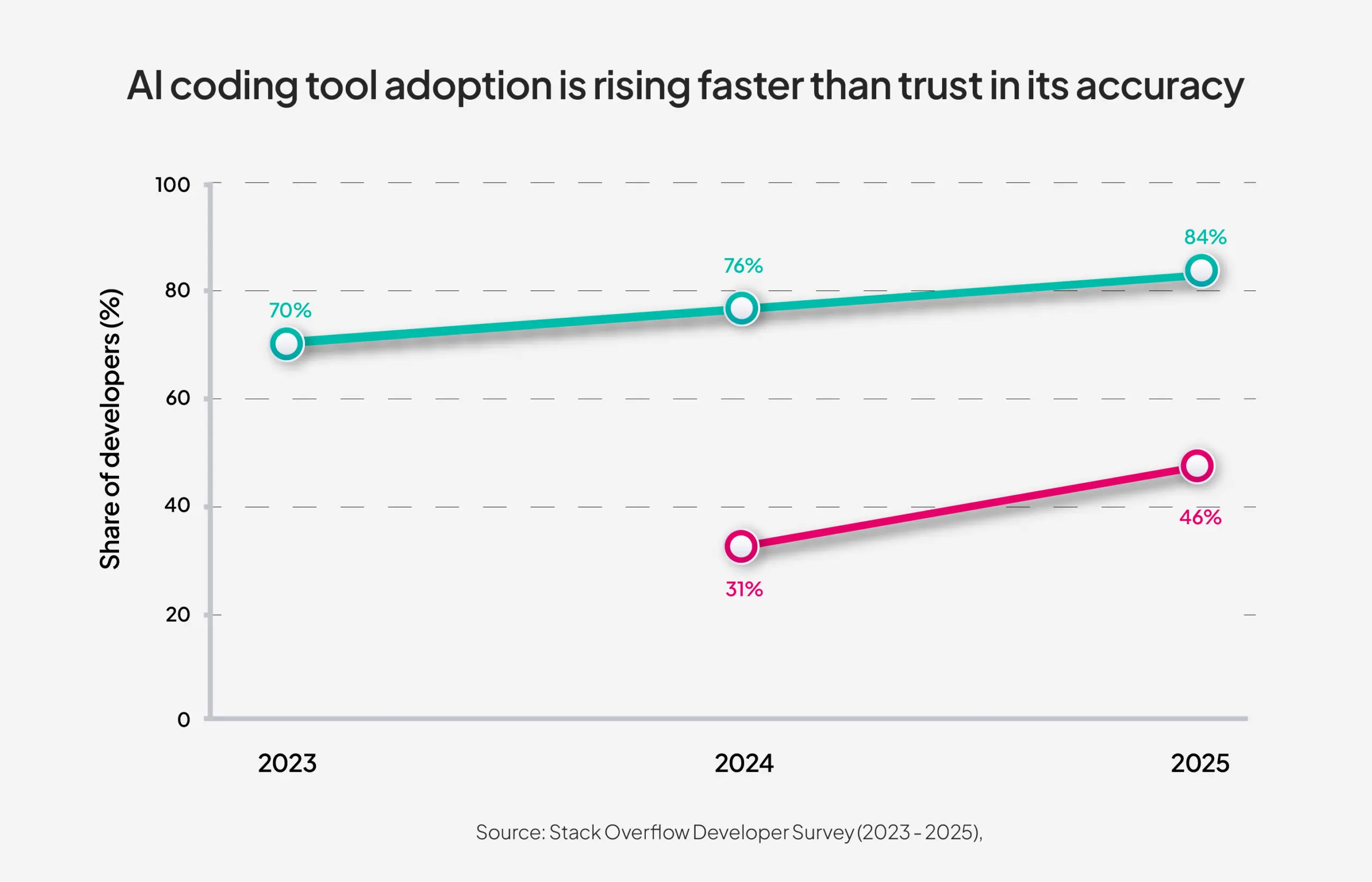
Line chart showing AI coding tool adoption rising from 70% in 2023 to 84% in 2025, while developer distrust in AI output accuracy increased from 31% in 2024 to 46% in 2025, based on Stack Overflow Developer Surveys.
Key takeaways
-
- Jobs: The BLS projects 10% growth for software developers from 2025 to 2035, against 3% for all occupations.
- Adoption: In its 2025 survey, Stack Overflow found 84% of developers use or plan to use AI tools, but 46% distrust their accuracy.
- Productivity: A 2025 randomised trial by METR found experienced developers took 19% longer with AI tools. An early GitHub and Microsoft experiment found one task finished 55.8% faster.
- Entry level: Stanford researchers report employment for 22–25-year-olds in highly AI-exposed occupations is about 19% below comparable peers, with no widespread displacement.
- Risk: Veracode’s 2025 testing found AI-generated code introduced security flaws in 45% of cases.
What does “AI replacing coding” actually mean?
“AI replacing coding” is three claims bundled together, and the evidence differs for each.
-
- AI writes code: Already true in part. Stack Overflow’s 2025 survey found 51% of professional developers use AI tools daily.
- AI completes tasks with little supervision: Emerging. Only 31% of Stack Overflow respondents currently use AI agents, and 38% do not plan to.
- AI removes the need for developers: Not visible in aggregate data. The clearest pressure is on early-career hiring (covered below).
Will coding be replaced by AI?
Coding is not being replaced by AI on the evidence available in 2026, but the work is changing shape.
The BLS projects software developer employment to grow 10% from 2025 to 2035. It cites continued demand for AI, IoT and robotics software. QA analysts and testers are projected to grow 6%.
Developers themselves are not alarmed. Stack Overflow’s 2025 survey reports that 64% do not see AI as a threat to their current job. The trend is worth watching, but it is not panic.
Is AI replacing coding jobs at the entry level?
Stanford’s August 2026 revision of its research found that employment among 22–25-year-olds in highly AI-exposed occupations was about 19% below where it would have been if it had kept pace with similarly aged workers in less-exposed occupations. This is a descriptive employment gap, not proof that AI alone caused the decline. The figure has widened from the 13% relative decline reported in the original August 2025 paper.
Indeed Hiring Lab’s July 2026 analysis found US software development postings have rebounded but remain 27.5% below their pre-pandemic level. Indeed reported that 71% of the rise came from senior roles, and notes the link to AI tools is correlation, not proof.
What about the UK?
UK software development postings also remain far below their pre-pandemic baseline, per Indeed’s August 2026 snapshot. Even so, Indeed’s September 2026 snapshot found that 9.7% of all UK job postings mentioned AI by the end of August. The number of UK postings with AI in their job titles has also almost tripled since 2022. This suggests growing demand for AI-related skills, although the figures cover the wider job market rather than software development alone
Human developers vs AI coding tools: where each is stronger
AI tools are strongest at fast, well-specified, routine code. Humans are strongest at ambiguity, accountability and context.
| Capability | Human developer | AI coding tools (2026) | Evidence |
|---|---|---|---|
| Routine, well-specified code | Slower to write from scratch | Fast at boilerplate and well-defined functions | One task finished 55.8% faster with AI assistance (GitHub Copilot productivity study). |
| Real-world speed on a familiar codebase | Deep knowledge of the repository | Mixed: review and integration overhead can cancel the gain | METR’s early-2025 trial found developers 19% slower with AI tools. Its 2026 update found the newer experiment inconclusive. |
| Ambiguous requirements and trade-offs | Can question the brief and weigh cost, risk and users | Needs explicit context; output quality depends on the prompt | 66% of developers report frustration with AI answers that are almost right, but not quite (Stack Overflow 2025 survey). |
| Debugging and verification | Prone to blind spots and fatigue | Can propose fixes and flag issues, but also creates work | 45% say debugging AI-generated code is time-consuming (Stack Overflow 2025 survey). |
| Security | Varies with training and review | Introduced flaws in 45% of Veracode’s test cases | Veracode’s 2025 GenAI Code Security Report. Spring 2026 update shows no improvement. |
| Knowledge currency | Learns continuously | Models have training cut-offs; tools can look up current documentation when configured | Claude Code documentation. |
| Accountability and ethics | Can be held accountable and interpret regulation | Cannot own a release or a compliance decision | 61.7% of developers have ethical or security concerns about AI-generated code (Stack Overflow 2025 survey). |
| Cost | Higher salary or day rate | Lower cost per task, but review time counts | METR’s overhead findings. |
Coders and AI working together is where the data points. Neither wins on every row.
Will GitHub Copilot replace developers?
No. GitHub Copilot works under a developer’s direction, even in its newer agent mode.
Copilot began as inline autocomplete. Per GitHub’s documentation, its coding agent can now be assigned an issue, work on it, raise a pull request and request a human review.
The speed evidence is mixed. A controlled experiment by GitHub and Microsoft researchers found developers using Copilot completed one task, building an HTTP server in JavaScript, 55.8% faster. In METR’s trial, 16 experienced developers completing 246 tasks in familiar repositories took 19% longer with AI. They had forecast a 24% speedup and afterwards believed they had gone 20% faster.
In its February 2026 update, METR said developers were probably getting more productivity benefits from late-2025 AI tools. However, the researchers considered their newer experiment unreliable because of participant selection effects and problems measuring time spent using multiple AI agents. They therefore cautioned against treating the results as a reliable estimate of AI’s productivity impact.
Copilot, ChatGPT, Claude and agentic coding tools
For how agents differ from generative tools, see our guide to agentic AI versus generative AI.
Is AI taking over coding?
AI is now part of most developers’ workflows, but the data does not show it taking over.
Stack Overflow’s 2025 survey found 51% of professional developers use AI tools daily, and that share has climbed each year since 2023. That measures use, not dependence.
Trust is lower than use. The same survey found 46% of developers distrust AI output accuracy and 33% trust it, with only 3% saying they “highly trust” it. Experienced developers are the most cautious, at 2.6% “highly trust”.
The same survey also found nearly 72% of developers say vibe coding is not part of their professional work. For background, see our explainer on vibe coding.
What is the future of coding with AI?
Coding is shifting from writing every line towards specifying, reviewing and securing AI-assisted work.
How the job is changing
Indeed’s August 2026 snapshot found postings with “AI” in the job title have almost tripled in the UK since 2022 (see the link above). In our view, four roles are likely to become more common by 2030. None of these is a sourced forecast.
-
- AI solution architects: design systems that combine several AI tools with human oversight.
- Prompt and context engineering specialists: write precise instructions and supply the right context for code generation.
- AI governance and ethics leads: check AI-generated code against ethical and regulatory standards.
- Human–AI delivery managers: lead teams that mix AI tools with human review.
We also expect three shifts. Automated test generation, such as AI test automation tools, will become standard. AI assistants will take a larger part in code review. Outsourcing providers will increasingly compete on how well they combine human and AI work, as covered in our software development outsourcing guide.
Low-code, no-code and AI
Low-code and no-code tools, and AI app builders, lower the barrier to a working prototype. They do not remove the engineering behind production software.
Production use still needs custom components, integration with existing systems, performance tuning and security work. Our guides to leading low-code platforms and no-code and AI development cover where each fits.
Where human oversight matters most
Regulated sectors such as finance and healthcare need accountable sign-off on compliance decisions, which AI tools cannot give. That is consistent with Stack Overflow’s finding that 61.7% of developers have ethical or security concerns about AI-generated code.
Enterprise work adds legacy integration, scalability planning, security frameworks and cross-platform compatibility. Our guide to scalable software solutions covers these choices.
Fields such as IoT are less settled. Evidence on AI performance there is thin, so treat AI output with extra caution. See our overview of IoT platforms for mobile app integration.
Retail teams weighing AI features can start with our AI e-commerce FAQs.
Skills developers need in the AI era: a 12-month roadmap
The skills that hold their value are the ones AI tools depend on people to supply: judgement, architecture, security and communication.
Technical skills
-
- AI tool proficiency: GitHub Copilot, ChatGPT, Claude and agentic tools, including prompting and combining several assistants in one workflow.
- Reviewing AI output: AI debugging and code review techniques.
- Architecture: system design patterns, microservices, cloud-native development and API design for AI service integration.
- Security-first practice: cybersecurity awareness for AI-generated code, and data privacy rules such as GDPR and CCPA.
- Quality: performance optimisation and cross-browser testing.
Soft skills
-
- Requirements: translating technical concepts into business value, and gathering requirements from clients.
- Leadership: mentoring and managing hybrid human–AI teams.
- Ethical reasoning: making responsible decisions about AI use.
- Continuous learning: adapting as tools change.
For development teams
-
- Introduce AI gradually, starting with code completion.
- Train people on what AI tools can and cannot do.
- Keep human review and testing as a standard step for AI-generated code.
- Build a team culture where AI supports human work. Our guide to building a high-quality development team and our post on AI-first development teams go further.
Learning path
How you use AI matters for learning. In Anthropic’s randomised trial, participants who asked follow-up or conceptual questions retained more than those who delegated code generation. Stack Overflow found 44% of developers now use AI tools to learn.
The risks of AI in development
AI’s benefits come with three risks: security, skill erosion and intellectual property.
Security vulnerabilities
Veracode’s 2025 report tested 100+ models on 80 tasks and found security flaws in 45% of cases, with security pass rates far behind syntax correctness. Veracode sells security tools, so read it as a vendor-run study.
An earlier NYU study found about 40% of 1,689 Copilot programs were vulnerable. That tested Copilot as it was in 2021, so it is not a current benchmark.
Skill erosion
Anthropic, which makes Claude, ran a randomised trial with 52 mostly junior engineers. Those using AI scored 17% lower on a quiz about concepts they had just used. The speed gain was not statistically significant, and the study measured short-term comprehension only.
Intellectual property
On 16 September 2026, the Ninth Circuit affirmed dismissal of the DMCA Section 1202(b) claim in Doe v. GitHub. The court held that AI-generated outputs that create new works without copyright management information do not, on the pleaded output theory, constitute removal or alteration of that information from an existing copy. The court did not decide the separate input theory, which the plaintiffs had forfeited. Two breach-of-contract claims remain pending. This is not legal advice.
For the practical side, read our guide to common mistakes when building AI tools.
Can AI replace hiring a freelance developer or an agency?
For prototypes and internal tools, sometimes. For production software carrying customer data, payments or compliance duties, rarely.
No single AI tool replaces a freelance developer for a build that has users. AI tools can write code, but someone still has to specify, test, secure, deploy and maintain it.
AI tools are usually enough when:
-
- the output is a prototype, a throwaway script or an internal tool;
- nobody’s data, money or compliance status depends on it;
- someone on your side can read and test the code.
They are usually not enough when:
-
- the software handles customer data, payments or regulated workflows;
- it must scale, integrate with legacy systems or be maintained for years;
- you need a named party accountable for defects.
For more on the trade-offs, read staff augmentation versus hiring developers or an agency, our Upwork versus software agency FAQs and custom software versus SaaS. To talk through your build, see our custom software development service.
What Emvigo’s delivery work shows
Two Emvigo engagements show AI as one component of a wider delivery job.
A musical instrument retailer’s e-commerce platform. Emvigo built the platform in six weeks for a client with no prior online store, expanding from a local region to customers across India and beyond. Results were 20% sales growth, 50% more customer inquiries and 35% higher conversion. The case study attributes the gains to logistics and payments optimisation.
A GDPR compliance platform revamp. In a 12-month partnership with a UK data privacy solutions provider, Emvigo helped the client grow its client base by 60%, increase revenue by 30% and achieve 25% faster onboarding. The one AI component was a Python LLM-powered redaction tool that identifies personal data in uploaded documents.
Our reading is that, in both, the outcomes came from system-level delivery work, and AI did a bounded job inside a human-designed system.
How Emvigo approaches AI-assisted development
We use AI tools in delivery and build AI features into client products, with human review at each stage.
-
- Custom AI integration: AI features built around a client’s business goals, through our AI consulting services.
- MVP-first delivery: AI-enabled minimum viable products to test an idea early, through our MVP development services and AI automation in MVP development.
- Responsible AI use: applying security, privacy and ethical considerations when integrating AI-generated code into client projects.
- Scalable design: systems that grow with AI capabilities while keeping human oversight.
Conclusion: evolution, not extinction
Will coding be replaced by AI? The evidence says no. It is reshaping coding from routine code production towards specifying, reviewing and securing AI-assisted work. The people most affected today are early-career developers, which is a real cost to take seriously.
The developers and teams best placed for 2026 are those who use AI tools with clear review standards, keep their architecture and security skills sharp, and stay accountable for what ships.
Frequently asked questions
Will coding be replaced by AI?
No. AI is changing how code is written, but the US Bureau of Labor Statistics still projects 10% growth in software developer employment from 2025 to 2035. The pressure is uneven: Stanford research finds employment of 22–25-year-olds in highly AI-exposed occupations is about 19% below less-exposed peers, so early-career roles are changing fastest.
Will GitHub Copilot replace developers?
No. GitHub Copilot now goes beyond autocomplete: its coding agent can take an assigned issue, raise a pull request and request a human review. That still places a developer in charge of the outcome. Evidence on speed is mixed: an early GitHub experiment found 55.8% faster completion of one task, while METR’s 2025 trial found experienced developers 19% slower.
Is AI taking over coding?
Not fully. Stack Overflow’s 2025 survey found 84% of developers use or plan to use AI tools, but 46% distrust their accuracy and only 31% currently use AI agents. The 2025 data describes a widely used assistant, not an autonomous replacement.
What is the future of coding with AI?
Coding is shifting from typing every line towards specifying, reviewing and securing AI-generated work. Indeed found 41% of UK software development postings were AI-related in 2026. In our view, demand will grow for architecture, testing, security and communication skills, with AI tool fluency becoming a baseline expectation rather than a differentiator.
Can AI replace a freelance developer?
For prototypes, scripts and internal tools, AI tools can often replace some freelance work. For production software that handles customer data, payments or regulated workflows, they cannot replace an accountable engineer. Veracode’s 2025 tests found AI-generated code introduced security flaws in 45% of cases, so review, testing and ownership still need people.
What programming jobs are most at risk from AI?
Early-career roles show the clearest pressure. Stanford’s August 2026 update found employment of 22–25-year-olds in highly AI-exposed occupations about 19% below comparable peers, while finding no widespread economy-wide displacement. BLS still projects software developer growth of 10% to 2035, so roles are evolving rather than vanishing.


