

Two sided marketplace development is the process of building a platform that connects two distinct user groups, usually buyers and sellers, so they can discover each other, transact and build repeat trust. It spans supply and demand onboarding, matching, payments and payouts, trust and dispute handling, and the admin tooling that keeps it running. If you are comparing development partners for a build, this guide covers scope, cost, timeline, risk and proof of what good delivery actually looks like.
Key takeaways
-
- A two sided marketplace lives or dies on liquidity, not features. Time to first match, fill rate and repeat rate matter more than how many screens you ship.
- Emvigo’s automotive trading platform for the UK market put private sellers and dealers on one app, with separate pricing models for each, and reached 1,300+ vehicle listings and 2,500+ downloads at launch.
- Stripe Connect is the most common way to split payments between a platform and its sellers; any marketplace touching card data needs PCI DSS compliance through its payment provider.
- Most founders should start with a marketplace MVP focused on one niche and one geography before expanding.
What is a two sided marketplace?
A two sided marketplace is a platform where two different user groups transact with each other, with the platform handling discovery, trust and usually payment. This differs from standard e-commerce, which has one seller (you) and many buyers. In a two sided marketplace, both sides are customers of the platform, and the platform’s job is making sure there is always enough of one side to satisfy the other.
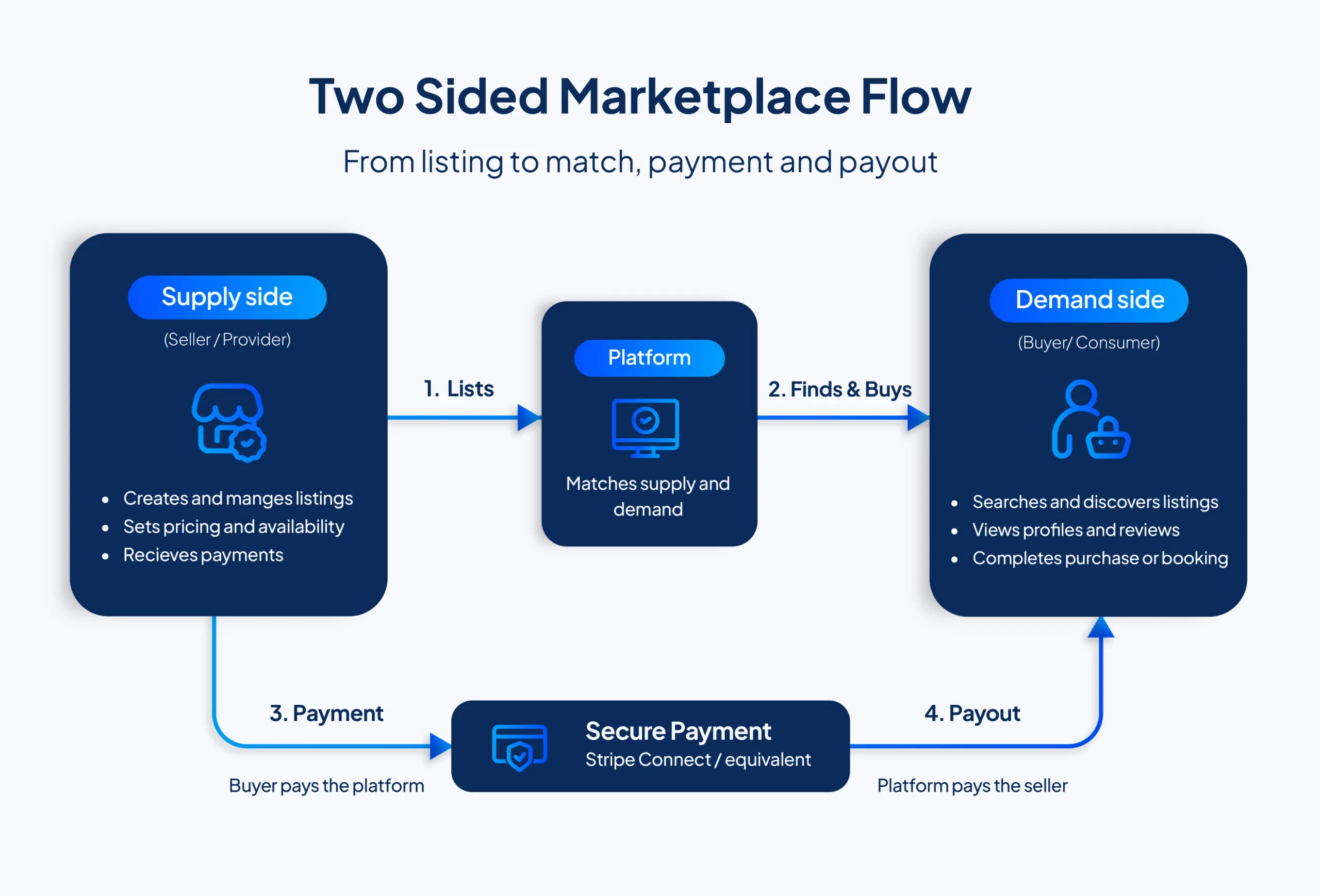
The two sided marketplace platform model spans very different industries, but the mechanics stay the same: supply lists something, demand searches for it, the platform facilitates the match and usually the money.
We have deliberately left client names out of this table. For a niche B2B example in detail, see our carbon credit marketplace development article.
Why two sided marketplaces are harder to build
A two sided marketplace is harder to build than a standard platform because you are solving for two user journeys, two sets of expectations and a timing problem, before a single feature generates value. A normal SaaS product has one user type to design for. A marketplace has at least two, and each only shows up once the other is already there.
That is the chicken and egg problem: buyers will not join with no sellers, and sellers will not join with no buyers. Every decision, from onboarding to pricing to the first screen a user sees, has to account for which side you are solving for first.
The two sides also often want contradictory things. Sellers want visibility and low fees. Buyers want choice and low prices. Admins need to referee both without becoming a bottleneck. Getting this wrong is the biggest reason marketplace builds stall after launch, which is why our marketplace platform development UK guide treats market selection as a first-order decision.
Core features checklist: supply, demand and admin
A two sided marketplace MVP needs three feature sets working together: one for people listing, one for people searching, and one for the team running the platform.
For feature-by-feature build sequencing, see our how to build a marketplace platform post.
Solving the cold start and liquidity problem
The cold start problem is solved by picking one side to seed manually first, narrowing your launch to a tight niche, and measuring liquidity rather than vanity metrics like total sign-ups. Most successful marketplaces recruit supply directly, often one listing or vendor at a time, before opening demand-side acquisition.
Supply-first works when supply is scarce or high-effort to onboard, such as verified tradespeople; you manually recruit a critical mass in one city or category before marketing to buyers. Demand-first works when supply can respond quickly once buyer interest is visible, such as a freelancer marketplace.
A credible framework here is starting with a small, dense “atomic network” rather than a broad, thin one, a concept popularised in a16z’s writing on network effects. The principle holds regardless of vertical: a narrow, well-served niche beats a wide, empty marketplace.
The metrics that matter once you are live:
-
- Time to first match — how long a new buyer or seller waits before their first successful connection
- Fill rate — the percentage of demand matched with available supply
- Repeat rate — the percentage of users, on either side, who transact again within a defined window
If these numbers are not improving month over month, new features will not fix the underlying liquidity problem.
Trust, ratings, reviews and dispute handling
Trust is the product in a two sided marketplace, built through verification, visible reputation and a dispute process both sides believe is fair. Buyers need confidence a seller will deliver; sellers need confidence a buyer will pay. Without this, transactions stall even when supply and demand are both present.
The mechanisms are well understood: identity or document verification at onboarding, two-way ratings and reviews on profiles, escrow-style payment holding so funds release once a condition is met, and active moderation of listings and messages. A formal dispute workflow, with clear timelines and escalation to a human reviewer, matters as much as the technology behind it; an unresolved dispute often pushes a user to churn regardless of outcome.
Payments, payouts and commission architecture
Payments need to split money between the platform and multiple sellers automatically, handle seller verification, and support refunds without manual intervention for every transaction. This is where off-the-shelf tooling saves months of engineering time.
Stripe Connect is the most widely used solution; Stripe’s documentation on building a marketplace sets out the standard pattern: customers pay the platform, the platform takes its commission, and the remainder routes automatically to the connected seller account. Adyen for Platforms and PayPal for Marketplaces offer comparable models.
Four things need deliberate design, not a bolt-on later:
-
- KYC and seller onboarding — identity and bank verification before a seller can receive payouts
- Split payments — automatic commission deduction at the point of transaction
- Refunds and chargebacks — a clear policy for who absorbs a refund and how it is enforced
- Tax handling — VAT or sales tax collection, and reporting documents sellers need at year end
Any platform processing card payments needs to account for PCI DSS, the data security standard maintained by the PCI Security Standards Council, though a compliant provider like Stripe or Adyen removes most of this burden from your own infrastructure.
Monetisation models compared
A two sided marketplace typically monetises through commission, subscription, listing fees, lead fees, featured placement, or a hybrid, and the right choice depends on transaction frequency and value.
Our automotive trading platform case study is a useful hybrid example: dealers paid a subscription for managing large inventories, while private sellers used pay-as-you-go pricing, both running on the same platform without fragmenting the product.
Matching, search and discovery
Good matching combines structured filters with relevance ranking, and uses recommendations to surface options a user would not have searched for directly. Search is the first moment a demand-side user decides whether your marketplace has what they need.
Filters (location, price, category, availability) handle explicit intent. Ranking then orders results by signals such as proximity, rating and response time. Recommendations go further, surfacing listings based on behaviour, which is where AI genuinely helps, particularly for large or fast-changing catalogues.
Where AI does not help, at MVP stage, is replacing a well-structured taxonomy and clean filtering. Many teams reach for a recommendation engine before solving basic search relevance, and end up with something impressive in a demo but worse than simple filters for a user who knows what they want.
Recommended tech stack and tools
The right stack depends on expected transaction volume, catalogue complexity, and whether a no-code platform can realistically carry the business to its next milestone.
A no-code platform such as Sharetribe is genuinely enough when your model is close to a standard template and you need to validate demand before committing engineering budget. Custom build is justified once you need non-standard matching logic, bespoke verification, deep integrations, or scale a hosted platform cannot support.
Build vs buy vs no code: a decision guide
For a deeper walkthrough with cost implications, see our build vs buy MVP strategy guide.
Marketplace MVP scope, timeline and phased roadmap
A marketplace MVP should launch with one niche, one geography, and the minimum feature set needed to prove a real match happens and real money moves, typically across four phases.
This mirrors what we have seen on real engagements: our wedding planning platform launched with core planning tools first, then added automated vendor matching once the base product had real users and feedback, rather than shipping both at once.
How much does two sided marketplace development cost?
Cost depends primarily on how many user journeys you need at launch, how complex your payment splitting is, and whether you need custom matching logic or a standard booking and listing pattern. As a guide, Emvigo’s published pricing for custom software puts MVPs at £15,000 to £30,000, mid-size web apps and SaaS platforms at £40,000 to £150,000, and enterprise builds at £150,000 and above, with MVPs typically shippable in around 4 weeks and mid-size builds running 8 to 16 weeks.
A two sided marketplace usually sits toward the higher end of the MVP range or into the mid-size bracket, because you are building two user journeys and a payment split architecture rather than one. The biggest cost drivers are verification and KYC complexity, whether matching or search is custom, how many payment methods and currencies you support, and how much admin tooling your team needs on day one. Rather than guess a number before understanding your model, a scoping call is the more useful next step. Our custom software development cost and MVP cost complete breakdown articles go into more detail on how these estimates are built.
Compliance, security and data
A two sided marketplace handling personal data and payments needs to plan for GDPR compliance from day one, and may need to consider FCA rules if it ever holds customer funds directly rather than routing them through a licensed payment provider.
Any UK or EU-facing marketplace processing personal data needs a lawful basis for that processing, clear privacy notices, and handling practices in line with UK GDPR, as set out in the ICO’s guide to the General Data Protection Regulation. Card payment data is almost always better handled by delegating to a PCI DSS compliant processor such as Stripe rather than storing card details directly.
On money: a marketplace that only passes payments through a licensed processor like Stripe Connect, where the processor is the regulated entity holding funds momentarily, sits differently to one that holds customer money in its own account before paying out sellers. The latter can trigger Payment Services Regulations or Electronic Money Regulations requirements under the FCA’s remit, and the specific triggers depend on exactly how funds flow through your platform. We do not advise on whether your model requires FCA authorisation; that is a question for legal counsel, informed by how your payment flow is architected. What we can do is build that architecture to route funds through a regulated processor by default, which is how most marketplaces avoid needing their own licence.
Common mistakes and red flags when choosing a marketplace development partner
The most common mistake is choosing a generalist agency with no prior two sided platform experience, because marketplace architecture decisions made in week one are expensive to unwind by month six. Watch for:
-
- No examples of marketplace, booking or vendor-matching platforms, only single-sided e-commerce or brochure sites
- Vague answers on how they would architect dual-audience features and pricing
- No clear plan for payments beyond “we’ll use Stripe,” with no detail on split payments or KYC
- Reluctance to discuss liquidity, cold start strategy, or sequencing supply versus demand
- Fixed-price quotes with no scoping phase, which usually means scope creep later
For a broader checklist, see our software development agency red flags guide.
How to evaluate a marketplace development company
Why Emvigo for two sided marketplace development
Emvigo is a UK-based software and AI development company with 14+ years of experience, ISO 9001:2015 certification, and a delivery model built around fixed scope, senior engineers and working demos every sprint. For two sided marketplace development specifically, that process has been tested on real dual-audience builds, not just standard e-commerce.
On our automotive trading platform project, we built a mobile-first, swipe-based marketplace for the UK car market combining private sellers and dealers in one app, with DVLA-backed real-time vehicle valuations and in-app negotiation replacing third-party intermediaries. The platform reached 1,300+ vehicle listings and 2,500+ downloads across Android and iOS at launch, with 20+ dealers and 300+ private users onboarded in the early adoption period.
On our wedding planning platform project, a 4.5 year engagement with a US wedding consultancy, we built a dual-audience platform serving couples and wedding professionals, with Stripe Connect and DocuSign handling payments and contracts, and a Typeform-powered matching system connecting couples to relevant vendors. That system increased vendor engagement by 40%, and automated matching combined with integrated planning tools cut couples’ planning time by 30%.
Every Emvigo project includes full IP transfer on delivery, a named senior engineer as technical lead from the first call, and sprint demos on your real data rather than a black-box process.
Conclusion
Two sided marketplace development succeeds or fails on fundamentals that have nothing to do with how polished the interface looks at launch. Liquidity, not feature count, decides whether buyers and sellers keep coming back. Trust, built through verification, reviews and a fair dispute process, decides whether they transact at all. And a payment architecture that routes funds through a regulated processor like Stripe Connect decides whether you can scale without taking on compliance burden you never intended to carry.
None of this is solved by picking the right tech stack alone. It is solved by sequencing: seeding one side before the other, launching narrow before expanding, and choosing a development partner who has actually built dual-audience platforms rather than one explaining the concept back to you for the first time on a sales call. The cost and timeline ranges in this guide give you a starting point, but the real scope, and the real fixed quote, comes from a conversation about your specific model, your niche and how you plan to solve the cold start problem on day one.
Ready to scope your two sided marketplace? Book a free consultation with Emvigo’s engineering team and leave with a realistic view of scope, timeline and cost.
Frequently asked questions
What is a two sided marketplace?
A two sided marketplace is a platform that connects two distinct user groups, typically buyers and sellers, allowing them to discover each other and transact while the platform facilitates matching, trust and usually payment. Examples include services marketplaces, rental platforms, talent marketplaces and B2B trading platforms.
How do you build a two sided marketplace?
You design supply-side, demand-side and admin features in parallel, choose a monetisation model, integrate split payments, and launch narrow, in one niche and one geography, before expanding. Discovery and architecture decisions made before writing code determine most of the long term cost and flexibility.
How do you balance buyers and sellers in a marketplace?
You monitor fill rate and time to first match, adjust onboarding incentives for whichever side is the current bottleneck, and avoid feature work that serves one side at the expense of the other’s experience. Most marketplaces cycle between supply and demand constraints as they grow.
How do two sided marketplaces make money?
Through commission on transactions, subscriptions, listing fees, lead fees, featured placement, or a hybrid of these models. The right choice depends on transaction frequency, average value and how price-sensitive each side is.
How much does it cost to build a two sided marketplace?
Cost depends on how many user journeys, payment complexity and matching logic your marketplace needs, but as a guide, Emvigo’s published MVP pricing starts at £15,000, with mid-size web apps and SaaS platforms typically running £40,000 to £150,000. A scoping call gives you a specific, fixed figure for your model.
How long does it take to build a marketplace MVP?
A marketplace MVP typically takes around 4 weeks for a narrow, single-niche launch, with mid-size builds involving more complex matching or payment logic running 8 to 16 weeks. The exact timeline depends on how much custom logic the matching and verification flows require.
How do you handle payments and payouts in a multi vendor marketplace?
You use a platform like Stripe Connect, which automates commission splitting, routes payouts to verified seller accounts, and manages KYC as part of onboarding. This removes the need to build custom ledger and payout infrastructure from scratch.
What features does a two sided marketplace MVP need?
Listing creation and verification for supply, search and checkout for demand, and moderation and payment oversight tools for admins, plus a working split payment integration. Ratings, reviews and advanced matching can usually wait until after initial liquidity is proven.
Do I need to be FCA regulated to run a marketplace that holds customer money?
It depends on exactly how funds flow through your platform; routing payments through a licensed processor like Stripe Connect, rather than holding customer money in your own account, is how most marketplaces avoid needing their own FCA authorisation. This is a question to confirm with legal counsel based on your specific payment architecture, not a generic yes or no.


