

Your biggest competitor just stole your billion-pound idea.
They had no access to your whiteboard sessions, your midnight eureka moments, or your perfectly crafted business plan. Yet somehow, they’ve launched exactly what you’ve been “planning to build” for the past eighteen months.
Meanwhile, you’re still debating whether to hire or find a digital product development partner.
89% of revolutionary product ideas never see their second birthday. They drown in execution paralysis while competitors sprint toward market dominance.
What separates success from statistics? A proven strategic framework and the right digital product development partnership that transforms concepts into market-dominating realities.
What Is Digital Product Development Success and Why Does It Matter?
Digital product development success isn’t just about building something that works. It’s about creating a solution that transforms user problems into market opportunities and generating sustainable business value.
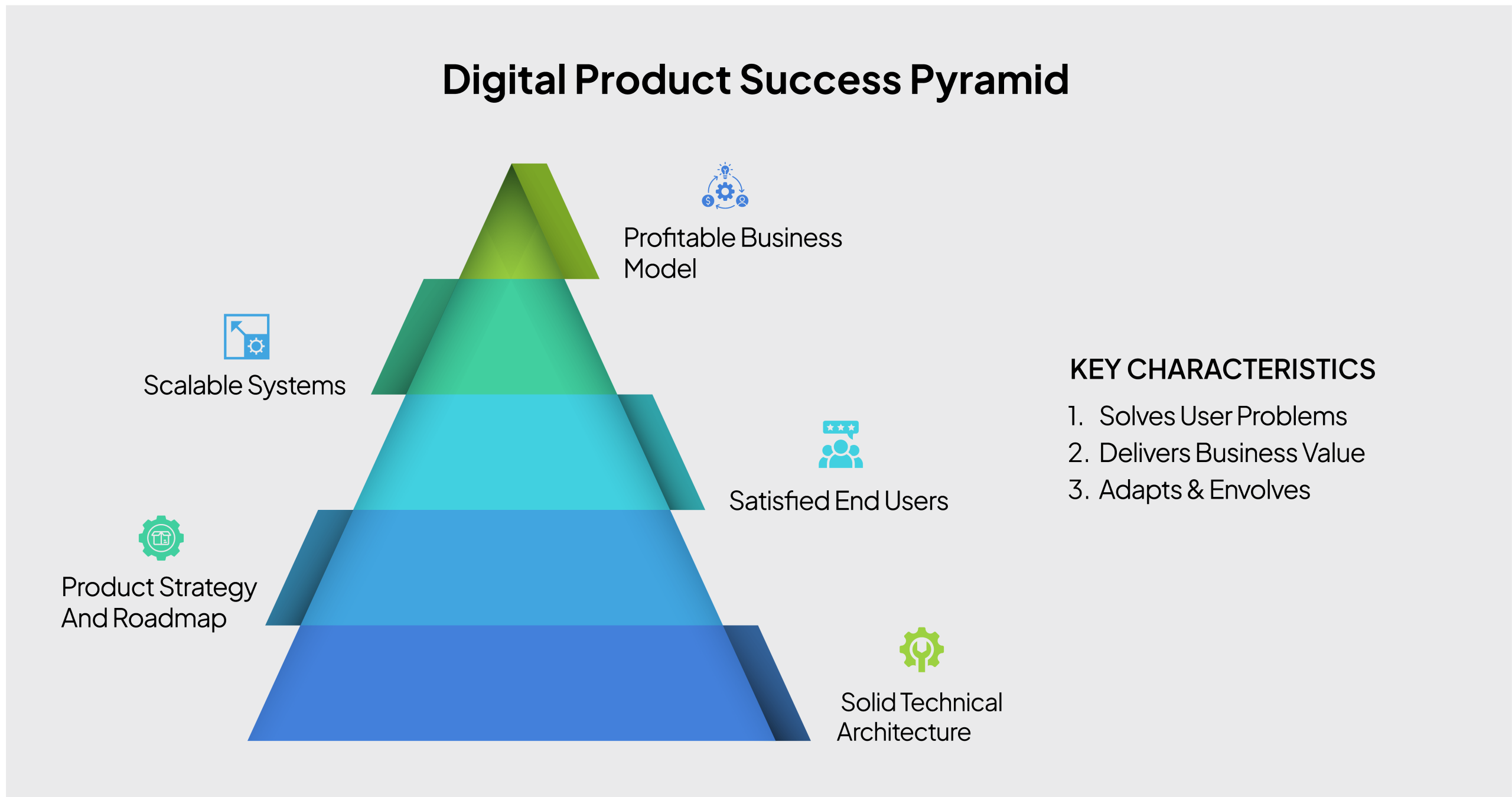
Think of digital product development success as building a thriving city rather than just constructing a single building. For this, you will need:
-
- Strong foundations (solid technical architecture)
- Clear planning (product strategy and roadmap)
- Happy residents (satisfied users)
- Growth infrastructure (scalable systems)
- Economic sustainability (profitable business model)
The most successful digital product development shares three critical characteristics:
- They solve genuine user problems
- They deliver measurable business value
- They adapt and evolve with market demands
According to McKinsey, companies with strong digital product strategies achieve 20% higher revenue growth than their competitors. But success requires more than just good intentions. Let’s try to understand those better.
How to Achieve Product-Market Fit in Today’s Competitive Landscape?
Product-market fit is like finding the perfect dance partner. When you’ve got it, everything flows naturally. Users can’t imagine a life without your product, and growth becomes organic rather than forced.
Marc Andreessen described it in the best way. He said, “Product-market fit means being in a good market with a product that can satisfy that market.”
Sounds simple, right? Yet it’s where most digital product development journeys derail.
Here’s your roadmap to achieving the perfect product-market fit:
The Three Pillars of Product-Market Fit
Pillar 1: Deep Market Understanding
-
- Conduct thorough user research
- Identify genuine pain points
- Analyse competitor gaps
- Validate demand before building
Pillar 2: Focused Problem-Solution Alignment
-
- Define your core value proposition
- Build for specific user segments
- Test assumptions early and often
- Iterate based on real feedback
Pillar 3: Measurable Success Metrics
-
- Track user engagement rates
- Monitor customer acquisition costs
- Measure retention and churn
- Analyse feature usage patterns
The companies that crack product-market fit usually see organic growth rates of 20-40% month-on-month. But 61% of successful products pivot at least once before finding their sweet spot.
Why Do Digital Product Development Fail Despite Having Great Ideas?
Even brilliant ideas crash down when execution goes wrong. It’s like having the perfect recipe but burning the meal because you ignored the cooking instructions.
A research study by CB Insights (The Top 12 Reasons Startups Fail) reveals the top reasons why digital products fail:
The Fatal Five: Digital Product Development Killers
- No Market Need (35%)
- Building products nobody truly wants
- Mistaking assumptions for validated demand
- Skipping discovery and user testing
- Ran Out of Cash / Failed to Raise (38%)
- Underestimating development and growth costs
- Weak financial planning and burn‐rate control
- Funding gaps and poor investor strategies
- Not the Right Team (14%)
- Missing critical technical or domain expertise
- Poor collaboration and communication breakdowns
- Founder conflicts or misaligned visions
- Outcompeted (20%)
- Ignoring competitive dynamics
- Lack of clear differentiation
- Entering the market too late or too slowly
- Pricing / Cost Issues (15%)
- Misaligned pricing models
- Costs exceeding revenue potential
- Inability to adapt pricing to customers’ willingness to pay
Take a look at this table. It shows how identical market opportunities can result in billion-dollar successes or failures. This is purely based on execution decisions and strategic focus.
| Success Factor | Failed Digital Products | Successful Digital Products | Key Differentiator |
| Market Validation | Quibi ($1.75B funding raised) – Built premium short-form content without validating user demand for mobile-first viewing | TikTok – Validated bite-sized video consumption patterns before scaling globally | Extensive user research and demand validation before development |
| Financial Planning | Jawbone ($900M funding raised) – Burned through investor funding without a sustainable revenue model | Zoom – Clear monetisation strategy with profitable growth trajectory | Realistic revenue models and sustainable unit economics |
| Team Composition | Theranos ($945M peak valuation) – Lacked essential medical and technical expertise for core product claims | Slack – Combined technical excellence with deep workplace communication expertise | Right mix of domain expertise and technical capabilities |
| Market Positioning | Google+ (Multi-billion dollar development costs) – Ignored Facebook’s market dominance and user behaviour patterns | WhatsApp – Identified a gap in simple, reliable messaging before market saturation | Clear competitive differentiation and market timing |
| Technical Architecture | Knight Capital ($440M loss in 45 minutes) – Poor system architecture led to catastrophic automated trading failures | Netflix – Built a scalable cloud architecture that handled massive growth easily | Robust, scalable technical foundations from the start |
| User Feedback Integration | Vine (Shut down in 2016) – Failed to monetise creators and compete with Instagram’s video features | Instagram Stories – Adapted Snapchat’s format based on user behaviour and creator needs | Systematic feedback collection and rapid feature iteration |
| Resource Allocation | WeWork ($47B peak valuation to near-bankruptcy) – Misallocated resources on expansion over sustainable business fundamentals | Shopify – Focused resources on e-commerce platform perfection before diversifying | Strategic focus on core value proposition and unit economics |
The most dangerous trap? It is being built in isolation. Successful digital product development requires constant market feedback, strategic pivoting, and technical excellence. Miss any of these, and you’re sailing towards the iceberg.
How to Build a Successful MVP That Users Actually Want?
Your MVP (Minimum Viable Product) isn’t a stripped-down version of your dream product. It’s a smart hypothesis test wrapped in functional software. Think of it as your product’s first date with the market. You want to make a good impression without revealing everything at once.
The most successful MVPs follow the “Build-Measure-Learn” cycle. But here’s what most guides won’t tell you: the secret lies in defining “minimum” correctly.
The MVP Strategy Framework
Step 1: Core Feature Definition
Start with your value proposition. What’s the one thing that makes users think, “I can’t live without this”? Everything else is noise.
-
- Identify your primary user persona
- Define their biggest pain point
- Create the simplest solution possible
- Test the core assumption
Step 2: Feature Prioritisation Matrix
Plot features on two axes: User Value vs Development Effort
-
- High Value + Low Effort = Build first
- High Value + High Effort = Plan for later
- Low Value + Low Effort = Maybe include
- Low Value + High Effort = Definitely skip
Step 3: Success Metrics Definition
Define what “success” looks like before you build anything:
-
- User engagement rates
- Feature adoption percentages
- Customer feedback scores
- Business metric improvements
Spotify’s MVP was just a desktop app that played music. No mobile, no social features, no algorithms. Yet it validated their core hypothesis that people want instant music streaming. Today, they have 500+ million users.
Do you know what’s the best way to ensure MVP success? We will spill the tea on how we successfully deployed 100+ MVPs in 4 weeks’ time!
What Is Technical Debt and How Does It Impact Digital Product Development?
Technical debt is like borrowing money to buy your house. It is useful in the short term, but it accumulates interest that eventually demands payment. In digital product development, it’s the accumulated cost of choosing quick solutions over the right solutions.
The Hidden Costs of Technical Debt in Digital Product Development
Immediate Impact:
-
- Slower feature development
- Increased bug frequency
- Developer frustration and turnover
- Higher maintenance costs
Long-term Consequences:
-
- System scalability limits
- Security vulnerabilities
- Integration difficulties
- Competitive disadvantage
Types of Technical Debt
Code Debt
-
- Poorly written or duplicated code
- Missing documentation
- Inadequate testing coverage
Architecture Debt
-
- Outdated system design
- Tightly coupled components
- Scalability limitations
Technology Debt
-
- Legacy frameworks and libraries
- Outdated development tools
- Security vulnerabilities
Knowledge Debt
-
- Undocumented processes
- Single points of failure
- Limited team expertise
Managing Technical Debt Strategically
The goal isn’t eliminating technical debt but managing it strategically. Some debt is acceptable if it helps you reach the market faster. The trick is knowing which shortcuts are investments and which are disasters waiting to happen.
The 80/20 Rule for Technical Debt:
-
- 80% of your problems come from 20% of your debt
- Focus on high-impact, high-usage code first
- Allocate 20% of development time to debt reduction
How to Use User Feedback to Improve Digital Product Development?
User feedback is your GPS when it comes to digital product development. It tells you where you are, where you’re going wrong, and how to reach your destination. But like any navigation system, garbage in means garbage out.
The most successful digital product development teams don’t just collect feedback. They create systematic feedback loops that drive continuous improvement. Companies that excel at this see 55% higher customer satisfaction scores and 34% better retention rates.
The User Feedback Ecosystem
Collection Channels:
-
- In-app feedback widgets
- User interviews and surveys
- Analytics and behaviour tracking
- Support ticket analysis
- Social media monitoring
Analysis Framework:
-
- Quantitative metrics (usage patterns, conversion rates)
- Qualitative insights (user emotions, pain points)
- Segmentation analysis (different user groups)
- Trend identification (patterns over time)
Action Pipeline:
-
- Feedback prioritisation matrix
- Feature request evaluation
- Bug fixing protocols
- Communication back to users
What are the Four Types of User Feedback
- Feature Requests (What users want)
- Bug Reports (What’s broken)
- Usage Patterns (How users behave)
- Emotional Responses (How users feel)
The magic happens when you connect these dots. For example, if users request feature X, but analytics show they don’t use similar feature Y, dig deeper. Maybe Y has poor usability, or maybe X solves a different problem entirely.
Airbnb’s breakthrough came from user feedback revealing that professional photography increased bookings by 40%. One insight, massive impact.
How to Manage a Digital Product Development Roadmap After an MVP Launch?
Post-MVP roadmap management is where good products become great and great products achieve market leadership. It’s the difference between reactive development and strategic product evolution.
Your MVP proves concept validation, but now you’re drowning in possibilities. Feature requests flood in. Stakeholders have opinions. Competitors launch similar products. How do you navigate this complexity while maintaining product focus?
The Data-Driven Roadmap Framework
Foundation: The Three Pillars
User Data (What do users actually do?)
-
- Feature usage analytics
- User journey mapping
- Conversion funnel analysis
- Retention cohort studies
Business Metrics (What drives growth?)
-
- Revenue impact analysis
- Customer acquisition costs
- Lifetime value trends
- Market positioning data
Technical Reality (What’s possible and sustainable?)
-
- System scalability limits
- Development effort estimates
- Technical debt implications
- Resource availability
How Do You Decide Which Features to Build First After Your MVP Launch?
After your MVP launches, you’ll be overwhelmed with feature requests, user feedback, and stakeholder demands. The question isn’t what you could build. It’s what you should build first to maximise impact with limited resources.
Think of it like renovating a house with a tight budget. You need to prioritise improvements that give you the biggest return on investment. At the same time, it should keep your family happy and the structure sound.
The Smart Feature Priority Framework for Digital Product Development
Every potential feature falls into one of four categories:
Quick Wins (Do These First)
-
- Easy to build, big user impact
- Example: Adding a “save for later” button
- Why: Fast user satisfaction boost with minimal effort
Strategic Investments (Plan These Next)
-
- Hard to build, but crucial for long-term success
- Example: Advanced analytics dashboard
- Why: Positions you ahead of competitors
User Delight (Do When Resources Allow)
-
- Nice-to-have features that create emotional connection
- Example: Fun animations or personalised messages
- Why: Builds loyalty and word-of-mouth marketing
Technical Foundations (Essential but Invisible)
-
- Backend improvements users don’t see but need
- Example: Database optimisation or security upgrades
- Why: Prevents future disasters and enables growth
The Evolution Strategy Matrix for Your Minimum Viable Product
Here is a matrix showing feature prioritisation based on User Impact, Business Value vs Technical Feasibility.
| Category | User Impact | Business Value | Technical Effort | Examples |
| Quick Wins | High | High | Low | UX improvements, onboarding fixes |
| Strategic Investments | High | High | High | AI-driven features, major product modules |
| User Delight | High | Medium/Low | Variable | Gamification, customisation |
| Technical Foundations | Low | Medium/High | High | Infrastructure, APIs, data pipelines |
The key is balancing what users want, what your business needs, and what’s technically realistic. Most successful digital product development tackles Quick Wins first. Then alternate between Strategic Investments and Technical Foundations while sprinkling in User Delight features.
Post-Launch Roadmap Phases in Digital Product Development
Phase 1: Stabilisation (Months 1-3)
-
- Fix critical bugs and usability issues
- Optimise core user flows
- Implement basic analytics
- Gather comprehensive user feedback
Phase 2: Growth (Months 4-12)
-
- Add features that increase engagement
- Implement monetisation strategies
- Expand to new user segments
- Improve onboarding and retention
Phase 3: Scale (Year 2+)
-
- Platform expansion opportunities
- Advanced feature development
- Market leadership positioning
- Innovation and disruption
Instagram started as Burbn, a check-in app that allows photo sharing. Post-MVP data showed users only engaged with photos. They pivoted, simplified, and built a billion-dollar platform.
Transform your post-launch strategy into a growth engine. Our product management experts help companies turn MVP success into market dominance. Ready to scale strategically? Let’s discuss this over a call.
What Is a Digital Product Development Lifecycle?
The digital product development lifecycle is your strategic blueprint. It is a systematic approach that transforms ideas into market-leading products.
Think of it as building a skyscraper. You wouldn’t start with the penthouse. Every successful digital product development in Emvigo starts with a ‘Discovery Phase’. It is then followed by proven phases, each with specific goals, deliverables, and success criteria.
The Complete Digital Product Development Lifecycle
Phase 1: Discovery and Strategy (Weeks 1-4)
-
- Market research and competitive analysis
- User persona development
- Problem validation and opportunity sizing
- Technical feasibility assessment
- Business model definition
Phase 2: Design and Planning (Weeks 5-8)
-
- User experience design and wireframing
- Technical architecture planning
- Feature specification and prioritisation
- Resource allocation and timeline planning
- Risk assessment and mitigation strategies
Phase 3: MVP Development (Weeks 9-13)
-
- Core feature development
- Quality assurance and testing
- Security implementation
- Performance optimisation
- Launch preparation
Phase 4: Launch and Validation (Weeks 13-16)
-
- Soft launch to a limited audience
- User feedback collection and analysis
- Performance monitoring and optimisation
- Market validation and pivot decisions
- Scale-up preparation
Phase 5: Growth and Evolution (Ongoing)
-
- Feature expansion based on data
- Market expansion strategies
- Scaling infrastructure and team
- Competitive positioning
- Innovation and disruption planning
Navigating the Journey: What Tools and Teams Drive Digital Product Development Success?
Navigating digital product development requires the right combination of tools, processes, and expertise.
The Core Team Architecture
Strategic Layer:
-
- Product Manager (the conductor)
- UX/UI Designer (the user advocate)
- Technical Lead (the architect)
Development Layer:
-
- Frontend Developers (the user interface crafters)
- Backend Developers (the system builders)
- DevOps Engineers (the scalability experts)
Quality Layer:
-
- QA Engineers (the guardians of excellence)
- Security Specialists (the protection experts)
- Data Analysts (the insight generators)
Essential Tool Stack for Digital Product Development
Planning and Strategy:
Design and Development:
Monitoring and Analytics:
The Partnership Decision Matrix in Digital Product Development
Smart companies recognise that building everything in-house isn’t always optimal. The key is knowing when to build, when to buy, and when to partner.
When to Build In-House:
-
- Core competency areas
- Long-term competitive advantages
- Highly customised requirements
- Sensitive intellectual property
When to Partner Strategically:
-
- Specialised expertise needs
- Rapid scaling requirements
- Cost-effective skill access
- Risk-sharing opportunities
How Does Strategic Partnership Accelerate Digital Product Success?
The companies that win with their digital product development aren’t necessarily those with the biggest teams. They’re the ones with the smartest partnerships. A strategic development partner acts as your true guiding force, bringing expertise, experience, and efficiency to your product journey.
Here’s what separates great partnerships from mere outsourcing:
The Co-Pilot Partnership Model
-
- Strategic Alignment: Your partner understands your business goals, not just your technical requirements. They contribute to product strategy, not just code delivery.
- Complementary Expertise: They fill skill gaps in your team whilst enhancing your existing capabilities. Think specialised knowledge in AI, blockchain, or advanced analytics.
- Scalable Flexibility: The partnership adapts to your needs—scaling up for launches, scaling down between releases, bringing in specialists for specific challenges.
- Knowledge Transfer: Great partners don’t create dependency; they build your internal capabilities whilst delivering results.
Partnership Success Metrics
-
- Faster time-to-market (typically 30-50% improvement)
- Higher code quality scores
- Reduced technical debt accumulation
- Enhanced team capabilities
- Better risk management
What’s the Future of Digital Product Development Success?
Artificial intelligence, machine learning, and automation are reshaping how we build, deploy, and optimise products. But here’s the crucial insight: technology amplifies strategy, it doesn’t replace it. Let’s check out some of the emerging trends that add momentum to the digital product development niche.
AI-Powered Development:
-
- Automated code generation and testing
- Intelligent user behaviour prediction
- Personalised product experiences
- Predictive maintenance and optimisation
Low-Code/No-Code Evolution:
-
- Faster prototyping capabilities
- Democratised product development
- Rapid market validation tools
- Enhanced collaboration between technical and non-technical teams
Ecosystem Integration:
-
- API-first architectures
- Microservices and containerisation
- Cloud-native development approaches
- Real-time data synchronisation
User-Centric Design:
-
- Voice and conversational interfaces
- Augmented and virtual reality experiences
- Accessibility-first development
- Sustainable and ethical design principles
Don’t let the complexity of modern digital product development overwhelm your vision. Ready to build a product that doesn’t just survive but leads? Meet the best MVP Development Team in the UK to discover more!
Why Digital Product Development Success Is Your Only Insurance Policy Against Market Irrelevance
The corporate graveyard is overflowing with companies that had brilliant ideas but catastrophic execution. Kodak invented the digital camera, but let competitors dominate the market it created. Blockbuster had the infrastructure to crush Netflix, but chose comfort over innovation. These aren’t ancient history, but warnings from the recent past.
But here’s where most companies get it wrong. They assume digital transformation is about technology. It’s not. It’s about systematic value creation that compounds over time. Your market position isn’t static. It’s either decaying or accelerating.
Your next move determines whether you’ll be writing the disruption story or becoming a chapter in someone else’s success.
Ready to secure your market position before your competitors realise the game has changed?
Secure Your Competitive Future – Book Your First Free Strategic Consultation Call
In the race for market relevance, second place means invisible. Let’s ensure you cross the finish line first.
Frequently Asked Questions on Digital Product Development
How long does it typically take to develop a successful digital product?
Most successful digital products take 3-6 months for MVP development and 12-18 months to achieve market leadership. However, the timeline varies significantly based on complexity, market conditions, and team capabilities. Emvigo has a rapid development model that will deliver your MVP in just 4 weeks.
What’s the most critical factor in digital product success?
Product-market fit remains the most critical factor. You can have great technology and lots of money. But if you don’t solve a real problem for a specific market, you won’t succeed.
How much should I budget for digital product development?
MVP development typically costs £50,000-£200,000, while full product development ranges from £200,000-£1,000,000+. Emvigo offers product development packages starting at £1500. The key is strategic investment, spending wisely on validation before scaling.
When should I consider partnering with a digital product development company?
Consider strategic partnerships when you need specialised expertise, want to accelerate time-to-market, or require flexible scaling capabilities. The best time is often during the strategy and MVP phases.
How do I know if my digital product is ready for market?
Your product is ready for the market when it solves a key user problem. It should show a clear value. Positive user engagement metrics are also important. Finally, it needs a strong technical foundation.