

AI demand planning software combines demand forecasting with inventory, supply and business data to help companies decide what to stock, when to replenish and how much to order.
The potential impact is measurable. In an AWS-documented More Retail implementation involving more than 6,000 store-SKU combinations, forecasting accuracy increased from 24% to 76%, fresh-produce wastage fell by up to 30%, in-stock rates improved from 80% to 90%, and gross profit increased by 25%. These were results from that specific implementation, not a universal benchmark.
For a company considering custom development, the important question is therefore not whether AI can forecast demand. It is how to build a planning system that turns forecasts into better inventory, procurement and supply decisions.
What Is AI Demand Planning Software?
AI demand planning software uses historical and operational data to forecast future demand and support decisions around inventory, procurement, replenishment and supply.
A forecasting system might produce:
Expected demand: 10,000 units
A demand planning platform adds the variables required to act on that prediction:
The planning engine can then determine whether additional stock is required and generate a replenishment recommendation based on the organisation’s rules.
Demand forecasting predicts what customers may buy. Demand planning combines that prediction with inventory, supply constraints and business rules to determine what the business should do next.
For businesses assessing the feasibility of an AI forecasting use case, Emvigo’s AI consulting services cover forecasting models, data readiness, model evaluation, ERP integration and human-in-the-loop workflows.
AI Demand Planning vs Inventory Forecasting
The distinction matters because AI demand planning is broader than inventory forecasting.
| Capability | Inventory forecasting | AI demand planning |
|---|---|---|
| Future demand prediction | ✓ Yes | ✓ Yes |
| SKU-level forecasting | ✓ Yes | ✓ Yes |
| Seasonality | ✓ Yes | ✓ Yes |
| Promotion effects | ~ Sometimes | ✓ Yes |
| Inventory constraints | ✓ Yes | ✓ Yes |
| Supplier lead times | ~ Limited | ✓ Yes |
| Scenario planning | ~ Limited | ✓ Yes |
| Replenishment recommendations | ~ Sometimes | ✓ Yes |
| Planner overrides | ~ Limited | ✓ Yes |
| S&OP support | ✕ No | ✓ Yes |
| ERP/WMS integration | ~ Sometimes | ✓ Yes |
Inventory forecasting primarily answers:
How much stock are we likely to need?
AI demand planning answers:
Given expected demand, inventory, supply constraints and business rules, what should we purchase, produce, allocate or replenish?
This distinction also matches Emvigo’s own content structure: the site’s content plan separates AI Inventory Forecasting Software Development as the stock-focused topic and AI Demand Planning Software Development as the broader planning/S&OP topic.
If your requirement ends with SKU-level forecasts, a forecasting application may be enough. If forecasts need to drive procurement, replenishment and supply decisions, you need a planning layer around the model.
Forecasting at Scale
Forecasting becomes an engineering and data problem as the number of SKUs, locations and forecast horizons increases.
For example:
5,000 SKUs × 20 locations = 100,000 SKU-location combinations.
That is before adding multiple channels or forecast horizons.
More Retail’s AWS-documented implementation dealt with more than 6,000 store-SKU combinations across its supermarket network. The retailer used Amazon Forecast alongside an automated ordering system to address the limitations of manual store-level forecasting.
At this scale, a demand planning platform needs to account for:
-
- SKU
- Location
- Product category
- Sales channel
- Forecast horizon
- Seasonality
- Promotions
- Pricing
- Inventory availability
- Supplier lead times
What data should feed the forecast?
AWS’s demand forecasting architecture identifies sources including POS, ERP, CRM, manufacturing and distribution systems, product vendors and logistics partners.
A custom platform can therefore combine:
One important data issue is stockout distortion.
If a product sells zero units because it was unavailable, that zero should not automatically be treated as genuine zero demand. Otherwise, the model can learn that the product is less popular than it actually is.
For broader context on how predictive analytics uses historical data to forecast future outcomes, see Emvigo’s AI predictive analytics guide.
Scenario Planning: What If Demand Changes?
Scenario planning lets planners test alternative demand and supply assumptions before committing to a plan.
For example, consider an illustrative planning scenario:
-
- Base demand: 100,000 units
- Demand increase: 15%
- Revised demand: 115,000 units
A second scenario could increase supplier lead time from 10 to 18 days.
These figures are illustrative examples, not industry benchmarks.
A production scenario engine can then calculate the effect on:
-
- Required inventory
- Replenishment quantities
- Safety stock
- Stockout exposure
- Supplier requirements
- Expected service levels
The important capability is not the specific numbers. It is allowing planners to change an assumption and immediately see the effect on the rest of the plan.
For example:
Promotion extended → demand assumption changes → forecast changes → inventory requirement changes → replenishment recommendation changes.
That is more useful than maintaining separate spreadsheet versions for every possible scenario.
How AI Demand Planning Supports S&OP
AI demand planning can provide the forecast, scenarios and exception data required for a structured Sales and Operations Planning (S&OP) process.
A practical workflow is:
Demand forecast → Demand review → Supply review → Scenario analysis → Consensus plan → Execution
The platform can bring together:
Demand
-
- AI-generated forecast
- Sales inputs
- Promotional plans
- Market signals
Supply
-
- Supplier capacity
- Lead times
- Inventory
- Production constraints
Financial inputs
-
- Revenue expectations
- Inventory costs
- Margin assumptions
Decision layer
-
- Approved demand plan
- Supply constraints
- Exceptions
- Selected scenario
The system should also preserve planner changes.
This gives management visibility into what the model predicted, what changed and what was ultimately approved.
For the reporting and decision-support layer, Emvigo’s Analytics & Business Intelligence services include predictive and prescriptive analytics, large-scale data processing and dashboards.
Integrating AI Demand Planning With ERP, WMS and POS
An enterprise demand planning platform needs reliable data exchange with the systems that contain sales, inventory, purchasing and supply information.
A typical flow is:
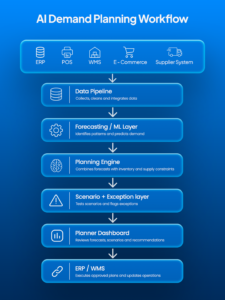
ERP
Typical inputs include:
-
- Product information
- Inventory
- Purchase orders
- Supplier information
POS
Provides actual sales by:
-
- Product
- Location
- Date
- Channel
E-commerce
Can provide:
-
- Online orders
- Product demand
- Returns
- Channel performance
WMS
Can provide:
-
- Warehouse stock
- Goods received
- Stock movements
- Fulfilment information
Supplier systems
Can provide:
-
- Lead times
- Delivery status
- Availability
- Purchase-order information
AWS’s reference architecture similarly describes collecting data from enterprise systems, processing it through data pipelines, generating forecasts and distributing outputs to business applications.
For the application and integration layer, Emvigo’s custom software development services include custom enterprise systems, data-driven solutions and API/integration services.
How Accurate Is AI Demand Planning Software?
There is no universal accuracy percentage for AI demand planning; performance should be measured against a defined baseline for the specific products, locations and forecast horizon.
Performance can vary according to:
-
- Historical data quality
- Demand volatility
- Forecast horizon
- Product category
- Stockout frequency
- Promotion frequency
- Forecast granularity
- Model selection
Metrics to measure
WAPE — Weighted Absolute Percentage Error
Useful for evaluating aggregate forecast error while accounting for different demand volumes.
MAE — Mean Absolute Error
Shows the average absolute error in the original demand units.
RMSE — Root Mean Squared Error
Places greater weight on larger forecasting errors.
MASE — Mean Absolute Scaled Error
Compares forecasting performance against a baseline method.
AWS documents multiple forecasting evaluation metrics, including WAPE, RMSE, MASE and weighted quantile loss.
Measure accuracy by segment
A production dashboard should allow performance to be broken down by:
-
- SKU
- Category
- Location
- Channel
- Forecast horizon
A single statement such as “the AI model is 91% accurate” is therefore not enough to evaluate an enterprise planning system.
When probabilistic forecasts are useful
Some planning decisions need more than one expected value.
AWS notes that P75 can be more informative than P50 in retail where the cost of understocking is higher than the cost of overstocking.
A documented real-world result
In the More Retail implementation, AWS reports that forecasting accuracy increased from 24% to 76%, with wastage reduced by up to 30%, in-stock rates improving from 80% to 90%, and gross profit increasing by 25%.
These figures demonstrate what that implementation achieved. They should not be presented as expected results for a new demand planning project.
Where AI Demand Planning Can Fail
AI demand planning is not equally reliable for every demand pattern, particularly when historical data does not represent future conditions.
New products
A newly launched SKU may have little or no historical demand.
The system may need to use:
-
- Similar-product data
- Category-level patterns
- Product attributes
- Planner input
Sudden demand shocks
A viral product, unexpected event or major market disruption can create demand that historical patterns cannot predict.
Supply-driven distortions
A product can appear to have low demand because it was repeatedly unavailable.
Intermittent demand
Products with long periods of zero sales followed by irregular orders can be difficult to forecast reliably.
Structural business changes
Entering a new market, changing distribution channels or discontinuing products can invalidate historical relationships.
A production system should therefore include exception handling, planner overrides, scenario planning and model monitoring rather than assuming that the AI forecast is always correct.
How to Build AI Demand Planning Software
The safest development approach is to start with a measurable planning problem, establish the current baseline and then build the AI and planning layers around it.
1. Define the planning use case
Start with one measurable objective.
For example:
Reduce stockouts for the top 2,000 SKUs across 50 stores.
Define:
-
- Products
- Locations
- Forecast horizon
- Planning frequency
- Existing forecasting method
- Target business KPI
2. Audit the data
Check:
-
- Historical sales
- Inventory records
- Stockout periods
- SKU changes
- Promotion history
- Product hierarchy
- Supplier data
- Data completeness
Do this before choosing the model.
3. Establish a baseline
Measure the current forecasting process first.
Then compare candidate AI/ML models against it.
The key question is:
Does the new model perform better than the existing method for the business problem being solved?
4. Train and evaluate models
Depending on the demand pattern and dataset, the development team can evaluate statistical, machine-learning and deep-learning approaches.
AWS’s demand forecasting documentation describes model complexity ranging from autoregressive approaches such as ARIMA to deep-learning approaches such as DeepAR.
The selection should be based on:
-
- Backtesting
- Forecast error
- Bias
- Business impact
- Operational cost
5. Build the planning layer
The forecast needs to interact with business rules.
For example:
Forecast demand
-
- Current inventory
- Inventory in transit
- Supplier lead time
- Safety-stock rules
- MOQ
→ Recommended replenishment
The exact calculation should reflect the organisation’s inventory policy.
6. Add planner workflows
Planners should be able to:
-
- Review forecasts
- See exceptions
- Adjust assumptions
- Compare scenarios
- Override recommendations
- Approve plans
- Track changes
The objective is not necessarily to remove planners. It is to let AI process large volumes of demand data while humans handle exceptions and business context.
7. Integrate and monitor
After validation, connect the platform to the systems where planning decisions are executed.
Monitor:
-
- Forecast accuracy
- Forecast bias
- Data quality
- Model performance
- Planner overrides
- Demand-pattern changes
What Should an AI Demand Planning MVP Include?
A demand planning MVP should prove one high-value planning use case rather than attempting to automate the entire supply chain.
For example, an MVP could focus on:
2,000 SKUs × 50 stores × 12-week forecast horizon
That gives the development team a defined scope and allows the business to determine whether the system improves the selected KPI before expanding into additional markets and categories.
If you want to validate the product as an MVP before committing to a larger enterprise build, Emvigo also offers MVP development services with a four-week delivery framework for suitably scoped products.
AI Demand Planning Software Development Cost and Timeline
The cost depends mainly on data complexity, integration requirements, planning workflows and the scale of the forecasting environment.
There is no credible universal market price for AI demand planning software specifically.
Instead of inventing a “typical demand planning cost”, a more defensible way to budget is to use an actual development rate and calculate the engineering effort.
That gives these straightforward planning examples:
These are arithmetic planning examples based on the published hourly range, not quoted demand-planning project prices.
Indicative development stages
These timeframes are planning estimates, not industry benchmarks.
What increases the cost?
Data engineering
Fragmented, incomplete or inconsistent data requires additional preparation and validation.
SKU-location scale
100,000 SKU-location combinations require substantially more processing and testing than a small pilot.
Integrations
ERP, WMS, POS, e-commerce and supplier integrations increase development and testing effort.
Planning complexity
Scenario planning, approval workflows, planner overrides and audit trails require application engineering beyond the forecasting model.
AI requirements
Custom modelling, retraining, monitoring and probabilistic forecasts increase ML engineering requirements.
Infrastructure and security
A production platform requires access controls, monitoring, deployment infrastructure and appropriate data protection.
For projects where the main requirement is custom enterprise software rather than just a forecasting model, Emvigo’s custom software development services cover custom enterprise systems, data-driven solutions and API/integration services.
Build vs Buy AI Demand Planning Software
Buy when established planning functionality covers your process; build when your planning logic, integrations or workflows are sufficiently specific to justify ownership of the platform.
A buyer considering the build route should also evaluate established supply-chain planning platforms such as:
-
- o9 Solutions
- Blue Yonder
- Kinaxis
- SAP Integrated Business Planning
- Oracle Supply Chain Planning
The comparison should be based on more than licence price.
Who should consider custom development?
Custom development is more compelling when the business has:
-
- A large SKU/location structure
- Existing ERP/WMS/POS systems requiring custom integration
- Proprietary planning rules
- A need for specialised scenario modelling
- A mature data environment
- A clear business KPI that the platform needs to improve
- A requirement to control the product roadmap
It is less compelling when the business has limited historical data, a small product range or requirements already covered by an established supply-chain platform.
What to Ask an AI Demand Planning Development Company
A credible development partner should be able to explain how it will validate the data, measure the model and connect the output to operational decisions.
1. How will you establish our current forecasting baseline?
Look for: A measurable assessment of the existing forecasting process before any claim that AI will improve it.
2. How will you handle stockouts and missing demand signals?
Look for: A data strategy that distinguishes genuine low demand from periods when products were unavailable.
3. Which metrics will you use to evaluate the model?
Look for: WAPE, MAE, RMSE, MASE or appropriate probabilistic metrics, segmented by product and forecast horizon rather than one headline accuracy figure.
4. How will you integrate with our ERP and WMS?
Look for: A clear data-flow diagram showing where information originates, how it is transformed and where planning recommendations go.
5. Can planners override the AI?
Look for: Controlled overrides, approval workflows and an audit trail.
6. How will you monitor the model after launch?
Look for: Data-quality monitoring, accuracy tracking, drift detection and a retraining or review process.
For a broader vendor-selection framework, Emvigo’s questions to ask a software development company covers delivery process, pricing, QA, IP ownership and post-launch support.
Why Choose Emvigo for AI Demand Planning Software Development?
An AI demand planning platform requires more than an ML model; it combines AI, data engineering, analytics, application development and system integration.
Emvigo’s current service offering covers:
-
- Advanced AI and ML
- AI consulting
- Analytics and Business Intelligence
- Custom software development
- API and system integration
- Cloud and DevOps support
Emvigo’s AI consulting service specifically lists demand forecasting as an ML application-development use case and also covers data pipelines, ERP integration, model evaluation and human-in-the-loop workflows.
Its Discovery & Scoping service is also relevant at the beginning of a demand-planning project because it focuses on requirements, technical feasibility, stakeholder alignment and scope definition before development.
That combination matters because the first question should be whether the data and planning process are ready for AI, not which model to deploy.
Conclusion
AI demand planning software creates value when it connects forecasting with operational decisions.
The strongest implementations combine:
Forecasting + inventory data + supply constraints + scenario planning + planner workflows + enterprise integrations.
The AWS-documented More Retail implementation reported improvements across forecasting accuracy, wastage and product availability, demonstrating the potential business impact of AI demand planning.
For a custom project, the better starting question is:
Which planning decision are we trying to improve, what data supports it, and how will we measure the improvement?
Establish that baseline first. Then validate the data, build a focused forecasting MVP, connect it to the planning workflow and expand into scenario planning and S&OP only after the initial use case has demonstrated value.
FAQs
What is AI demand planning software?
AI demand planning software uses historical and operational data to forecast future demand and support decisions around inventory, procurement, replenishment and supply planning.
What is the difference between AI demand planning and inventory forecasting?
Inventory forecasting primarily estimates future stock requirements. AI demand planning combines forecasts with inventory, supply constraints, lead times, scenarios and business rules to support broader planning decisions.
Can AI demand planning software support scenario planning?
Yes. A demand planning platform can allow planners to change assumptions such as demand, promotions, supplier lead times or inventory constraints and calculate how those changes affect the resulting plan.
How accurate is AI demand planning software?
There is no universal accuracy figure. Performance depends on data quality, demand patterns, forecast horizon and model selection. WAPE, MAE, RMSE, MASE and probabilistic metrics can be used to evaluate performance against a baseline.
Can AI demand planning software integrate with ERP and WMS?
Yes. A custom platform can exchange inventory, product, purchasing and supply information with ERP and WMS systems and return forecasts or planning recommendations to those systems.
How much does AI demand planning software development cost?
There is no fixed industry price. Data engineering, SKU and location scale, AI complexity, integrations, planning workflows and infrastructure are major cost drivers. Using a published development rate of $25–$49/hour, for example, 2,000 engineering hours would represent $50,000–$98,000 before other project-specific costs. This is a planning calculation, not a quoted demand-planning project price.