
Editorial disclosure: Emvigo is an AI agent development company and the publisher of this guide. Every company in this guide — including Emvigo — is described using the same fields, in the same neutral tone, with its real, verified Clutch rating linked directly to its review profile. Our own opinion on which company we’d pick, and why, is set apart in a separate, clearly labelled “Editor’s Choice” section near the end.
TL;DR: Choosing an AI agent development company in 2026 means picking a partner who can move you past demo-stage chatbots into governed, production-grade autonomous AI agents — systems that plan, use tools, call your CRM/ERP/APIs, and verify their own output. This guide lists 12 Clutch-verified AI agent development companies, each rated 4.0★ or higher with ratings hyperlinked to their live review profiles, presented in the same format so you can compare on facts. The guide also includes a 7-point vendor checklist, a 30-day pilot framework, and answers to common questions about agentic AI development and AI agent software development costs.
Introduction
In 2024–2025, companies were “experimenting” with AI agents. By 2026, the question has changed — leaders now want partners who can take agents to production without risking security, uptime, or compliance.
A proof-of-concept agent is easy. A production-grade agent that touches your CRM, ERP, data warehouse, and owns real workflows (support, finance ops, DevOps, demand gen) is a completely different challenge — and it’s the reason AI agent development services have become one of the fastest-growing categories on Clutch, the leading B2B ratings platform for software and AI vendors.
That’s why choosing the right AI agent development company matters. You’re not buying a chatbot — you’re choosing:
-
- How safely your data flows across tools
- How quickly you can build and iterate agents
- Whether your agents survive real load, edge cases, and audits
This guide highlights 12 AI agent development companies actually shipping enterprise-ready agents — not demo bots. Every company listed is Clutch-verified with a rating of 4.0 or higher, and every rating links directly to the live, verified profile so you can read the underlying reviews yourself.
Use this as a shortlist, not a popularity ranking. The best choice depends on your stack, budget, and how “agent-first” you want your operations to be.
Click Here to jump straight to the comparison
How We Selected These AI Agent Development Companies
When we say “production-grade agents,” we’re evaluating:
-
- Real deployments, not just demos – documented, verified client reviews, not just a landing page.
- Verified reputation – every company on this list is listed on Clutch with a published rating of 4.0★ or above, based on real client reviews.
- Agent orchestration & tool use – ability to handle multi-step workflows, tools, APIs, RAG, and policy guardrails, not just single prompts.
- Security, compliance & governance – options for VPC/on-prem, role-based access, audit logs, monitoring, evals.
- Enterprise support & ecosystem – integrations with CRM, ITSM, data platforms, and collaboration tools.
- Services/consulting muscle – a team that can help you go from PoC to scaled roll-out, not just self-serve dashboards.
What Does “AI Agent Development” Actually Mean?
Before comparing AI agent development services, let’s clear up the confusion. When a vendor says “we build AI agents,” they could mean three very different things:
1. Basic AI Assistant
Answers questions, drafts emails, summarises documents. Essentially a smart chatbot with no real autonomy.
2. Workflow Automation
Fixed sequences with deterministic triggers. Think “if this happens, do that.” Useful, but not adaptive — this is closer to traditional business process automation than agentic AI.
3. True Agentic System
This is where it gets interesting. A real agentic AI system can:
-
- Plan multi-step tasks
- Pick and use tools dynamically
- Call internal systems (CRM, databases, APIs)
- Run actions and verify the results
- Loop and adapt until a goal is met
Modern AI agent frameworks increasingly rely on MCP (Model Context Protocol) — a standard connectivity layer that lets your agent talk to internal tools without building custom integrations for every single connection. If you’re comparing agentic AI vs generative AI, the distinction matters: generative AI produces content, agentic AI takes action.
Bottom line: If a vendor isn’t building true agentic systems, you’re buying a demo, not something your team will actually depend on.
The Top 12 AI Agent Development Companies (2026 Shortlist)
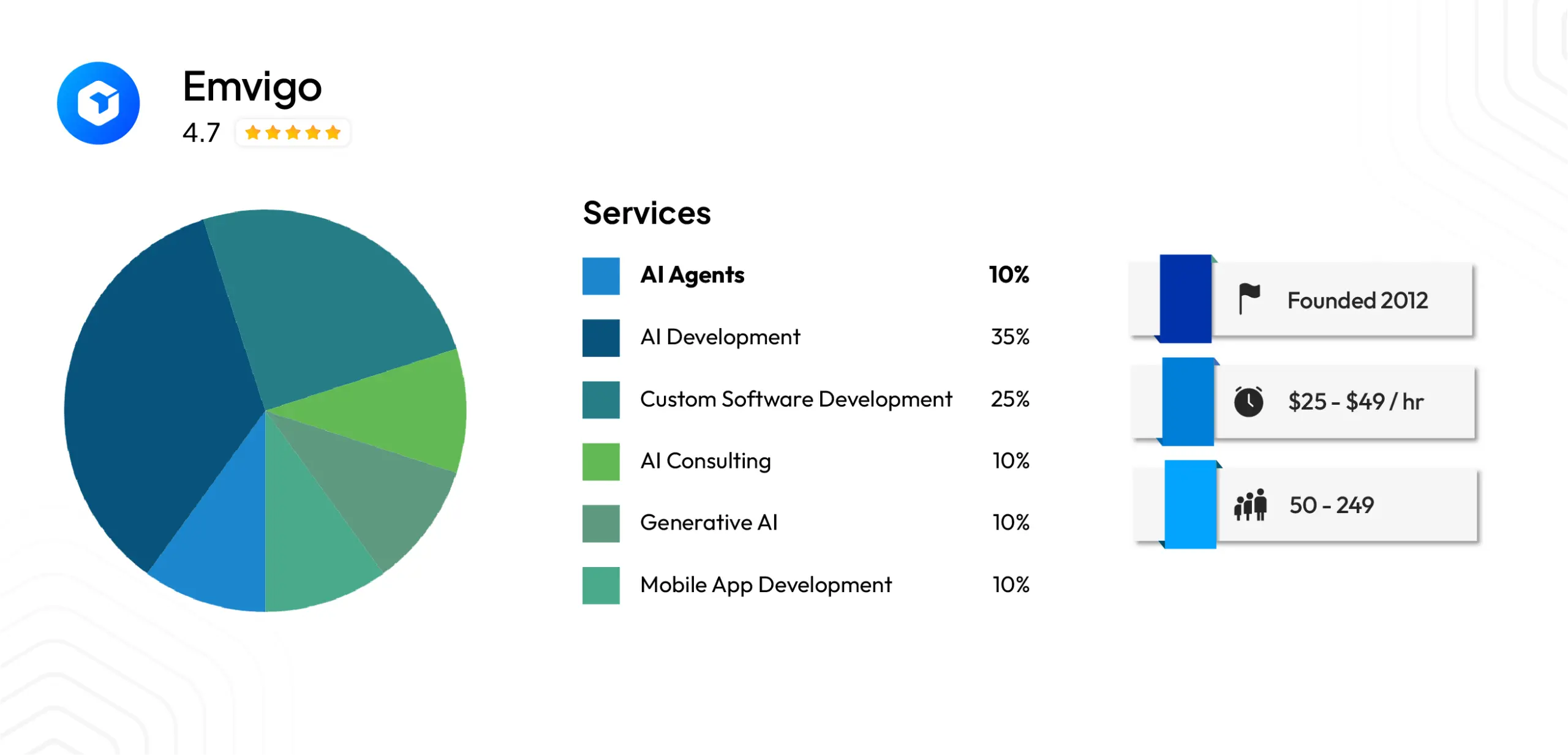
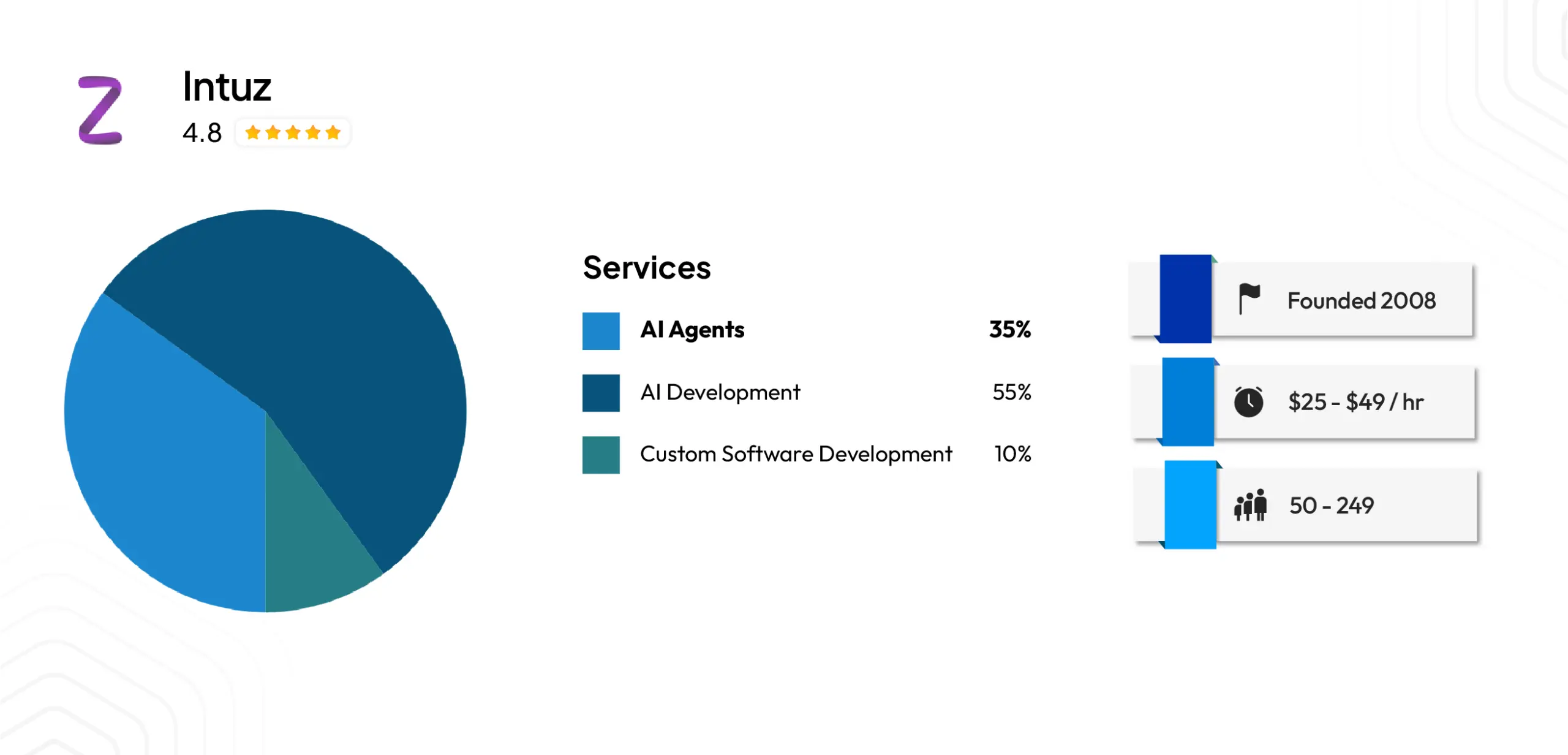
Every company below is Clutch-verified with a published rating of 4.0★ or higher. Each entry follows the same format — heading with a best-for tagline, then Clutch rating, location & team size, AI Agents share of service mix, what they do, best for as bullet points — so you can compare on facts rather than framing. Companies are ordered alphabetically after Emvigo, which is listed first per this article’s publisher disclosure (see top of page), not by performance ranking.
1. Emvigo (Agentic features inside a broader software build)
-
- Clutch rating: 4.7/5
- Location / team size: London, UK & India
- Avg. hourly rate: $25 – $49/hr
What they do: Emvigo is a UK- and India-based custom software development company, ISO 9001:2015 certified, offering AI/ML development, mobile app development, cloud architecture, and DevOps alongside a dedicated Agentic AI Solutions practice. Their agentic AI process runs through four stages — problem discovery & agent blueprinting, agent design (planner/executor/verifier architecture), development & integration (LLM/NLP, tool-use, API and workflow connectors), and testing/deployment/monitoring. Sample builds include autonomous research agents, workflow orchestrators, support agents that triage-escalate-respond-log, and data-pipeline/analytics agents. Clutch reviews cite project sizes from $2,500 to $300,000 and note strengths in flexibility and client communication, with UI/creative design flagged as an area to watch.
Best for: Teams that want agentic features scoped and built inside a wider custom software or MVP engagement, with integration into existing systems.
2. Intuz (Multiple connected voice and workflow agents)
-
- Clutch rating: 4.8/5
- Location / team size: San Ramon, CA
- Avg. hourly rate: $25 – $49/hr
What they do: Intuz is an AI-first development company based in San Ramon, California, building custom AI agents and automation solutions on AWS and PyTorch-based stacks. A documented project for a home health agency involved building multiple connected agents in one engagement — a voice AI agent for intake calls, a fax-reader agent to digitise incoming documents, and back-office support tools — rather than a single standalone bot. Reviews highlight organised project management, budget-conscious delivery, and strong alignment with client values across 14 industries including healthcare, e-commerce, and IT.
Best for: Teams needing multiple connected agents (voice, document processing, back-office) built as one coordinated system.
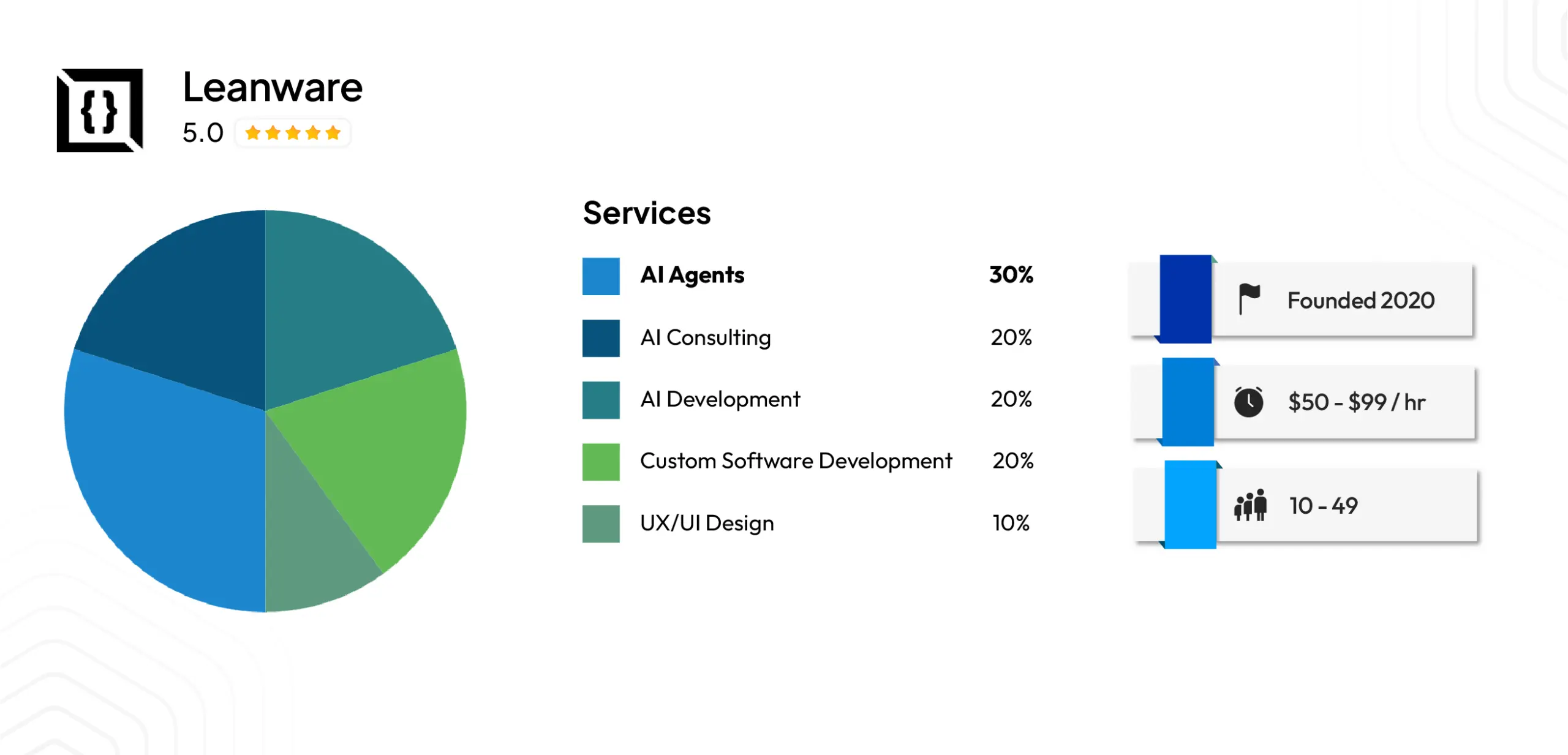
3. Leanware (Fast AI integration for startups)
-
- Clutch rating: 5.0/5
- Location / team size: Bogotá, Colombia / 10–49
- Avg. hourly rate: $25 – $49/hr
What they do: Leanware is a Bogotá-based software development company building web and mobile apps, AI integration, and UI/UX design, with AI Agents as its single largest service line. Clients cite improved functionality and responsiveness after AI and frontend development work, including efficiency gains from a scalable design system. Reviews describe qualified, attentive developers and note no significant areas for improvement across its six core industries — IT, healthcare, eCommerce, financial services, and others.
Best for: Early-stage and growth-stage startups needing an agentic AI feature shipped alongside broader product development.
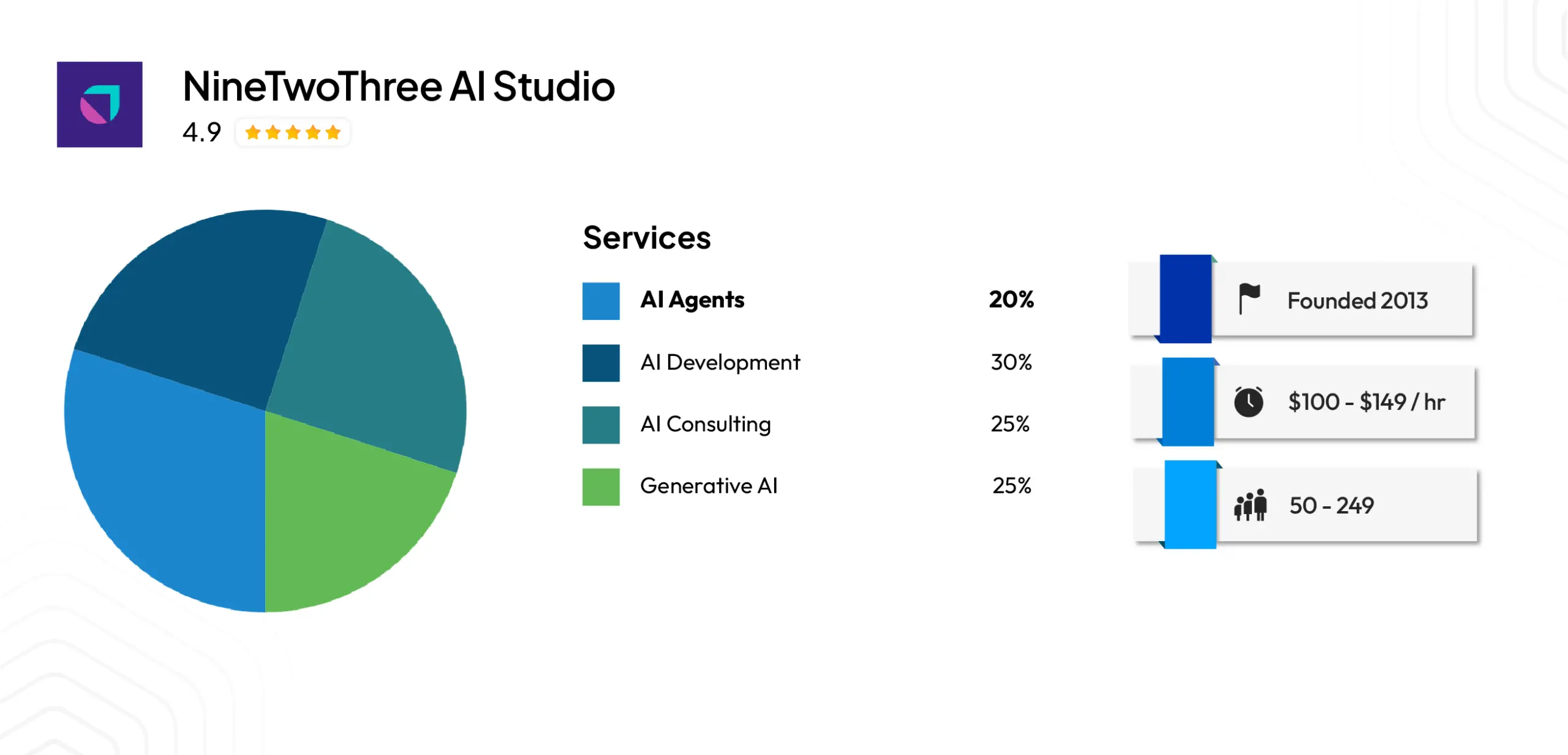
4. NineTwoThree AI Studio (Custom LLM and generative AI agents)
-
- Clutch rating: 4.9/5
- Location / team size: Danvers, MA / 50–249
- Avg. hourly rate: $100 – $149/hr
What they do: NineTwoThree AI Studio is a Massachusetts-based AI development firm building custom chatbots, machine learning applications, and full-stack web applications powered by generative AI. A recent client engagement delivered a production-ready large language model chatbot within three months, with the client specifically citing clear communication and industry-specific expertise carried over from prior projects. Reviews across 13 industries — including financial services, medical, and automotive — consistently note effective communication and on-time delivery.
Best for: Teams needing a specialist generative-AI/LLM partner rather than a full-service software agency.
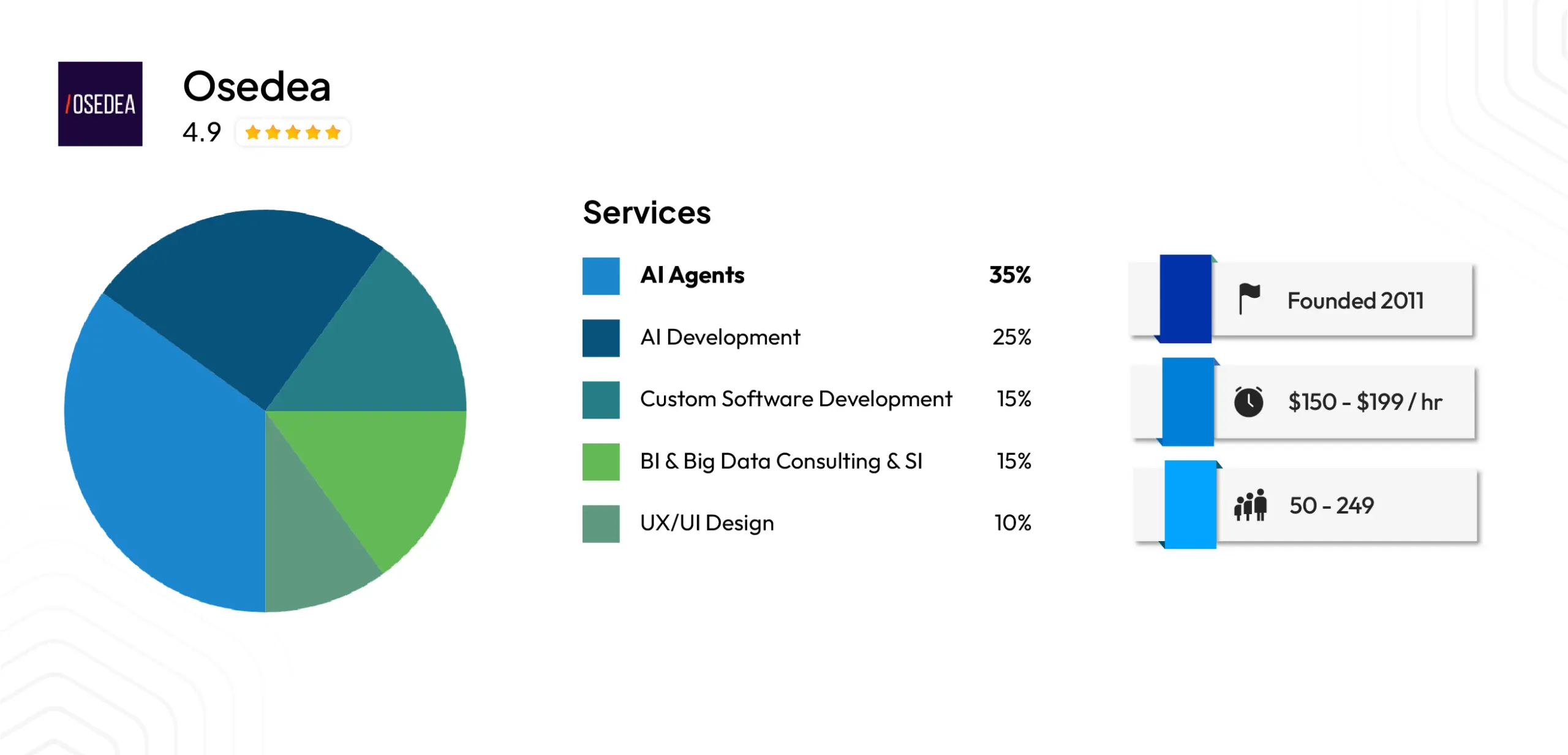
5. Osedea (Agents built on data and BI pipelines)
-
- Clutch rating: 4.9/5
- Location / team size: Montréal, Canada / 50–249
- Avg. hourly rate: $150 – $199/hr
What they do: Osedea is a Montréal-based technology firm specialising in AI, UI/UX design, and web-based application development, pairing agent work with business intelligence and big-data consulting. Clients across 17 industries — including food & beverage, manufacturing, and real estate — consistently praise clear, proactive communication, with several reviews noting daily standups and on-time or ahead-of-schedule delivery.
Best for: Agent use cases that are fundamentally data/analytics problems — forecasting, reporting automation, dashboard-driven decisioning.
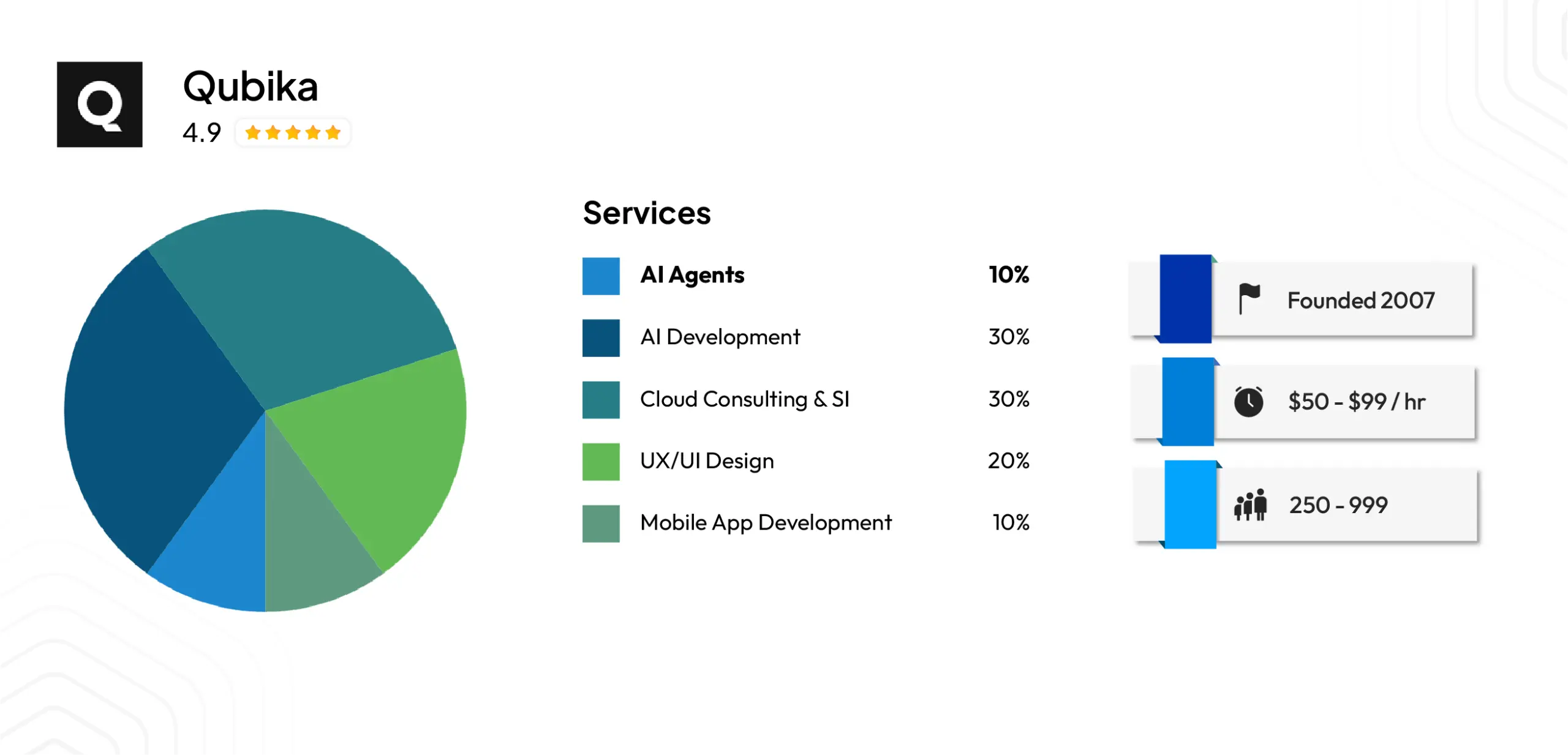
6. Qubika (Agents embedded in existing products)
-
- Clutch rating: 4.9/5
- Location / team size: Austin, TX / 250–999
- Avg. hourly rate: $50 – $99/hr
What they do: Qubika is an Austin-based, versatile technology services company spanning mobile app development, data engineering, and product design alongside AI agent work. A documented case built an AI agent for a real estate platform that recommended properties based on conversation logs with potential buyers. Reviews across 13 industries — notably IT, education, and hospitality — cite strong project management and the ability to quickly provide skilled talent.
Best for: Product teams embedding agent capabilities directly into an existing customer-facing mobile or web application.
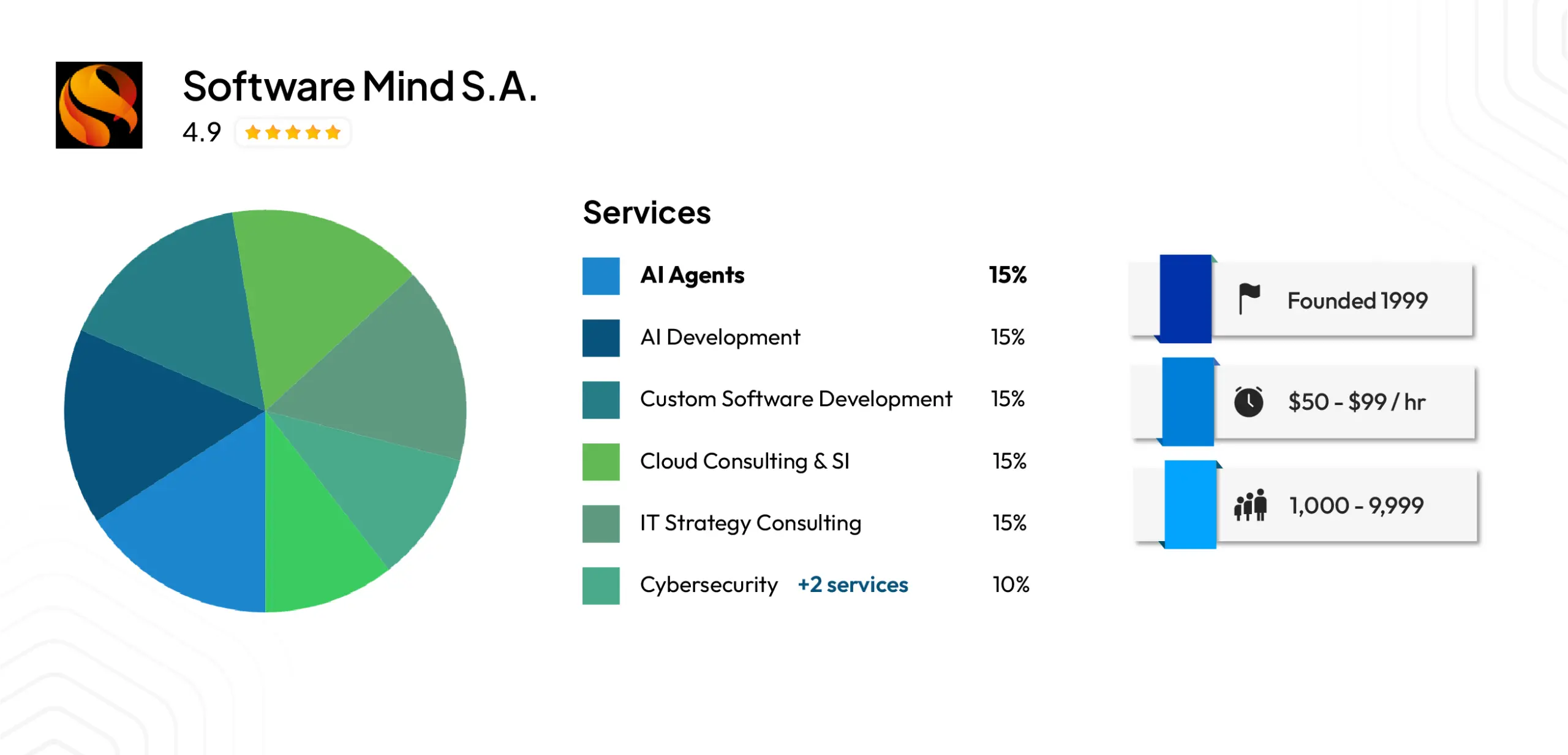
7. Software Mind S.A. (Enterprise-grade governance and staffing depth)
-
- Clutch rating: 4.9/5
- Location / team size: Kraków, Poland / 1,000–9,999
- Avg. hourly rate: $50 – $99/hr
What they do: Software Mind S.A. is a large-scale software development company headquartered in Kraków, Poland, delivering mobile applications, cloud platforms, AI, and UI/UX design, with a dedicated AI Agents practice sitting alongside cybersecurity and IT strategy consulting. Reviews across 10 industries — particularly financial services and telecommunications — highlight transparency, biweekly status check-ins, and proactive handling of project challenges, with clients describing the relationship as a genuine partnership rather than a vendor engagement.
Best for: Enterprises embedding agentic AI inside a broader cloud/compliance modernisation programme, needing staffing depth to scale quickly.
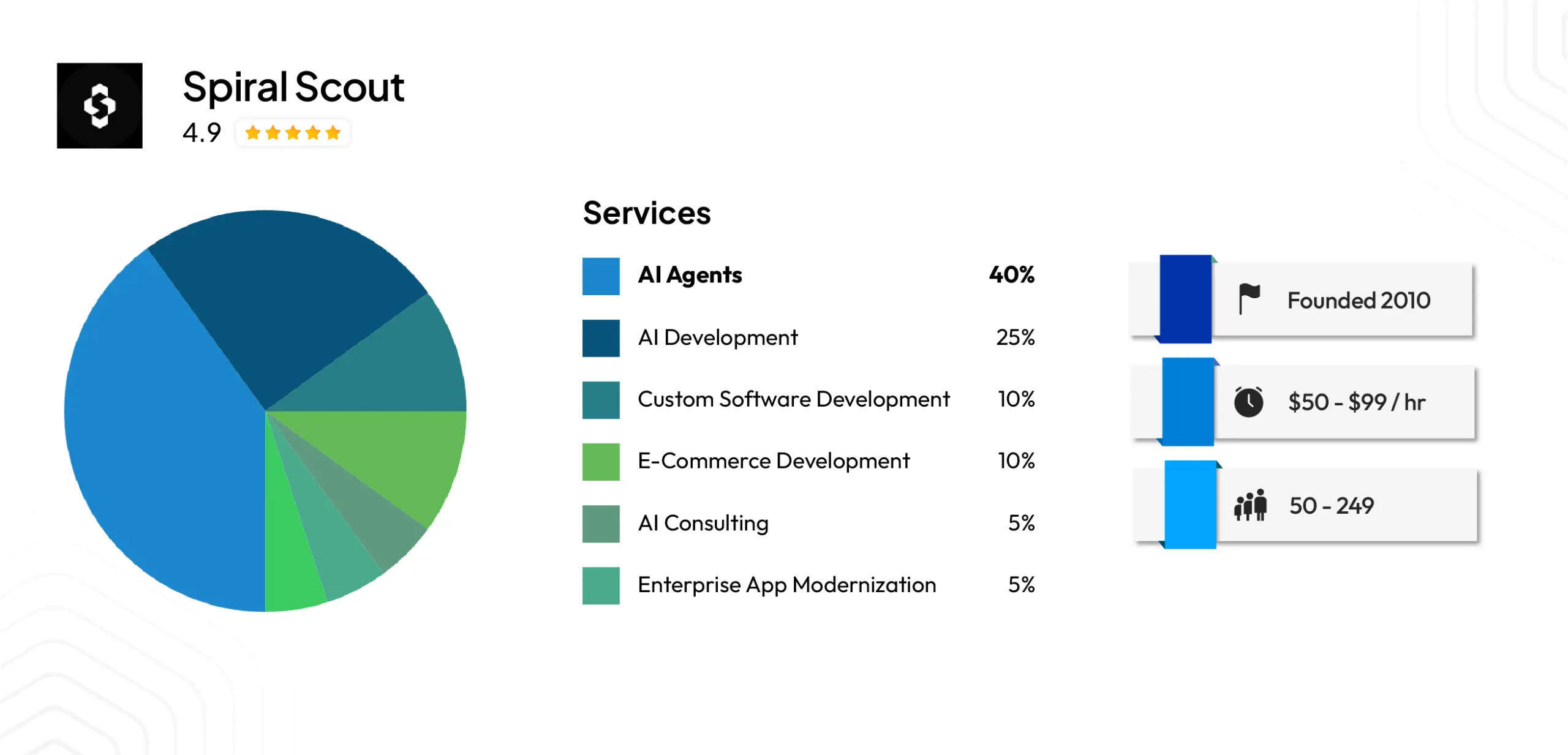
8. Spiral Scout (Demo-to-production agent delivery)
-
- Clutch rating: 4.9/5
- Location / team size: San Francisco, CA / 50–249
- Avg. hourly rate: $50 – $99/hr
What they do: Spiral Scout is a San Francisco-based technology company offering AI Agents, virtual assistants, and broader software development, taking projects from discovery through to implementation. The team also built Wippy, its own intelligent application runtime for making agentic systems production-ready, and won a 2026 Clutch Global Award for AI agent development, a distinction given to only the top 15 companies globally in the category. Reviews across 14 industries — eCommerce, education, and healthcare among them — cite deep engagement and timely delivery.
Best for: Startups and mid-market teams that need agents taken from demo to production, not left at prototype stage.
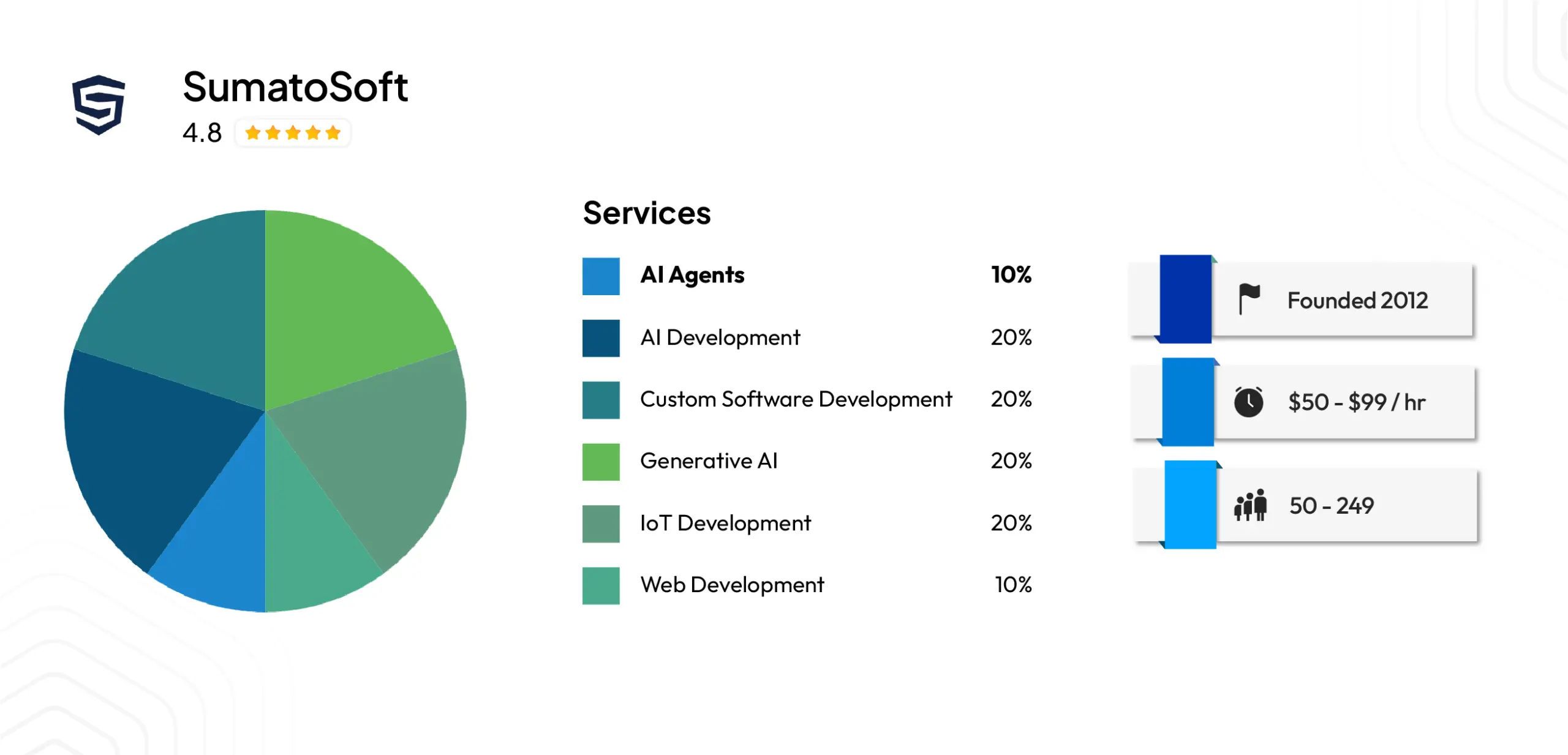
9. SumatoSoft (Healthcare and IoT-focused agents)
-
- Clutch rating: 4.8/5
- Location / team size: Boston, MA / 50–249
- Avg. hourly rate: $50 – $99/hr
What they do: SumatoSoft is a Boston-based software development company with client work concentrated in healthcare, IoT, and eCommerce, building chatbots, telemedicine platforms, and eCommerce functionality alongside agent work. Reviews across 10 industries highlight professionalism and ease of communication, with clients noting timely delivery and a personalised partnership approach; some feedback points to room for improvement in English proficiency and timeline accuracy.
Best for: Regulated or data-sensitive industries needing agentic AI paired with domain-specific compliance awareness.
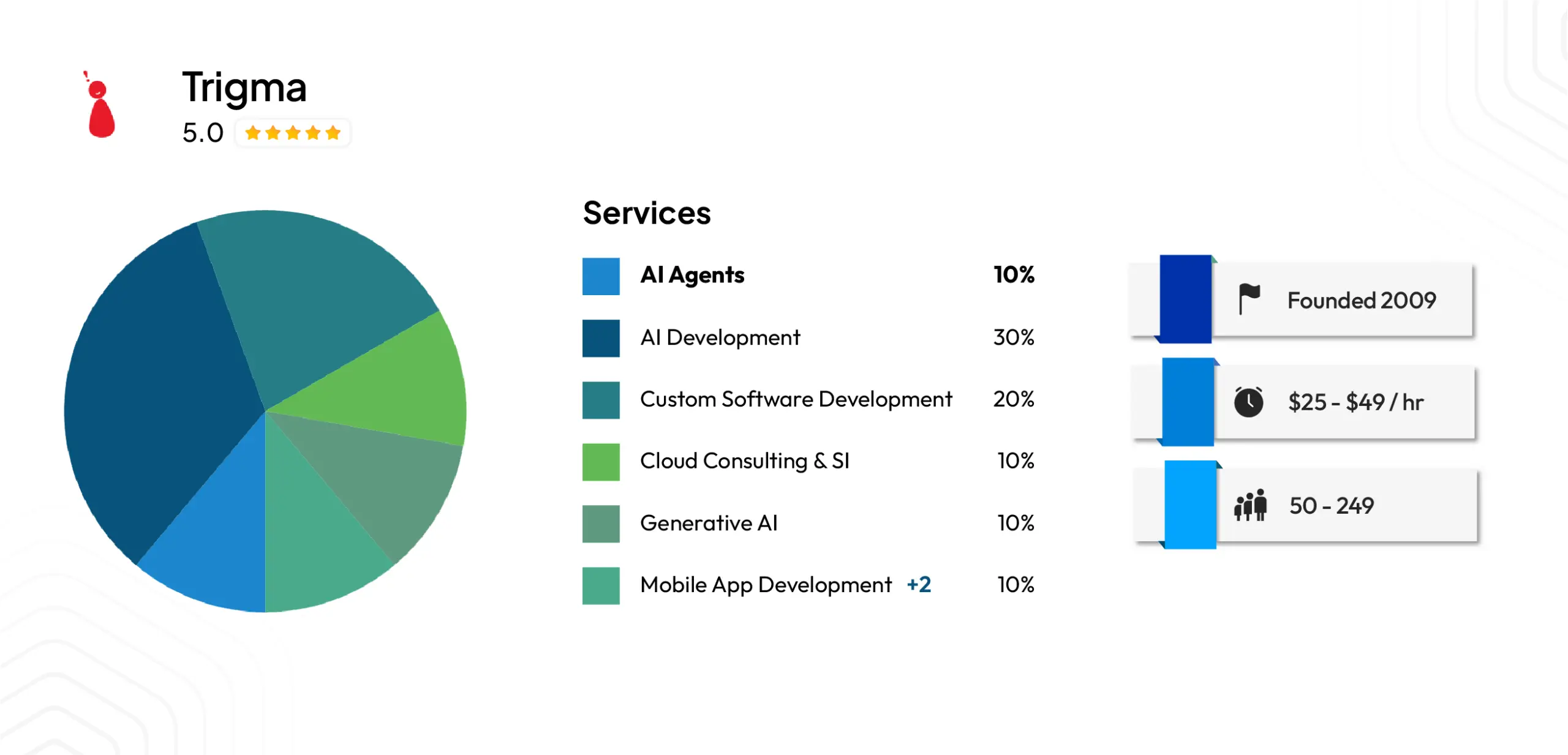
10. Trigma (Multi-agent and ERP-linked automation)
-
- Clutch rating: 5.0/5
- Location / team size: Sahibzada Ajit Singh Nagar, India / 50–249
- Avg. hourly rate: $25 – $49/hr
What they do: Trigma is an India-based AI solutions provider specialising in AI agents, AI-powered ERP systems, and intelligent automation, holding the largest verified review count of any company in the Clutch AI Agents category. A documented project built a multi-agent quality-inspection system for an automotive solutions provider, with AI agents handling inspection workflows end-to-end; a separate project delivered an AI sales assistant that improved efficiency and pipeline visibility for a client’s sales team. Reviews across 9 countries highlight responsiveness and the ability to tailor solutions to specific operational needs.
Best for: Cross-functional agent networks tied to ERP, quality inspection, or sales-ops automation, particularly in manufacturing.
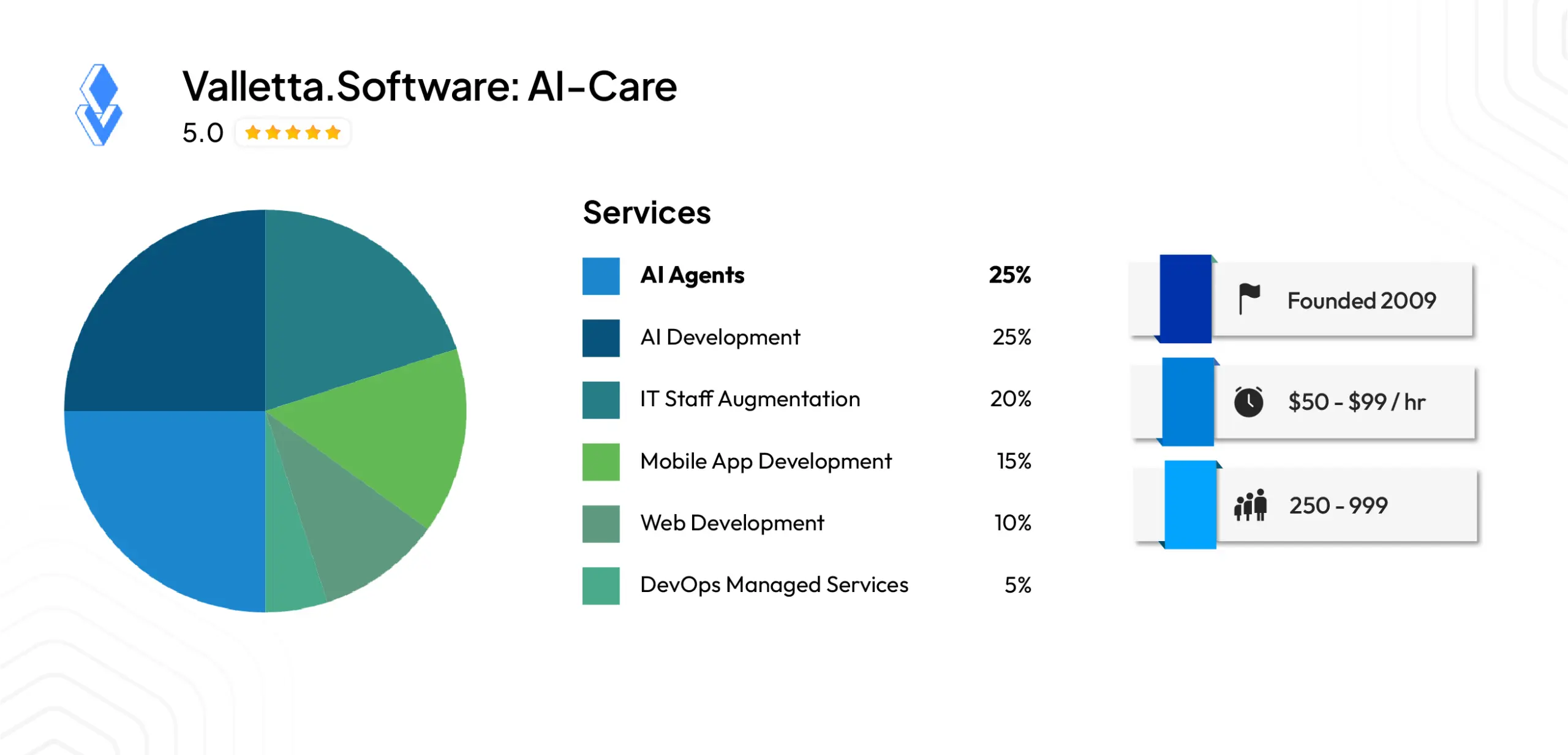
11. Valletta.Software: AI-Care (Fixed-price, safety-first agent deployment)
-
- Clutch rating: 5.0/5
- Location / team size: San Ġiljan, Malta / 250–999
- Avg. hourly rate: $50 – $99/hr
What they do: Valletta.Software: AI-Care is a Malta-based company specialising in the integration and deployment of AI agents, including AI bots and virtual assistants, and sells three fixed-price AI Agent packages ranging from $900 for a basic personal-entrepreneur setup to $25,000 for enterprise clients — a documented case deployed a self-hosted AI assistant (OpenClaw) on a Mac Mini, integrated with Telegram and Slack. Reviews consistently cite patience, responsiveness, and the ability to simplify complex technical setups for non-technical clients.
Best for: Smaller teams wanting a fixed-scope, fixed-price entry point into agentic AI before a larger custom build.
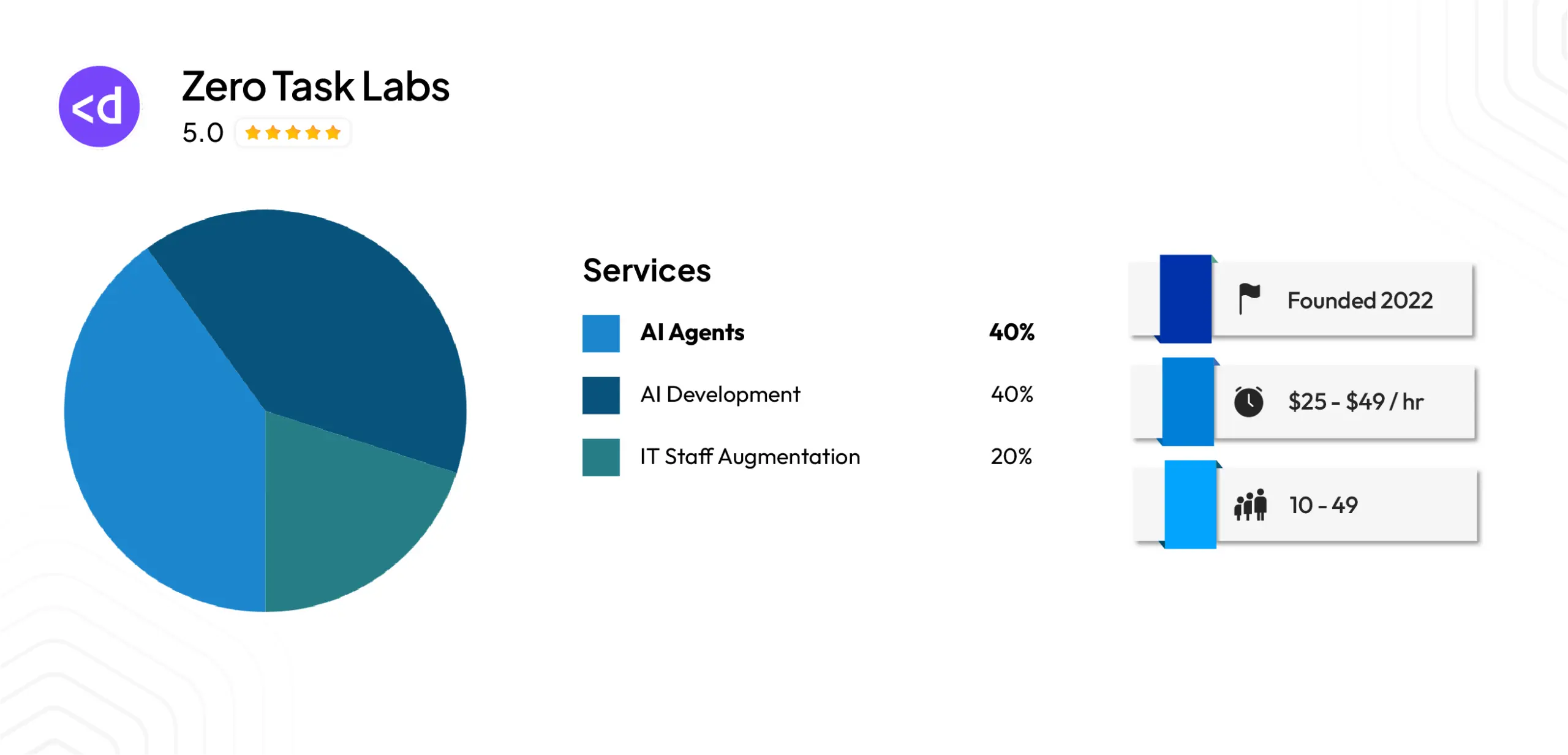
12. Zero Task Labs (Lean internal process-automation agents)
-
- Clutch rating: 5.0/5
- Location / team size: Not publicly listed / 10–49
- Avg. hourly rate: $25 – $49/hr
What they do: Zero Task Labs is an AI Agents specialist developing agents and virtual assistants specifically to automate internal business processes and improve operational efficiency, rather than customer-facing products. Recent reviews document a 40% reduction in candidate search time for a recruiting client and streamlined QA workflows for another, with 9 of the last 9 reviews rated 5 stars. Reviews across 6 industries — IT and advertising & marketing in particular — highlight structured project management and proactive communication.
Best for: SMBs automating a specific internal process (recruiting, QA workflows) rather than building enterprise-wide agent infrastructure.
Side by Side Comparison
| Company | Clutch Rating | Team Size | Min. Project | Hourly Rate | Best For |
|---|---|---|---|---|---|
| Emvigo |
4.7/5 | 50–249 | $10,000+ | $25–$49/hr | Agentic features scoped inside a wider custom software or MVP engagement |
| Intuz | 4.8/5 | 50–249 | $10,000+ | $25–$49/hr | Multiple connected agents (voice, document, back-office) as one system |
| Leanware | 5.0/5 | 10–49 | $25,000+ | $25–$49/hr | Early/growth-stage startups needing an agentic feature shipped fast |
| NineTwoThree AI Studio | 4.9/5 | 50–249 | $100,000+ | $100–$149/hr | Specialist generative AI/LLM partner over a full-service agency |
| Osedea | 4.9/5 | 50–249 | $50,000+ | $150–$199/hr | Agent use cases that are fundamentally data and analytics problems |
| Qubika | 4.9/5 | 250–999 | $10,000+ | $50–$99/hr | Embedding agents into an existing customer-facing application |
| Software Mind S.A. | 4.9/5 | 1,000–9,999 | $50,000+ | $50–$99/hr | Enterprises embedding agents inside a broader cloud and compliance programme |
| Spiral Scout | 4.9/5 | 50–249 | $10,000+ | $50–$99/hr | Taking AI agents from proof of concept to production |
| SumatoSoft | 4.8/5 | 50–249 | $25,000+ | $50–$99/hr | Regulated and data-sensitive industries needing compliance-aware agents |
| Trigma | 5.0/5 | 50–249 | $10,000+ | $25–$49/hr | Cross-functional agent networks integrated with ERP and manufacturing QA |
| Valletta.Software: AI-Care | 5.0/5 | 250–999 | $25,000+ | $50–$99/hr | Fixed-scope, fixed-price entry point into agentic AI |
| Zero Task Labs | 5.0/5 | 10–49 | $10,000+ | $25–$49/hr | SMBs automating one specific internal business process |
7 Things to Check Before Choosing an AI Agent Development Company
Use this checklist as your vendor filter. If a provider can’t answer these questions cleanly, you’re setting yourself up for headaches later.
1. Can They Integrate with Your Stack Without Duct Tape?
Look for MCP readiness or an equivalent integration strategy. Ask how they’ll connect to your internal APIs, databases, ticketing systems, and knowledge sources. If the answer is vague, walk away.
2. Can You Control Permissions and Blast Radius?
You need:
-
- Least-privilege design
- Environment separation (dev/staging/prod)
- Approval workflows for sensitive actions
- Full audit logs
Why it matters: An agent with too much access can do serious damage. You want guardrails from day one.
3. Can You Evaluate and Monitor Agents Like Software?
The best AI agent service providers treat agents like production code. That means regression tests, offline evaluation sets, and post-deploy monitoring (latency, failures, tool errors, cost). If they don’t have an evaluation harness, they’re winging it.
4. Can They Ship Inside Your SDLC?
Agents must fit your PR reviews, QA process, release pipeline, and incident response. Otherwise, adoption dies quietly in a corner somewhere.
5. Do They Understand “Verification,” Not Just Generation?
The best agentic AI platforms emphasise verifiable outputs — plans, screenshots, test runs, artifacts. Generation is easy. Proof is hard.
6. Do They Have a Realistic Stance on Autonomy?
If they promise 100% autonomous everything, run. You want human-in-the-loop by design, especially for high-risk actions. Full autonomy is a liability, not a feature.
7. Will They Leave You with Capability, Not Dependency?
You need clear documentation, handover playbooks, internal team enablement, and repeatable patterns you can reuse. Red flag: if they’re building a black box only they can maintain, you’ll be locked in forever.
How to Run a 30-Day AI Agent Pilot (So It Doesn’t Become a Science Project)
If you want this to actually land inside your org, here’s how to pilot properly:
Week 1: Pick One Job-to-Be-Done and Lock the Boundaries
Choose something that touches real systems, has measurable outcomes, and doesn’t require production write access on day one.
Examples you can actually prove:
-
- “Support ticket → root cause → PR draft + test”
- “Lead inbox → qualification summary → CRM update (staging)”
- “QA regression triage → repro steps + failing test suggestion”
Week 2: Build the Tool Layer (MCP-First If Possible)
MCP exists to avoid the “custom connector explosion.” Expose the minimum tool set your agent needs. Nothing more.
Week 3: Add Evaluation + Failure Handling
You need a small offline test set, “golden answers” for consistent checks, and defined fallback rules (human handoff, safe stop, retry logic).
Week 4: Ship to a Controlled Group, Measure, Iterate
Ship to 5–20 users. Track time saved, error rate, number of escalations, and trust signals (how often humans accept the output).
If your vendor can’t talk this language, they’re not an agent vendor. They’re a prototype vendor.
Editor’s Choice
Everything above is presented on equal terms — same fields, same tone, no company talked up over another. This section is different: it’s our opinion, and we’re labelling it as one.
As the publisher of this guide and an AI agent development company ourselves, our honest pick is Emvigo, for a specific reason — we’re structured as an engineering team that ships inside a broader custom software build, rather than a narrow AI-agents-only shop. That trade-off won’t suit everyone. If your need is a bounded, fixed-price agent pilot, Valletta.Software: AI-Care’s packaged approach or Zero Task Labs’ internal-automation focus may get you there faster and cheaper. If you’re an enterprise embedding agents into a larger cloud or compliance programme, Software Mind’s staffing depth or Trigma’s ERP-linked automation experience may be a better match. We’d rather point you to the right fit than claim we’re it by default.
Making the Right Choice
The AI agent development space is noisy. Some vendors rebrand chatbots as “agents” without the underlying planning, tool-use, or verification capability that separates a real agentic system from a scripted bot.
Whichever company you shortlist from this guide, use the 7-point checklist above and the 30-day pilot framework to test them — not marketing copy. A good partner should be able to answer specifics about governance, evaluation, and tool integration without hesitation.
Ready to move beyond AI demos? Whether you’re evaluating vendors or planning your first production AI agent, our team can help you scope the architecture, integrations, governance, and rollout strategy. Book a free consultation to discuss your project.
Frequently Asked Questions (FAQs)
What is an AI agent development company?
An AI agent development company specialises in building autonomous AI agents that can plan, execute tasks, use tools, and verify results — going beyond basic chatbots to deliver production-grade agentic systems.
What’s the difference between AI agents and chatbots?
Chatbots respond to queries with pre-programmed or generated text. AI agents are autonomous systems that can plan multi-step tasks, call tools and APIs, make decisions, and adapt based on outcomes. See our breakdown of agentic AI vs generative AI for more on this distinction.
How much does it cost to develop an AI agent?
Costs vary widely based on complexity, integrations, and vendor. Expect anywhere from $2K–$10K for a focused proof-of-concept with a specialist boutique, up to $500K+ for enterprise-scale custom AI agent solutions with full governance and integration.
Which is the best AI agent development company in 2026?
There’s no single best — the right fit depends on your budget, industry, and whether you need a bounded pilot or a full enterprise rollout. This guide lists 12 Clutch-verified companies, all rated 4.0 stars or higher, on identical criteria so readers can compare them directly.
What industries benefit most from AI agents?
Key industries include:
Software development (QA, code review, DevOps), Customer support (triage, ticket routing, knowledge retrieval), Sales and marketing (lead qualification, CRM updates), Finance and operations (data reconciliation, compliance checks).
What is MCP (Model Context Protocol)?
MCP is a standard connectivity layer that lets AI agents interact with tools, databases, and APIs without building custom integrations for each connection. It simplifies AI workflow automation and reduces integration complexity — read more in our guide to Google Antigravity and MCP.
How long does it take to build a production-grade AI agent?
A focused pilot can be built in 4–6 weeks. A production-ready system with governance, monitoring, and integrations typically takes 3–6 months, depending on complexity.
Can AI agents integrate with my existing tools?
Yes. The best AI agent software companies use frameworks like MCP to integrate with CRMs, ticketing systems, databases, Slack, email, and internal APIs.
What are the risks of deploying AI agents?
Key risks include over-permissioned agents causing data leaks or unintended actions, lack of verification leading to incorrect outputs, and poor monitoring causing silent failures. Work with AI agent consulting firms that prioritise governance, testing, and human-in-the-loop design.
Are these AI agent development companies actually verified?
Yes. Every company in this guide is listed on Clutch with a published rating of 4.0★ or higher, based on verified client reviews. Ratings are hyperlinked directly to each company’s live Clutch profile so you can confirm the data yourself — Clutch ratings referenced here were current as of August 2026 and may shift over time.