
Late-night questions, endless queues, and frustrated users—sound familiar? Traditional customer support often struggles to keep up with today’s always-on customers who expect quick, personalised answers. If answers aren’t immediate, customers may move on or turn to competitors. This is where AI chatbot benefits truly shine. From offering 24/7 assistance to managing thousands of conversations simultaneously, AI chatbots are redefining what efficient, customer-focused service looks like in the digital era.
Imagine a support system that never sleeps, learns from every interaction, and delivers instant, accurate responses—every time. These intelligent tools don’t just respond—they understand intent, anticipate needs, and create seamless experiences that strengthen customer trust. They also help businesses cut costs, scale support effortlessly, and empower human agents to focus on high-value interactions.
Beyond faster resolutions, the right AI chatbot helps companies improve efficiency, boost satisfaction, and build stronger customer loyalty. Let’s see the top AI chatbot benefits transforming customer support and setting a new standard for service excellence today.
What is an AI-Powered Chatbot?
An AI-powered chatbot is a software that uses conversational AI, machine learning, and natural language processing (NLP) to hold human-like conversations. Not just scripted “if you click this, answer that” flows—this is dynamic, adaptive support.
Some key terms to keep in mind:
-
- Natural Language Processing (NLP) chatbot — understands intent, context, and nuance.
- Intelligent virtual assistants — bots that can refer to previous user history, switch contexts, escalate issues.
- Generative AI in customer service — able to generate answers (not just pick pre-written ones).
- Natural Language Processing (NLP) chatbot — understands intent, context, and nuance.
Examples of what an AI-powered chatbot can do (“AI-powered chatbot examples”):
-
- A user asks, “Where’s my order?” Bot pulls up status automatically.
- Want product recommendations? Bot learn preferences.
- Need multilingual support? Bot supports several languages without needing multiple human teams.
- A user asks, “Where’s my order?” Bot pulls up status automatically.
Why Businesses Are Adopting AI Chatbots for Customer Support
Businesses are increasingly embracing AI chatbots not just for operational efficiency, but as part of a larger strategic shift in how they engage with customers and position themselves in the market.
Here’s why adoption is growing:
-
- Brand modernisation – Companies want to be seen as innovative and tech-savvy. AI chatbots signal forward-thinking customer service.
- Enhanced accessibility – Chatbots allow businesses to offer support across multiple channels (web, app, social media) without creating entirely new teams.
- Global reach – With multilingual capabilities, chatbots help businesses expand into new markets and serve diverse audiences.
- Consistency in messaging – Bots help companies ensure their brand messaging and policies are delivered uniformly across all touchpoints.
- Faster onboarding for new products/services – Chatbots can educate customers about new offerings instantly, helping businesses drive adoption quickly.
- Support for hybrid customer journeys – As customer interactions span online and offline channels, chatbots provide a bridge, guiding users smoothly between them.
- Brand modernisation – Companies want to be seen as innovative and tech-savvy. AI chatbots signal forward-thinking customer service.
Top AI Chatbots Benefits for Customer Support
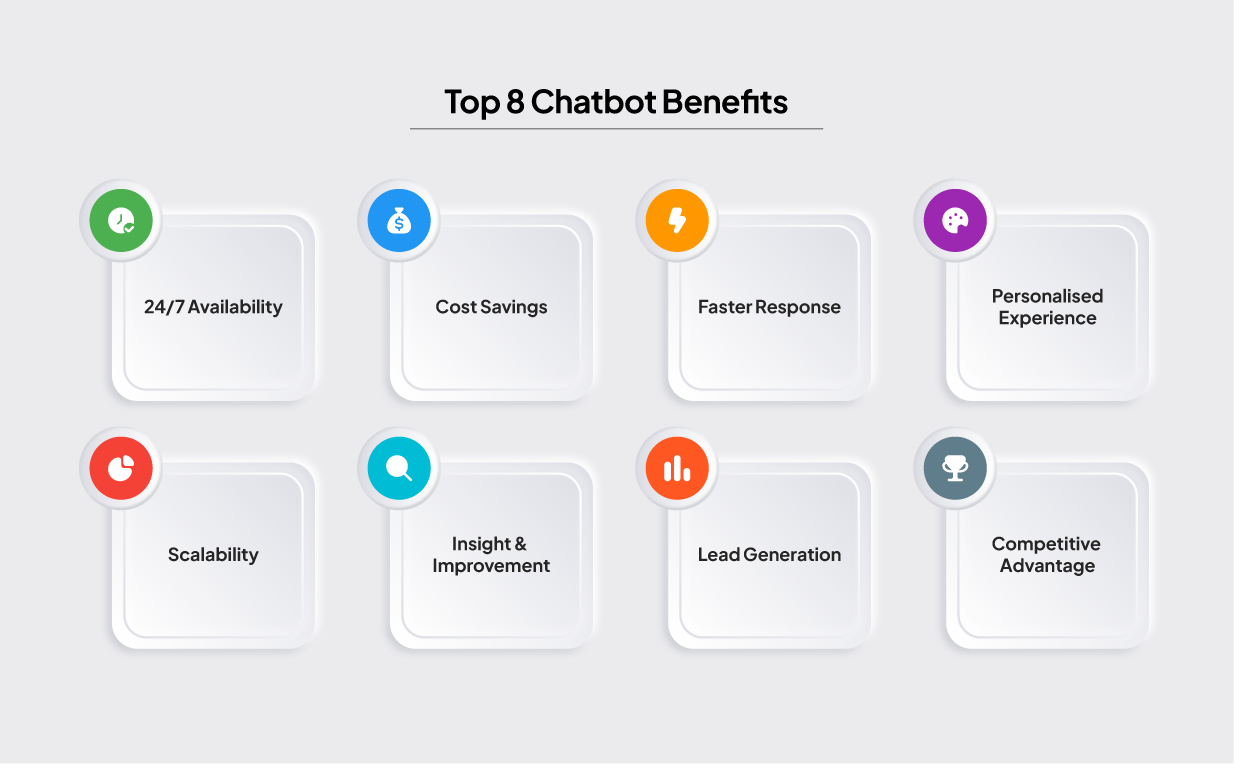
1. 24/7 Availability & Instant Responses
One of the biggest perks is always-on service. A 24/7 customer support AI means a visitor at 2:30 AM isn’t blocked—they get instant help.
-
- According to survey data, 51% of consumers say they prefer interacting with bots over humans when they want immediate service.
- AI customer service chatbots don’t need breaks or sleep, they drastically reduce the “dark hours” where customers feel neglected.
- According to survey data, 51% of consumers say they prefer interacting with bots over humans when they want immediate service.
This leads to fewer lost sales, better trust, and more satisfied customers overall.
2. Cost Savings & Operational Efficiency
The numbers are compelling when it comes to savings:
-
- Chatbots reduce customer service operations costs by approximately 35%, while improving revenues.
- Many organisations report that AI chatbots for customer support allow them to reduce staffing needs during peak seasons by up to 68%.
- Because much of the routine, repetitive work is automated, human agents can focus on complex, high-value queries.
3. Faster Response Times & Improved Resolution Rates
Speed matters. Customers hate wait times.
-
- Companies using AI report a 37% drop in first response times compared with those not using automation.
- Bots can often resolve simple queries immediately, reducing load on human agents. For example, in multiple government chatbot studies, simple FAQ type issues are handled directly by bots, freeing staff for critical tasks.
- Companies using AI report a 37% drop in first response times compared with those not using automation.
These improvements boost satisfaction and show customers you value their time.
4. Personalised Customer Experience & Brand Consistency
Personalisation is not a bonus—it’s expected.
-
- A Zendesk stat: more than two-thirds of CX organisations believe generative AI helps them add warmth and familiarity in digital interactions.
- Bots trained with customer history can provide conversations like: “I see you ordered last week…” or “Here are recommendations based on your past views,” which builds trust.
- A Zendesk stat: more than two-thirds of CX organisations believe generative AI helps them add warmth and familiarity in digital interactions.
Also, consistency is a big win: brand tone, policies, product info—all stay aligned through an AI-customer-service chatbot using a shared knowledge base.
5. Scalability & Handling High Volumes
When traffic spikes—sales events, product launches, holiday seasons—AI chatbots scale effortlessly.
-
- Bots can handle hundreds, thousands, even tens of thousands of simultaneous chats, unlike human teams.
- Studies of public sector usage find that governments are increasingly using bots to manage high query volumes with fewer delays.
- Bots can handle hundreds, thousands, even tens of thousands of simultaneous chats, unlike human teams.
This customer support scalability means you maintain quality, even under pressure.
6. Insight & Continuous Improvement
Every conversation is data: what customers ask, where they hesitate, what they dislike. AI-powered chatbots are valuable data sources.
-
- Organisations using them get analytics on trending questions, sentiment and frequent friction points.
- That data fuels customer experience automation improvements, product updates, and even new service ideas.
- Organisations using them get analytics on trending questions, sentiment and frequent friction points.
In short, AI chatbots don’t just solve customer queries—they help businesses learn from every interaction. That insight drives smarter decisions, better products, and stronger customer experiences
7. Lead Generation & Upselling
Bots aren’t just support tools; they can help grow revenue.
-
- For example, a bot can ask, “How can I help you today?” then guide users to product pages, collect their preferences, and pass warm leads to sales.
- Reports show that chatbots can boost sales conversions, especially when connected with CRM and marketing tools.
- For example, a bot can ask, “How can I help you today?” then guide users to product pages, collect their preferences, and pass warm leads to sales.
Also, generative-AI chatbots can suggest cross-sells, upsells, or complementary services based on behavior.
8. Competitive Advantage & Customer Satisfaction
When competitors give instant, personalised support with little waiting, they set higher standards—and customers notice if you fall behind.
-
- IBM’s research: organisations with mature AI-powered customer service report 17% higher customer satisfaction.
- Zendesk: “70% of CX leaders believe chatbots are becoming skilled architects of highly personalised customer journeys.”
- IBM’s research: organisations with mature AI-powered customer service report 17% higher customer satisfaction.
This helps with retention, word-of-mouth, and building a brand people trust.
Best Practices for AI Chatbot Implementation
All the benefits in the world won’t matter if implementation is sloppy. To make your AI chatbot for business really work, follow these best practices:
1.Define clear goals
-
- What kinds of queries will your chatbot handle?
- Which KPIs matter—cost savings, first response time, customer satisfaction?
- What kinds of queries will your chatbot handle?
2.Work with real data + feedback loops
-
- Use logs from live support to train the bot.
- Collect customer feedback and continuously improve the NLP models.
- Use logs from live support to train the bot.
3.Ensure smooth UX & conversation flow
-
- Make sure the bot is easy to use, transparent (let the user know they’re talking to a bot), and can hand over to a human when needed.
- Make sure the bot is easy to use, transparent (let the user know they’re talking to a bot), and can hand over to a human when needed.
4.Integrate with your systems
-
- CRM, order databases, support ticketing.
- If you have a mobile app, embed chatbot in-app for seamless support.
- CRM, order databases, support ticketing.
This is where Emvigo can help—bringing expertise in app development and seamlessly embedding AI-powered chatbots for smarter customer support
5.Maintain brand voice & consistency
-
-
- Create a knowledge base.
- Regularly audit bot responses for tone, accuracy.
- Create a knowledge base.
-
6.Privacy, security, ethics
-
-
- Transparent policies.
- Data protection.
- Trust is a factor in adoption (studies show trust and design are critical in government chatbot adoption)
- Transparent policies.
-
Challenges & Considerations
To be fair, there are pitfalls. Understanding them helps you build better:
-
- Misunderstanding complex questions still happens. Bots are great for routine support, not always for ambiguous or emotionally charged conversations.
- Maintenance & training are required. Without ongoing tuning, performance degrades.
- Customer trust & privacy concerns can block adoption. Make policies clear, and design with transparency.
- Cost of setup (especially for advanced NLP, training data, integrations). But usually outweighed by long-term savings and benefits.
- Misunderstanding complex questions still happens. Bots are great for routine support, not always for ambiguous or emotionally charged conversations.
The Future: Trends in AI-Powered Chatbots
AI chatbots are becoming smarter and more useful every day. In the future, they will have more natural conversations, work across text, voice, and images, connect with apps and devices, and learn from every interaction. Businesses will use them not just to save time, but to improve experiences and make smarter decisions.
Let’s look at the main trends shaping AI chatbots.
1. More Human-Like Conversations
-
- Chatbots will use advanced generative AI to engage in conversations that feel natural, empathetic, and context-aware.
- They’ll understand nuance, tone, and even humour, reducing the robotic feel of today’s bots.
- Chatbots will use advanced generative AI to engage in conversations that feel natural, empathetic, and context-aware.
2. Multimodal Interaction
-
- AI chatbots will not just handle text—they’ll integrate voice, images, video, and even AR/VR interactions.
- For example, a customer could describe a product issue via voice and images, and the bot could guide them step-by-step visually.
- AI chatbots will not just handle text—they’ll integrate voice, images, video, and even AR/VR interactions.
3. Stronger Integration with Apps and Devices
-
- Chatbots will connect deeply with IoT devices, business apps, and CRMs, enabling seamless workflows.
- Example: A home assistant could adjust lighting, schedule reminders, and handle purchases all in one conversation.
- Chatbots will connect deeply with IoT devices, business apps, and CRMs, enabling seamless workflows.
4. Smarter Escalation and Decision-Making
-
- Bots will know when to hand off to humans, ensuring customer satisfaction while reducing friction.
- AI will analyse queries in real time, determine intent, and predict the best resolution path.
- Bots will know when to hand off to humans, ensuring customer satisfaction while reducing friction.
5. Strategic Business Asset
-
- Companies will use chatbots not just for cost-saving but as growth and engagement tools.
- Chatbots will handle sales, marketing, onboarding, HR, and personalised recommendations, becoming an integral part of business strategy.
- Companies will use chatbots not just for cost-saving but as growth and engagement tools.
6. Continuous Learning and Personalisation
-
- AI bots will continuously learn from interactions and user behaviour, providing highly personalised experiences.
- They’ll anticipate needs, offer proactive assistance, and personalise responses to each user.
- AI bots will continuously learn from interactions and user behaviour, providing highly personalised experiences.
7. Ethical and Responsible AI
-
- Expect more focus on privacy, transparency, and fairness.
- Businesses will adopt AI governance to ensure bots are reliable, unbiased, and trustworthy.
- Expect more focus on privacy, transparency, and fairness.
Bringing It All Together: What’s Next?
If you’re considering an AI-customer service chatbot, here’s a suggested roadmap:
-
- Audit your current support queries—what are the most common ones?
- Choose a platform or a trusted partner like Emvigo for AI chatbot implementation.
- Build a minimum viable AI chatbot (MVP) to handle top 10-20 FAQs.
- Measure: cost per interaction, response times, customer satisfaction.
- Iterate: expand capabilities (language support, upselling, lead gen, deeper integrations).
- Audit your current support queries—what are the most common ones?
Bring AI Efficiency to Your Customer Support
An AI-powered chatbot isn’t just a tech gadget. It’s a way to change how your business interacts with customers. With benefits like cost savings, efficiency, scalability, and lead generation, it’s a tool that delivers measurable ROI.
If you do it right, your chatbot becomes more than support—it becomes a brand ambassador, a salesperson, and a guardian of customer satisfaction.
If you want help making that happen for your business—from strategy, design, to building the best AI chatbots—Emvigo has the expertise.
Frequently Asked Questions About AI Powered chatbot
1.What is an AI-powered chatbot exactly?
An AI-powered chatbot uses conversational AI, NLP, and machine learning to understand intent, context, and provide human-like support. It adapts over time.
2.How to build an AI-powered chatbot for business?
Start with defining goals, use data, choose appropriate platforms, integrate with your systems (CRM, app, etc.), embed features like hand-offs and escalations, and continuously train.
3.What are the main benefits of AI chatbots?
Key benefits: 24/7 availability, AI chatbot cost savings, improved efficiency, personalisation, better customer satisfaction, scalability, and even chatbot lead generation.
4.Will an AI chatbot replace human agents?
No. The best systems augment humans. Bots handle routine queries; humans deal with complexity, empathy, strategy.
5.Why choose Emvigo for AI-powered chatbot development?
Emvigo combines deep AI expertise with a flexible development approach. We build chatbots that are scalable, personalised, and integrated with your business systems to enhance user experience and drive results.