

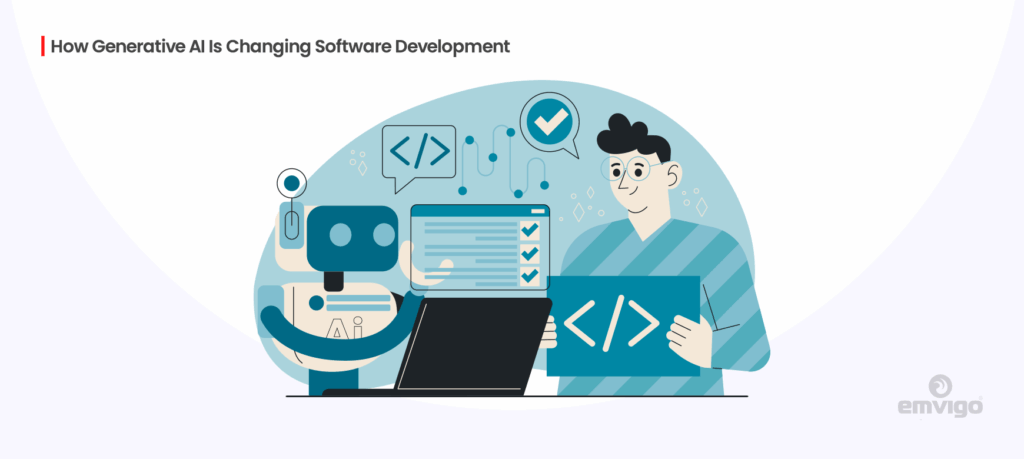
Generative AI is no longer a futuristic concept — it’s already changing how software is imagined, built, and delivered. From generating code automatically to assisting developers with intelligent suggestions, generative AI in software development is reshaping every stage of the software lifecycle.
It’s helping teams move faster, cut costs, and focus on creativity rather than routine work. For UK businesses, this shift represents not just an efficiency upgrade, but a real competitive edge in an increasingly AI-driven digital economy.
In this blog, we’ll explore what generative AI in software development actually means, how it’s being applied across the industry, the challenges to consider, and how companies can start integrating it into their workflows confidently.
What Is Generative AI in Software Development?
Generative AI in software development refers to the use of artificial intelligence systems that can create new content — such as code, documentation, or even design elements — based on the patterns they’ve learned from existing data.
Unlike traditional AI models that simply analyse or classify information, generative AI produces entirely new outputs. In a development environment, this means it can:
-
- Write or complete code snippets automatically
- Generate unit, integration, or functional test cases
- Suggest debugging fixes in real time
- Produce documentation alongside the code
- Create prototypes or UI layouts from natural language prompts
Essentially, it acts as an intelligent assistant that supports developers at every stage of the software lifecycle.
For example, a developer can describe a function in plain English — “create a Python script that sorts a list of names alphabetically” — and a generative AI tool like GitHub Copilot or OpenAI Codex will instantly write the code.
By learning from millions of examples, generative AI doesn’t just copy — it adapts, using context to deliver relevant, efficient code suggestions. This makes the entire software development process faster, more consistent, and more creative.
In short, generative AI in software development helps teams move from manual, repetitive coding to a smarter, automated, and more collaborative approach that saves time, reduces errors, and boosts innovation.
How Generative AI Is Already Transforming Software Development
The impact of generative AI in software development is already visible across the industry. From automating tedious coding tasks to helping teams debug and test software more intelligently, it’s fundamentally changing how developers build, deploy, and maintain applications.
Let’s see some of the most common and effective ways this technology is being used in real projects today.
1. Code Generation
Code generation is one of the most practical uses of generative AI in software development. Developers can now describe what they want to build using plain English, and AI tools generate working code that fits the description.
For instance, tools like GitHub Copilot or Amazon CodeWhisperer can autocomplete lines of code, generate functions, or even build an entire module from a single prompt. This drastically reduces the time spent on writing boilerplate code and helps teams focus on solving complex business problems rather than repetitive tasks.
Generative AI also makes it easier for junior developers to produce high-quality code faster, as it provides real-time learning and feedback during development.
2. AI-Powered Debugging
Debugging has always been one of the most time-consuming parts of software development. Traditional debugging requires manual review, detailed log analysis, and repeated testing.
With generative AI in software development, this process becomes far more efficient. AI tools can now detect code anomalies, highlight potential bugs, and suggest possible fixes as developers type.
For example, an AI model trained on thousands of code repositories can recognise error patterns and recommend optimal solutions instantly — sometimes even before a build fails. This proactive approach to debugging saves valuable time and ensures higher-quality code is deployed faster.
3. Automated Testing
Testing is critical for reliable software, but it’s often one of the biggest bottlenecks in agile workflows. Generative AI is helping teams overcome this by automatically generating test cases, updating them when code changes, and running continuous validation.
AI can create both unit and functional tests, improving test coverage without adding extra manual work. This ensures that even with rapid releases, software remains stable and secure.
For example, a generative AI tool can analyse new code, identify edge cases, and instantly suggest or generate the necessary test scenarios — something that used to take hours of manual effort.
4. NLP-Based Workflow Enhancement
One of the most exciting advancements is how natural language processing (NLP) is simplifying developer workflows. Using NLP, teams can now communicate with code in natural English instead of complex syntax.
This means that even non-technical team members can describe what they want — for example, “add a search bar to the homepage that filters results dynamically” — and AI tools can translate that request into functional code.
This not only improves collaboration between developers, designers, and business stakeholders but also accelerates the prototyping process. It makes software development more inclusive and accessible to cross-functional teams.
5. Intelligent Documentation Generation
Documentation is essential but often neglected. With gen AI in software development, this step can now happen automatically.
AI tools can read code, understand its structure and logic, and generate accurate documentation as developers work. This means documentation stays up to date with every code change, helping teams onboard faster and maintain consistent project knowledge.
For instance, AI can automatically create README files, API references, and code explanations that help future developers understand the project without spending hours reading through legacy code.
6. Continuous Learning and Optimisation
Another key advantage of gen AI is its ability to learn and improve over time. As teams continue to use AI-powered tools, the system adapts to coding styles, preferred frameworks, and best practices.
This personalised learning experience helps developers become more productive with each project. Over time, the AI model becomes more aligned with your company’s specific standards and workflow patterns — a massive step forward for long-term efficiency.
7. Enhanced Collaboration and Productivity
AI integration isn’t just about automation — it’s about creating smarter workflows. By reducing manual work, generative AI in software development enables developers to focus on design, architecture, and innovation.
Product managers can visualise concepts faster, QA teams can automate validation, and business leaders can see quicker returns on their software investments. The result is a more productive, creative, and collaborative software environment.
Generative AI in software development is already changing how teams write, test, and deliver software. It’s not just a productivity tool — it’s a catalyst for innovation, helping businesses bring digital products to market faster, reduce costs, and maintain higher quality with less effort. And these are not the only areas where generative AI can be applied; its potential extends to design, project management, customer support, and many other aspects of technology and business workflows.
Why Businesses Are Adopting Generative AI in Software Development
The adoption of generative AI in software development is no longer a futuristic idea — it is now a practical strategy for businesses aiming to stay competitive, reduce costs, and deliver high-quality software faster. Companies of all sizes are recognising that AI can accelerate workflows, improve reliability, and free up developers to focus on creativity and innovation.
Here are the key reasons why businesses are integrating generative AI into their software processes:
1. Faster Time-to-Market
Speed is crucial in today’s digital economy. AI-powered tools can generate code snippets, create test cases, and even assist with prototyping, allowing products to move from concept to launch much faster.
For example, an MVP that traditionally might take 12 weeks to develop can often be completed in 4–6 weeks with AI assistance. This means businesses can respond to market demands faster and gain a competitive edge over slower-moving competitors.
2. Cost Efficiency
By automating repetitive and low-value tasks, generative AI reduces the number of hours developers spend on mundane work. This not only cuts operational costs but also allows teams to scale without increasing headcount.
Cost efficiency isn’t just about labour — faster delivery and fewer errors also reduce the expense of bug fixes, rework, and delayed releases. Emvigo helps businesses implement AI-powered development workflows to save time, reduce costs, and deliver high-quality software faster. Get started with our AI solutions today.
3. Improved Accuracy and Quality
AI-assisted coding helps reduce human error. By providing real-time suggestions, highlighting potential bugs, and generating automated tests, generative AI in software development ensures that code is more reliable and consistent.
For businesses, this translates into higher-quality software, fewer post-release issues, and improved user satisfaction.
4. Scalability of Development Efforts
As businesses grow, managing complex codebases and large teams can become challenging. Generative AI allows companies to scale their software development processes efficiently by:
-
- Handling repetitive tasks across multiple projects
- Standardising code quality across teams
- Accelerating onboarding of new developers
This scalability means organisations can take on larger, more complex projects without compromising delivery timelines or quality.
5. Enhanced Developer Satisfaction
Developers often spend a significant portion of their time on repetitive coding, debugging, or writing documentation. By adopting generative AI in software development, these routine tasks are reduced, allowing developers to focus on problem-solving, architecture, and innovation.
A happier, more engaged development team can deliver better software and contribute to long-term business success.
6. Competitive Advantage
Businesses that embrace AI early can gain a strong competitive advantage. By leveraging generative AI, companies can:
-
- Deliver products to market faster than competitors
- Experiment and innovate with less risk
- Improve customer experiences through faster updates and more reliable software
Adopting AI strategically ensures companies don’t just keep up with industry trends — they stay ahead.
7. Cross-Functional Benefits
The impact of generative AI extends beyond the development team. Project managers, designers, QA engineers, and even business stakeholders can benefit from AI-enhanced workflows. For example:
-
- QA teams get auto-generated test scripts
- Designers can create prototypes from prompts
- Product managers can see quicker iterations on features
This broader application makes generative AI in software development a catalyst for overall organisational efficiency.
Businesses are adopting generative AI in software development because it accelerates delivery, reduces costs, improves software quality, and enhances developer productivity. Its benefits extend across teams and processes, making it a practical, high-impact investment rather than a theoretical experiment.
Organisations that start using generative AI strategically now are positioning themselves for faster growth, better customer experiences, and long-term innovation.
Leading Tools Driving Generative AI in Software Development
The rise of generative AI in software development has been powered by a new generation of intelligent tools that help developers write code faster, reduce errors, and streamline testing. These tools are not just about automation — they enable smarter workflows, collaboration across teams, and faster delivery of high-quality software.
Here’s a look at some of the leading platforms making a real impact today:
1. GitHub Copilot
Developed by GitHub and powered by OpenAI, Copilot integrates directly into popular code editors such as Visual Studio Code. It can autocomplete entire lines of code, generate functions from simple prompts, and suggest fixes for potential errors.
For businesses, Copilot accelerates MVP development by allowing teams to focus on architecture and design rather than repetitive coding tasks. It’s particularly useful for teams working across multiple programming languages or frameworks.
2. Amazon CodeWhisperer
Amazon CodeWhisperer is AWS’s AI-powered coding companion. It helps developers generate code snippets, implement security best practices, and follow AWS architecture patterns automatically.
By leveraging CodeWhisperer, companies can quickly build cloud-based applications while ensuring code quality and security compliance — a key advantage for fintech and enterprise projects where regulatory requirements are strict.
3. OpenAI Codex
OpenAI Codex is the engine behind many generative AI coding tools, translating natural language prompts into executable code. Developers can describe a feature in plain English, and Codex generates the corresponding code in multiple languages.
This capability is ideal for rapid prototyping and MVP development, helping teams quickly validate ideas without extensive manual coding. Codex also integrates with IDEs, making it easy to incorporate AI assistance into existing workflows.
4. Tabnine
Tabnine provides AI-powered code completion across a wide variety of programming languages and IDEs. It predicts code based on context, past patterns, and best practices, helping developers write faster and with fewer errors.
For businesses, Tabnine can improve team productivity by standardising coding practices across distributed teams and ensuring consistent output, particularly when scaling software projects.
5. Other Emerging Tools
While Copilot, CodeWhisperer, Codex, and Tabnine are the most widely adopted, the market for generative AI in software development continues to grow. New tools are emerging for:
-
- Automated testing and quality assurance
- Natural language-driven code generation
- AI-assisted code review and documentation
These tools enable teams to go beyond code generation, applying AI to the entire software delivery lifecycle.
How UK Businesses Can Leverage These Tools
To make the most of generative AI in software development, companies should:
-
- Start with pilot projects to test tools in their environment.
- Train developers in prompt engineering and best practices.
- Integrate AI tools into CI/CD pipelines for testing, security, and deployment.
- Monitor AI output to ensure quality and compliance.
By strategically adopting these platforms, businesses can accelerate development, improve code quality, and reduce time-to-market — all while preparing teams for the AI-driven future of software development.
Traditional vs AI-Enhanced Software Development
| Stage / Feature | Traditional Software Development | AI-Enhanced Software Development |
|---|---|---|
| Code Writing | Manual line-by-line coding; developer writes every function from scratch | AI-assisted generation and completion; tools like GitHub Copilot and CodeWhisperer suggest code snippets, functions, and modules |
| Testing | Developers write unit, integration, and functional tests manually | AI generates and maintains test cases automatically, ensuring faster and more consistent coverage |
| Debugging | Errors detected through manual inspection, logging, and trial-and-error | AI detects bugs in real-time, suggests fixes, and can even prevent common coding mistakes |
| Documentation | Written after development is complete, often outdated or incomplete | Generated alongside the code; AI produces updated documentation automatically, keeping it accurate and aligned with changes |
| MVP Delivery | Typically 8–12 weeks, depending on complexity | 4–6 weeks; AI accelerates prototyping, coding, testing, and validation |
| Developer Productivity | Focused on repetitive, task-based work | Focused on higher-order thinking, design, and innovation; AI reduces mundane tasks |
| Collaboration | Requires extensive manual communication between teams | AI can bridge gaps using natural language processing; non-technical stakeholders can interact with code or prototypes |
| Error Rate / Quality | Higher likelihood of bugs due to manual coding | Reduced errors due to AI-assisted suggestions, testing, and validation |
Companies Already Benefiting from Generative AI
1. Microsoft
-
- Use Case: AI-assisted code generation
- Details: Microsoft reports that up to 30% of its code is now being written by artificial intelligence, reflecting a significant shift towards AI-driven development processes.
2. Delta Airlines
-
- Use Case: Generative AI chatbots for customer service
- Details: Delta’s “Ask Delta” chatbot assists customers with tasks like check-in, baggage tracking, and flight information, reducing call center volumes by 20%.
3. Cognizant
-
- Use Case: AI agent for legal document processing
- Details: Cognizant utilized Google’s Vertex AI and Gemini to build an AI agent that helps legal teams draft contracts, assign risk scores, and optimize operational impact.
4. Mastercard
-
- Use Case: AI chatbots for customer service
- Details: Mastercard employs AI chatbots to provide quick, relevant answers to user queries, including personalized recommendations and transaction insights.
5. Morgan Stanley
-
- Use Case: AI tools for financial analysis
- Details: Morgan Stanley has implemented generative AI tools to assist financial advisors in streamlining research and offering more insightful advice to clients.
These examples illustrate how companies across various industries are leveraging generative AI in software development to enhance efficiency, improve customer service, and drive innovation.
Key Challenges in Using Gen AI in Software Development
While generative AI in software development offers remarkable advantages, businesses need to be aware of certain challenges to ensure safe and effective adoption. Understanding these risks allows companies to implement AI responsibly and maximise its benefits.
1. Data Bias and Hallucinations
Generative AI models learn from existing datasets, which means they can sometimes produce biased or inaccurate outputs — a phenomenon often called “hallucination”.
-
- Code suggestions may include deprecated practices or inefficient logic
- Outputs can reflect bias present in training data
Mitigation Tip: Regular human review and validation of AI-generated code is essential to maintain accuracy and reliability.
2. Security and Compliance Concerns
Automatically generated code may unintentionally introduce vulnerabilities or insecure dependencies. This is particularly critical for UK businesses handling sensitive data or operating under strict regulatory frameworks.
Mitigation Tip: Integrate AI tools into secure CI/CD pipelines, perform automated security scans, and maintain strict code review practices to reduce risk.
3. Intellectual Property and Legal Considerations
Ownership of AI-generated code remains a legal grey area, especially in collaborative projects or open-source environments. Businesses must be aware of licensing and intellectual property implications when using AI-generated content.
Mitigation Tip: Define clear policies on AI-generated work, maintain documentation of AI inputs and outputs, and consult legal experts if needed.
4. Over-Reliance on AI
While generative AI accelerates software development, it cannot replace human creativity, judgement, or strategic thinking. Over-reliance on AI may lead to lower-quality solutions or missed business insights.
Mitigation Tip: Use AI as an assistant rather than a replacement — blend AI suggestions with developer expertise for optimal results.
By proactively addressing these challenges, UK businesses can safely leverage generative AI in software development, achieving faster delivery, higher quality, and better productivity without compromising security or compliance.
How UK Companies Can Get Started with Generative AI
Adopting generative AI in software development doesn’t require a full-scale transformation from day one. The most successful UK businesses start small — experimenting, learning, and scaling gradually. Here’s how to get started effectively:
1. Identify High-Impact Use Cases
Begin by pinpointing areas in your development cycle that are repetitive, time-consuming, or prone to human error — for instance, code generation, testing, or documentation. These are ideal starting points where AI can immediately demonstrate measurable value.
Focus on tasks that improve speed, reduce rework, or enhance developer productivity, ensuring your pilot projects deliver quick wins and business confidence.
2.Choose the Right AI Tools
Select tools that fit your tech stack and team workflow. Leading options include GitHub Copilot, Amazon CodeWhisperer, and Tabnine for code generation, or Testim.io and Replit Ghostwriter for automated testing and collaboration.
Each tool has unique strengths, so evaluate them based on security, integration compatibility, and data privacy — especially critical for UK businesses under GDPR.
3. Upskill Your Teams
Successful adoption relies on people, not just tools. Encourage developers, QA teams, and project managers to understand how generative AI works, its limitations, and how to use it responsibly.
Workshops, internal demos, or AI learning programs can empower your team to collaborate effectively with AI tools, making the transition smoother and more productive.
4. Start with an MVP Approach
Instead of reworking existing systems, start with a Minimum Viable Product (MVP) that uses AI assistance. This allows your team to test AI workflows, gather feedback, and refine performance — all while keeping risk and investment low. Working with an experienced AI development partner like Emvigo can accelerate implementation. With deep expertise in AI strategy, custom model development, and software modernisation, Emvigo helps businesses build AI-driven systems that deliver real-world value. Schedule a free consultation.
Once results are proven, you can gradually expand AI integration across your projects.
At Emvigo, we help UK businesses turn AI potential into practical results. Our team blends deep technical expertise with hands-on delivery experience to make generative AI in software development accessible, scalable, and secure for every organisation.
Why Choose Emvigo?
-
- Proven Success: We’ve helped businesses reduce delivery timelines by up to 30% through AI-driven automation and smart development workflows.
- Quality Assurance: As an ISO 9001:2015-certified company, we ensure robust quality standards and reliable delivery across every project.
- Innovation at Scale: From building intelligent MVPs to developing enterprise-grade AI integrations, we provide custom solutions to fit your goals and infrastructure.
- End-to-End Partnership: From proof of concept to deployment and scaling, our experts stay with you at every step of your AI journey.
Whether you’re modernising your tech stack or embracing an AI-first approach, Emvigo is your trusted partner for building future-ready, intelligent software that drives real business impact.
Frequently Asked Questions
What is generative AI in software development?
Generative AI uses machine learning models to create code, test cases, or documentation automatically. It helps developers work faster, reduce errors, and deliver high-quality software efficiently.
How is generative AI used in software development today?
Developers use it for code generation, debugging, test automation, and documentation. Tools like GitHub Copilot and Amazon CodeWhisperer make the development process quicker and more intelligent.
Can generative AI replace human developers?
No, it assists developers rather than replaces them. AI handles repetitive coding tasks, while humans focus on creative design, problem-solving, and decision-making.
What are the benefits of using generative AI in software development?
It improves speed, reduces costs, enhances accuracy, and boosts developer productivity — helping teams deliver projects faster with fewer errors.
Is AI-generated code secure and reliable?
AI-generated code should always be reviewed by developers. With proper oversight, it can be secure and highly reliable for production use.
How can UK companies start using generative AI?
Start small with pilot projects, train your teams in prompt engineering, and collaborate with AI experts like Emvigo to integrate AI safely into your workflow.
How long does it take to implement generative AI in a development workflow?
Implementation can vary, but starting with pilot projects or MVPs usually takes a few weeks to a few months, depending on complexity and team readiness.
Can generative AI improve the delivery of MVPs?
Yes, AI can accelerate coding, testing, and prototyping, often reducing MVP delivery timelines by 30–50% compared to traditional methods.
Is training required to use generative AI tools effectively?
Some training is recommended. Developers need to understand AI prompts, review outputs, and integrate tools safely into their workflow for best results.
Does generative AI reduce software development costs?
Yes, by automating repetitive tasks, decreasing errors, and speeding up delivery, businesses save on labour, rework, and delayed-release costs.
Final Thoughts
Generative AI in software development is no longer a futuristic concept — it’s a practical tool that helps developers work smarter, deliver faster, and innovate with greater confidence. By automating repetitive tasks, enhancing code quality, and accelerating MVP creation, AI empowers UK businesses to stay competitive in an increasingly digital landscape.
The key to success lies in starting small, blending AI with human expertise, and scaling thoughtfully. Partnering with experienced teams like Emvigo ensures that AI is implemented securely, efficiently, and in a way that drives real business impact.
Embrace AI today to unlock faster delivery, cost savings, and future-ready software solutions that give your business a competitive edge.
Take the next step — connect with Emvigo and see how generative AI can transform your software development processes.