

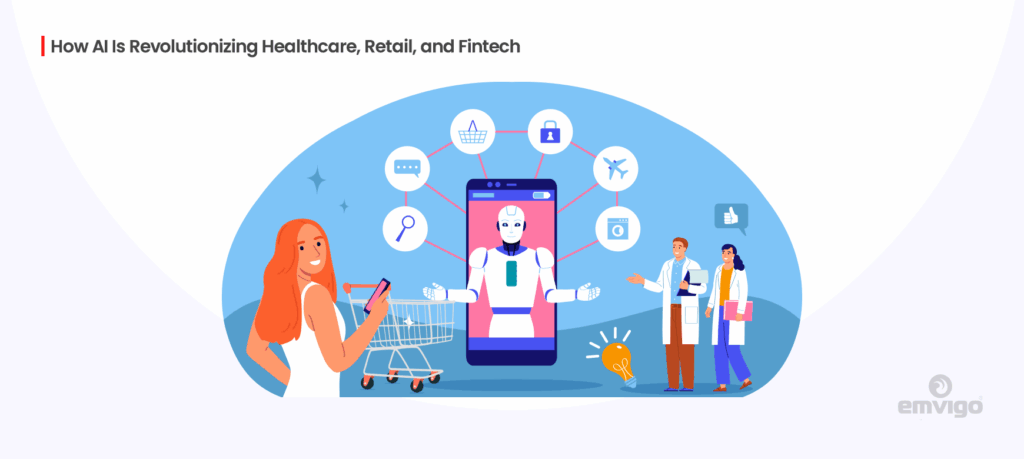
AI in Healthcare, Fintech, and Retail is reshaping the way businesses operate in 2026. From diagnosing complex medical conditions to streamlining financial processes and enhancing shopping experiences, AI is moving beyond automation to become a strategic driver of efficiency and growth. In healthcare, AI is enabling faster, more accurate diagnoses and personalised treatment plans. In fintech, it strengthens security, accelerates decision-making, and delivers seamless customer interactions. Meanwhile, in retail, AI powers smart inventory management, tailored recommendations, and smoother operations, helping businesses stay competitive in a rapidly evolving market.
This blog will tell how AI is reshaping these industries, highlight real-world applications, discuss potential challenges, and provide insights on how your business can successfully leverage AI to stay competitive in a rapidly evolving digital landscape.
AI Business Transformation: How AI is Changing Industries
Artificial Intelligence (AI) is actively reshaping the way businesses operate. From analysing vast datasets to automating routine tasks, AI helps companies make smarter decisions, improve efficiency, and deliver better customer experiences. Industries such as healthcare, fintech, and retail are experiencing significant benefits, from faster diagnosis and personalised care to smarter financial decisions and predictive retail strategies.
Key advantages of AI include:
-
- Smarter decision-making: Rapid processing of data provides accurate insights
- Operational efficiency: Automation reduces manual work and costs
- Enhanced customer experiences: Personalisation at scale keeps customers engaged
- Predictive insights: AI anticipates trends and customer behaviour, enabling proactive strategies
To fully leverage AI, businesses require software that can grow and adapt alongside their AI capabilities. Flexible, scalable systems allow companies to implement AI without running into bottlenecks as operations expand. For practical guidance on building such systems, see our detailed guide on Scalable Software Solutions.
In essence, AI is more than a tool—it is a strategic driver of business transformation, enabling organisations to stay competitive and future-ready.
AI in Healthcare: Transforming Patient Care and Medical Operations
Artificial Intelligence (AI) is transforming healthcare by enabling faster, more accurate diagnoses and improving patient outcomes. Here’s how AI is making a difference:
Key Benefits of AI in Healthcare
-
- Faster Diagnosis: AI algorithms can analyze medical images, such as X-rays and MRIs, more quickly than human doctors, leading to earlier detection of diseases like cancer and eye conditions.
- Personalized Treatment Plans: AI can process vast amounts of patient data to recommend tailored treatment options, enhancing the effectiveness of care.
- Operational Efficiency: By automating administrative tasks like scheduling and billing, AI allows healthcare providers to focus more on patient care.
- Remote Monitoring: AI-powered devices can track patient vitals in real-time, enabling continuous care and early intervention when necessary.
- Predictive Analytics: AI can identify patterns in patient data to predict potential health issues, allowing for proactive management.
- Faster Diagnosis: AI algorithms can analyze medical images, such as X-rays and MRIs, more quickly than human doctors, leading to earlier detection of diseases like cancer and eye conditions.
Case Study: University of Rochester Medical Center
A notable example of AI’s impact in healthcare is the collaboration between the University of Rochester Medical Center (URMC) and Butterfly Network. In this initiative, URMC distributed 862 Butterfly IQ probes to incoming medical students. These handheld ultrasound devices, powered by AI, enabled rapid and accurate imaging at the point of care.
Key outcomes of this initiative include:
-
- 116% Increase in Ultrasound Charge Capture: The use of AI-driven imaging led to a significant rise in ultrasound procedures billed, reflecting improved utilisation.
- 74% Increase in Scanning Sessions: The portability and ease of use of the Butterfly IQ probes resulted in more frequent imaging sessions.
- 3x Increase in Ultrasounds Sent to Electronic Health Record (EHR) System: The integration of AI-enhanced imaging with EHR systems streamlined the documentation process.
This case study underscores the potential of AI to enhance diagnostic capabilities and operational efficiency in healthcare settings.
If you’re considering integrating AI into your healthcare practice, it’s essential to assess whether custom AI tools are the right fit for your needs. Our guide on How to Know if You Need Custom AI Tools can help you evaluate your requirements and make an informed decision.
Implement AI in your healthcare practice with Emvigo and unlock smarter, faster, and more efficient patient care. Get started today.
Retail: Personalisation at Scale with AI in Retail
AI in retail is transforming the shopping experience by enabling personalised recommendations, smarter inventory management, and enhanced customer engagement. By analysing customer behaviour and purchase history, AI helps retailers anticipate needs, optimise operations, and deliver tailored experiences.
Key Benefits of AI in Retail
-
- Personalised Recommendations: Suggest products based on browsing history, previous purchases, and real-time behaviour.
- Visual Search & Sizing Tools: Help customers find the right products and reduce returns.
- Inventory Optimisation: Predictive analytics prevent overstocking and stockouts.
- AI Chatbots: Provide 24/7 customer support and enable upselling opportunities.
- Predictive Insights: Analyse shopping trends to plan promotions, stock levels, and marketing campaigns.
How Retailers Can Get Started
-
- Collect and analyse customer data to understand preferences and buying patterns.
- Implement AI-powered recommendation engines to personalise product suggestions.
- Integrate chatbots for instant customer support and engagement.
- Use predictive analytics to optimise inventory, marketing, and sales strategies.
For retailers exploring AI beyond personalisation, understanding the challenges of generative AI can help anticipate implementation hurdles. Learn more in our guide: Generative AI Challenges for Product Owners.
Fintech: How AI in Fintech Drives Speed, Security, and Smarter Decisions
Artificial Intelligence is reshaping the financial sector by enabling faster transactions, stronger security, and smarter decision-making. From fraud prevention to customer support, AI is becoming an essential part of how modern fintech companies operate.
Key Benefits of AI in Fintech
-
- Real-Time Fraud Detection: AI systems monitor transactions continuously, identifying suspicious behaviour within seconds and reducing financial risks.
- Fairer Credit Scoring: Instead of relying solely on credit history, AI evaluates alternative data—such as spending patterns and repayment behaviour—to create more accurate credit profiles.
- 24/7 Virtual Assistance: Chatbots and voice assistants offer round-the-clock support, helping customers manage accounts, process payments, and get quick answers.
- Enhanced Risk Management: Predictive models help financial institutions forecast risks, improve compliance, and make informed decisions faster.
- Personalised Financial Insights: AI analyses customer data to provide peronalised budgeting tips, investment suggestions, and savings recommendations.
How Fintech Companies Can Get Started
-
- Identify high-impact areas: Begin with automation in fraud detection, risk analysis, or customer support.
- Choose explainable AI models: Build transparency and trust into decision-making systems.
- Ensure regulatory compliance: Align AI tools with GDPR, PSD2, and FCA standards to protect customer data and maintain legal integrity.
- Invest in scalable infrastructure: Prepare for growth with secure, high-performance systems designed for long-term efficiency.
At Emvigo, we help fintech businesses harness AI to make operations smarter, safer, and more efficient. Whether you’re automating risk management or improving customer experience, our team can guide you every step of the way. Schedule a free consultation today.
Risks and Challenges of AI Adoption
While AI offers enormous potential, adopting it without the right approach can create new challenges for businesses. From data privacy to algorithmic bias, understanding these risks early helps ensure that your AI systems are both responsible and reliable.
Common Challenges Businesses Face
-
- Bias in Algorithms:
AI models learn from data — if that data is biased, the results will be too. This can lead to unfair or inaccurate decisions, especially in sensitive areas such as finance or healthcare. - Lack of Transparency:
Complex AI systems (often called black-box models) can be difficult to interpret. This lack of clarity makes it harder to explain or justify how certain decisions are made. - Data Privacy Concerns:
AI relies heavily on large datasets. Mishandling personal or sensitive information can result in non-compliance with regulations such as GDPR and lead to reputational damage. - Overreliance on Automation:
Fully depending on AI without human oversight can create operational risks. In high-stakes situations, human validation remains essential for accuracy and ethical decision-making.
- Bias in Algorithms:
How to Overcome These Challenges
-
-
Adopt Human-in-the-Loop Systems:
Combine AI efficiency with human judgement to validate key decisions.
-
Prioritise Explainable AI:
Choose transparent models that allow you to trace how outcomes are generated.
-
Implement Strong Data Governance:
Establish clear policies on how data is collected, stored, and used to ensure compliance and security.
-
Regularly Audit and Retrain Models:
AI systems evolve with data — frequent audits help detect bias and maintain performance accuracy.
-
Work with Ethical AI Partners:
Collaborate with technology partners who follow recognised ethical frameworks and industry best practices.
-
Future of AI: Emerging Trends in Healthcare, Retail, and Fintech
AI is evolving rapidly — and its next phase will go beyond automation and prediction. The future of AI in healthcare, retail, and fintech is all about creating systems that can adapt, understand, and make decisions more like humans. Businesses that embrace these changes early will stay competitive and deliver smarter, more personalised experiences to their customers.
Key AI Trends to Watch
-
- Generative AI in Healthcare:
AI tools will assist doctors by summarising patient histories, automating medical documentation, and offering insights from real-time clinical data, freeing up more time for patient care. - Hyper-Personalisation in Retail:
Retailers will use emotional and behavioural data to deliver truly individualised recommendations — even predicting customer moods to tailor products and offers in real time. - Autonomous Financial Planning in Fintech:
AI-powered robo-advisers will evolve to make proactive portfolio adjustments, helping customers manage investments dynamically and efficiently. - AI + IoT Integration:
Connected devices will provide real-time data that AI can analyse — powering smart shelves in retail, remote patient monitoring in healthcare, and predictive maintenance in financial systems. - AI vs Automation:
Understanding the difference between AI and automation is becoming increasingly important. While automation handles repetitive tasks, AI adds intelligence, decision-making, and predictive capabilities. Businesses combining both can achieve smarter, faster outcomes. - Ethical and Transparent AI:
As regulations tighten, companies will prioritise fairness, transparency, and accountability in AI systems, ensuring long-term trust with users and regulators.
- Generative AI in Healthcare:
The Road Ahead
AI will continue to reshape industries by enhancing efficiency, decision-making, and user experience. The key will be to balance innovation with responsibility — ensuring that AI not only works smarter but also acts ethically. Emvigo helps forward-thinking businesses harness the next generation of AI solutions. From scalable systems to ethical design, our team ensures your organisation is ready for the intelligent future ahead.
Why Businesses Choose Emvigo for AI Innovation
Emvigo is a UK-based software development company focused on AI innovation across healthcare, retail, and fintech. At Emvigo, we help businesses turn innovative ideas into intelligent solutions using AI. Whether you are just starting out or looking to scale, our team ensures your technology is efficient, ethical, and future-ready.
How Emvigo Makes a Difference
-
- Expertise Across Industries: We have proven experience in healthcare, fintech, and retail, allowing us to create solutions that meet the unique needs of your sector.
- AI-Powered MVPs and Full-Scale Platforms: We guide businesses from concept to launch. Our approach starts with building AI-powered Minimum Viable Products (MVPs) that validate ideas quickly.
- Responsible AI Practices: We prioritise GDPR compliance, transparency, and fairness to ensure your AI solutions are trustworthy and reliable.
- Scalable Solutions: From initial implementation to enterprise-level systems, our solutions grow with your business.
- Measurable Results: Every project focuses on delivering real-world value, whether it’s improving customer experience, optimising operations, or driving revenue.
Partner with Emvigo to create AI solutions that are smart, secure, and impactful. We help turn your ideas into practical technology that delivers real results.
FAQs: AI in Healthcare, Retail, and Fintech
1. How is AI transforming healthcare, retail, and fintech?
AI boosts efficiency and personalisation. In healthcare, it aids diagnosis; in retail, it recommends products; in fintech, it detects fraud and improves financial decisions.
2. What are the benefits of adopting AI in business?
AI automates tasks, improves accuracy, enhances customer experience, and optimises costs for better operational efficiency.
3. Is AI affordable for small and medium-sized businesses?
Yes. Cloud-based tools and open-source solutions make AI cost-effective, and Emvigo helps businesses implement scalable, budget-friendly solutions.
4. How can businesses ensure ethical AI usage?
Use GDPR-compliant and explainable AI models, conduct regular audits, and partner with experienced teams to maintain fairness and transparency.
5. How can AI improve customer engagement in retail?
AI analyses behaviour and purchase history to deliver personalised recommendations, predictive offers, and chatbot support for better engagement.
6. What risks should businesses consider when adopting AI?
Key risks include algorithmic bias, data privacy issues, overreliance on automation, and lack of transparency, which can be mitigated with audits and human oversight.
7. How can AI help fintech companies make smarter decisions?
AI enables real-time fraud detection, predictive risk assessment, personalised financial advice, and more efficient operations.
8. What is the ROI of AI in healthcare or retail?
AI delivers measurable ROI by reducing operational costs, improving efficiency, and increasing revenue through better patient outcomes in healthcare and personalised experiences in retail.
9. How long does AI implementation take for SMEs?
Implementation varies based on scope. Small-scale AI projects or MVPs can take a few weeks to a few months, while full-scale solutions may take longer. Emvigo helps plan timelines for efficient deployment.