
You’re pouring resources into content that ranks top on page one. Traffic’s decent.
But, Google answers your audience’s questions before they ever reach your site. The featured snippet sits there, bold and proud, saying “no need to click through, we’ve got you sorted.”
Most marketers see this and panic.
when youBut let me tell you one thing, zero-click content isn’t killing your conversions! It’s becoming your most powerful brand-building tool.
Think of zero-click marketing like owning prime billboard space on the M25 during rush hour. Thousands see your message daily. Most don’t pull over. But when they need what you offer? Your brand’s already lodged in their minds, trusted and familiar. That’s the conversion path nobody’s tracking properly, and it’s worth its weight in gold.
TL;DR: What You’ll Learn
-
- Zero-click content dominates modern search with 58%+ of queries ending on the SERP itself
- Featured snippets, AI Overviews and knowledge panels build authority without traditional clicks
- Brand visibility in SERP features drives indirect conversions through trust and recall
- Optimisation tactics: structured data, concise answers, question-based formatting
- Tracking metrics beyond CTR: impressions, brand searches, SERP feature ownership
- Strategic balance between click-driven depth content and zero-click visibility plays
- Future-proofing for generative AI search and voice assistants, reading your answers aloud
What Exactly Is Zero-Click Content and Why Does It Matter in SEO?
Zero-click content refers to search results that provide complete answers directly on the search engine results page (SERP) without requiring users to click through to a website. These appear as featured snippets, People Also Ask (PAA) boxes, knowledge panels, local packs, or increasingly, AI-generated overviews.
Picture your GPS guiding you home. You don’t need to pull over and read a manual, but the answer comes instantly, in real-time, exactly when you need it. That’s precisely how zero-click content works in modern search.
Over 58% of searches now end without a click, yet brands are seeing their conversion rates climb.
Understanding How the Zero-Click Content
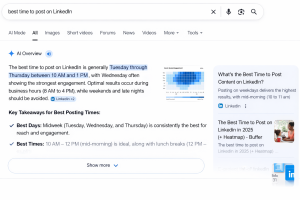
When someone searches “best time to post on LinkedIn,” Google might display a concise answer at the top, pulled from a site. But it is presented in a way that satisfies the query immediately. The searcher gets their answer. You get… well, we’ll come to that. (For the mechanics behind why Google surfaces certain answers at all, this walkthrough of how search engines crawl, index and rank content lays out the process step by step.)
Why Zero-Click Searches Are Exploding
The numbers tell a compelling story. Research shows that zero-click searches now account for 60% of all Google queries, a figure that’s climbed steadily since 2019.
Mobile searches, voice queries through Alexa or Siri, and Google’s push toward keeping users on their platform have all accelerated this trend.
But here’s the twist: this isn’t really bad news.
The SERP Real Estate That Actually Matters
Think about the hierarchy of visibility:
-
- Position zero (featured snippets) sits above traditional organic results
- AI Overviews dominate mobile screens with generated summaries
- Knowledge panels occupy valuable right-rail space
- People Also Ask boxes expand to show your expertise across multiple queries
When your content powers these features, you’re not losing visibility. You’re gaining prime positioning that traditional SEO experts would’ve killed for five years ago.
How Are Zero-Click Searches Changing User Behaviour?
Remember when “just Google it” meant clicking through five blue links to find your answer? Those days are fossils now.
The Instant Gratification Economy
Modern searchers aren’t just impatient. They’re efficient.
Why go through intro paragraphs and cookie banners when the search generative experience serves up the answer before your finger leaves the trackpad?
This behavioural shift runs deeper than convenience. Users now treat Google like a knowledge assistant rather than a directory. They ask questions conversationally (“How long to cook salmon at 180°C”) and expect immediate, authoritative responses. Voice search has amplified this, and people don’t want to read search results aloud through their car speakers.
From Click-Through to Read-Through
The traditional funnel looked like this: Search → Click → Read → Convert.
The new funnel? Search → Read → Remember → Search Your Brand → Convert.
See the difference?
Zero-click content shifts where you intercept the customer journey. Instead of capturing attention on your website, you’re capturing it in the SERP itself. The conversion doesn’t happen in that moment. It happens three days later when they remember you were the authority Google quoted.
What This Means for Content Strategy
You can’t optimise for 2018’s playbook anymore. Users expect:
-
- Immediate answers formatted for scanability
- Trustworthy sources that search engines validate by featuring
- Multi-device compatibility (voice, mobile, desktop)
- Context-rich information that anticipates follow-up questions
Brands still clinging to “get the click at all costs” are missing the forest for the trees. The new game rewards visibility and authority. Clicks become a secondary metric.
At Emvigo, we’ve watched this transformation firsthand with our clients. The ones thriving aren’t obsessing over CTR drops. They’re celebrating impression growth and tracking how SERP features translate to direct searches for their brand name weeks later.
Why Does Zero-Click Content Still Drive Conversions?
I know what you are probably thinking right now – “If nobody’s clicking, how am I making money?”
Fair question. But wrong assumption.
The Brand Halo Effect
Here’s what actually happens when your content occupies featured snippets and AI Overviews:
You build what marketers call “borrowed authority.” Google essentially endorses you as the definitive source. That’s not something you can buy with ads or manufacture with clever copy.
When a prospect sees your brand, answer their question three times in different searches; they are not taking notes. It may appear in a featured snippet about “B2B lead generation tactics.” It may show up again in a PAA about “content marketing ROI.”
It may appear again in an AI Overview about “SEO trends 2026.” But their brain is.
Psychologists call this the “mere exposure effect.” The more someone encounters your brand in trusted contexts, the more likely they are to choose you when purchase intent finally kicks in.
SERP Visibility Without Clicks: The Numbers Don’t Lie
Studies tracking user behaviour post-zero-click interactions reveal fascinating patterns:
-
- Brand recall increases by 47% when users see your content in featured snippets
- Branded search queries rise by 32% within two weeks of consistent SERP feature ownership
- Conversion rates on branded searches outperform generic queries by 3-4x
Translation?
Zero-click marketing acts as top-of-funnel brand building. You’re not closing sales in the SERP. You are warming leads so that when they enter your funnel (via direct navigation or branded search), they’re basically pre-qualified.
The Voice Search and Mobile Factor
When someone asks Alexa, “What’s the best CRM for small businesses,” and Alexa reads your answer aloud, did you get a click? Nope. Did you get brand exposure to someone actively researching solutions? Yes.
Voice search queries, which are zero-click by nature, are projected to account for 50% of all searches by 2026. If your content isn’t optimised for these interactions, you’re invisible in the fastest-growing search channel.
Real-World Conversion Paths
Let me give you a realistic scenario:
A marketing director searches “how to improve organic traffic.” Your article appears in a featured snippet with a clear, actionable three-step process. She doesn’t click.
Three weeks later, her CEO asks about SEO agencies. She remembers “that company Google featured” and searches your brand name directly. Your site comes up. She explores your services and books a consultation.
Was that first interaction a conversion? Not traditionally. Was it the most critical touchpoint in the entire journey? Without question.
Zero-Click Content Conversion Pathways
| User Action (SERP-Level Behaviour) | Brand Impact | Conversion Outcome |
| User reads your featured snippet answer without clicking | Authority established instantly; brand associated with expertise | Later branded search → direct website visit → enquiry or demo booking |
| User sees your brand repeatedly in “People Also Ask” expansions | Perceived category dominance; cognitive familiarity increases | Higher CTR on future searches → newsletter signup or content download |
| User views the product comparison table in SERP (no click) | Trust built through transparency and structured information | Shortened consideration cycle → direct conversion on return visit |
| User watches embedded short-form video preview in results | Emotional engagement + humanisation of brand | Click-through to video landing page → gated resource access |
| User sees review stars and structured ratings markup | Social proof reinforced before site interaction | Higher intent traffic → increased free trial or purchase rate |
| User interacts with local pack listing (maps, FAQs, hours) | Credibility + accessibility signals strengthened | Direct call, booking, or in-store visit without a website session |
| User reads the AI-generated search overview citing your brand | Implied endorsement via inclusion in the summarised answer | Mid-funnel acceleration → branded search → sales conversation |
How To Optimise Zero-Click Content for Maximum SEO Impact?
Alright, strategy session time. You’re convinced zero-click content matters. Now, how do you actually own those SERP features?
Start With Question-Based Content Architecture
Search engines love serving answers to questions. Users love asking questions. Your content should bridge that gap effectively.
For every topic you cover, identify the core questions your audience types into search bars:
-
- What is [topic]?
- How does [topic] work?
- Why does [topic] matter?
- When should I use [topic]?
Structure your content with these questions as H2 or H3 headings. Below each, provide a concise 40-60-word answer in the opening paragraph. Then expand with detail.
This dual-layer approach satisfies both featured snippet optimisation and users who click through for depth.
Master the Art of Concise, Structured Answers
Featured snippets favour specific formats:
-
- Paragraph snippets: 40-60 words, direct answer, no fluff
- List snippets: Numbered or bulleted steps, each under 10 words
- Table snippets: Comparison data, specs, pricing
When you’re targeting answer engine optimisation, think like you’re writing for someone with seven seconds to spare. Lead with the answer. Then justify it. Never bury the lede three paragraphs deep.
Schema Markup: Your Secret Weapon
Structured data tells search engines exactly what your content represents. Want to dominate PAA boxes? Implement FAQ schema. Trying to own recipe results? Recipe schema. Product comparisons? Product schema.
Tools like Schema.org provide markup for virtually every content type. And most of your competitors still haven’t bothered implementing it properly. That’s your advantage.
Leverage Tools to Identify Zero-Click Opportunities
Don’t guess which queries trigger featured snippets. Use data:
-
- Ahrefs shows which keywords have SERP features and who owns them
- Semrush tracks feature ownership over time
- Google Search Console reveals which queries show your content in features
Mine these tools for quick wins – queries where you rank positions 2-5 but don’t own the snippet. A content tweak, adding a concise answer paragraph, could get you to position zero.
Optimise for AI Overviews and Search Generative Experience
Google’s AI-powered results pull from multiple sources to synthesise answers. To position your content as a preferred source:
-
- Include statistical data with citations (AI loves facts)
- Use clear, confident language (no “maybe” or “possibly”)
- Answer follow-up questions proactively (think user journey)
- Maintain topical authority (cover subjects comprehensively, not superficially)
The brands winning in AI Overview SEO aren’t trying to game algorithms. They’re producing genuinely authoritative content that AI systems trust enough to cite.
Content Refresh: Your Quarterly Ritual
Zero-click content lives and dies by freshness. A featured snippet you owned six months ago might now belong to a competitor who updated their stats or expanded their answer.
Set quarterly reminders to:
-
- Update statistics and dates
- Expand answers based on new PAA questions
- Add recent examples or case studies
- Refine formatting based on what’s currently winning snippets
Think of this as gardening, not construction. You’re constantly pruning, watering, and nurturing, not building once and walking away.
Emvigo’s content optimisation sprints focus exactly on this. We identify your owned SERP features, finding vulnerable snippets your competitors own. Systematically capturing that visibility through strategic refreshes and technical optimisation is how this works.
What Metrics Should You Track for Zero-Click Content Success?
If you’re still judging zero-click marketing success by click-through rates, we need to talk. That’s like measuring a billboard campaign by how many people stop their cars to read it up close.
Impression Share: Your New North Star
Impressions tell you how often your content appears in search results – clicked or not. For zero-click content, this metric becomes critical. You want to see:
-
- Impression growth month-over-month
- High impression volume on informational, question-based queries
- SERP feature impressions specifically (if your analytics tool tracks it)
More eyeballs on your content in trusted positions equals more brand exposure. That’s the play.
SERP Feature Ownership Tracking
How many featured snippets do you own? How many PAA boxes include your content? How often does your brand appear in AI Overviews?
Tools like SEMrush and Ahrefs provide “SERP feature” reports showing exactly which features you’ve captured. Track this like you’d track keyword rankings.
Set goals: “Own 25 featured snippets by Q3” or “Appear in 15 PAA boxes for our core topic cluster.”
Branded Search Uplift
This is where zero-click content proves its conversion value. Monitor branded search volume over time. Use Google Trends to compare branded searches against industry terms. Watch for correlation between SERP feature wins and spikes in people searching your company name directly.
If you grab a high-volume featured snippet in March and see branded searches increase 20% in April, you’ve established causation worth celebrating and replicating.
Voice Search Presence
Harder to measure, but increasingly critical. Tools like Answer the Public and AlsoAsked show question-based queries that voice assistants pull from. If your content appears as answers to these queries, you’re winning voice search zero-click visibility.
Track:
-
- Question-based keyword rankings
- Conversational long-tail query performance
- Mobile vs desktop impression ratios (voice skews mobile)
Engagement Metrics for Click-Throughs
For the users who do click after seeing your SERP feature, watch these signals:
-
- Lower bounce rates (they’re pre-qualified)
- Higher pages per session (they trust you already)
- Stronger conversion rates (brand familiarity shortens sales cycles)
Users arriving from featured snippets often behave differently from cold traffic. Remember to track them as a separate segment.
Zero-Click Success Dashboard
| Metric | Ideal Range / Benchmark | Trend Indicator | What It Reveals About Performance |
| Branded Search Volume Growth | +10–25% QoQ | ↗ Consistent upward trend | Zero-click exposure is driving recall and brand-led intent |
| Share of SERP Features Owned (Featured Snippets, PAA, AI Overviews, Local Pack) | 20–40% of the target keyword set | ↗ Expanding footprint | Visibility dominance beyond blue links |
| Featured Snippet Retention Rate | >70% month-on-month | → Stable or rising | Content defensibility and authority strength |
| Impression-to-Click Ratio (Declining CTR with Rising Impressions) | Rising impressions with flat/slightly lower CTR | ↗ Impressions, ↘ slight CTR | Zero-click visibility working; influence without direct traffic |
| Branded CTR | >35% on branded queries | ↗ Increasing | Trust built at the SERP level converts to direct engagement |
| Assisted Conversions from Organic | 30–60% of total organic conversions | ↗ Growing share | Zero-click touchpoints contributing to multi-step journeys |
| Direct Traffic Growth | +8–20% QoQ | ↗ Sustained lift | Offline/zero-click recall translates into intentional visits |
| Time-to-Conversion (First Touch to Sale) | Decreasing over time | ↘ Shortening cycle | Pre-education via SERP features reduces friction |
How Can You Balance Click-Driven and Zero-Click SEO Strategies?
You need in-depth content for clicks and revenue, but you also need concise answers for SERP visibility. How do you serve both masters without diluting either?
The Content Segmentation Framework
Not every piece of content should chase zero-click optimisation. Think of your content library in three tiers:
Tier 1: Quick Answer Content (Zero-Click Optimised)
-
- Target: Informational, question-based queries
- Format: 400-800 words, structured with concise answers
- Goal: Featured snippets, PAA boxes, voice search
- Example: “What is content marketing?” or “How to calculate ROI”
Tier 2: Comprehensive Guides (Hybrid Approach)
-
- Target: Longer-tail educational queries
- Format: 1,500-2,500 words, starts with a quick answer, then dives deep
- Goal: Snippet for the intro, clicks for depth, backlinks for authority
- Example: “Complete guide to B2B content strategy” or “SEO audit checklist 2025”
Tier 3: Conversion-Focused Assets (Click-Driven)
-
- Target: Bottom-of-funnel, commercial intent
- Format: Landing pages, case studies, product comparisons
- Goal: Drive clicks, demo requests, and purchases
- Example: “Best marketing automation platforms compared” or “Emvigo services”
Creating Answer-First Depth Content
The smartest approach combines both strategies in a single asset. Structure like this:
- Opening section: Direct 50-word answer targeting featured snippet
- H2 sections: Each starts with a concise answer, then expands
- Deep dive sections: Tactical details, examples, case studies for readers who click
- Conversion elements: CTAs, demos, resources embedded naturally
This way, you satisfy Google’s appetite for quick answers while still providing value that encourages click-throughs from users wanting more.
Keyword Intent Mapping
Align your optimisation approach with user intent:
-
- Informational queries (“what is,” “how to,” “why does”) → Zero-click focus
- Commercial queries (“best,” “top,” “review,” “vs”) → Hybrid approach
- Transactional queries (“buy,” “pricing,” “demo,” “contact”) → Click-driven
Don’t waste energy trying to win featured snippets for “enterprise software demo”. That’s not how users engage with transactional content. But for “what is enterprise software,” absolutely dominate that SERP feature.
The 70/20/10 Content Investment Rule
Split your content production efforts:
-
- 70% on hybrid content that can win SERP features and drive clicks
- 20% on pure zero-click content targeting high-volume informational queries
- 10% on conversion-focused assets with zero SERP feature ambitions
This balance ensures you’re building brand authority through visibility while still driving direct conversions through click-based content.
What Are Future Trends in Zero-Click Content and Search Engines?
If you think zero-click searches are peaking, you’re in for a surprise. The trend’s accelerating into territories that fundamentally reshape how search works.
Generative AI Search Is Already Here
Google’s Search Generative Experience (SGE), Bing’s AI chat integration, and emerging platforms like Perplexity are rewriting the rulebook. These systems don’t just display your content. They synthesise it alongside competitors’, creating hybrid answers that may cite you… or not.
What this means for zero-click content strategy:
-
- Citation becomes currency: Being named as a source in AI-generated answers builds credibility
- Comprehensive coverage wins: AI pulls from sources that cover topics thoroughly, not superficially
- Structured data matters more: Machines parse marked-up content more reliably
- Brand mentions accumulate value: Even uncredited AI summaries build awareness if your points are distinctive
The winners will be brands becoming authoritative enough that AI systems can’t write about topics without referencing them.
Voice Assistants Reading Your Content Aloud
Alexa, Siri, Google Assistant – these aren’t peripheral channels anymore. They’re primary search interfaces for millions, especially while driving, cooking, or multitasking.
Your content’s voice search zero click readiness determines whether you exist in this medium:
-
- Is your answer conversational when read aloud?
- Does it make sense without visual context?
- Is it concise enough for someone to remember after hearing it once?
Optimising for voice isn’t radically different from featured snippet optimisation. It’s just more unforgiving about bloat and jargon.
Knowledge Panel Domination and Entity SEO
Google’s evolving toward “entity-first” search – understanding topics, brands, and people as distinct entities with relationships, not just keywords.
Building entity authority means:
-
- Consistent NAP (Name, Address, Phone) across the web
- Structured data on every relevant page
- Wikipedia presence (if applicable to your industry)
- Brand mentions and co-citations with industry leaders
- E-E-A-T signals (expertise, experience, authoritativeness, trust)
Brands that invest in entity optimisation now will own knowledge panels and rich results that competitors can’t easily replicate later.
The Rise of Vertical Search Engines
ChatGPT search, Perplexity, and niche AI search tools are fracturing the search landscape. Users increasingly go directly to these platforms for specific queries rather than defaulting to Google.
Your zero-click marketing strategy needs to account for:
-
- Multi-platform optimisation: What works for Google featured snippets may differ from what Perplexity cites
- Direct source links: Some AI engines provide attribution links, and your content needs to be accessible
- Conversational formatting: AI search favours natural language over keyword-stuffed content
Privacy, Cookies, and the Zero-Click Advantage
As third-party cookies crumble and tracking becomes restricted, brand building through SERP visibility without clicks becomes more valuable. You’re creating awareness and trust without relying on retargeting pixels or attribution models that privacy regulations are killing.
This shift favours enterprises thinking long-term about brand equity over quick-hit performance marketing tactics.
Emvigo’s SEO strategies account for these shifts. We’re not just optimising for Google’s algorithm today. We’re positioning your content to remain visible as search fragments across platforms, assistants, and AI systems that don’t even exist yet.
Design for What’s Next With Us
Build search resilience across emerging platforms before algorithm shifts catch competitors off guard – Start the Strategy.
How Can You Get Started With Zero-Click Content Optimisation?
You’re sold on the strategy. You see the trends. Now, where do you actually begin without overhauling your entire content operation overnight?
Audit Your Current SERP Feature Presence
Before creating new content, understand where you already stand:
- Run a SERP feature report in SEMrush or Ahrefs for your domain
- Identify which keywords currently trigger features (yours or competitors’)
- Analyse the gap: Which features could you realistically capture with minimal effort?
- Prioritise quick wins: Keywords where you rank positions 2-5 without owning the snippet
This audit typically reveals 15-30 opportunities to capture features by simply reformatting existing content.
Implement Schema Markup Systematically
If you’re not using structured data, you’re fighting with one hand tied behind your back. Start with:
-
- FAQ schema on your most-visited informational pages
- Article schema on blog posts
- How-To schema on instructional content
- Product schema on service or product pages
Tools like Google’s Structured Data Markup Helper make this approachable even without developer support. Validate your implementation with Google’s Rich Results Test.
Create a Question Bank From Real Searches
Mine these sources for questions your audience actually asks:
-
- Google Search Console: Filter for question-based queries
- Answer the Public: Generate hundreds of question variations
- People Also Ask: Manually collect PAA questions from target keywords
- Customer support tickets: Real questions = real search behaviour
Build a spreadsheet with 50-100 questions mapped to your core topics. These become your zero-click content roadmap.
Refresh High-Potential Content First
Don’t start from scratch. Identify existing content that:
-
- Ranks in positions 1-5 for target keywords
- Receives solid impressions but low clicks (sign of SERP feature cannibalisation)
- Covers topics with active featured snippets (showing Google deems them feature-worthy)
Add concise answer paragraphs, implement schema, update stats, and watch whether you capture or reclaim SERP features.
Test and Iterate Based on Feature Performance
Zero-click content optimisation isn’t one-and-done. Track which formats, answer styles, and content structures win features for your niche. Sometimes paragraph snippets work best; other times, lists dominate. Your data reveals patterns.
Run monthly reports on:
-
- New features captured
- Features lost
- Impression growth on feature-enabled keywords
- Branded search trends
Double down on what works. Adjust what doesn’t.
FAQs on Zero-Click Content and Search Visibility
What is zero-click content SEO?
Zero-click content SEO involves optimising content to appear in SERP features like featured snippets, AI Overviews, and knowledge panels, where users get answers without clicking through. It prioritises visibility and authority over traditional click-based metrics.
Will zero-click content reduce my website traffic?
Not necessarily. While individual query clicks may decrease, zero-click marketing builds brand awareness that drives branded searches and direct navigation later. Studies show users exposed to your content in SERP features convert at higher rates when they eventually visit.
How do featured snippets and AI Overviews affect conversions?
They pre-qualify audiences by establishing trust before users reach your site. When prospects see Google endorsing you as an authority, they enter your funnel warmer. This leads to shorter sales cycles and higher conversion rates on branded searches.
Can zero-click marketing still generate leads?
Absolutely. Zero-click content generates leads indirectly through brand recall and authority building. Users who see your content answering questions across multiple searches often return via branded queries with higher purchase intent. This convert at rates 3-4x higher than cold traffic.
How quickly can I optimise content for zero-click search?
Quick wins are possible within 4-6 weeks by reformatting existing content with concise answers and schema markup. Building comprehensive zero-click content authority across your topic space takes 3-6 months of consistent optimisation and content refreshes.
The Answer Is Already Out There – Are You the One Providing It?
Whether you optimise for zero-click content or not, your audience’s questions are getting answered on the SERP. The only variable is whether your brand gets credit or whether your competitors do.
Featured snippets don’t care about your domain authority or backlink profile as much as they care about answer quality and structure. That levels the playing field in ways traditional SEO never did.
Most organisations see zero-click marketing as a standalone tactic rather than a strategic pillar integrated with their broader content, brand, and conversion operations. They optimise individual pages without building topical authority. They chase snippets without tracking brand impact and celebrate features won without connecting them to revenue.
The New Search Economy Rewards Authority, Not Clicks
Think beyond immediate traffic. When your content consistently appears in featured snippets, AI Overviews, and voice search results across your industry’s core topics, you’re not just answering questions – you’re becoming the answer. That positioning translates to pricing power, shorter sales cycles, and customer trust that paid advertising simply cannot manufacture.
The evolution toward zero-click searches isn’t making SEO obsolete. It’s making bad SEO obsolete. Thin content, keyword stuffing, and backlink manipulation never belonged in search results.
What replaces them is exactly what should have been there all along: authoritative, helpful, expertly crafted answers that serve users’ needs instantly.
Let’s talk about building your zero-click visibility engine. Book a strategy session with Emvigo’s SEO specialists. Let’s map out exactly which SERP features you should own, how to capture them, and how to track the conversions they’re driving behind the scenes.