


Two weeks after the launch of one of my friends’ MVP, their Slack channel exploded with 47 unread messages. Customer support was fielding 300% more queries. The database was creaking. And their star developer just sent a message that made every founder’s heart skip: “We need to talk.”
But here’s the plot twist: this wasn’t a disaster story. It was the beginning of their most successful year yet.
They cracked the code on scaling your development team before their success became their biggest problem. One might have roughly 90 days from the moment your success metrics spike to get this right. Miss that window, and you’ll spend the next year playing catch-up while your competitors capture the market you validated.
This guide will give you a clear plan for scaling your development team. It will help you build a bigger and better team that works more efficiently.
When is the Right Time to Start Scaling Your Development Team?
Timing in team scaling is everything. Scale too early, and you’ll burn through capital faster than a student through their maintenance loan. Scale too late, and you’ll watch competitors overtake you while your team burns out trying to keep up.
The Telltale Signs Your Team Needs Scaling
Your development team is sending you signals louder than a fire alarm at 2 AM. Here are the unmistakable indicators:
-
- Sprint Velocity is Declining Consistently
When your team’s story points drop by 20% or more over consecutive sprints, it’s not just a rough patch. It’s a clear sign that your current capacity can’t handle the workload. - Technical Debt is Mounting Faster Than You Can Address It
Are your developers are spending more than 30% of their time fixing bugs rather than building features? This is a sign that you’ve hit a scaling bottleneck. - Your Best Developers Are Showing Burnout Symptoms
Late-night messages, weekend deployments becoming the norm, and your star developer mentioning “work-life balance” in stand-ups? Time to scale. - Customer Feature Requests Are Piling Up
When your product backlog grows faster than your team can tackle it, you’re not just missing opportunities. You’re also risking customer churn.
- Sprint Velocity is Declining Consistently
The Role of MVP Success in Team Scaling Strategy
A successful MVP launch is both a blessing and a curse. It definitely validates your product-market fit. But it also immediately creates pressure to scale your development team.
The sweet spot for scaling lies in what we call the “MVP Success Window”. It’s that important 90-day period after you start gaining users. User acquisition is growing, but hasn’t yet stressed your infrastructure.
Companies that begin their team scaling strategy within this window are 40% more likely to succeed. Wait beyond this period, and you’re literally just playing catch-up. This could also be the time when your competitors trigger their growth way ahead of the trajectory.
Key Metrics That Trigger Scaling Decisions:
-
- Monthly Active Users (MAU) growing by 25%+ month-over-month
- Customer acquisition cost decreasing when lifetime value increases
- Infrastructure costs rising faster than revenue
- Feature development cycle extending beyond planned timelines
The beauty of understanding this juncture is that it connects to your broader digital product success strategy. The journey from MVP to market leadership requires not just a great product. It should have a team capable of supporting rapid growth without compromising quality.
MVP Success Metrics vs. Team Scaling Triggers
| Metric (what to watch) | Actionable trigger (when it’s a red flag) | What it indicates | Immediate scaling decision / recommended action | Evidence/notes |
| MAU / active-user growth | ≥ 25% month-on-month sustained for 2 consecutive months, or a one-week spike >50% | Product-market demand is accelerating — you’re entering the MVP Success Window, and product/infra/ops will soon be stressed | Start capacity planning: prioritise infra work, spin up 1–3 augmented senior devs (or 1 SRE + 1 backend), prepare support scaling and monitoring playbook | Rapid growth benchmarks and advice for SaaS/startups. Use MoM ≥25% as a practical signal to act. (ChartMogul) |
| Customer-support volume | Support queries up 50–100% MoM (or sudden spikes 200–300%) | UX edge-cases / bugs or onboarding gaps impacting customers; risk of churn | Add temporary support capacity, implement automation/self-service, and assign 1 developer to fix high-impact P0 issues; consider staff augmentation for short-term surge | Intercom / Zendesk best practices and case studies on scaling support during spikes. (Intercom) |
| Sprint velocity | Velocity down ≥ 20% across 2 consecutive sprints | Team capacity overloaded, interruptions, or increasing firefighting | Pause hiring for low-value features; run a short stability/triage sprint, add 1 senior dev or QA to unblock the team, and reallocate sprint capacity for debt | Agile/Atlassian guidance: velocity drops are an early symptom — investigate and relieve capacity fast. (Atlassian) |
| Technical debt/dev time on bugs | Developers spending >30% of time on maintenance/bugs | Core engineering capacity being consumed by operational work — future feature velocity will collapse | Allocate dedicated refactor sprints, hire/augment a senior architect or experienced mid-senior dev, and reserve 10–20% sprint capacity for debt until metric <20% | Multiple industry surveys/reports show technical debt consumes 30–40% of dev time — use this as a trigger to act. (SonarSource) |
| Lead time for changes (DORA) | Lead time slips to >1 week (moving from Elite/High into Medium) or deployment frequency falls substantially | Delivery pipeline bottlenecks, slower feedback loops, and higher opportunity costs | Invest in CI/CD & automation, hire/augment 1 DevOps/SRE, create deployment reliability goals (improve DORA metrics) | DORA benchmarks / Accelerate research: elite/high performers have short lead times; slipping bands means urgent process/people investment. (dora.dev) |
| Infrastructure/cloud cost growth | Cloud costs grow faster than revenue (e.g., cloud spend ↑20% while revenue ↑<10%) or unexplained cost anomalies | Unsafe unit economics; scaling is losing money | Run immediate FinOps audit, add SRE/FinOps capacity, right-size/optimise critical services (or move to reserved/spot pricing) | FinOps guidance — if cloud costs outpace revenue, prioritise a FinOps & architecture review. (FinOps Foundation) |
| Backlog & feature requests | Backlog >150 items or estimated time to clear backlog > 6 months | Prioritisation failure; signals you’re missing market opportunities, and customers are waiting | Add product ownership capacity (PO/PM) + 1–2 devs (or augment), run backlog-pruning workshops, create a “holding tank” for unready items | Practical backlog heuristics: keep backlog manageable (<150 items) and prune to maintain agility. (Eficode.com) |
| Onboarding ramp / time-to-first-PR | New hires take >1–3 months to submit meaningful PRs | Onboarding/systems are slow — senior devs become onboarding bottlenecks | Fix onboarding (scripts, infra, AD/creation, runbooks), consider temporary augmented hires who can be productive in 1–2 weeks while revamping in-house onboarding | Industry surveys show that the typical first-meaningful-PR is 1–3 months for in-house hires; augmentation vendors often reach one- to two-week productivity. (Cortex) |
| Code & test coverage (quality gates) | Critical/new code < 80% coverage or test failures rising | Regression risk increases; delivery stability at risk | Enforce quality gates (new code coverage 80%+), hire QA/automation engineer(s) or augment for test automation | SonarQube / industry guidance: aim for ~80% new-code coverage and enforce test gates for scaling safely. (SonarSource) |
| Regression / bug-reopen rate | Bug reopens / regression > 5% per sprint | Low-quality escaping into releases; firefighting steals capacity | Add QA/automation, strengthen code reviews and release checklist, consider temporary test-automation augmentation | QA practitioners suggest aiming for low internal defect leakage; >5% reopen rate is a clear deterioration signal |
How to Scale a Software Development Team?
Scaling your development team isn’t like hiring for other departments. You can’t just post a job on LinkedIn and expect magic to happen. Software development team scaling requires a strategic approach. This should balance immediate needs with long-term vision.
The Strategic Framework for Team Expansion
Step 1: Audit Your Current Capabilities
Before adding new team members, understand exactly what skills and capacity gaps exist. This isn’t about headcount, it’s about capability mapping.
Step 2: Define Your Scaling Model
Will you scale vertically (adding senior developers) or horizontally (adding junior developers with strong mentorship)? Each approach serves different strategic goals.
Step 3: Establish Your Integration Process
New team members should be productive within their first week, not their first month. This requires effective onboarding systems and clear documentation.
Step 4: Implement Quality Gates
As your team grows, informal quality control breaks down. Establish code review processes, automated testing, and clear development standards before you scale.
Choosing Your Team Scaling Strategy
The Gradual Growth Approach
Add 1-2 developers every quarter, allowing for proper cultural integration and knowledge transfer. Perfect for bootstrapped companies with steady growth.
The Rapid Expansion Model
Double your team size within 6 months to capture market opportunities quickly. Requires strong leadership and robust processes.
The Skills-First Strategy
Focus on adding specific expertise rather than general development capacity. Ideal when facing technical challenges that require specialised knowledge.
Each approach has its merits. But the key is matching your scaling strategy to your business objectives and available resources.
Your team scaling strategy should be as unique as your product. We’ve helped over 200 UK startups navigate this critical decision through our discovery phase services. Ready to build a strategy that works for your unique situation? We will help you craft your winning game plan over a free strategy session.
What Are the Challenges of Scaling Your Development Team?
Scaling your development team is riddled with pitfalls that can damage even the most promising startups. Understanding these challenges isn’t pessimism, it’s preparation.
The Talent Shortage Crisis
The market faces a software developer shortage of over 700,000 professionals. For every senior developer position, there are approximately 6 competing offers. It’s about competing for exceptional developers who can maintain your velocity whilst adapting to your culture.
The Hidden Costs of Traditional Hiring:
-
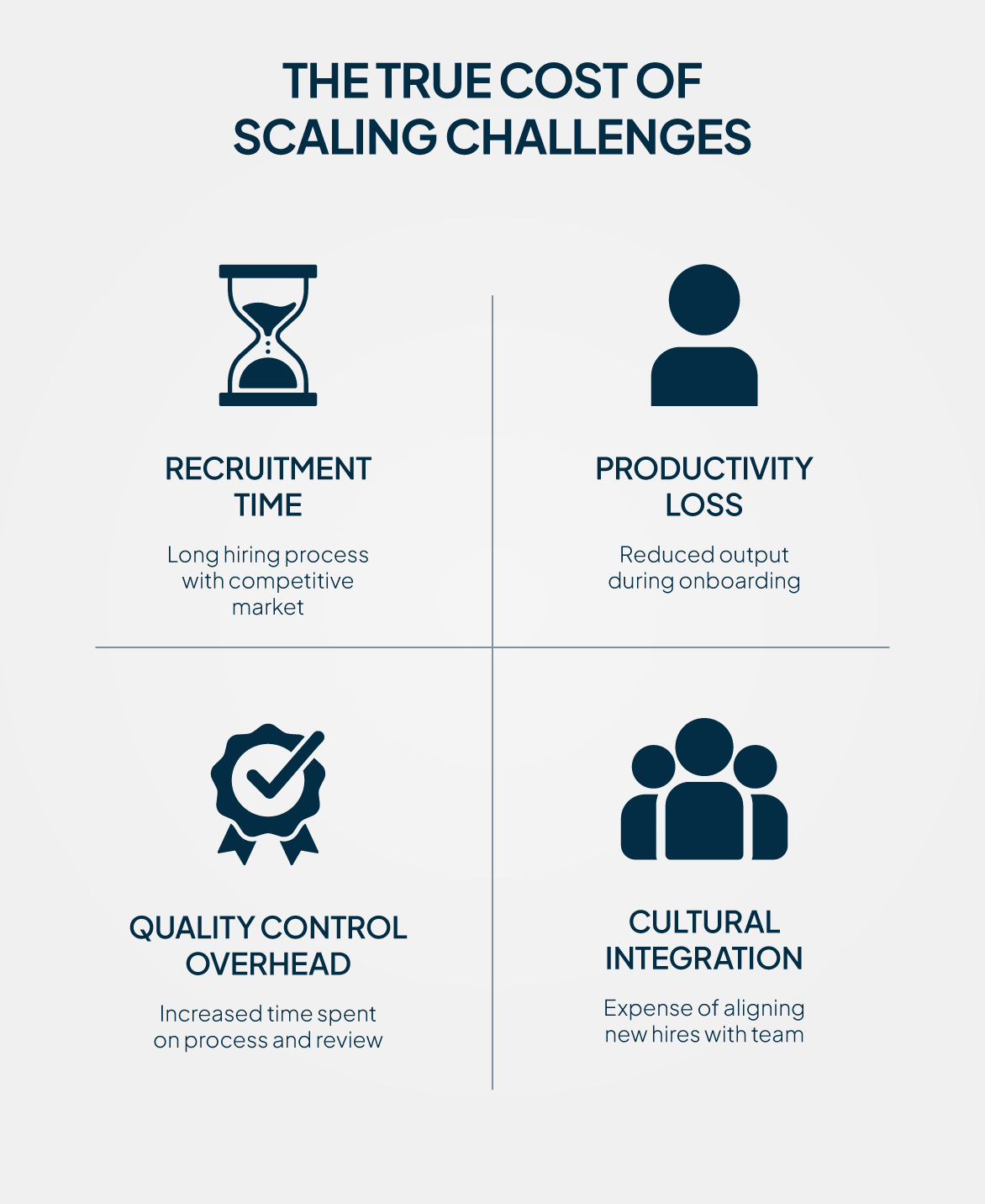
- Average time-to-hire for senior developers: 89 days
- Cost per hire (including recruitment, onboarding, and equipment): £15,000-£25,000
- Risk of bad hires: 40% of technical hires don’t meet performance expectations within their first year
Cultural Dilution During Rapid Growth
Here’s something most scaling guides won’t tell you. Every new hire changes your team culture. Add the wrong person, and you can destroy the collaborative spirit that made your MVP successful.
The Communication Complexity Problem
When your team grows from 5 to 15 developers, communication paths increase exponentially. What used to be a quick conversation across desks now requires formal processes, documentation, and structured meetings.
Maintaining Code Quality at Scale
Technical debt compounds faster during scaling periods. New developers, pressure to deliver features quickly. Inadequate code review processes create a perfect storm for quality degradation.
Quality Control Metrics That Matter:
-
- Code review coverage: Should maintain 100% even during rapid scaling
- Automated test coverage: Must stay above 80% for critical features
- Bug regression rate: Shouldn’t exceed 5% per sprint, regardless of team size
The Onboarding Bottleneck
Your senior developers become bottlenecks when they’re constantly training new team members. This creates a vicious cycle where your most productive developers become less productive. This will eventually slow the overall velocity.
Benefits of Staff Augmentation for Software Development
Now, here’s where the conversation gets interesting. What if I told you there’s a way to scale your development team without most of these traditional challenges? Enter staff augmentation – the pit crew strategy for software development.
Staff Augmentation vs Traditional Hiring
Unlike traditional hiring, staff augmentation allows you to scale your development team with pre-vetted, experienced developers. They will easily adapt and integrate with your existing processes.
Immediate Impact Benefits:
-
- Rapid Deployment: New team members can be productive within days, not months
- Risk Mitigation: Try before you buy. Assess cultural and technical fit before making long-term commitments
- Cost Efficiency: 40-60% lower total cost compared to traditional hiring when factoring in recruitment, onboarding, and infrastructure costs
- Skill Specialisation: Access to specific expertise for particular projects without permanent overhead
The Team Extension Model: Your Secret Weapon
Team extension takes staff augmentation further. Instead of project-based contractors, you get dedicated developers who become genuine extensions of your internal team. They attend your stand-ups and understand your product vision. They will be equally invested in your long-term success.
Why Team Extension Works for Scaling:
-
- Maintains team culture while adding capacity
- Provides flexibility to scale up or down based on project demands
- Offers access to senior developers who might not be available for permanent roles
- Reduces the administrative burden of traditional employment
Consider the case of a London-based e-commerce startup. Facing a 400% increase in user traffic post-MVP launch, they needed to double their development team within 8 weeks. Traditional hiring would have taken 6 months minimum.
Through strategic staff augmentation, they added 4 senior developers who were productive within their first week. The result? They shipped their major platform update 2 months ahead of schedule. This enabled them to capture 60% of their target market before competitors could react.
The key wasn’t just the speed but the quality. The augmented team members brought experience from similar scaling challenges. This provided them with insights that prevented common pitfalls in development.
In-House vs Staff Augmentation for MVP Development
This is where most CTOs get stuck. The classic dilemma: build your dream team in-house or leverage external expertise to accelerate growth?
The In-House Model: Pros and Cons
The God-Like Benefits:
-
- Complete Control: Every hiring decision, every cultural nuance, every process is yours to define
- Long-term Commitment: Team members are invested in your company’s long-term success
- Intellectual Property Security: All knowledge and expertise remain within your organisation
- Cultural Alignment: Easier to maintain company culture and values
The Devilish Drawbacks:
-
- Time Intensity: Average 3-6 months to find, hire, and onboard senior developers
- Financial Risk: High upfront costs with no guarantee of performance or cultural fit
- Limited Talent Pool: Restricted to developers willing to relocate or work in your specific location
- Scaling Inflexibility: Difficult to rapidly adjust team size based on project demands
The Staff Augmentation Advantage
The God-Like Benefits:
-
- Speed to Market: Scale your development team within weeks, not months
- Cost Effectiveness: 40-60% lower total cost when including recruitment, benefits, and infrastructure
- Expertise Access: Tap into global talent pools and specialised skills
- Risk Management: Trial periods and flexible contracts reduce hiring mistakes
The Devilish Drawbacks:
-
- Cultural Integration: Requires intentional effort to maintain team cohesion
- Knowledge Transfer: Need robust processes to ensure continuity
- Communication Overhead: May require additional coordination for distributed teams
The Hybrid Strategy: Best of Both Worlds
Smart companies aren’t choosing between in-house and staff augmentation. Instead, they’re combining both strategically. Maintain a core in-house team for critical functions whilst using staff augmentation for specialised needs and rapid scaling.
The 70-30 Rule:
-
- 70% core in-house team for essential functions and cultural continuity
- 30% augmented staff for specialised skills, peak capacity, and experimental projects
We have partnered with over 500 companies to implement successful hybrid scaling strategies. Our clients typically achieve 2.5x faster time-to-market, maintaining 95% code quality standards.
The secret? Treating augmented developers as true team extensions, not external contractors. Want to see how this could work for your specific situation? Let’s explore your scaling possibilities over a call.
How Can an IT Service Company Help Scale a Development Team?
The right IT service company doesn’t just provide developers. They become your strategic partner in building a scalable, high-performance development organisation.
Beyond Staff Augmentation: Complete Team Transformation
An experienced IT service company brings something invaluable. It’s pattern recognition from hundreds of similar scaling challenges. They’ve seen what works, what fails, and what catches companies off guard during rapid growth.
Strategic Capabilities That Matter:
-
- Team Architecture Design: Helping you structure teams for optimal communication and productivity
- Process Implementation: Establishing scalable development workflows before bottlenecks occur
- Technology Stack Optimisation: Ensuring your technical foundation can support team growth
- Quality Assurance Systems: Building automated testing and quality gates that scale with your team
The Managed Services Approach
Some IT service companies offer managed services that go beyond individual developers. They provide entire sub-teams with their own project management, quality assurance, and technical leadership.
When Managed Services Make Sense:
-
- You need to launch a parallel product line
- Specific projects require specialised expertise
- You want to maintain focus on core development whilst outsourcing auxiliary features
- Scaling requires capabilities you don’t have in-house
Cultural Integration Excellence
The best IT service companies understand that successful team scaling isn’t just about adding capacity. They realise it’s about maintaining the culture and velocity that made your MVP successful.
What to Look for in an IT Service Partner:
-
- Market Experience: Understanding of local business practices and cultural nuances
- Industry Expertise: Experience with companies at your stage and in your sector
- Proven Integration Processes: Clear methodologies for cultural and technical integration
- Flexible Engagement Models: Ability to adapt as your needs evolve
Risk Mitigation Through Experience
An experienced IT service company acts as your insurance policy against common scaling mistakes. They can identify potential pitfalls before they become problems. This way they implement solutions based on proven success patterns.
Common Scaling Pitfalls They Help Avoid:
-
- Hiring for immediate needs rather than future requirements
- Underestimating the time and cost of proper onboarding
- Neglecting process improvements during rapid growth
- Failing to maintain code quality standards under pressure
How to Maintain Code Quality While Scaling a Development Team?
This is where most scaling efforts fall apart. You add developers to move faster. But code quality degrades, bugs multiply, and you end up moving slower than before. It’s the ultimate scaling paradox.
The Quality-Scale Framework
Maintaining code quality while scaling your development team requires intentional system design. You can’t rely on informal processes that worked for your original small team.
Foundation Layer: Automated Quality Gates
-
- Continuous Integration: Every code commit triggers automated testing
- Code Coverage Requirements: Minimum 80% test coverage for all new features
- Static Code Analysis: Automated tools that catch quality issues before human review
- Performance Benchmarks: Automated testing that ensures new code doesn’t degrade system performance
The Code Review Evolution
As your team grows, code review processes must evolve from casual peer reviews to structured quality assurance systems.
Scaling Code Review Strategies:
-
- Review Assignment Algorithms: Systematic assignment based on expertise and workload
- Review Checklists: Standardised criteria that every review must address
- Review Metrics: Tracking review quality, not just quantity
- Knowledge Sharing: Code reviews become teaching opportunities for new team members
Documentation as a Scaling Tool
Most teams treat documentation as a burden rather than a scaling enabler. Proper documentation allows new team members to contribute meaningfully without constant mentorship from senior developers.
Documentation That Scales:
-
- Architecture Decision Records: Why specific technical choices were made
- API Documentation: Self-updating documentation that stays current with code changes
- Development Workflows: Clear processes for common development tasks
- Troubleshooting Guides: Solutions to common problems that new developers encounter
The Technical Debt Management System
Technical debt accumulates faster during scaling periods. Without systematic management, it can cripple your development velocity just when you need it most.
Debt Management Strategies:
-
- Debt Categorisation: Not all technical debt is equally problematic
- Regular Debt Audits: Monthly assessments of debt accumulation and impact
- Debt Allocation: Dedicating a specific percentage of each sprint to debt reduction
- Prevention Systems: Processes that prevent new debt from accumulating
What is a Team Scaling Strategy?
A team scaling strategy is a comprehensive blueprint for growing your development capacity. It has to be executed while still maintaining the elements that made your original team successful.
The Strategic Framework Components
-
- Capacity Planning:
Understanding not just how many developers you need, but what skills and experience levels will optimise your team performance. - Cultural Preservation:
Maintaining the collaborative spirit and innovative thinking that drove your MVP success while integrating new team members. - Process Evolution:
Adapting your development workflows, communication patterns, and decision-making processes to work effectively at larger scales. - Technology Scalability:
Ensuring your development tools, infrastructure, and architectural decisions can support a larger team.
- Capacity Planning:
The Timeline Approach to Scaling Strategy
Phase 1: Foundation (Months 1-3)
-
- Establish scalable processes before adding team members
- Document existing workflows and technical decisions
- Implement quality gates and automated testing
- Define cultural values and teamwork agreements
Phase 2: Controlled Growth (Months 4-9)
-
- Add team members systematically with proper onboarding
- Monitor team velocity and quality metrics
- Refine processes based on real growth challenges
- Establish mentorship and knowledge-sharing systems
Phase 3: Optimised Scale (Months 10-18)
-
- Fine-tune team structure for optimal communication
- Implement advanced development practices
- Establish team leadership and project management systems
- Plan for sustainable long-term growth
Measuring Scaling Success
Your team scaling strategy needs clear success metrics beyond just team size:
Velocity Metrics:
-
- Story points delivered per sprint (should increase with team size)
- Feature delivery frequency (faster releases despite complexity)
- Time from concept to deployment (decreasing cycle times)
Quality Metrics:
-
- Bug regression rate (should remain stable or improve)
- Code review quality scores
- Customer satisfaction with delivered features
Team Health Metrics:
-
- Developer satisfaction and retention rates
- Knowledge distribution across team members
- Communication efficiency and effectiveness
The Strategic Decision Matrix
Not all scaling decisions are created equal. Your team scaling strategy should include a decision framework for different scenarios:
-
- High-Impact, High-Urgency: Rapid staff augmentation for critical features
- High-Impact, Low-Urgency: Strategic in-house hiring for core competencies
- Low-Impact, High-Urgency: Temporary contractor support for specific projects
- Low-Impact, Low-Urgency: Training and development of existing team members
Emvigo don’t just provide developers! We help you architect your entire scaling strategy. The result? Teams that are 3x more productive at scale than they were as startups. Ready to unlock your team’s scaling potential? Let’s build your strategic blueprint.
Scaling Your Development Team: The Blueprint for Unstoppable Growth
Your development team’s growth journey will decide if you join the 15% of startups that lead the market. Otherwise, you may become just another good idea that failed to grow.
The companies winning this race understand that scaling your development team is both an art and a science. They combine the strategic rigour of experienced CTOs with the flexibility to adapt to rapidly changing market conditions. They don’t just hire developers – they architect sustainable growth machines.
Tomorrow’s market leaders are those implementing hybrid scaling strategies today. They do maintain a strong in-house core. But they also leverage staff augmentation services for rapid capacity expansion.
AI will change how developers work. Remote collaboration tools will evolve. Market competition will intensify. But one constant remains. Companies with scalable, high-performance development teams will adapt faster and capture more market share.
Your Scaling Co-Pilot Awaits
The difference between startups that scale successfully and those that stumble isn’t luck. It’s having the right strategic partner during critical growth phases. Emvigo has been the scaling co-pilot for over 700 projects, helping them navigate from MVP success to market leadership.
Your championship race is just beginning, and every great driver needs an exceptional pit crew. Ready to accelerate your scaling success? Schedule your first free strategic consultation with the best IT service agency in the UK.
Frequently Asked Questions on Scaling Your Development Team
How long does it typically take to scale a development team effectively?
Strategic team scaling typically takes 6-12 months for sustainable results. Rapid scaling through staff augmentation can show immediate impact within 2-4 weeks. Building in-house teams requires 3-6 months per hire.
What’s the optimal team size for most startups after MVP success?
Most successful startups scale to 8-12 developers within their first year post-MVP. This size maintains agility, providing sufficient capacity for feature development and infrastructure scaling.
How do I maintain team culture when scaling rapidly?
Focus on documenting your cultural values early. Implement structured onboarding processes, and use staff augmentation services that prioritise cultural fit alongside technical skills.
What metrics should I track during team scaling?
Monitor sprint velocity, code quality metrics, team satisfaction scores, feature delivery frequency, and time-to-productivity for new team members.
Is staff augmentation more cost-effective than traditional hiring?
Staff augmentation usually costs 40-60% less than traditional hiring. This includes recruitment, onboarding, benefits, and infrastructure costs. It also helps teams become productive faster.