

The most successful companies share a common trait: they anticipate market disruptions while their competitors react too late to capitalise on emerging opportunities.
Smart companies use predictive analytics to identify risks and opportunities early—before they happen. Predictive analytics examples show how businesses stay one step ahead by using data to plan ahead. They identify them before they unfold.
From Netflix predicting what you’ll watch next to Amazon forecasting demand, predictive analytics is already shaping decisions that affect millions of people daily. Let’s review how different industries use this powerful technology to stay ahead.
What Makes Predictive Analytics So Powerful?
At its core, predictive analytics uses past data, machine learning, and statistics to find patterns. Traditional reports explain what happened. Predictive analytics goes a step further—it tells you what’s likely to happen next.
The beauty lies in its versatility. Whether you’re a manufacturing company implementing AI solutions or a retailer managing stock, predictive analytics can be customised to fit your industry’s needs.
Predictive Analytics: A Cross-Industry Perspective
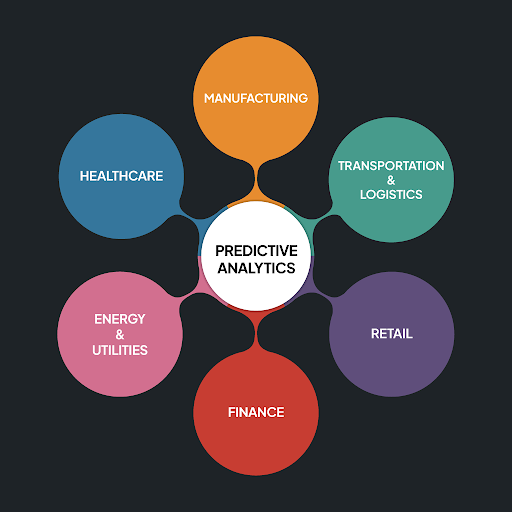
1.Healthcare: Saving Lives Through Data
What if hospitals could predict which patients might need emergency care before symptoms worsen?
Some of the most impactful predictive analytics examples are in healthcare, where early interventions can save lives.
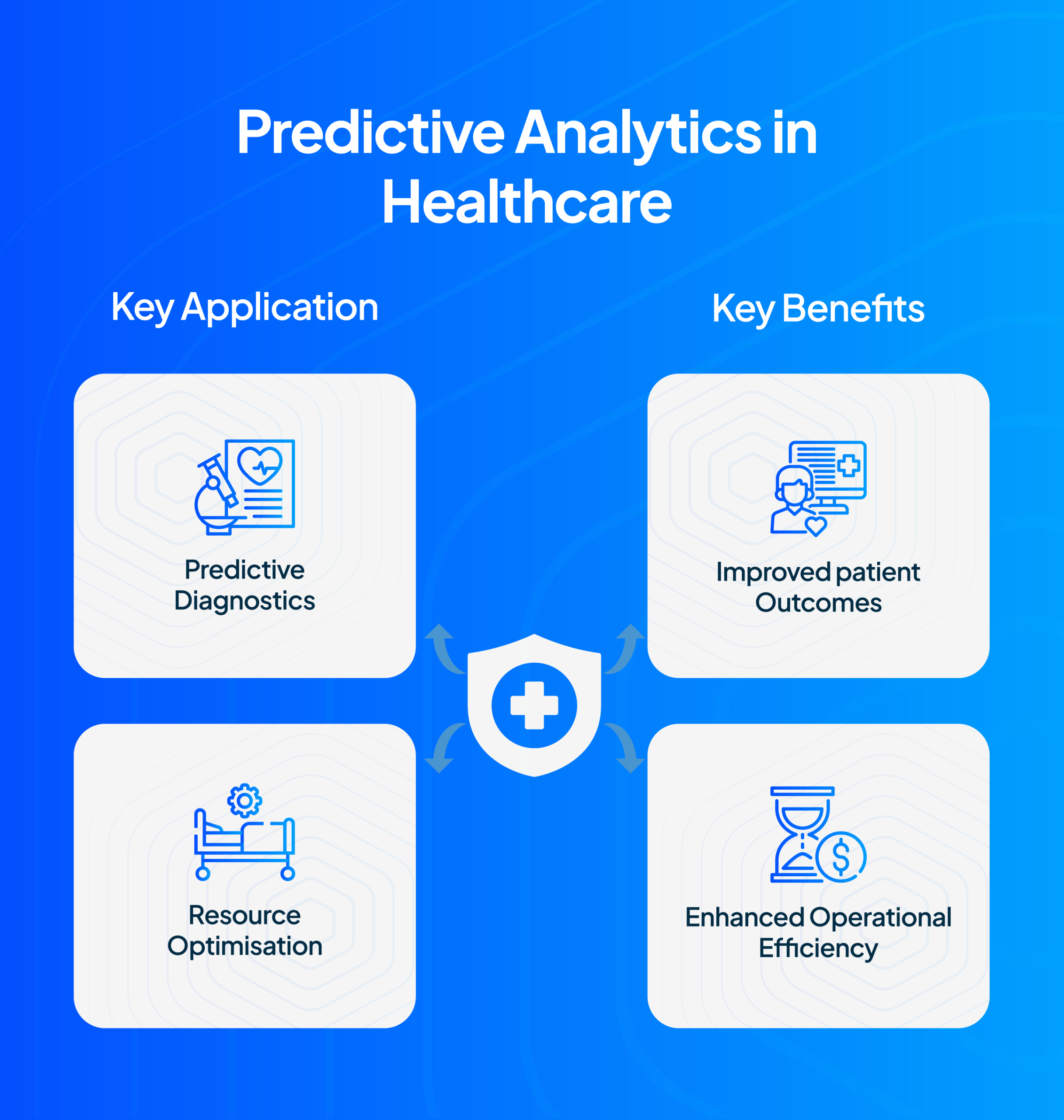
Healthcare organisations worldwide are making this a reality through predictive analytics. Hospitals and medical centres are using advanced models to:
-
- Predicting Disease Risk : Identifies patients at high risk of developing a disease by analysing their health data, allowing for early prevention.
- Preventing Hospital Readmissions : Pinpoints patients likely to be readmitted to the hospital after discharge, so healthcare teams can provide extra support and follow-up care to prevent it.
- Personalised Treatment : Predicts how a patient will respond to a specific treatment or drug based on their unique genetic and medical information, leading to more effective care plans.
- Optimising Hospital Operations : Forecasts patient volume and emergency room traffic to help hospitals manage staffing, beds, and resources more efficiently, reducing wait times.
- Detecting Fraud : Analyses billing and claims data to spot unusual patterns that could signal fraudulent activity, saving healthcare systems money.
- Managing Population Health : Helps public health officials predict and track the spread of diseases, allowing them to allocate resources and create targeted health campaigns for a community.
Resource Planning
-
- Flu Outbreak Preparation: Anticipates seasonal flu outbreaks to prepare facilities and staff accordingly.
- Staff Scheduling: Optimises staff schedules based on predicted patient volumes to avoid understaffing or overstaffing.
- Supply Chain Management: Manages medical supply chains more effectively by forecasting demand and preventing shortages.
- Equipment Maintenance: Predicts when machines will fail to schedule preventative repairs.
According to a study by Davis et al (2022), machine learning models using both manual and automated features predicted 30-day hospital readmissions with high accuracy (AUC 0.83), outperforming traditional models like LACE (AUC 0.66). In practice, predictive analytics has helped hospitals cut readmissions by 25% and improve patient satisfaction, as reported by the Health Foundation
Emvigo’s healthcare solutions utilise predictive analytics to improve patient outcomes, optimise operations, and reduce costs.
2.Financial Services: Risk Management Reimagined
Financial institutions use predictive analytics to gain a clearer understanding of market shifts and ensure they meet regulatory requirements.
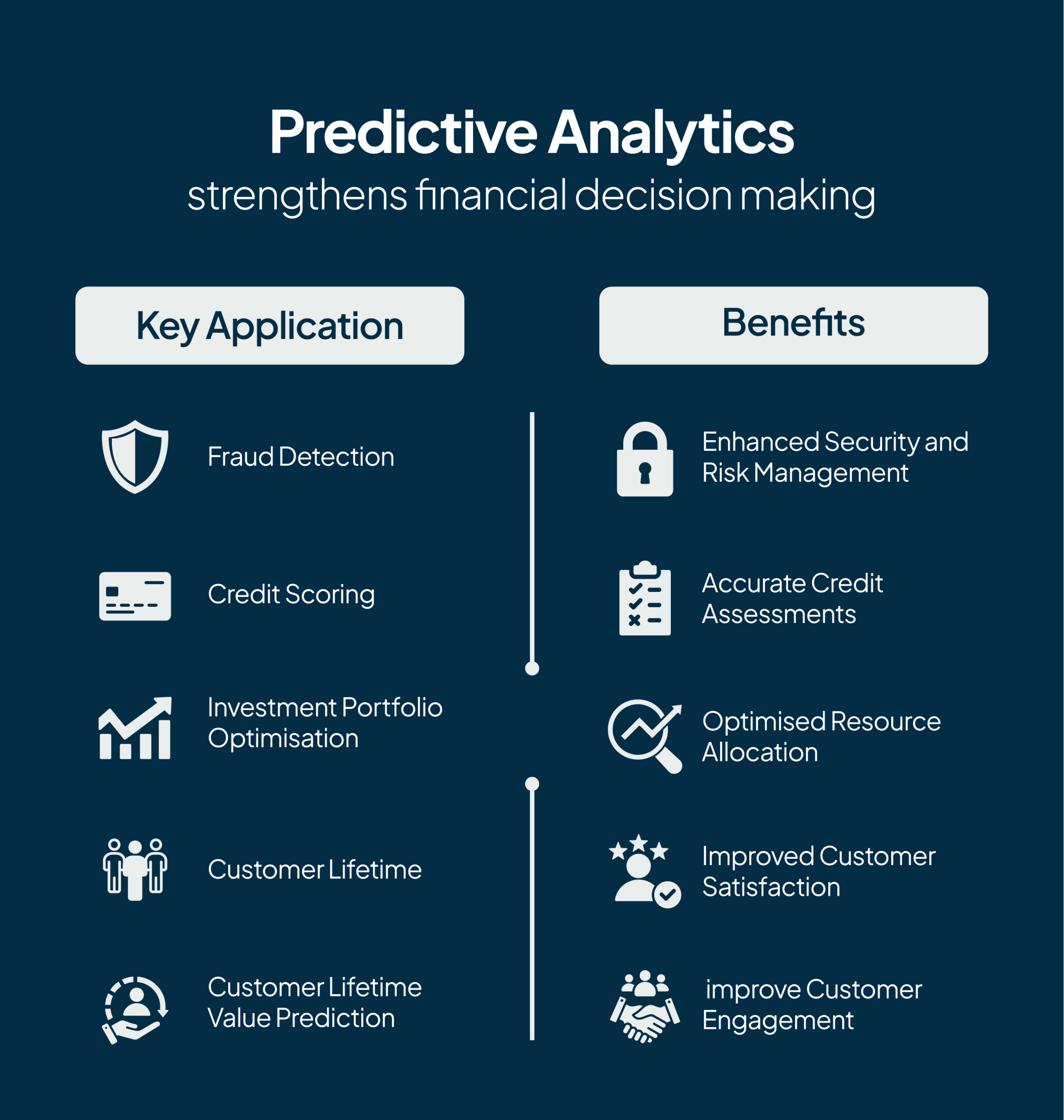
In financial services, predictive analytics examples include:
1. Risk Management
-
- Credit Risk: Predicts the likelihood of a loan default to create more accurate credit scores.
Banks now analyse thousands of data points to predict loan defaults. It’s more accurate than traditional credit scoring methods. This approach has enabled more inclusive lending while maintaining risk controls. - Market Risk: Forecasts market trends to help financial firms manage investments and reduce risk.
- Credit Risk: Predicts the likelihood of a loan default to create more accurate credit scores.
2. Fraud Detection and Prevention
-
- Real-time Fraud Detection: Real-time predictive models can identify suspicious transaction patterns within milliseconds, protecting both institutions and customers.
AI and behavioural analytics are helping major UK banks reduce fraud, with tools like ThreatMetrix analysing 92 billion transactions across 4 billion email addresses. By tracking unique user behaviour, banks detect fraud early.
Metro Bank used this tech to identify £2.5M in mule payments and cut first-party fraud by 44% in six months
- Anomaly Detection: Identifies spending patterns that are outside of a customer’s normal behaviour to flag suspicious transactions.
- Real-time Fraud Detection: Real-time predictive models can identify suspicious transaction patterns within milliseconds, protecting both institutions and customers.
3. Customer Engagement and Personalisation
-
- Personalised Products: Recommends specific products (e.g., mortgages, new credit cards) to customers based on their financial habits and life stage.
- Churn Prediction: Identifies customers who are likely to switch to a competitor, allowing the bank to offer them targeted retention deals.
4. Operational Efficiency
-
- Cash Flow Forecasting: Predicts future cash flow for better budgeting and financial planning.
- Automated Trading: Powers high-speed trading strategies by using algorithms to act on predicted market movements.
The Financial Conduct Authority supports using predictive analytics to improve financial services. This is only if proper rules and safeguards are in place
Emvigo’s Advanced AI and ML solutions enable financial institutions to implement predictive models that enhance decision-making and mitigate risks.
3.Retail and E-commerce: Understanding Customer Behaviour
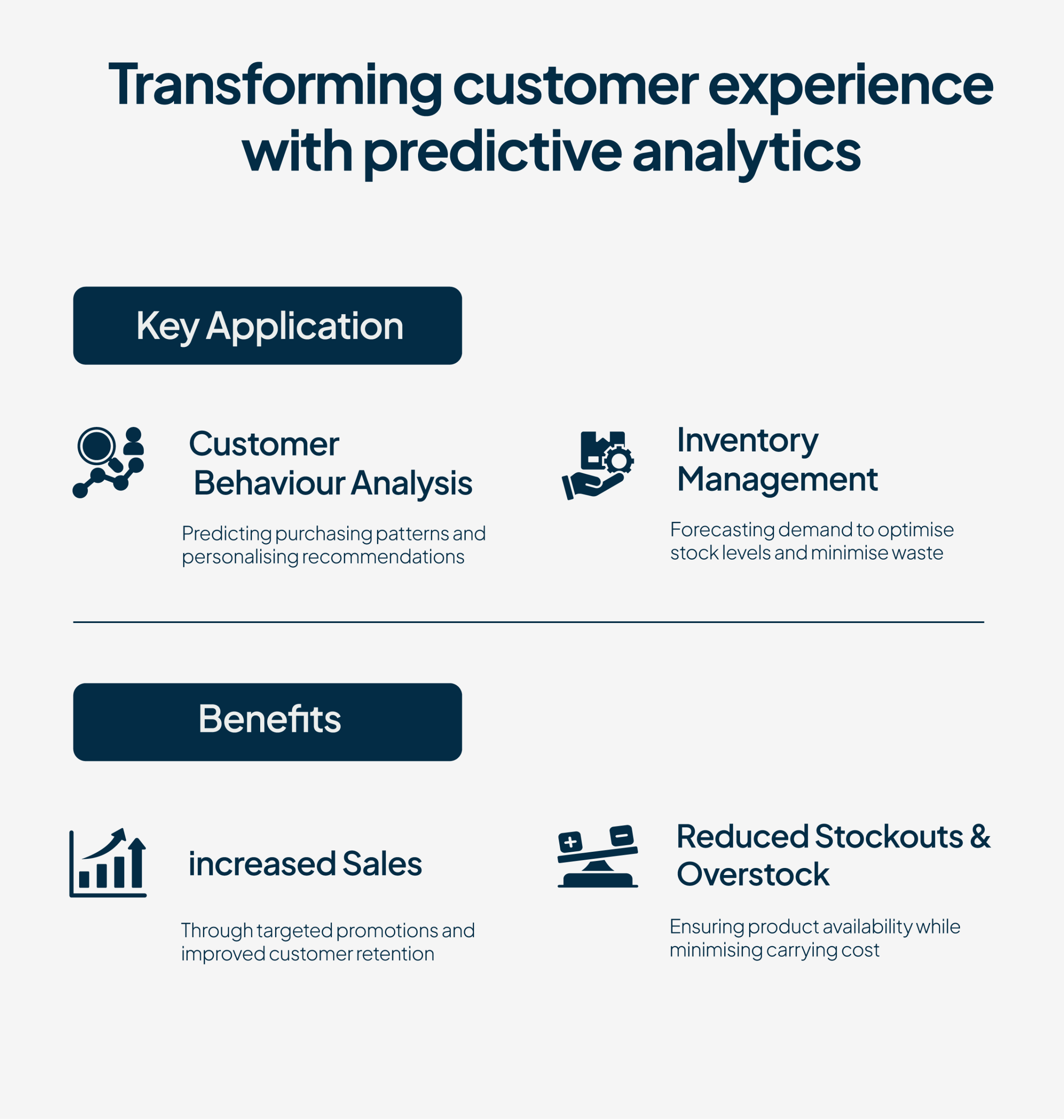
Why do some products sell fast while others don’t? Retailers use predictive analytics to forecast what customers want—before they even know it.
Demand Forecasting
Major UK retailers like Tesco and Sainsbury’s use predictive models to:
-
- Forecast product demand at individual store levels
- Optimise inventory management and reduce waste
- Plan promotional campaigns with greater precision
Customer Personalisation
E-commerce platforms use predictive analytics to understand what customers want, helping them create more personalised shopping experiences. This matters most for businesses aiming to boost conversions and improve performance. A 2024 study found that 81% of consumers prefer brands that personalise their experience. As Elizabeth Tobey from NICE points out, true personalisation today means meeting customers on the channels they prefer and keeping the conversation going smoothly.
Price Optimisation
Dynamic pricing is a smart way of setting prices by constantly tracking things like competitor prices, customer demand, and market changes. It updates prices instantly based on this data, helping businesses stay competitive and maximise profits
Key Retail Analytics Applications:
-
- Basket Analysis: Predicting what customers are likely to purchase together
- Churn Prevention: Identifying customers at risk of switching to competitors
- Seasonal Planning: Forecasting demand for seasonal products and trends
- Supply Chain Optimisation: Predicting delivery delays and optimising logistics
Emvigo’s retail solutions utilise predictive analytics and personalised experiences to increase conversions and customer loyalty.
4.Manufacturing: Predictive Maintenance and Quality Control
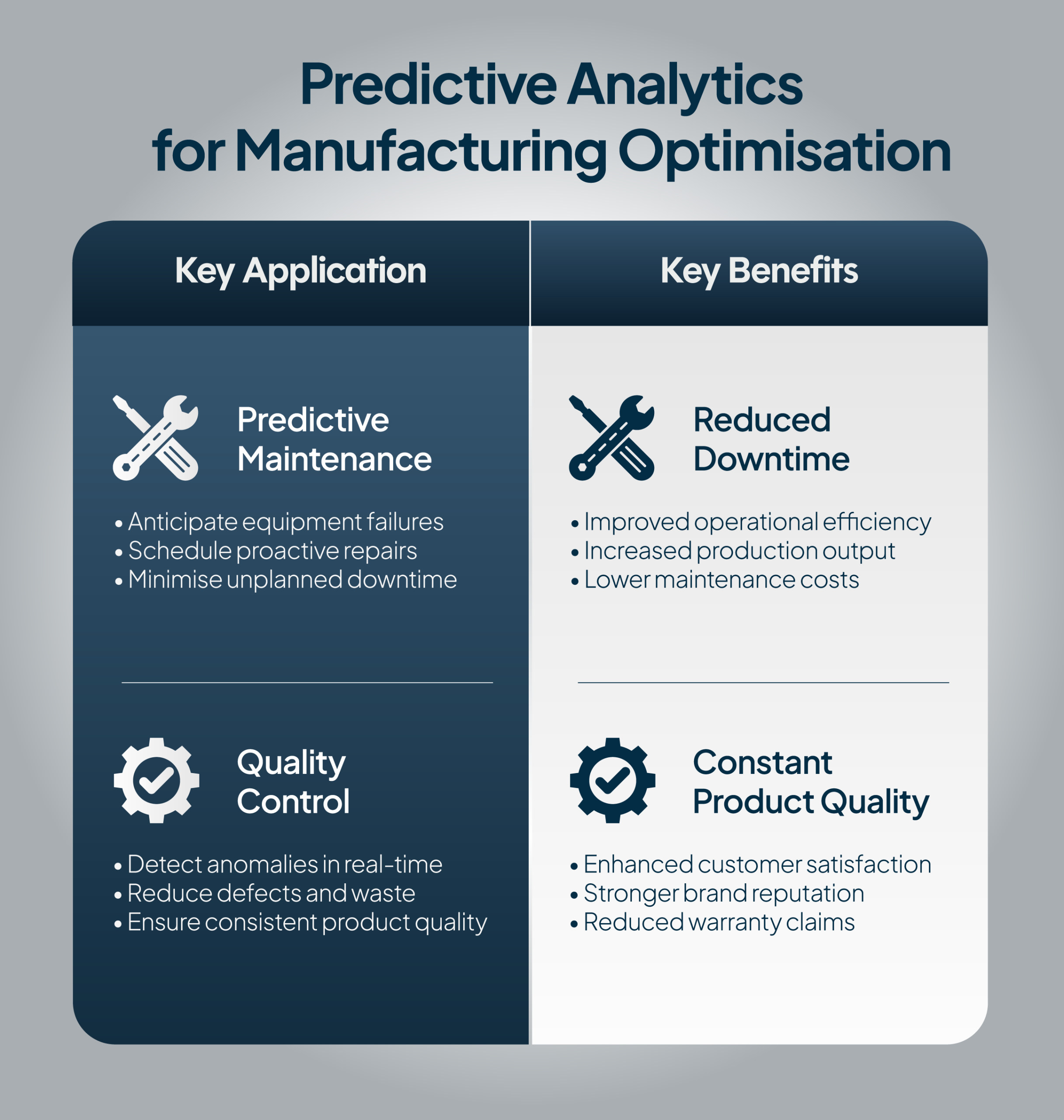
Manufacturers worldwide use predictive analytics to boost productivity. It helps cut costs through smart, data-driven applications.
In manufacturing, predictive analytics examples include
Predictive Maintenance
Manufacturers now use sensors and smart tools instead of fixed maintenance schedules. This is done to predict when equipment is likely to fail.
-
- Reduces unplanned downtime by up to 50%
- Extends equipment lifespan
- Optimises maintenance costs
Quality Control
Predictive models check production data live to spot problems before faulty products are made. This has helped UK manufacturers reduce waste and improve customer satisfaction.
General Motors used AI and IoT sensors to predict over 70% of equipment failures at least 24 hours in advance, cutting downtime and extending machine life. A Deloitte report shows 89% of manufacturers are investing in digital transformation, with predictive maintenance adoption up 33% in mid-sized plants. ROI is achievable in 12–18 months.
5.Transportation and Logistics: Optimising Movement
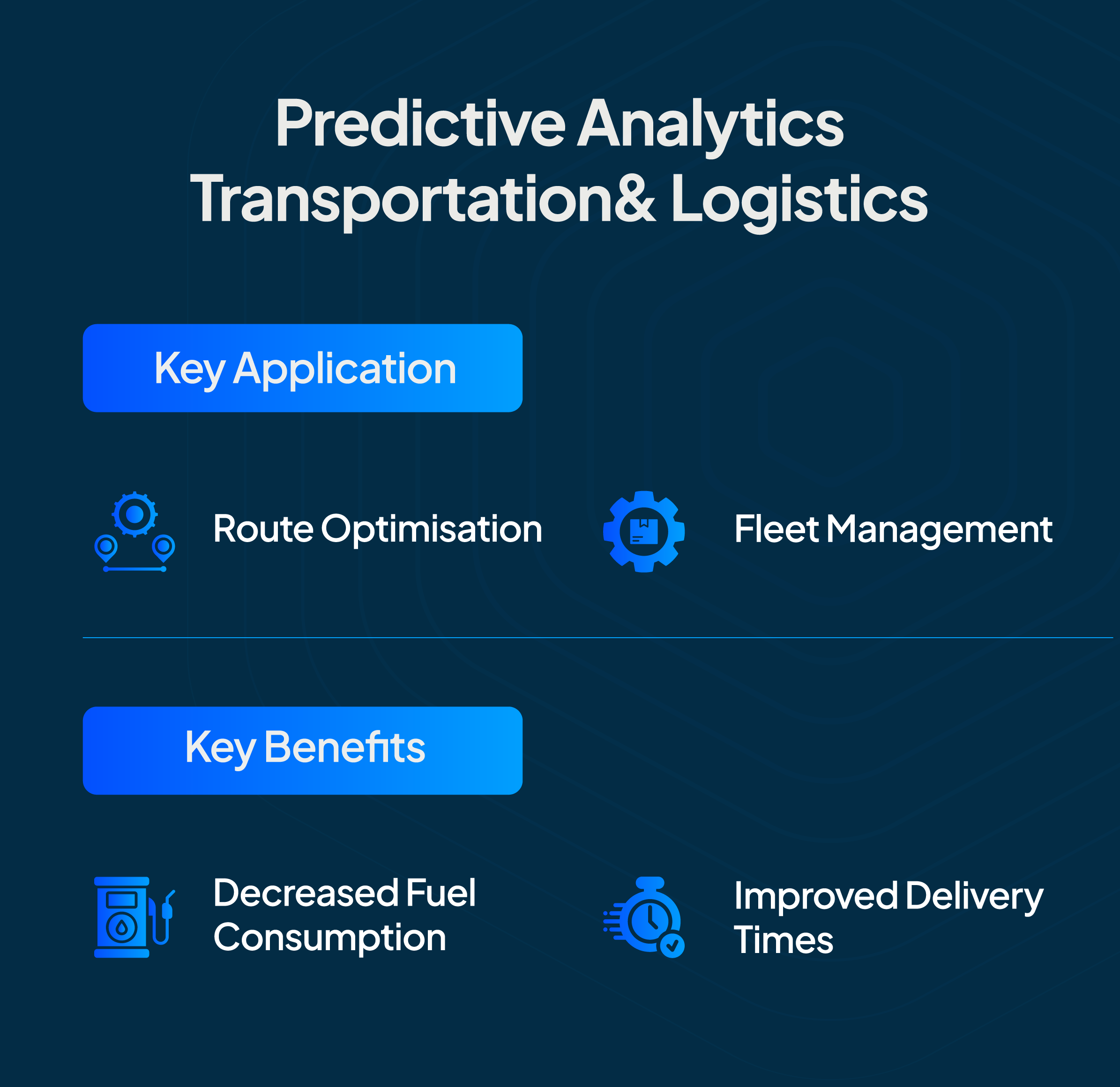
To provide accurate arrival times despite changing conditions like traffic and weather, delivery companies use predictive analytics. This technology helps them optimise their operations, leading to improved efficiency and increased customer satisfaction.
Route Optimisation
Logistics companies use predictive models to:
-
- Forecast traffic patterns and weather conditions
- Optimise delivery routes in real-time
- Predict vehicle maintenance needs
- Estimate accurate delivery times
Fleet operators use analytics to track drivers, vehicles, and conditions. This helps cut fuel costs and boost safety.
The Department for Transport statistics says predictive analytics helps fleet companies save 15–20% on fuel.
GPS fleet tracking helps cut costs by optimising routes, reducing fuel use, and improving driver behaviour. It lowers repair bills through predictive maintenance and can reduce insurance premiums. Businesses also save by using staff and vehicles more efficiently. Though it has upfront costs, the long-term savings are often much greater.
6.Energy and Utilities: Smart Grid Management
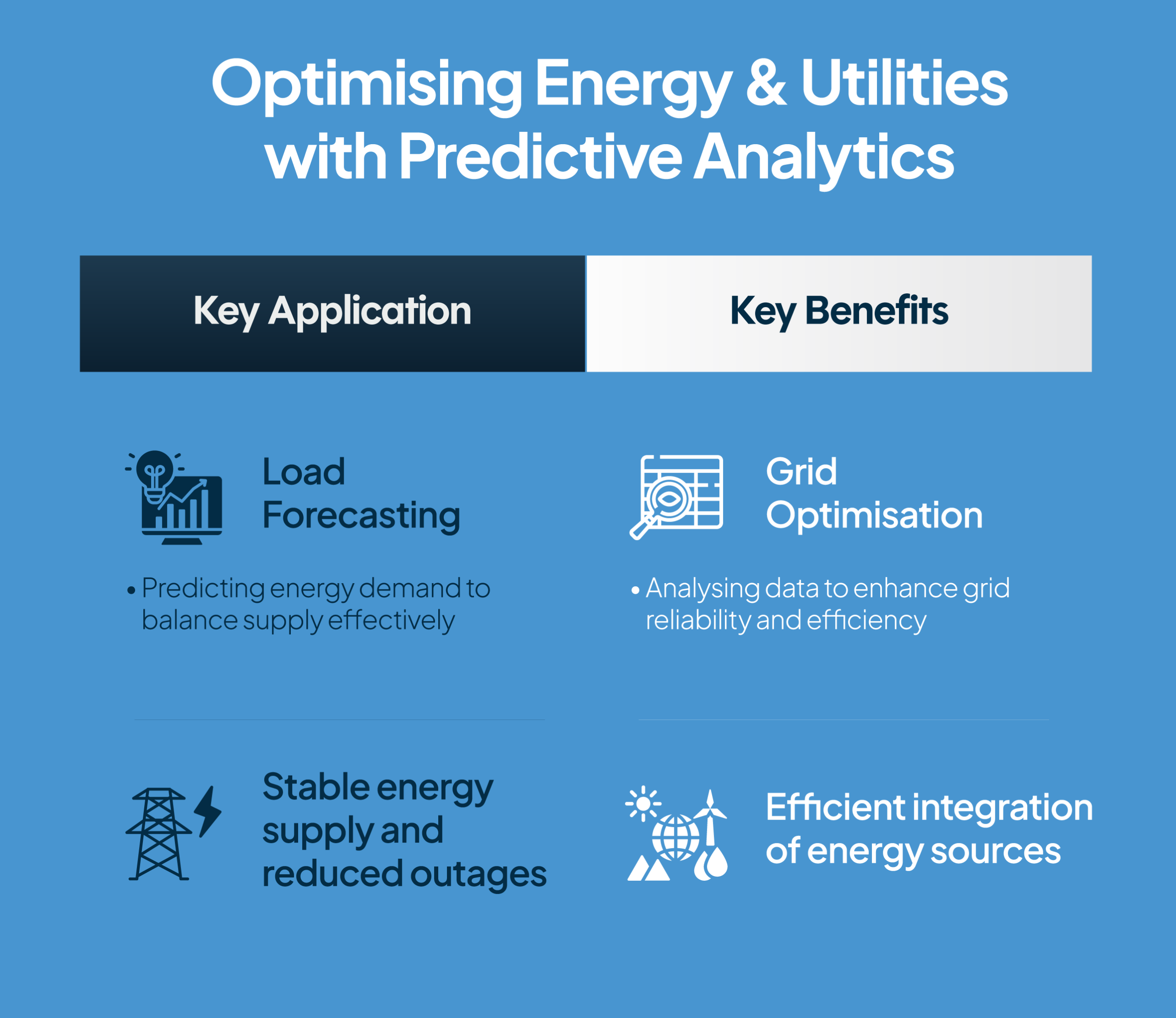
How do energy companies stay reliable with shifting demand and unpredictable renewables? They use predictive analytics to balance supply and forecast energy needs in real time.
The energy sector is meeting this challenge with predictive analytics. It helps manage complex grids and support the shift to renewables.
Demand Forecasting
Energy companies use predictive models to:
-
- Forecast electricity demand patterns
- Optimise energy generation and distribution
- Integrate renewable energy sources more effectively
- Predict peak usage periods
Grid Maintenance
Predictive analytics helps utility companies find equipment problems before they cause power cuts. This, in turn, improves service reliability and customer satisfaction.
According to a recent study, machine learning improves predictive maintenance in smart grids by detecting faults early and reducing outages. Models like Random Forest and neural networks analyse sensor data in real time. This speeds up fault detection and cuts downtime. Challenges include data imbalance and system integration.
These diverse Predictive analytics examples show how different industries use data to anticipate future outcomes. This technology helps companies proactively manage risks and optimise operations. Ultimately, it’s about using data to make smarter, more efficient business decisions.
Emvigo’s AI-driven platforms help energy companies balance supply and demand, integrate renewable sources, and perform predictive maintenance, ensuring efficient energy distribution.
The Future of Predictive Analytics: Custom Solutions for Competitive Advantage
Predictive analytics is evolving fast with AI and machine learning. Real-time data, IoT, and smarter algorithms promise greater accuracy and wider use.
For businesses, it’s not about if they should use predictive analytics—but how fast they can start using it well. The sooner they do, the more of an advantage they’ll gain over time.
“The best companies don’t just collect data—they turn it into predictions that guide every decision, from big plans to daily tasks.”
As we’ve seen through these diverse predictive analytics examples across industries, the technology’s transformative impact is undeniable. However, when ready-made analytics tools aren’t enough, your business needs custom solutions.
Emvigo, a leading software development company, helps businesses build smart, predictive systems that turn data into a real competitive advantage.
Ready to transform your data into predictive insights? Schedule a free strategy session with Emvigo
Implementing Predictive Analytics: Practical
Considerations
Thinking about implementing predictive analytics but not sure where to begin?
While the benefits are clear, successful implementation requires careful planning. Many businesses rush into analytics projects without considering the foundations needed for success.
Before diving into predictive analytics implementation, businesses should consider several key factors:
Data Quality and Availability
For many businesses, the real challenge isn’t analytics — it’s data quality and access. Companies like Emvigo help fix these issues, laying the foundation for successful predictive analytics.
Skills and Resources
Building effective predictive models requires specialised expertise. Companies choose to add staff, hire developers, or work with agencies—based on their needs and long-term plans. Many businesses struggle to find the right balance between cost and capability
Technology Infrastructure
Predictive analytics demands robust computing power and scalable infrastructure. Investing in scalable IT solutions becomes crucial for organisations serious about analytics implementation. However, many companies underestimate the infrastructure costs and complexity involved.
Cloud-based solutions often provide the most cost-effective approach. They offer scalability without massive upfront investments. This ensures your platform can scale with your data. And deliver insights exactly when you need them.
Ethical Considerations
As predictive analytics becomes more sophisticated, businesses must consider ethical implications, particularly around data privacy and algorithmic bias. Non-compliance can lead to hefty fines and damaged reputation.
Emvigo develops analytics solutions that prioritise data governance and transparency, enabling clients to make informed, compliant, and accountable decisions.
Frequently Asked Questions
What industries benefit most from predictive analytics?
Every industry can use predictive analytics, but it works fastest in areas with lots of data and clear patterns. Industries like healthcare, finance, retail, manufacturing, and transport.
How accurate are predictive analytics models?
Accuracy varies significantly depending on the use case, data quality, and model sophistication. In well-developed areas, predictive models can be 80–95% accurate, but this depends on the industry and how they’re used.
What’s the typical ROI of predictive analytics implementation?
Industry research shows that companies often get 3–5 times their investment back in the first year. But the results depend on how well and where predictive analytics is used.
Do small businesses need predictive analytics?
Absolutely. Modern cloud-based analytics platforms make predictive analytics accessible to businesses of all sizes. Small businesses often see bigger benefits because they can move faster and use insights more quickly.
Thinking about using analytics to grow your business? Emvigo can build the right solution around your needs.
Let Emvigo turn your data into your competitive advantage.