

Building software products isn’t just about writing code anymore. It’s about creating digital solutions that solve real problems and drive business growth.
That shift changes the way businesses need to think about development. It’s no longer just a technical project but a journey that starts with understanding problems, exploring ideas, and carefully shaping them into products that deliver real value. In this guide, we’ll walk you through the key stages of software product development, share common challenges, and highlight best practices to help you build solutions that truly make an impact.
What Is Software Product Development?
Software product development is the complete process of creating, designing, and delivering software applications that meet specific market needs. It’s more than just coding. It involves research, planning, design, development, testing, and ongoing maintenance.
For example, think about a food delivery app. It’s not just about writing the code that processes orders. The process starts with researching what users expect, designing a smooth ordering experience, building features like real-time tracking, testing for bugs, and then continuously updating the app to add improvements or fix issues.
Before diving into development, it’s crucial to understand the different types of software you might build. Our comprehensive guide to computer software types can help you identify which category your product fits into and what development approaches work best for each type.
Think of software product development like building a house. You wouldn’t start putting bricks together without a clear plan. That’s where the inception phase comes in. It’s the stage where you shape your ideas, set goals, and figure out possible challenges. Just like a strong blueprint helps you build a safe house, the inception phase helps you build a product that’s reliable and ready to grow.
Similarly, successful software products require careful planning and structured execution. The key difference between custom software development and product development lies in the end goal.
Product development focuses on creating solutions for broader markets rather than single clients. This approach requires deeper market research and scalable architecture planning.
The Software Product Development Lifecycle: 8 Essential Stages
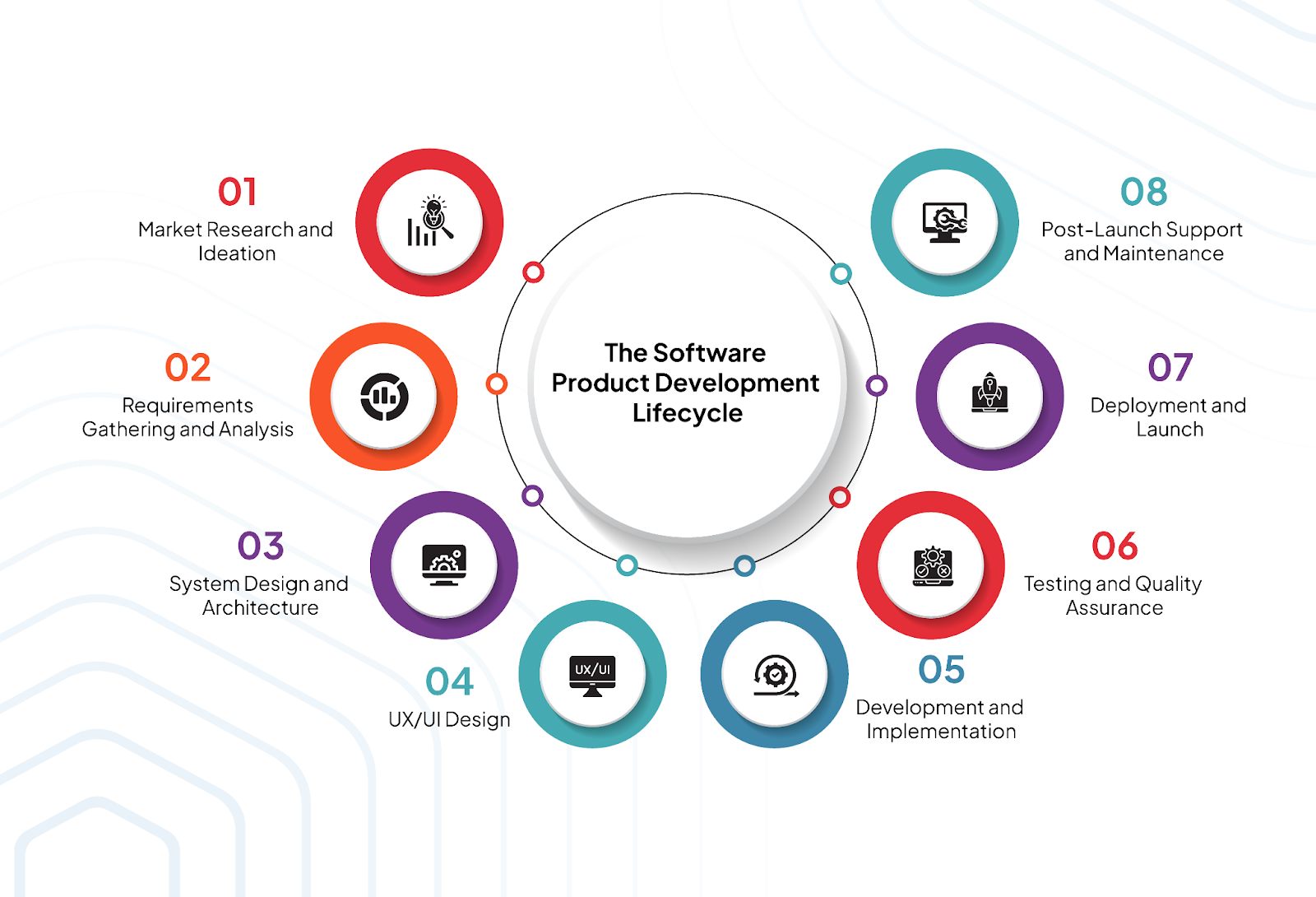
1. Market Research and Ideation
Before writing a single line of code, you need to understand your market inside out. This stage is about identifying your target users, learning their pain points, and validating whether your idea solves a real problem.
Online surveys, interviews, and market research can help you define user personas, map out the competitive landscape, and measure the potential of your product. At this stage, you also shape your unique value proposition — what makes your product different and valuable.
-
- Define your unique value proposition
- Research market size and potential
- Identify key user personas
- Map out competitive landscape
Smart businesses often use gap analysis techniques to identify market opportunities that competitors have missed.
2. Requirements Gathering and Analysis
This is the stage where your idea turns into clear, actionable specifications for software product development. Instead of just having a concept, you now define exactly what the product should do and how it should work.
Your development team will capture these details in documents such as the Business Requirements Document (BRD), which outlines business goals and stakeholder needs, and the Functional Requirements Document (FRD), which translates those goals into specific features and behaviours of the system. Along with these, they’ll create user stories and acceptance criteria to guide development. Together, these artefacts form the blueprint that keeps the entire team aligned throughout the process.
-
- Define technical specifications clearly
- Establish project scope and boundaries
- Create detailed wireframes and mockups
- Set measurable success criteria
- Define technical specifications clearly
Poor requirements gathering is one of the biggest reasons software product development projects fail. Take time to get this right from the start.
3. System Design and Architecture
During this phase, architects and senior developers create the technical blueprint for your product. They’ll design system architecture diagrams and plan database structures. API specifications are defined, and the technology stack is carefully selected.
Getting this right is critical because poor design decisions early on can create long-term problems. For example, choosing the wrong database structure might work for a small user base but could lead to slow performance or expensive migrations once your app scales. Similarly, neglecting integration requirements at this stage might make it harder to connect with third-party tools later. A well-thought-out architecture saves time, money, and frustration by ensuring your product can grow and adapt smoothly.
The choices made here will impact your product’s scalability, performance, and maintenance costs for years to come. Consider factors like expected user load, integration requirements, and future feature expansion when making architectural decisions.
4. User Experience (UX) and Interface (UI) Design
This phase focuses on mapping user journeys, building wireframes, and shaping how people will interact with your product. Visual design and branding elements are developed in parallel, ensuring the product not only works well but also looks and feels consistent with your brand.
Investing in UX and UI design at this stage is vital because even the most powerful software can fail if users find it confusing or frustrating. For example, an e-commerce app with confusing navigation might cause customers to abandon their carts, directly impacting revenue. Usability testing helps prevent these issues early, giving real users the chance to validate your design decisions before full-scale development begins.
-
- Create interactive prototypes
- Conduct user testing sessions
- Define design system standards
- Ensure accessibility compliance
Remember: your users don’t care how clever your code is if they can’t figure out how to use your product effectively.
5. Development and Implementation
The development phase is where design documents turn into a working product. Most modern teams follow agile methodologies, breaking the work into short sprints that allow for flexibility, faster feedback, and continuous improvement. This way, issues can be spotted early, and features can be refined based on real user or stakeholder input.
Key activities at this stage include frontend and backend development, API integration, and database implementation. Following established coding standards and best practices is essential — cutting corners here can lead to technical debt that slows down future progress. A structured development approach ensures that your product is not only functional at launch but also easier to maintain and scale over time.
Many businesses are now leveraging AI and automation to speed up MVP development without compromising quality. Teams are also adopting the best agile software development tools to streamline collaboration and delivery.
Code reviews and version control ensure consistent quality throughout the software product development process.
6. Testing and Quality Assurance
Testing isn’t something that comes after development — it’s a continuous process that runs through the entire software product development lifecycle. Regular testing helps catch issues early, saving time and reducing the cost of fixing bugs later.
Modern QA practices include unit testing (checking individual components), integration testing (ensuring different parts of the system work together), and performance testing (confirming the product can handle real-world user loads). Skipping or rushing this stage can lead to system crashes, security vulnerabilities, or a poor user experience. A strong QA process builds confidence that your product is reliable, scalable, and ready for real users.
-
- Security testing protects against vulnerabilities
- User acceptance testing (UAT) validates requirements
- Cross-browser compatibility ensures broad accessibility
- Automated testing reduces manual effort
- Security testing protects against vulnerabilities
Automated testing tools are transforming development by improving accuracy whilst reducing QA effort significantly.
7. Deployment and Launch
Getting your software product live involves much more than just uploading files to a server. A smooth launch requires a carefully prepared production environment, with configurations designed for performance, reliability, and security.
Key activities include database migration, data seeding, and setting up monitoring tools to track system behaviour once it’s live. If these steps are skipped or rushed, it can result in downtime, data issues, or security risks — problems that can quickly damage user trust. A structured deployment process ensures your product goes live smoothly and is ready to perform from day one.
-
- Configure performance monitoring
- Implement security hardening
- Set up SSL certificates
- Plan rollback procedures
Consider a phased rollout approach for your software product development launch. Starting with a small user group allows you to identify and fix issues before full deployment.
8. Post-Launch Support and Maintenance
Your work doesn’t end once the product goes live. In many ways, this is where the real journey begins. Ongoing support and maintenance are essential for keeping your software reliable, secure, and aligned with user needs.
Key activities include bug fixes and security updates to ensure smooth operations, along with performance monitoring to keep the user experience consistent. Over time, feature enhancements based on user feedback help the product evolve, while scaling infrastructure ensures it can handle a growing user base without issues. Continuous maintenance not only extends the product’s lifecycle but also strengthens user trust and business value.
Key Considerations for Software Product Development Success
Technical Expertise and Experience
When evaluating development partners, assess their industry experience carefully. Look for teams with proven track records in similar software product development projects.
Review their technology expertise and framework specialisations. Case studies and client references provide valuable insights into their capabilities.
Development Process and Communication
Understand their project management approach and reporting schedules. Clear communication protocols prevent misunderstandings and delays.
Ask about their methods for handling changing requirements during software product development. Flexibility is crucial in today’s fast-moving market.
Quality Assurance and Testing Standards
Inquire about their testing methodologies and quality standards. Code security practices should be industry-standard or better.
Ongoing support arrangements after launch are equally important for software product development success.
When choosing a software development company, look beyond just technical skills – cultural fit and communication style matter enormously for project success. Consider asking essential outsourcing software development questions to ensure you find the right development partner.
Modern Trends in Software Product Development
AI and Machine Learning Integration
AI has the potential to fundamentally transform software product development processes. It’s increasing development speed whilst improving final product quality.
From code generation to automated testing, AI is revolutionising how we build software products. Many companies are integrating intelligent features as standard offerings.
Low-Code and No-Code Platforms
These platforms are democratising software product development by allowing non-technical users to create functional applications.
The rise of no-code AI software development is particularly exciting for businesses wanting to integrate intelligent features without extensive technical expertise.
However, they’re not suitable for all use cases. Complex software product development still requires traditional approaches and custom coding.
Cloud-Native Development
Modern software product development is designed from the ground up to leverage cloud infrastructure.
This approach offers better scalability, reliability, and cost-effectiveness than traditional on-premises solutions. Container-based architectures are becoming the standard.
Microservices architecture supports independent scaling and deployment of different product components.
| Trend | Impact | Best For | Considerations |
|---|---|---|---|
| AI Integration | 40% faster development | Complex data processing | Requires ML expertise |
| No-Code Platforms | 60% cost reduction | Simple applications | Limited customization |
| Cloud-Native | Unlimited scalability | Growing user bases | Security compliance |
| Microservices | Independent scaling | Large applications | Added complexity |
Cost Factors and Budget Planning for Software Product Development
Software product development costs vary dramatically based on several key factors.
Development Team Location Impact • UK-based teams: £40-100+ per hour
-
- Eastern European teams: £25-60 per hour
- Asian teams: £15-40 per hour
- Eastern European teams: £25-60 per hour
Additional Software Product Development Costs
-
- Third-party integrations and licences
- Cloud hosting and infrastructure
- Ongoing maintenance and support
- Marketing and user acquisition
- Third-party integrations and licences
For startups and small businesses, consider starting with an MVP development approach to validate your concept before investing in full-scale software product development.
This strategy reduces initial investment whilst providing valuable market feedback for future development phases.
Common Pitfalls in Software Product Development
Scope Creep Management
One of the biggest project killers is continuously adding new features during software product development.
Combat this by clearly defining requirements upfront. Implement a formal change request process early in the project.
Regular scope reviews with stakeholders prevent uncontrolled expansion. Document all changes and their impact on timeline and budget.
Insufficient Testing Protocols
Rushing to market without proper testing often backfires spectacularly. Budget 20-30% of your software product development time for comprehensive testing.
Automated testing catches issues early when they’re cheaper to fix. Manual testing ensures user experience meets expectations.
Poor Communication Channels
Regular communication prevents misunderstandings and keeps software product development projects on track.
Establish clear reporting schedules from day one. Create feedback loops that allow for quick course corrections when needed.
Ignoring Scalability Requirements
Building for today’s needs without considering tomorrow’s growth leads to expensive rewrites. Plan for success from the beginning of your software product development journey.
Architecture decisions should support at least 10x growth in users and data volume.
Frequently Asked Questions
How long does development typically take?
Development timelines vary greatly depending on complexity. Simple applications might take 3-6 months, whilst complex enterprise solutions can require 12-18 months or more.
Should I build in-house or outsource?
This depends on your budget, timeline, and internal capabilities. Outsourcing software development often provides specialised expertise and faster delivery.
How do I protect my intellectual property?
Always use comprehensive NDAs and ensure development contracts clearly specify IP ownership. Work with reputable firms that have established security practices.
Accelerate Your Business with Expert Software Product Development
Software product development is a significant investment that can transform your business when executed properly.
The key is choosing the right approach, team, and technology stack for your specific needs and market requirements.
Remember: the cheapest option rarely delivers the best results in software product development. Focus on finding partners who understand your business goals and can deliver scalable, maintainable solutions.
Whether you’re building your first digital product or expanding your existing portfolio, invest time in planning and partner selection. Your future self will thank you for making thoughtful decisions today.
“The best software products are born from deep understanding of user problems, not just technical capabilities.”
Ready to transform your innovative idea into market-ready software? Expert software product development teams can guide you through this complex process and deliver solutions that drive measurable business growth.
Let’s turn your idea into a scalable software product that drives real business growth in the UK. Our proven software product development process has helped dozens of businesses launch successful digital solutions – yours could be next. Our experienced team combines technical excellence with business acumen to deliver products that users love and businesses profit from.