
What if you could increase customer engagement by 30%? What if you could boost sales by 25%—even while your team sleeps? Imagine turning every website visitor into a chat. What if every question became a new opportunity? And what if every interaction gave you useful data? This isn’t wishful thinking. It’s the reality businesses are creating with NLP development. Take H&M as an example. Their NLP chatbot delivers results: 30% higher engagement and up to 25% more sales. The customer service revolution is already here. Some companies still rely on traditional methods. The smart ones use NLP to level up support.
NLP makes operations smoother. It also increases revenue. Whether you lead a business, build software, or shape strategy—this guide will show you how to create language systems that really work.
What is NLP Development?
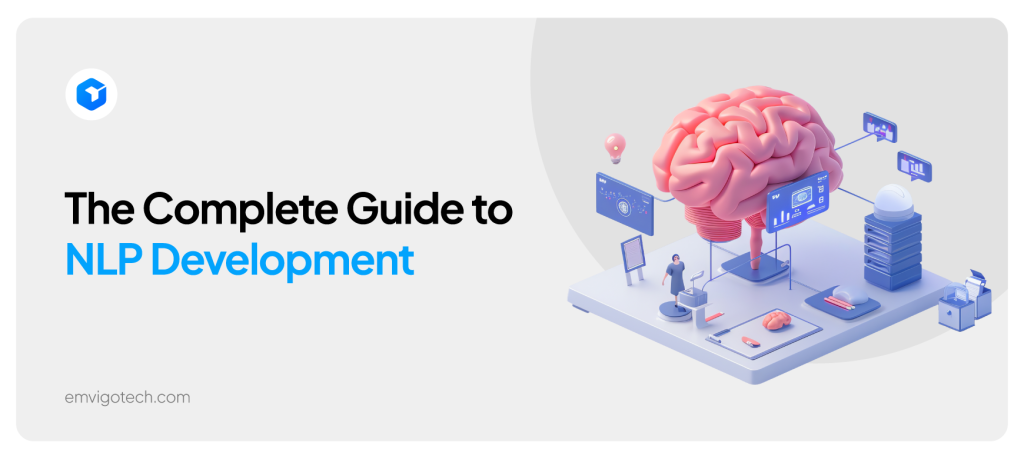
NLP (Natural Language Processing) development is the process of creating AI systems that can understand, interpret, and generate human language. It combines linguistics, AI, and machine learning to power tools like chatbots, sentiment analysis, and translation systems. Think of it as teaching computers to “speak human.” This means they can process text, understand context, extract meaning, and respond correctly.
NLP development uses language science, computer science, and AI to help machines understand humans. It’s the base for tools like chatbots, sentiment analysis, and language translation, built with scalable software.
Key Components of NLP Systems
NLP development encompasses several crucial elements:
-
- Text Processing: Cleaning and preparing raw text data for analysis.
- Language Understanding: Extracting meaning and intent from human language
- Machine Learning Integration: Training models to improve accuracy over time
- Response Generation: Creating appropriate outputs based on input analysis
- Context Awareness: Understanding the nuances and context of communication
Quick Win: Even partial automation of text processing can save 20–30% of your team’s time instantly.
Why NLP Development Matters in Today’s World
NLP development has become very important as the world goes more digital. Here’s why it matters so much:
Enhanced Customer Experience
Businesses in many fields use NLP for round-the-clock customer support. They do this with intelligent chatbots and virtual assistants. These systems can answer common questions, reply instantly, and pass difficult issues to humans when needed.
Data-Driven Decision Making
NLP development helps businesses change text from social media, reviews, emails, and documents into useful insights. It lets them understand customers, spot trends, and make better decisions.
Accessibility and Inclusion
NLP development plays a crucial role in making technology more accessible. Voice recognition helps people who have trouble moving. Text-to-speech helps people who can’t see well.
Global Communication
NLP-powered translation tools now make it easier to talk in real time across different languages and cultures.
Transform your unstructured data into actionable business insights with Emvigo’s comprehensive software development services. Our expert team specializes in creating custom NLP solutions that drive real business value. Schedule your strategy session now!
Common NLP Applications Transforming Businesses
Chatbots and Virtual Assistants
NLP helps build chatbots and virtual assistants. They understand and answer customer questions in a natural way. These tools give quick support 24/7. They help customers get answers fast without waiting for a human agent.
Many of these NLP-driven benefits play a big role in e-commerce, where AI is reshaping how online stores interact with customers and boost sales. For more insights, see AI Ecommerce FAQs, which covers how AI helps online retailers improve service and grow their business.
Sentiment Analysis
Sentiment analysis looks at text like reviews or social media posts. It finds out if people feel positive, negative, or neutral. Businesses use this to know what customers think and improve their products or services.
Machine Translation
Machine translation changes text from one language to another automatically. This helps companies talk to customers and partners around the world. It breaks down language barriers quickly and easily.
Speech Recognition
Speech recognition turns spoken words into text. It is used in voice assistants like Siri and Alexa. This lets people control devices or search by speaking instead of typing.
Text Summarization
Text summarization creates a short summary of a long document. It helps people get the main points quickly without reading everything. This is useful for news, reports, and research papers.
Spam Detection
Spam detection filters out unwanted emails or messages. It protects inboxes from scams and phishing by spotting spam language patterns.
Document Classification
Document classification sorts documents into groups or topics. This helps companies manage large amounts of files and find what they need quickly.
Information Extraction
Information extraction pulls out key facts from text. For example, it can find dates or amounts in contracts. This turns text into useful data for easy use.
Question Answering Systems
Question answering systems let users ask questions in normal language. They find the exact answers from big databases. This helps users get info fast without reading a lot.
Pro Tip: Start with one or two high-impact applications, like sentiment analysis or chatbots, before scaling to more complex NLP functions.
How NLP Development Works: A Step-by-Step Process
Understanding the NLP development process is crucial for anyone looking to implement these solutions. Here’s how it typically unfolds:
When to Use Automation Alone
Imagine that you’re processing customer enquiries. Traditional automation can categorise emails and route them to the right department. Add AI, and suddenly the system understands context, sentiment, and urgency. It can draft personalised responses and escalate complex issues automatically.
When to Use Automation Alone
This is AI-powered automation in action. The predictability of rule-based systems is enhanced by the intelligence of machine learning.
1. Data Collection and Preparation
The foundation of any successful NLP project begins with gathering relevant text data. This might include customer emails, social media posts, documents, or conversational transcripts.
2. Text Preprocessing
Raw text needs cleaning and standardisation. This means cleaning the text by taking out extra symbols, making all letters small, fixing spelling, and getting it ready to use.
3. Feature Extraction
The system finds important parts in the text, like keywords, phrases, and language patterns to help with analysis.
4. Model Selection and Training
Developers choose appropriate algorithms and train them using the prepared data. This might involve machine learning models, deep learning networks, or pre-trained language models.
5. Testing and Validation
Email routing: Directing enquiries based on keywords or sender domains.
6. Deployment and Monitoring
After validation, the NLP system is deployed in the live setting and regularly monitored to maintain peak performance.
ROI Comparison: Manual vs NLP-Powered Operations
NLP Impact on Business Functions
| Business Function | Manual Process Cost/Month | NLP-Powered Cost/Month | Time Saved | Accuracy Improvement |
|---|---|---|---|---|
| Customer Support | £8,000 – £15,000 | £2,000 – £4,000 | 70–80% | 15% satisfaction |
| Document Processing | £5,000 – £10,000 | £1,500 – £3,000 | 85–90% | 25% accuracy |
| Social Media Monitoring | £3,000 – £6,000 | £500 – £1,500 | 90–95% | 40% coverage |
| Content Moderation | £4,000 – £8,000 | £800 – £2,000 | 80–85% | 30% consistency |
Real-World Case Study: NLP Development in Action
Case Study: H&M’s AI-Powered Chatbot Revolution
H&M used AI-powered chatbots with advanced NLP technology to improve customer engagement and boost sales.
The Challenge: H&M’s manual customer service struggled with high query volumes, slow response times, and inconsistent personalisation during peak periods. They needed 24/7 support whilst maintaining a personal touch.
Implementation: H&M implemented NLP-powered chatbots that understand customer behaviour and preferences to provide personalised support. These chatbots handle queries, suggest products, assist with orders, and ensure the brand’s voice remains consistent across all touchpoints.
Results: The NLP chatbot implementation delivered impressive outcomes:
-
- 30% increase in customer engagement
- 15-25% increase in online sales
- 24/7 lead nurturing and support
- Faster response times and reduced wait periods
- Consistent and personalised customer interactions
Impact: The solution enhanced operational efficiency, improved customer satisfaction, and delivered significant cost savings whilst scaling their customer service capabilities.
H&M’s success story could be yours! Emvigo’s proven track record in AI and automation solutions helps businesses achieve remarkable ROI through intelligent NLP implementations. Let’s explore how we can achieve similar success for your business.
Similarly, Philips Healthcare has applied NLP in the form of advanced speech-to-text technology to streamline medical note-taking. At the University Hospital in Oslo, doctors use Philips’ speech-recognition tools to document patient consultations in real time. This not only improves operational efficiency but also gives clinicians more time to focus on patient care—showing how NLP can deliver measurable impact across industries, from retail to healthcare.
H&M and Philips prove that NLP delivers real impact across industries. H&M’s AI chatbots boosted engagement and sales, while Philips’ speech-to-text tools streamlined healthcare documentation. Both show how smart NLP solutions enhance efficiency, improve service, and free up time for what matters most—whether serving customers or caring for patients.
Benefits of Implementing NLP Developments
Operational Efficiency
NLP systems can quickly process large amounts of text data—tasks that would take human teams hours or even days to complete manually. By automating these processes, businesses can save time, reduce errors, and free up employees to focus on higher-value work. This leads to faster decision-making and smoother day-to-day operations.
Cost Reduction
Automated text processing and customer service capabilities significantly reduce operational costs whilst maintaining service quality. Learn how Emvigo’s industry-specific NLP solutions can help your business achieve the same results.
Scalability
NLP solutions can manage more data and user requests without needing a lot more resources.
Improved Accuracy
Modern NLP systems are very accurate at analysing text and understanding language.
Competitive Advantage
Companies that use NLP get helpful information and tools that make them better than competitors still doing work by hand.
Benefits of Implementing NLP Developments
Understanding when to implement NLP development isn’t just about recognising the need—it’s about timing your investment for maximum impact. Different business stages present unique opportunities and challenges for NLP integration, particularly when considering advanced business systems.
Startup Stage (0-50 employees): Foundation Building
Key Triggers for NLP Implementation:
-
- Manual customer support becomes unsustainable as user base grows
- Need to analyse user feedback at scale to validate product-market fit
- Limited resources require maximum automation efficiency
- Competitive differentiation through intelligent features
Recommended NLP Solutions:
-
- Basic chatbots for customer support
- Simple sentiment analysis for product feedback
- Automated email classification and routing
Strategic Considerations: Startups should focus on NLP solutions that directly impact revenue generation or significantly reduce operational costs. The key is starting small with MVP implementations that can scale as the business grows.
Growth Stage (50-200 employees): Scaling Operations
Key Triggers for NLP Implementation:
-
- Customer service costs rising faster than revenue
- Need for automated insights to guide rapid scaling decisions
- Data volume overwhelming manual analysis capabilities
- Integration requirements with existing business systems
Recommended NLP Solutions:
-
- Advanced chatbots with multi-intent recognition
- Comprehensive social media monitoring
- Document processing automation
- Customer journey analysis through text data
Strategic Considerations: Growth-stage companies benefit most from NLP solutions that enhance operational efficiency whilst providing actionable business intelligence. Focus on scalable software development approaches that can adapt to changing business needs.
Established Business (200+ employees): Optimisation and Innovation
Key Triggers for NLP Implementation:
-
- Maintaining competitive advantage in mature markets
- Improving operational efficiency across departments
- Expanding into new markets with language barriers
- Regulatory compliance requiring automated text analysis
Recommended NLP Solutions:
-
- Advanced virtual assistants
- Multi-language customer support systems
- Comprehensive analytics for market research
- Automated compliance monitoring
Strategic Considerations: Established businesses should consider NLP as part of broader digital transformation initiatives. Integration with existing enterprise software becomes crucial at this stage, enabling seamless workflows and comprehensive data analysis.
Enterprise Level (1000+ employees): Comprehensive Transformation
Key Triggers for NLP Implementation:
-
- Organisation-wide efficiency gains through automation
- Complex regulatory compliance across multiple jurisdictions
- Integration with sophisticated business system ecosystems
- Global operations requiring multilingual capabilities
Recommended NLP Solutions:
-
- Comprehensive NLP platforms with enterprise software integration
- AI-powered business intelligence systems
- Global multilingual communication tools
- Advanced predictive analytics using text data
Strategic Considerations: Enterprise-level NLP implementations require sophisticated integration with existing business infrastructure. These solutions often become part of larger AI initiatives that transform entire business processes. Success at this level depends on having robust system foundations and clear data governance frameworks.
Getting Started with NLP Development
Define Your Objectives
Clearly outline what you want to achieve with NLP development. Whether it’s improving customer service, analysing feedback, or automating document processing, specific goals guide the entire development process.
If you’re unsure whether off-the-shelf solutions fit your needs or if custom AI tools would be a better fit, Emvigo’s guide on how to know if you need custom AI tools can help clarify your options.
Start with an MVP Approach
Launching a Minimum Viable Product (MVP) enables you to test your NLP ideas with minimal upfront investment. By developing a basic, working version of your solution first, you can gather valuable user feedback, measure impact early, and refine your system before full-scale deployment. This iterative approach reduces risk and ensures your NLP implementation aligns well with your evolving business goals. Emvigo specialises in delivering MVP-ready NLP solutions in just 4 weeks, helping you validate concepts quickly and build a solid foundation for growth. Schedule a free call and discuss how we can support your NLP journey.
Assess Your Data
Evaluate the text data you have available. Quality and quantity of data directly impact the success of your NLP implementation.
Choose the Right Partner
NLP development requires specialised expertise. Partnering with experienced developers ensures your project’s success and optimal results.
At Emvigo, we specialise in custom NLP implementations personalised to your specific business needs. With our expertise, our team can guide you through every step of the NLP development process, from initial consultation to deployment and ongoing support.
Challenges in NLP Development and How to Overcome Them
Data Quality Issues
Poor quality or biased training data can significantly impact NLP system performance. Address this by implementing robust data cleaning processes and ensuring diverse, representative datasets.
Context Understanding
Natural language is complex and context-dependent. Overcome this challenge by incorporating contextual models and continuous learning mechanisms.
Language Variations
Different dialects, slang, and informal language can confuse NLP systems. Combat this through comprehensive training data that includes various language variations.
Integration Complexity
Integrating NLP systems with existing infrastructure can be challenging. Plan for proper API design and system architecture from the beginning.
Future Trends in NLP Development
The field of NLP development continues to evolve rapidly. Key trends shaping the future include:
Multimodal NLP
Future systems will process not just text but also images, audio, and video to create more comprehensive understanding.
Conversational AI Advancement
Chatbots and virtual assistants will become smarter. They will handle longer conversations and understand what you mean more clearly.
Low-Code NLP Solutions
Development platforms will make NLP more accessible to non-technical users through visual interfaces and pre-built components. Businesses can now combine these tools with no-code AI software development approaches to rapidly build and deploy NLP applications without deep programming expertise.
Enhanced Privacy Protection
New techniques will enable NLP processing whilst maintaining user privacy and data protection.
Frequently Asked Questions
What programming languages are best for NLP development?
Python remains the most popular choice due to its extensive libraries like NLTK, spaCy, and transformers. However, Java, R, and JavaScript are also viable options depending on your specific requirements and existing technology stack.
Can small businesses benefit from NLP development?
Absolutely! Small businesses can leverage NLP for customer service automation, social media monitoring, and review analysis. Cloud-based NLP services make these technologies accessible without significant upfront investment.
What’s the difference between NLP and machine learning?
NLP is a specific application of machine learning focused on language processing. Machine learning is the broader field encompassing various techniques for pattern recognition and prediction, whilst NLP specifically deals with human language understanding and generation.
How do I measure the success of an NLP implementation?
Success metrics depend on your objectives but commonly include accuracy rates, processing speed, user satisfaction scores, cost savings, and efficiency improvements. Regular monitoring and evaluation ensure your system continues meeting business goals.