
I came across a brilliant founder pitch for what seemed like the next big thing. Her energy was infectious, her vision crystal clear. But when I asked about her MVP strategy, she paused. “We’re building everything users might want,” she said. “Better safe than sorry, right?”
Wrong. Dead wrong.
That’s exactly what happens with MVPs. Research shows that 70% of startups fail because they build products nobody wants. This is because they lost focus. They prioritised the nice-to-haves over the must-haves.
Let me walk you through a proven MVP strategy framework that prevents scope creep and ensures your core MVP features actually solve real problems.
In the race to market leadership, winners don’t build everything. They build what matters most.
What is an MVP Strategy and Why is it the First Step to MVP Success?
Think of your MVP strategy as your race plan. Before any Formula 1 driver hits the track, they’ve got a meticulously crafted strategy. They know which corners to attack, when to conserve fuel, and exactly when to push for overtaking. Without this plan, even the fastest car becomes a liability.
Your MVP product strategy works the same way. It’s your blueprint for building a minimum viable product that actually drives results. But most founders go wrong when they confuse “minimum” with “basic” or “cheap.”
A true MVP strategy isn’t about building something basic. It’s about building something focused. Something that solves one core problem brilliantly rather than ten problems poorly.
Bad MVP Strategy:
-
- “Let’s include every feature users might want”
- “More features = more value”
- “We can’t launch without X, Y, and Z”
- No clear success metrics
- Features chosen by gut feeling
Winning MVP Strategy:
-
- Laser focus on one core user problem
- Features validated by real user research
- Clear success metrics defined upfront
- Built-in feedback loops for learning
- Roadmap for iterative improvement
The difference?
The first approach leads to what I call “kitchen sink syndrome“. Its products are bloated with features that sound good in boardrooms but solve nothing in the real world. The second creates products that users actually want to pay for.
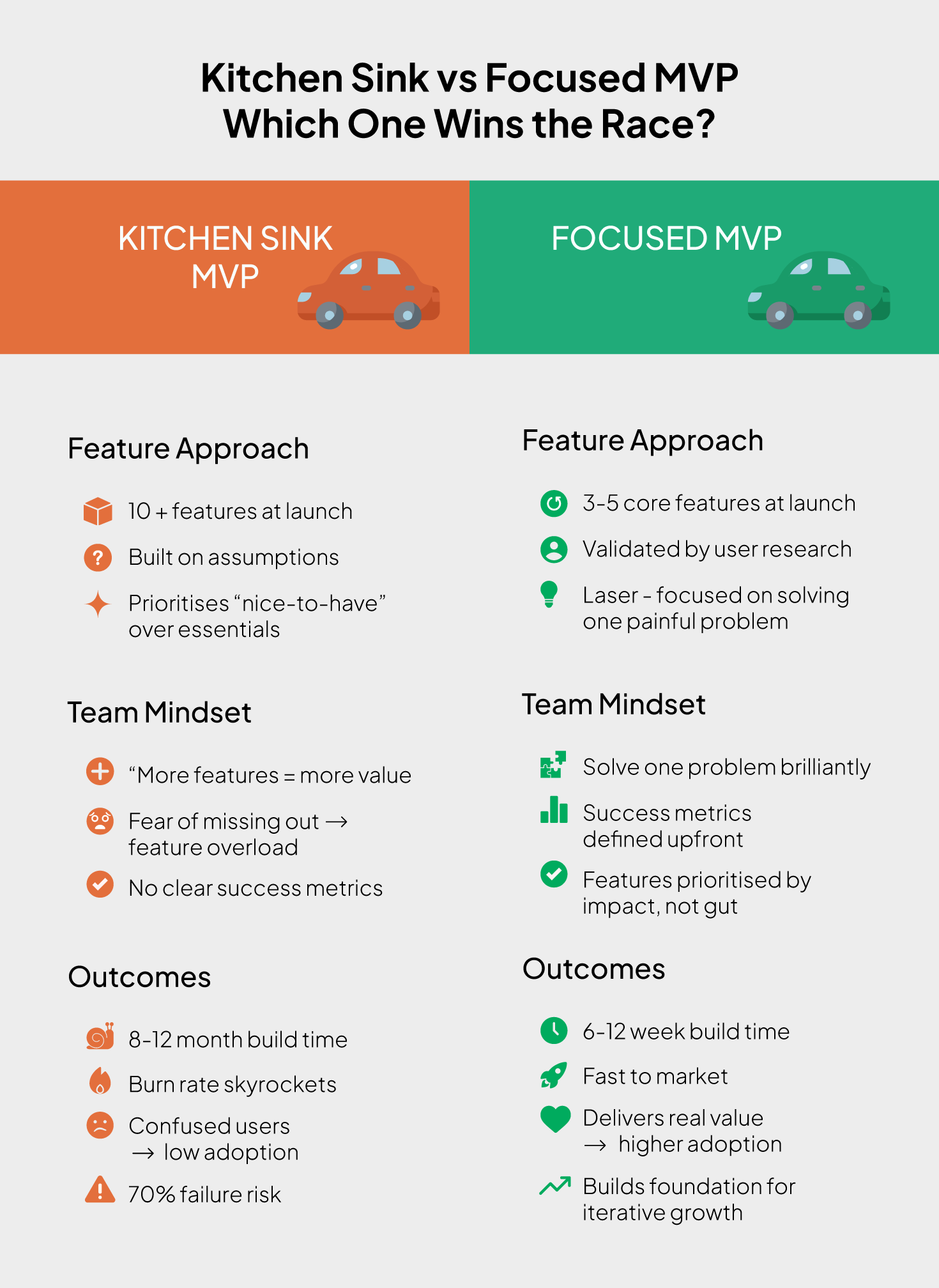
Your MVP strategy framework should answer three fundamental questions:
- What’s the single most important problem we’re solving?
- What’s the minimum set of features needed to solve it?
- How will we measure success and learn from users?
Get these wrong, and you’re not building an MVP. You’re building an expensive experiment with no hypothesis.
How Do We Define the Core MVP Features That Matter Most?
Here’s where the rubber meets the road. Defining your core MVP features isn’t about what you think users want. It’s about what they actually need to solve their most pressing problem.
I use what I call the “Racing Car Method.” Every component in a racing car earns its place. If it doesn’t make the car faster, safer, or more reliable, it gets cut. No exceptions. Your MVP feature prioritisation should work the same way.
Step 1: User Research and User Story Mapping
Before you write a single line of code, you need to understand your users’ journey. Not the journey you imagine they take, but the actual path they follow when trying to solve their problem.
Start with user interviews. Real conversations with real people who have the problem you’re trying to solve. Ask them:
-
- How do you currently handle this problem?
- What’s the most frustrating part of existing solutions?
- If you could wave a magic wand, what would the perfect solution do?
- What would make you switch from your current approach?
Map their responses into user stories: “As a [user type], I want [functionality] so that [benefit].” But here’s the crucial bit. Not all user stories are created equal. Some are race-winning engines. Others are cup holders.
Step 2: The MVP Feature Prioritisation Matrix (The Asset)
This is where my MVP feature prioritisation matrix becomes your co-pilot. It’s a simple but powerful framework that helps you make those tough feature decisions.
Opportunity: Impact vs Effort Matrix
| Impact \ Effort | Low Effort | High Effort |
| High Impact | Quick Wins – Build first | Major Projects – Plan carefully |
| Low Impact | Fill-ins – Build later | Avoid – Don’t build |
But impact isn’t just about user value. It’s about business value too. The best core MVP features sit at the intersection of:
-
- User Need: Solves a real, painful problem
- Business Value: Drives key metrics (retention, conversion, revenue)
- Technical Feasibility: Can be built with available resources
- Strategic Fit: Aligns with your long-term vision
Struggling with feature overload? Don’t let your brilliant vision get buried under feature bloat. Our product strategy experts help ambitious founders define the core MVP features that actually win users. Ready for a laser-focused MVP strategy? Sign up for a free MVP discussion slot.
Step 3: Validate Before You Build
Here’s where most founders stumble. They assume their prioritisation is correct and start building. That’s like choosing your racing line without knowing the track conditions.
Before committing to any feature, validate it. Build wireframes, create prototypes, or even fake the functionality with manual processes. The goal isn’t to build it perfectly. It’s to prove that users actually want it.
Common MVP Feature Validation Methods:
-
- Landing page tests for demand validation
- Clickable prototypes for usability testing
- Concierge MVP for complex workflows
- Wizard of Oz testing for automation features
Remember: every hour spent validating features saves ten hours of building the wrong thing.
What are MVP Features That Matter Most?
Not all features are born equal. After analysing hundreds of successful MVPs, I’ve identified the features that consistently drive results. Think of these as the essential components every racing car needs, regardless of the specific race.
-
- Core User Value Features:
These solve the primary problem your users hired your product to solve. Without these, you don’t have a product, you have a demo. - Onboarding and First-Use Experience:
Users decide whether your product works within the first 60 seconds. Make those seconds count. - Feedback Collection Mechanisms:
Built-in ways to capture user reactions, feature requests, and pain points. Your MVP is the beginning of your learning journey. - Basic Analytics and Tracking:
How will you know if your MVP strategy is working? Build measurement into the foundation, not as an afterthought. - Essential Integrations:
What existing tools do your users rely on? Easier integration with their current workflow often matters more than flashy new features.
- Core User Value Features:
The specific features matter less than the methodology. A winning MVP feature prioritisation process focuses on outcomes, not outputs. It asks “What behaviour change do we want to drive?” not “What features should we build?”
How to Prioritise Features for an MVP?
Feature prioritisation is where good intentions meet harsh realities. You’ve got unlimited ideas but limited time, budget, and development capacity. How do you choose?
I use a modified version of the RICE framework (Reach, Impact, Confidence, Effort) combined with strategic fit analysis:
R – Reach: How many users will this feature affect in the first quarter?
I – Impact: How significantly will this feature change user behaviour?
C – Confidence: How certain are we that users actually want this?
E – Effort: How much development time and resources will this require?
But I add a fifth dimension:
S – Strategic Fit: How well does this feature align with our long-term vision?
RICE-S Prioritisation Example
| Initiative | Reach | Impact | Confidence | Effort | Strategic Fit | Priority Score |
| Example 1 | 8 | 9 | 80% | 5 | High | 11.52 |
| Example 2 | 5 | 7 | 70% | 3 | Medium | 8.17 |
| Example 3 | 3 | 4 | 90% | 2 | Low | 5.40 |

This framework helps avoid the common mistake of adding features just because they are easy or exciting. It reminds us to think about whether users really want these features and if they match our strategy.
Pro tip: Involve your entire team in scoring. Different perspectives reveal assumptions and blind spots. Your developer might spot technical dependencies your designer missed. Your sales team knows which features prospects actually ask about.
How Does a Good MVP Product Strategy Prevent Scope Creep?
Scope creep is the silent killer of MVP projects. It starts innocently, “Just one more small feature”. And before you know it, your three-month MVP has become a twelve-month monster.
Your MVP product strategy acts as your defensive wall against scope creep. Here’s how:
- Clear Success Metrics:
When everyone knows exactly what success looks like, it’s harder to justify “nice-to-have” features. If a feature doesn’t move your key metrics, it doesn’t belong in your MVP. - User-Centric Feature Validation:
Every feature request gets tested against real user needs. “The CEO’s favourite feature” doesn’t trump user research. - Resource Constraints as Creative Catalysts:
Fixed budgets and timelines force prioritisation. Embrace constraints, they breed innovation. - Regular Strategy Reviews:
Weekly check-ins to assess whether you’re still building the right thing. Markets shift, users evolve, and strategies must adapt. - The “Not Now” List:
Every rejected feature goes on a prioritised backlog. This isn’t about saying “no”, it’s about saying “not yet.”
I can help you with a comprehensive understanding of how the MVP strategy fits into your broader product development journey. Check out our complete guide to digital product success. It explores the full pathway from initial concept to market leadership.
Real-World Example of Emvigo mitigating a scope creep:
One of our clients came to us with an ambitious social media management platform. Their original spec included posting scheduling, analytics, team collaboration, content creation tools, and AI-powered recommendations. Classic scope creep in the planning stage.
We helped them focus on their core MVP features: posting, scheduling and basic analytics. That’s it. Two features, brilliantly executed.
They launched in 8 weeks instead of 8 months and acquired their first 1,000 users in month one. They validated demand before building the bells and whistles. The other features? They’re on the roadmap, prioritised by actual user feedback, not by speculation.
Is scope creep turning your MVP dream into a development nightmare? Our product strategy experts specialise in keeping ambitious founders focused on what matters. We’ve helped dozens of startups define laser-focused core MVP features that win users fast.
Let’s turn your feature chaos into a winning strategy – Book a free consultation with our MVP specialists!
What are the Common MVP Feature Prioritisation Techniques?
Different situations call for different prioritisation techniques. Here are the most effective methods I use with clients, along with when each works best:
MoSCoW Method (Must-have, Should-have, Could-have, Won’t-have):
Perfect for stakeholder alignment. When you’ve got multiple decision-makers with different priorities, MoSCoW creates clarity.
-
- Must-have: Core functionality without which the product fails
- Should-have: Important but not critical for launch
- Could-have: Nice additions if time and resources allow
- Won’t-have: Explicitly excluded to prevent scope creep
Kano Model:
Brilliant for understanding user satisfaction. Categorises features into:
-
- Basic: Expected features (users notice if missing)
- Performance: Features that directly improve satisfaction
- Excitement: Unexpected features that delight users
Value vs Complexity Matrix:
Similar to Impact vs Effort, but focuses on business value and technical complexity. Helps balance user needs with technical realities.
Jobs-to-be-Done Framework:
Prioritises features based on the “jobs” users hire your product to do. Particularly effective for B2B products where users have clear workflows.
Buy-a-Feature:
Get stakeholders to “purchase” features with limited budgets. Forces real trade-off decisions rather than wishful thinking.
The key isn’t picking one technique and sticking with it. Smart MVP feature prioritisation combines multiple approaches. Use MoSCoW for initial filtering, RICE for detailed scoring, and Kano for understanding user psychology.
How to Build an MVP to Achieve Product-Market Fit?
Your real goal isn’t just launching an MVP or a full product. It’s achieving product-market fit! It’s that magical moment when your product solves a real problem so well that users can’t imagine living without it.
Your MVP strategy should be designed for learning, not just launching. Here’s the framework I suggest:
Phase 1: Problem-Solution Fit (Weeks 1-4)
-
- Validate that the problem exists and is painful enough
- Confirm your solution approach resonates with users
- Test core user journeys with wireframes or prototypes
Phase 2: Product-Market Fit Foundation (Weeks 5-12)
-
- Build and launch your core MVP features
- Implement robust feedback collection systems
- Measure user behaviour, not just user opinions
Phase 3: Scaling Preparation (Weeks 13-24)
-
- Iterate based on user data and feedback
- Optimise for retention and engagement
- Plan next phase features based on validated learning
Key Metrics for Each Phase:
| Phase | Primary Metrics | Success Indicators |
| Problem-Solution | Interview insights, prototype testing | 40%+ express strong interest |
| MVP Launch | User acquisition, engagement, retention | 40%+ weekly active users |
| Scaling Prep | NPS, retention rates, feature usage | 50+ NPS, 60%+ monthly retention |
Critical Success Factors:
-
- Build-Measure-Learn Loops: Every feature should generate learning. What did users do? What didn’t they do? What feedback did they give?
- Retention Over Acquisition: It’s cheaper to keep existing users than acquire new ones. Focus on making current users successful before chasing growth.
- Qualitative + Quantitative Data: Numbers tell you what’s happening. User interviews tell you why it’s happening.
- Speed Over Perfection: Perfection is the enemy of good. Your MVP should be good enough to generate learning, not good enough to win design awards.
Frequently Asked Questions on MVP Strategy and MVP Development
How many features should be in an MVP Strategy?
There’s no magic number, but I recommend following the “one core job” rule. Your MVP should do one thing brilliantly rather than ten things poorly. Most successful MVPs have 3-7 core features that work together to solve one primary user problem.
How long should MVP development take?
Most successful MVPs launch within 8-16 weeks. If it’s taking longer, you’re probably building too many features. MVP stands for Minimum Viable Product, not Maximum Viable Product. With the best MVP development companies like Emvigo, it would just take 4 weeks for a successful MVP.
Should I include analytics in my MVP?
Absolutely. Analytics are essential. How else will you know if your MVP strategy is working? Build measurement into your foundation, not as an afterthought.
What if users ask for features not in my MVP strategy?
Celebrate! User feedback is validation that you’ve built something people care about. Add requested features to your prioritised backlog, but don’t immediately build them. Validate the demand first.
How do I know if my MVP is successful?
Success metrics depend on your product, but common indicators include:
-
- 40%+ user retention after one week
- Positive user feedback
- Willingness to pay
- Organic user referrals
Define success metrics before you launch, not after.
The MVP Strategy That Separates Winners from Wannabes
In the high-stakes race of digital product development, the trophy doesn’t go to whoever builds the most features. It goes to whoever crosses the finish line first with a product users actually want.
But here’s the thing about racing. Even the best drivers need experienced co-pilots. Someone who’s navigated these turns before. Someone who knows when to push forward and when to hold back. Someone who can spot the opportunities and avoid the crashes that derail promising products.
Your MVP vision deserves a co-pilot who’s been around the track. Our MVP team has guided dozens of ambitious founders from brilliant ideas to market-ready products. The best part is that with us, you get to build it in just 4 weeks!
Ready to build something that matters? Let’s craft your winning MVP strategy together – Book your strategy session today.
Because in the race to market leadership, the winner isn’t always the fastest. It’s the one with the smartest strategy. And that could be you.