
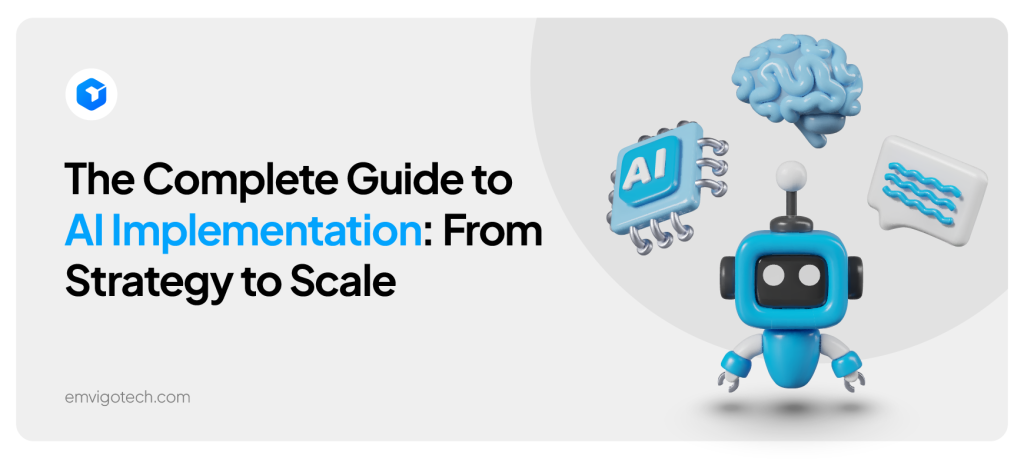
Your board expects AI-driven results within 12 months. Your IT team warns that legacy systems aren’t ready. Your competitors are already deploying machine learning models. In contrast, you’re still debating whether to start with chatbots or predictive analytics.
A successful AI implementation orchestrates a complete business transformation while your organisation continues operating at full capacity. It’s about justifying million-pound investments to sceptical stakeholders. It is also about managing teams that fear automation will eliminate their roles.
This guide will equip you with everything you need for your AI implementation journey. We’ll see strategic foundations, practical execution steps, and scaling frameworks that work. At the end, you’ll have a clear roadmap with actionable insights and proven methodologies.
Phase 1: Strategic Foundations – Why Does Your AI Implementation Need a Clear Vision?
A successful AI implementation begins with a fundamental question. What specific business problems are we solving?
Defining Your AI Implementation Strategy
Your AI implementation strategy is not always about adopting the latest technology. It’s about creating measurable business value. McKinsey shows that companies with clear AI strategies are 2.3 times more likely to achieve significant returns.
Start by identifying high-impact use cases that align with your strategic objectives:
Revenue Enhancement Opportunities:
-
- Personalised customer experiences
- Predictive sales forecasting
- Dynamic pricing optimisation
- Intelligent product recommendations
Operational Excellence Applications:
-
- Process automation and optimisation
- Predictive maintenance
- Quality control enhancement
- Supply chain optimisation
The key is specificity. Instead of “improve customer service,” define “reduce response times by 60%, maintaining 95% satisfaction scores.” This precision transforms vague aspirations into measurable AI implementation goals.
But many organisations stumble here. They jump into technology selection without understanding the fundamental differences between various approaches.
Building Stakeholder Alignment
Successful AI implementation requires more than technical expertise. It demands organisational buy-in. Create a compelling business case that addresses:
-
- Financial Impact: Clear ROI projections with realistic timelines
- Risk Mitigation: How AI addresses current business vulnerabilities
- Competitive Advantage: Market positioning and differentiation opportunities
- Change Management: How teams will adapt and benefit
How Do AI vs Automation Shape Your AI Implementation?
One of the most common misconceptions in AI implementation is blending AI with traditional automation. Understanding this distinction is crucial for choosing the right technology path.
The Fundamental Differences
-
- Traditional Automation
It follows predetermined rules and workflows. It’s excellent for standardised, repetitive tasks with clear decision trees. Think of automated email responses or workflow routing systems. - Artificial Intelligence
AI learns from data, adapts to new situations, and makes decisions based on patterns and insights. It excels in complex, variable environments where rules-based systems would fail.
- Traditional Automation
Choosing Your Technology Path
The most effective AI implementation strategies often combine both approaches:
Start with Automation for:
-
- Well-defined processes with clear rules
- High-volume, repetitive tasks
- Immediate ROI requirements
- Limited data availability
Progress to AI for:
-
- Complex decision-making scenarios
- Pattern recognition requirements
- Predictive analytics needs
- Personalisation objectives
- Complex decision-making scenarios
Consider a customer service transformation. Begin by automating ticket routing first(rules-based). Then implement AI for sentiment analysis and intelligent response suggestions (learning-based).
This hybrid approach reduces implementation risk while building organisational confidence in intelligent technologies.
Budgeting for Reality: What Are the Hidden Costs of AI Implementation?
Perhaps no aspect of AI implementation is more misunderstood than its true cost. Many organisations budget for software licences and initial development. But they often end up overlooking significant expenses that can derail projects.
The Complete Cost Breakdown
Visible Costs (30% of total):
-
- Software licences and platforms
- Initial development and consulting
- Basic infrastructure setup
- Software licences and platforms
Hidden Costs (70% of total):
-
- Data preparation and cleaning (often 60-80% of project time)
- Ongoing model maintenance and retraining
- Infrastructure scaling and optimisation
- Security and compliance implementation
- Change management and training
- Integration with existing systems
- Data preparation and cleaning (often 60-80% of project time)
Real-World Budget Planning in AI Implementation
A recent study by Gartner found that successful AI implementations cost 3.2 times more than initial estimates. Here’s why:
-
- Data Infrastructure Investment: Most organisations discover their data isn’t AI-ready. Cleaning, structuring, and preparing data can consume 60-80% of project resources.
- Talent Acquisition Costs: The global AI talent shortage means premium salaries. A senior ML engineer in the UK commands £80,000-£120,000 for a year, with consultancy rates reaching £1,200 per day.
- Continuous Improvement: Unlike traditional software, AI models require ongoing retraining, monitoring, and optimisation. Budget 25-30% of initial development costs annually for maintenance.
- Compliance and Governance: With regulations like the EU AI Act, compliance costs are no longer optional. Factor in legal reviews, audit processes, and governance frameworks.
The solution isn’t to avoid these costs but to plan for them strategically.
Phase 2: Execution & Development – Is Your Organisation Ready for AI Implementation?
Having established strategic foundations, the execution phase is where vision meets reality. This is where many AI implementations encounter their greatest challenges. This is also the stage where proper preparation makes the difference between success and failure.
Assessing Your AI Readiness
Before committing significant resources, conduct a comprehensive AI readiness assessment. This has to happen across four critical dimensions:
Technical Infrastructure:
-
- Data quality and accessibility
- Computing resources and scalability
- Integration capabilities with existing systems
- Security and compliance frameworks
Organisational Capabilities:
-
- Available talent and skill gaps
- Change management readiness
- Leadership commitment and support
- Cultural adaptability to data-driven decisions
Data Maturity:
-
- Volume, variety, and velocity of available data
- Data governance policies and procedures
- Privacy and compliance considerations
- Historical data quality and completeness
Financial Preparedness:
-
- Budget allocation for the complete implementation lifecycle
- ROI measurement frameworks
- Risk tolerance and contingency planning
- Long-term investment commitment
This assessment reveals whether you’re ready to proceed or need foundational improvements first. Having worked with global clients, do you know what Emvigo believes the fastest route to project failure is? It is rushing into AI implementation without proper preparation.
Building the Right Expertise: How Do You Approach Building Your AI Team?
The AI talent shortage is real and growing. With all the hype, the demand for AI specialists is increasing by 74% annually. At the same time, traditional hiring approaches often fall short. Smart organisations are exploring multiple team-building strategies.
The Three-Model Approach
In-House Team Building:
-
- Advantages: Deep domain knowledge, long-term commitment, cultural alignment
- Challenges: High acquisition costs, lengthy hiring processes, skills gaps
- Best for: Large enterprises with ongoing AI initiatives and substantial budget
Outsourced AI Development:
-
- Advantages: Immediate expertise access, cost efficiency, risk transfer
- Challenges: Limited domain knowledge, potential communication barriers, dependency
- Best for: Specific projects with defined scopes and timelines
Hybrid Model:
-
- Advantages: Combines internal ownership with external expertise, flexible scaling
- Challenges: Complex management, integration requirements, coordination overhead
- Best for: Most organisations seeking a balance between control and capability
At Emvigo, we understand that AI isn’t just about algorithms. We acknowledge that it’s about solving real business problems responsibly.
Our in-house team combines deep technical expertise with ethical AI practices. We know that AI can be confusing and potentially harmful if not implemented correctly. That’s why we follow strict ethical guidelines and transparency standards in every project we deliver.
Need a complete AI team or want to augment your existing capabilities? We provide the expertise to navigate your AI implementation journey safely and effectively. Our AI development services maintain the highest standards of responsible AI deployment.
Essential AI Team Roles
Regardless of your chosen model, successful AI implementation requires these key competencies:
-
- AI Strategist: Aligns AI initiatives with business objectives
- Data Scientists: Develop and optimise machine learning models
- ML Engineers: Operationalise models for production environments
- Data Engineers: Build and maintain data pipelines and infrastructure
- MLOps Specialists: Ensure continuous deployment and monitoring
- Domain Experts: Provide business context and validation
The hybrid model often proves most effective for most of our partners. It combines internal strategic oversight with external technical expertise.
Data & Infrastructure Readiness: Is Your Foundation Solid for AI Implementation?
Your AI implementation success relies on a simple truth. Algorithms are only as good as the data that feeds them. We observed that 67% of organisations begin AI projects without proper data assessment.
The Data Readiness Framework
Data Quality Assessment:
-
- Completeness: Are there significant gaps in your datasets?
- Consistency: Do data formats and definitions align across systems?
- Accuracy: How reliable and up-to-date is your information?
- Relevance: Does your data relate to your AI objectives?
Data Accessibility Evaluation:
-
- Integration complexity with existing systems
- Real-time data streaming capabilities
- Historical data availability and format
- Privacy and compliance restrictions
Infrastructure Scalability Review:
-
- Current computing capacity and performance
- Cloud readiness and migration requirements
- Network bandwidth and latency considerations
- Security frameworks and access controls
Common Infrastructure Pitfalls to Avoid in AI Implementation
Many organisations discover infrastructure limitations only after beginning development:
-
- Siloed Data Systems: Information scattered across incompatible platforms creates integration nightmares. Plan for data consolidation in the early stage.
- Insufficient Computing Resources: AI workloads demand significant processing power. Cloud scalability often proves more cost-effective than on-premises expansion.
- Legacy System Constraints: Older systems may lack APIs or real-time capabilities. Factor modernisation costs into your budget.
- Security Gaps: AI systems need stronger security frameworks. Ensure your infrastructure can handle increased data flows whilst maintaining compliance.
The solution involves conducting thorough technical due diligence before committing to AI implementations.
Phase 3: Scaling & Optimisation – How Do You Move AI from Proof of Concept to Production?
The journey from successful pilot to enterprise-wide deployment represents AI implementation’s greatest challenge. Research indicates that 87% of data science projects never make it past the proof of concept stage.
The Scaling Challenge
Why do so many AI implementations stall at the pilot stage?
-
- Technical Complexity: Production environments demand robustness, scalability, and reliability. This is something pilot projects mostly don’t need.
- Organisational Resistance: Success in controlled environments doesn’t guarantee enterprise-wide acceptance.
- Resource Constraints: Scaling requires significant infrastructure investment and change management resources.
- Integration Difficulties: Production deployment often reveals hidden integration challenges with existing systems.
The Practical Scaling Framework for AI Implementation
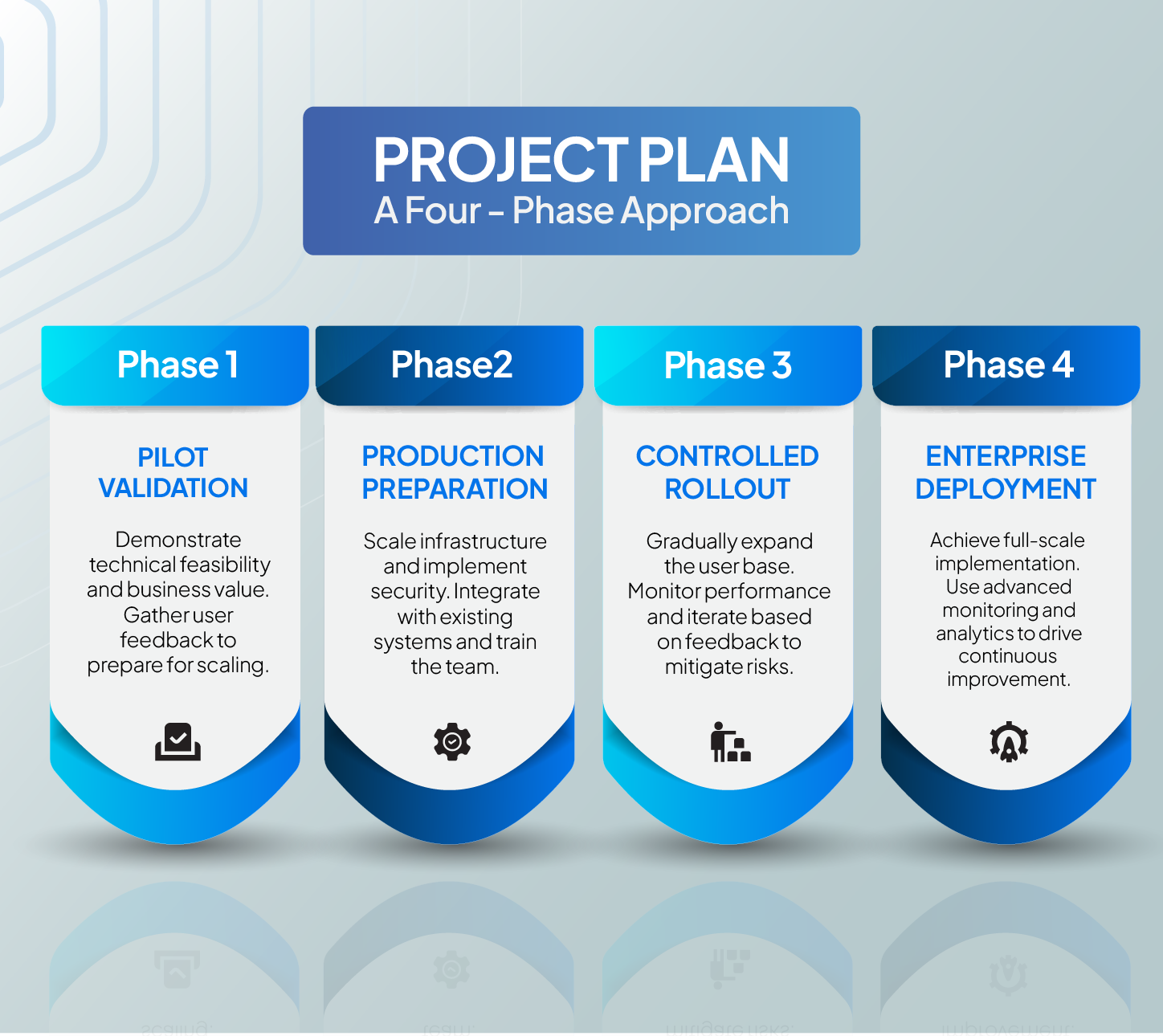
Phase 1: Pilot Validation (Months 1-3)
-
- Demonstrate technical feasibility
- Validate business value hypothesis
- Gather user feedback and requirements
- Identify scaling prerequisites
Phase 2: Production Preparation (Months 3-6)
-
- Infrastructure scaling and optimisation
- Security and compliance implementation
- Integration with existing systems
- Team training and change management
Phase 3: Controlled Rollout (Months 6-9)
-
- Gradual user base expansion
- Performance monitoring and optimisation
- Feedback collection and iteration
- Risk mitigation and contingency planning
Phase 4: Enterprise Deployment (Months 9-12)
-
- Full-scale implementation
- Advanced monitoring and analytics
- Continuous improvement frameworks
- Success measurement and reporting
This phased approach reduces risk whilst building organisational confidence. Each stage provides opportunities to address challenges before they become critical failures.
Operationalising AI: What is Your MLOps Implementation Roadmap?
Are you familiar with the term MLOps? It is the practice of applying DevOps principles to machine learning. MLOps transforms experimental AI models into reliable, scalable production systems. Without proper MLOps implementation, even successful pilots can become operational nightmares.
The MLOps Imperative
Traditional software deployment is challenging enough. AI deployment introduces additional complexities:
-
- Model Drift: AI performance degrades over time as data patterns change
- Version Control: Managing multiple model versions, datasets, and experiments
- Continuous Training: Models require regular retraining with fresh data
- Monitoring: Performance tracking beyond traditional application metrics
- Compliance: Auditable model decisions and explainable AI requirements
The 90-Day MLOps Roadmap
Days 1-30: Foundation Setting
-
- Establish version control for models and datasets
- Implement automated testing frameworks
- Create model performance monitoring dashboards
- Design a data pipeline architecture
Days 31-60: Automation Implementation
-
- Deploy continuous integration for model development
- Establish automated model validation processes
- Implement containerisation for consistent deployment
- Create rollback procedures and safety mechanisms
Days 61-90: Optimisation and Governance
-
- Advanced monitoring and alerting systems
- A/B testing frameworks for model comparison
- Compliance reporting and audit trails
- Performance optimisation and scaling procedures
This systematic approach ensures your AI implementation can operate reliably at enterprise scale.
Ensuring Trust & Compliance: How Do You Build an AI Governance Framework?
As AI becomes more prevalent, governance is no longer an optional choice to make. The EU AI Act, coming into force in 2025, makes compliance mandatory for many AI applications. Beyond regulatory requirements, AI governance builds stakeholder trust and mitigates operational risks.
The Four Pillars of AI Governance
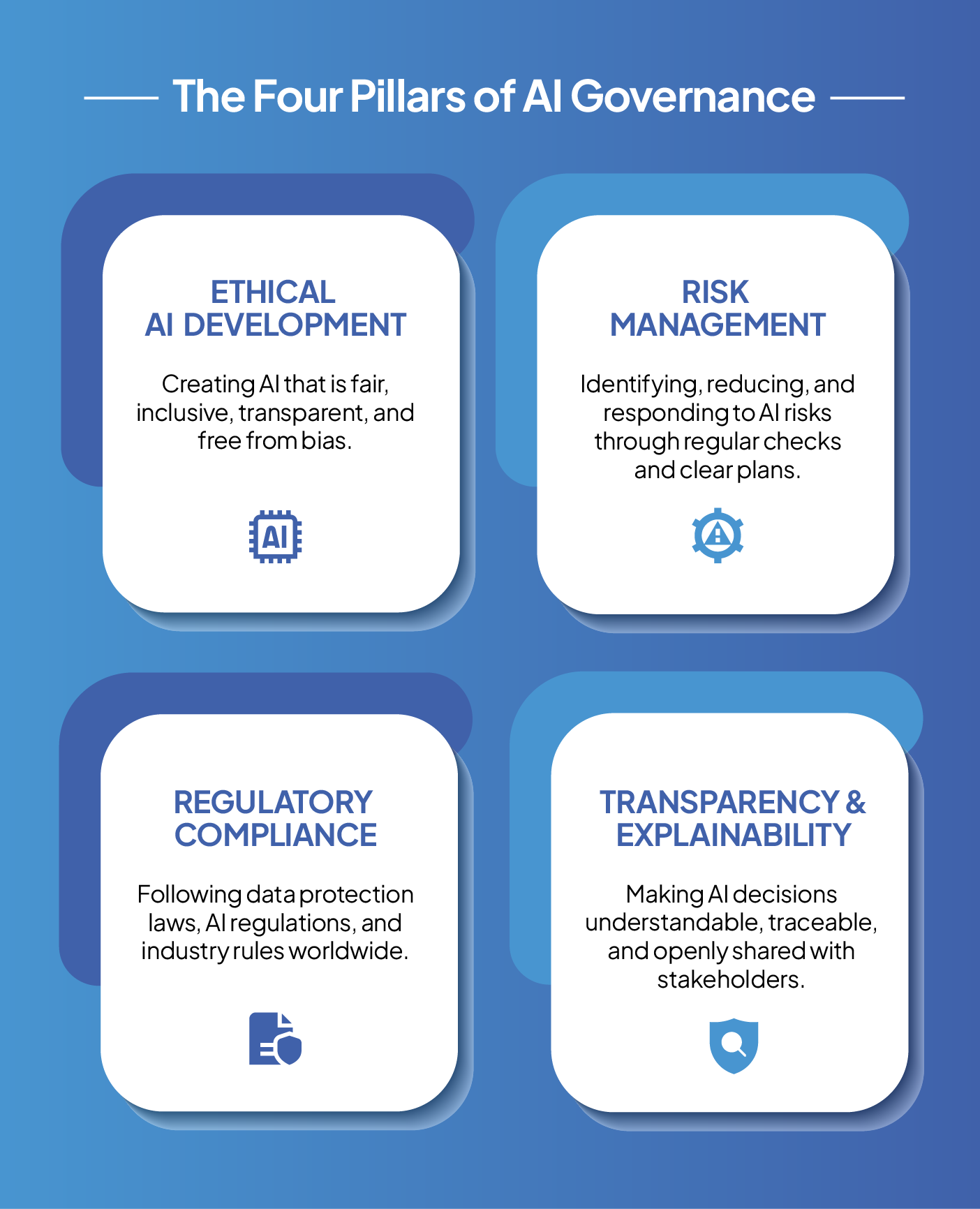
Ethical AI Development:
-
- Bias detection and mitigation strategies
- Fairness metrics and monitoring systems
- Inclusive development processes and diverse perspectives
- Transparent decision-making frameworks
Risk Management:
-
- Comprehensive risk assessment methodologies
- Mitigation strategies for identified vulnerabilities
- Incident response and recovery procedures
- Regular audit and review processes
Regulatory Compliance:
-
- GDPR data protection requirements
- EU AI Act classification and obligations
- Industry-specific regulations (financial services, healthcare)
- International standards and best practices
Transparency and Explainability:
-
- Model interpretability requirements
- Decision audit trails and documentation
- Stakeholder communication frameworks
- Public reporting and accountability measures
Building Your Governance Framework
Start with a governance charter that defines:
-
- Roles and responsibilities for AI oversight
- Decision-making processes and approval workflows
- Risk tolerance levels and escalation procedures
- Compliance monitoring and reporting requirements
Implement technical controls:
-
- Automated bias detection in model outputs
- Explainable AI techniques for critical decisions
- Comprehensive logging and audit trails
- Regular model performance and fairness assessments
Create organisational processes:
-
- Regular governance committee meetings
- Stakeholder feedback and review mechanisms
- Training programmes for AI ethics and compliance
- Incident reporting and resolution procedures
Beyond the Pilot Trap: Why 2025 Will Separate AI Winners from Losers
Amazon reduced logistics costs by £2.8 billion through AI optimisation. Netflix prevents £800 million in annual churn through predictive analytics. Goldman Sachs eliminated 400 hours of manual compliance work per analyst using automated document processing.
The difference is their systematic approach to scaling AI beyond proof-of-concept theatre. They solved the integration challenges that keep your pilots trapped in departmental silos. Their operational frameworks turn experimental models into production systems, generating measurable business value.
2025 marks the end of AI experimentation as a competitive strategy. The companies pulling ahead have moved beyond asking whether AI works. Instead, they’ve solved how to make it work at scale.
Emerging Trends Shaping AI Implementation
-
- Responsible AI by Design
Governance and ethics are integrated from project inception, not added afterwards. This proactive approach reduces compliance costs and builds stakeholder trust. - AI Agents and Autonomous Systems
Moving beyond predictive models to AI systems that take actions and make decisions independently within defined parameters. - Edge AI Implementation
Bringing AI processing closer to data sources, reducing latency and improving privacy compliance. - Hyper-Personalisation
AI systems that adapt continuously to individual user behaviours and preferences. This creates truly personalised experiences. - Explainable AI Requirements
Demand for AI systems that can articulate their decision-making in terms that humans understand.
- Responsible AI by Design
What Separates Scaling Success from Pilot Purgatory
The companies breaking free from endless pilots share four critical capabilities. These capabilities are:
-
- Modular AI Infrastructure
They build systems that integrate new models without rebuilding entire platforms. When GPT-5 launches, they’ll deploy it in days, not months. Their architecture decisions today determine their competitive speed tomorrow. - Skills-First Talent Strategy
Instead of hiring for specific tools, they recruit for adaptability. Their teams master new frameworks quickly because they understand the underlying principles. They avoid the talent bottlenecks that paralyse traditional hiring approaches. - Strategic Technology Partnerships
They’ve identified AI specialists like Emvigo who understand their industry constraints. They look beyond mere vendor relationships. They choose strategic alliances that provide exclusive access to emerging capabilities and rapid deployment expertise. - Proactive Compliance Positioning
They’re building governance frameworks that anticipate regulations, not react to them. When the EU AI Act enforcement begins, they’ll be compliant by design, while competitors scramble to catch up.
- Modular AI Infrastructure
Frequently Asked Questions
What are the primary steps in successful AI implementation?
The primary steps in successful AI implementation involve:
-
- Defining a clear strategy
- Ensuring data and infrastructure readiness
- Building a skilled AI team
- Developing and testing models
- Scaling and governing AI solutions for production
How can businesses measure the ROI of AI implementation?
Businesses can measure the ROI of AI implementation by tracking benefits like:
-
- Cost reduction (automated tasks)
- Revenue increase (personalised recommendations)
- Efficiency gains
- Customer satisfaction
- Enhanced decision-making
What are the common challenges in AI implementation?
The common challenges in AI implementation include:
-
- Poor data quality
- Lack of a clear AI implementation strategy
- Talent shortages
- Integration with legacy systems
- Managing the hidden costs of AI implementation
- Ensuring proper AI governance and ethical considerations.
Is generative AI implementation different from traditional AI implementation?
Yes, generative AI implementation shares core AI implementation principles but has unique considerations. These include managing:
-
- Model hallucinations
- Intellectual property risks
- Higher computational demands
- Specific ethical guidelines related to content generation.
How important is AI governance in the overall AI implementation process?
AI governance is critically important in the overall AI implementation process. It ensures that AI systems are developed and used ethically, transparently, and securely. It ensures compliance with regulations, mitigating risks and building trust with users and stakeholders.
The £2.3 Million Question: Build, Buy, or Partner?
Every month you delay scaling your AI implementation costs more than money. It will cost you your market position.
Our analysis reveals three critical success factors that distinguish winners:
-
- Technical Architecture Mastery
Winners built modular systems that integrate new AI models without platform reconstruction. They anticipated GPT evolution, regulatory changes, and scaling demands from day one. - Regulatory Foresight
They implemented AI governance frameworks before compliance became mandatory. When the EU AI Act takes full effect, they’ll maintain competitive velocity while others pause for legal reviews. - Partnership Intelligence
They identified AI specialists who understood their industry constraints, not just their technical requirements. These strategic relationships provided exclusive access to emerging capabilities and rapid deployment expertise.
- Technical Architecture Mastery
Ready to transform your AI vision into measurable business value?
Emvigo guides ambitious organisations through every stage of their AI implementation journey. Our experts ensure your AI initiatives deliver genuine ROI.
Don’t let hidden costs, talent shortages, or scaling challenges derail your AI ambitions.
Schedule your complimentary AI Implementation Strategy Session
Your intelligent future starts with the next decision you make. Make it count.