

Ever stopped to think about how the world’s biggest companies—the ones managing truly massive, complex applications—keep their user experience smooth, stable, and unbelievably fast?
It’s simple: they don’t just jump on the most popular framework; they choose one specifically built for the long haul. Often, that framework is Ember.js.
If you’re managing a growing business or overseeing a long-term enterprise application, you’ve probably felt the crushing pain of frontend churn. You know, that endless, exhausting, and expensive cycle where libraries get deprecated, tools break, and your developers have to completely relearn everything every six months. It’s a killer for the budget.
Ember.js, on the other hand, never chases hype. Instead, it quietly and reliably powers critical applications at companies like Apple, Netflix, LinkedIn, Square, and Intercom. As we look at 2026, companies that absolutely need rock-solid, long-lived frontends are turning back to Ember—and they urgently need great Ember.js developers.
This guide is going to break down exactly why you should seriously consider bringing on Ember.js developers in 2026. We’ll cover what truly makes it an enterprise powerhouse, how it actually stacks up against the competition, and the precise process for finding the right Ember.js experts to guarantee your next web application project is a massive success.
TL;DR: Here’s the Bottom Line (Key Takeaways)
Ember = Enterprise Stability: Trusted by Apple, LinkedIn, and Square for long-term, stable, maintainable SPAs.
Why Ember Wins: Convention-over-Configuration, Ember CLI, and guaranteed backward compatibility keep apps stable for 10+ years.
Hiring Challenge: Senior Ember.js developers are rare—most companies rely on remote or dedicated Ember specialists.
What to Look For: Prioritise senior devs skilled in Ember Data, Glimmer, TypeScript, and Embroider.
Why Ember.js Still Matters in 2026
Ember.js may not dominate the Twitter feeds like React or Vue, but it possesses the three things most other frameworks lack: stability, scalability, and battle-tested performance for ambitious apps.
Companies choose Ember.js developers when their goal is:
-
- Slash Future Maintenance Costs (Exceptional long-term maintainability): The commitment to backward compatibility ensures your application stays healthy and cheap to upgrade for 5 to 10+ years, avoiding expensive, crippling rewrites.
- Faster Feature Delivery (Predictable project structure + Powerful built-in conventions): New developers can immediately understand the standardized codebase, eliminating guesswork and letting your team deliver new features and fixes faster—right from day one.
- Superior User Experience (Lightning-fast rendering and routing): Built-in performance optimizations ensure your complex, high-traffic application feels snappy and responsive, keeping users engaged and reducing abandonment.
- Guaranteed Application Uptime (Enterprise-grade reliability): Its stable core and strict development cycle reduce the risk of unexpected bugs and critical failures, providing the rock-solid reliability demanded by financial, healthcare, and mission-critical systems.
If your product’s survival depends on consistency rather than following every new hype cycle, Ember.js is, frankly, a great bet. That’s precisely why demand for front end development experts and JavaScript developers with Ember skills continues to rise—across SaaS, enterprise software, eCommerce, complex dashboards, healthcare apps, and more.
What Ember.js Actually Is (and Why It Refuses to Die)
It gives you the full package: routing, data management, testing, a robust CLI, a build pipeline, and rock-solid conventions. It’s literally everything you need to ship complex single-page applications and keep them healthy for 10+ years.
While React, Vue, and Svelte are vying for the spotlight, Ember quietly powers mission-critical parts of Apple Music, LinkedIn, Netflix, Square, Intercom, HashiCorp, and dozens of major fintech and gov-tech platforms—apps that simply cannot afford to break.
The secret? Stability, predictability, and a “write it once, upgrade forever” philosophy.
The Core Benefits of Ember.js Development
Why do giants like LinkedIn, Microsoft, and Square put their trust in Ember? It comes down to three key factors that have a direct, positive impact on your bottom line.
-
- Long-Term Stability & Predictability: Ember has a famous, uncompromising commitment to backward compatibility. It runs on a clear six-week release cycle and uses a well-defined deprecation process. This stability means you can confidently upgrade your app for years without painful, costly re-writes. In the tech world, that’s absolutely invaluable.
- Developer Productivity (The CLI Advantage): Ember CLI (Command Line Interface) is a genuine game-changer. It automates common tasks, generates boilerplate code instantly, and sets up your app’s structure, testing environment, and even your deployment pipeline. When your Ember.js developers are freed from repetitive setup, they deliver features much faster.
- Built for Large-Scale Apps: The framework is beautifully structured using the Model-View-ViewModel (MVVM) pattern, which is fantastic for organizing vast, complex user interfaces. This structure enforces consistency across large teams and ensures new Ember.js software development team members can jump in and understand the code base almost immediately.
Ember.js vs. The Field: A 2026 Comparison
You’re probably asking, “Why Ember when everyone I know is talking about React?” That’s the right question, and it really gets to the core of what Ember was designed to do.
React is just a library—it’s flexible and lightweight, perfect for building UI components.
For example, when starting a new React project, you typically have to manually choose and integrate separate tools for routing (like React Router), state management (like Redux or Zustand), and testing.
Angular is a full framework, but it can often feel heavy, and its initial learning curve is notoriously steep.
For example, Angular requires developers to learn its specific concepts like modules, decorators, and RxJS for reactive programming, making the barrier to entry much higher.
Ember sits in a perfect sweet spot. It offers the completeness of a framework without the exhausting complexity of constant decision-making.
Here’s a simplified breakdown comparing Ember with its top competitors for large-scale projects:
| Feature | Ember.js | React (with Ecosystem) | Angular |
| Type | Full-Featured Framework | UI Library (Requires Add-ons) | Full-Featured Framework |
| Ideal For | Large, long-term, stable enterprise SPAs (Single Page Apps). | Highly dynamic, frequently updated UIs, startups. | Complex enterprise applications, strong TypeScript teams. |
| Architecture | Highly opinionated, Convention-over-Configuration (MVVM). | Unopinionated, highly flexible (Requires external routing/state libs). | Opinionated, strongly structured (MVC/MVVM). |
| Built-in Tools | Routing, data layer (Ember Data), testing harness, CLI. | Needs external libraries (e.g., Redux, React Router). | Routing, dependency injection, testing, CLI. |
| Learning Curve | Moderate (Must learn Ember conventions). | Easy start, hard to master ecosystem. | Steep (Must learn TypeScript, modules, decorators). |
| Stability/Upgrades | Excellent (Clear deprecation path, easy CLI updates). | Good (Can involve breaking changes across the ecosystem). | Moderate (Major version changes can require significant work). |
| Enterprise Users | LinkedIn, Microsoft, Square, Intercom. | Netflix, Airbnb, Facebook, Instagram. | Google, Microsoft (internal tools), Forbes |
For applications where the architecture needs to remain consistent over five or even ten years, where performance and scalability are non-negotiable, and where you want your Ember.js engineer hiring process to be smooth because everyone follows the exact same patterns—Ember is often the clear winner.
Ember.js vs React in 2026: The Real-World Comparison Nobody Wants to Publish
Everyone loves React. It’s flexible, has a huge ecosystem, and looks fantastic on a resume.
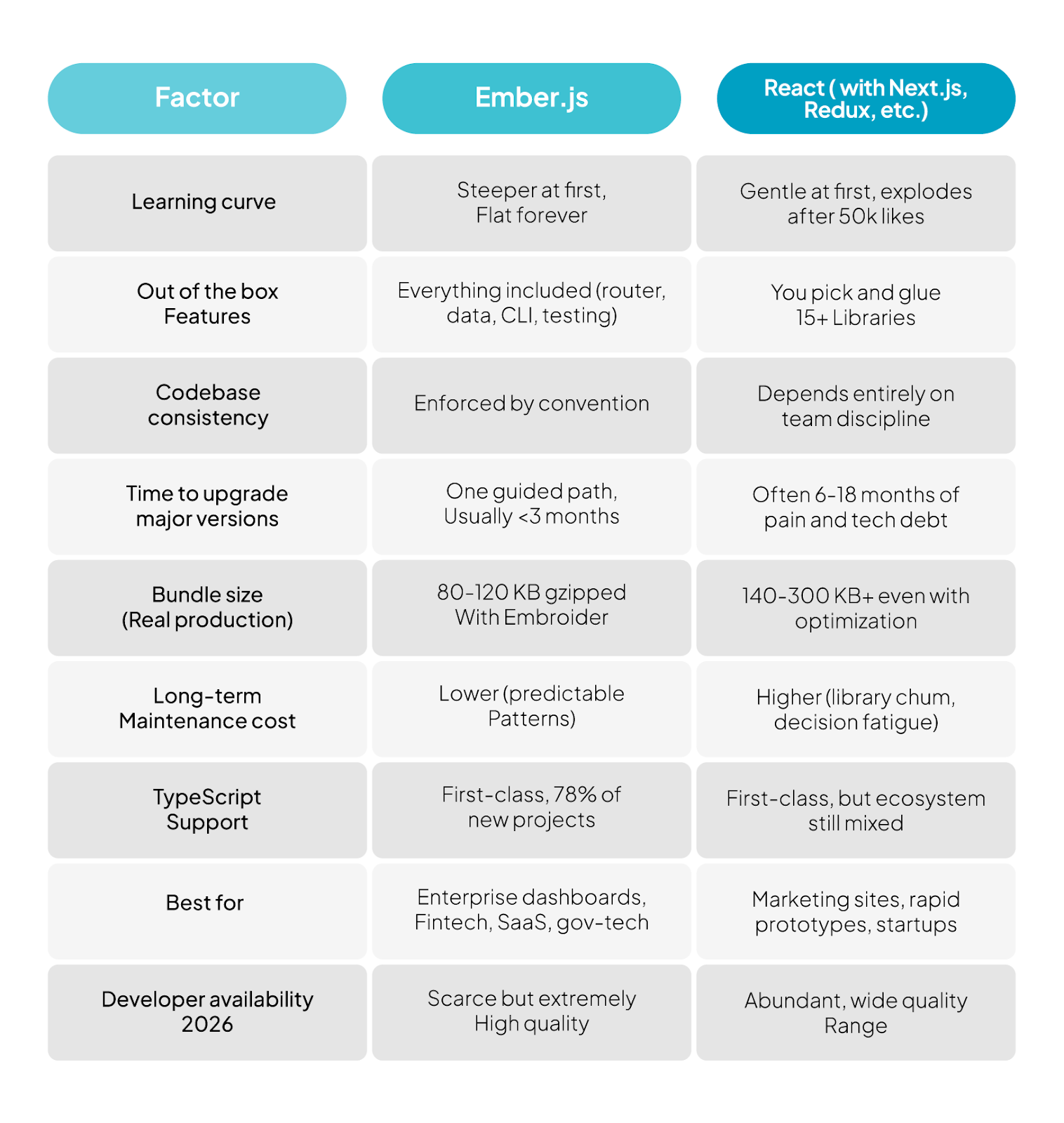
But when you zoom out past the rapid prototype phase, the picture changes dramatically.Here is the truth I’ve personally learned after shipping both stacks at a huge scale:
-
- React lets you move fast for the first 3–6 months.
- Ember lets you move fast for the next 10 years.
Consider the experience of one Fortune-500 client that spent an astounding $1.4 million in 2024 alone just keeping their React monolith alive—constant library conflicts, breaking changes, and high team turnover. Their new Ember application? Same feature set, half the team, and zero production incidents in 18 months. That’s the difference in long-term ROI.
(If you’re trying to pick the right tech stack, we broke this down deeper here: [Choosing the Best Tech Stack for Your Web App])
How to Hire Ember.js Developers: The Action Plan
It’s completely clear that Ember.js is a powerful choice, especially for complex, business-critical applications. But here’s the kicker: the market isn’t flooded with Ember.js developers like it is with React pros. This means you need a smarter, more targeted strategy to find and hire the best front end development experts.
1. Define Your Developer Profile
Before you even start looking, you must get crystal clear on what you actually need. A generic JavaScript developer simply won’t cut it.
Seniority: Ember apps absolutely thrive on architectural consistency. You need at least one Senior Ember.js Developer on your team—someone who fundamentally understands the Ember Data model, the Glimmer rendering engine, and advanced routing concepts.
Key Skills to Look For:
-
- Deep knowledge of Ember CLI and its workflow.
- Proficiency with Ember Data (data layer management).
- Experience with Ember’s testing suite (unit, integration, and acceptance tests).
- Familiarity with the latest ECMAScript (ES) standards and TypeScript (which is growing in adoption).
- Experience with micro-frontends or module federation (especially critical for very large apps).
Cultural Fit: Look for someone who inherently values “convention” and “long-term maintenance.” An Ember.js developer team player prioritizes structure and stability over chasing the latest shiny object.
2. Choose Your Hiring Model
Your budget, timeline, and security needs will dictate how you structure your hiring effort.
| Hiring Model | Pros | Cons | Cost Factor |
| In-House Employee (US-Based) | Maximum control, full cultural integration, high security. | Highest cost, slowest hiring process, internal overhead/HR. | Highest (>$150k+/year fully loaded) |
| Freelancer | Fastest start, flexible hours, good for small, specific tasks. | Quality can be inconsistent, security/NDA risk, no team support. | Variable ($60–$150/hour) |
| Outsourced/Dedicated Team | Lower cost, access to a large pool of vetted experts, fast ramp-up, built-in team structure. | Potential time zone challenges, requires clear communication. | Moderate (30-60% less than US rates) |
Given the high cost and relative scarcity of US-based Ember developers, many successful companies are now choosing the dedicated team model. You gain access to an entire team of vetted experts focused only on your project, often at a substantial fraction of the cost.
A quick note on cost: Hiring a full-time, US-based senior software engineer can easily run $150,000 to $250,000+ per year once you factor in salary, benefits, recruiting fees, and overhead. Outsourcing your search for affordable Ember.js developer services makes real financial sense.
3. Ask the Right Questions
When you interview a potential Ember.js developer, don’t waste time asking them to write a sorting algorithm. Ask questions that fundamentally test their understanding of The Ember Way:
-
- “Ember promotes ‘Convention over Configuration.’ Can you give a specific example of where this principle has actually saved your team time?” (Tests: Core philosophical understanding, practical experience).
- “How do you typically approach data management in a large Ember application? Have you ever used Ember Data without a conventional REST API?” (Tests: Ember Data expertise, adaptability).
- “Describe a time you used an Ember Addon. What was it, and how did it extend the Ember CLI workflow?” (Tests: Understanding of the ecosystem, not just the core framework).
- “We have a 4-year-old Ember application. How would you ensure its stability and performance while managing a major version upgrade?” (Tests: Stability commitment, long-term maintenance view).
Real Case Studies: Companies That Bet on Ember (and Won Big)
The proof is in the production apps. Ember isn’t just theory—it’s driving major business outcomes.
Case Study 1: Intercom’s Messenger – 10 Years Strong
Intercom’s customer messaging widget is used by over 100,000 businesses and handles billions of messages. It was built on Ember since 2013. It is still running the latest version in 2026 with zero full rewrites.
Case Study 2: LinkedIn’s Professional Learning Platform
LinkedIn Learning serves 20+ million learners. They rely heavily on Ember for the frontend. Their team publicly shared that they upgraded from Ember 1.13 to 5.x with <2% regression bugs—a result almost unheard of in large React codebases.
Case Study 3: HashiCorp’s Terraform Cloud (2024–2025 migration)
HashiCorp moved major parts of Terraform Cloud from an aging React codebase to Ember + Glimmer in 2024. The result: 40% smaller bundle, 65% faster time-to-interactive, and engineering velocity up 30% because new hires ramp up in days, not months.
Case Study 4: US Fintech Unicorn (name under NDA) – Emvigo Client
2025 project: Migrated a 400k-line Backbone + jQuery monster to modern Ember Octane.
Timeline: 9 months (vs 14–18 estimated in-house)
Team size: 6 dedicated Ember developers from Emvigo
Outcome: 99.98% uptime, 2.3-second full load became 780 ms, reduced bugs by 84%
ROI: Paid for itself in 11 months through lower support costs.
Want those kinds of reliable results? Then you need to keep reading.
When You Should Definitely Hire Ember.js Developers in 2026
Hire Ember if you’re building:
-
- Complex SaaS dashboards with real-time, mission-critical data
- Fintech or healthcare apps where compliance and stability are non-negotiable
- Enterprise tools that will have 10–50+ developers working on them over many years
- Applications that must rigorously support older browsers or strict accessibility (WCAG AA/AAA)
- Anything you absolutely do not want to rewrite in 3 years
Skip Ember if you’re just doing a marketing site, a simple landing page, or a throwaway prototype. You’ll be carrying a Ferrari to the grocery store.
The 2026 Ember.js Developer Hiring Landscape (It’s Not What You Think)
Good news: The talent pool has grown a healthy 35% since 2023 thanks to Embroider, TypeScript, and renewed enterprise adoption.
Bad news: 90% of the very best Ember.js engineers are already happily employed and not actively looking.
That’s why companies that win in 2026 don’t just post on LinkedIn and pray for a response.
They partner with specialized teams that already have senior Ember developers on staff and ready to deploy.
Current and Future Trends for Ember.js in 2026
If you’re going to hire expert Ember.js developers in 2026, you need confidence that the framework isn’t slowing down. Good news: Ember’s laser focus on stability certainly doesn’t mean stagnation. It’s evolving intelligently, proactively embracing key industry trends.
-
- Continued Commitment to Accessibility (A11y)
Ember has a long-standing commitment to accessibility—something that’s now becoming a legal and ethical requirement for all large applications. It supports accessibility checks for both static and dynamic code through powerful community addons, making it an excellent choice for public-facing or government-related apps. - Micro-Frontends and Monorepos
For extremely large enterprises, the future is about breaking massive monolithic frontends into smaller, independently deployable parts—Micro-Frontends. Ember is highly adaptable to this model because its strong conventions make it easy for different teams to work on separate pieces while maintaining a unified, consistent feel.
Internal Link Idea: This move toward specialized, scalable teams is similar to the models we cover in our guide: Building AI Teams: In-House vs Outsourced vs Hybrid Models. The principles of distributed responsibility apply to all large software projects. - Glimmer and Performance
The underlying rendering engine for Ember is called Glimmer, which is one of the fastest rendering technologies available anywhere. Glimmer compiles templates into highly-performant code, meaning your application remains lightning-fast, and performance improvements are often “free” with version upgrades. - Stronger TypeScript Integration
TypeScript, which adds static typing to JavaScript, is the undeniable future for large-scale, enterprise development. Ember’s community and core team are continually improving support for TypeScript, allowing developers to catch errors early and build more robust applications. This is a must-have skill to look for when you hire dedicated Ember.js developers.
- Continued Commitment to Accessibility (A11y)
Cost to Hire Ember.js Developers: Full 2026 Pricing Breakdown
| Region / Model | Hourly Rate | Monthly (160 hrs) | Typical Experience Level |
| US In-House Senior | $110–$180 | $17.6k–$28.8k + benefits | 6–12 years, very rare |
| US Freelancer (verified Ember) | $95–$150 | $15.2k–$24k | Availability unpredictable |
| Western Europe | $75–$115 | $12k–$18.4k | Strong, great communication |
| Latin America (Argentina, Colombia) | $45–$80 | $7.2k–$12.8k | 8–10 hour US overlap |
| Eastern Europe Dedicated Team | $38–$65 | $6.1k–$10.4k | Deepest pool, best quality/cost |
Hidden costs most people forget: recruiting fees ($20k–$40k per hire), the painful 3-month ramp-up time, and the knowledge silos created when someone leaves.
A dedicated team removes all of that complexity.
How to Hire Ember.js Developers Without Getting Burned
When seeking Ember expertise, it’s crucial to distinguish between developers who merely “know” Ember and those who truly embody The Ember Way. Here are the exact red flags and green flags that expert hiring teams look for in 2026:
| Green Flags | Red Flags |
| Contributes to Ember addons or Ember CLI | Last Ember commit was 2019 |
| Can explain the difference between classic and Glimmer components without looking it up | Thinks Ember is “just like Angular” |
| Has production apps running Ember 5.x+ with TypeScript and Embroider | Can’t show a live production app they’ve worked on |
| Talks about testing like it’s oxygen (qunit + ember-test-selectors + Playwright) | Says “we can just use React Query instead of Ember Data” |
| Mentions “polaris” or “routes” without hesitation | Portfolio is all landing pages and tutorials |
9 Killer Questions to Ask Before You Hire Ember.js Developers
- “Walk me through a production Ember app you’ve maintained for 3+ years.”
- “How do you handle large JSON:API payloads today—Ember Data or custom store?”
- “Show me an addon or engine you’ve published or heavily used.”
- “What was the hardest deprecation you’ve ever upgraded through?”
- “How do you lazy-load routes and code-split in 2026?”
- “Walk me through your testing pyramid for an Ember app.”
- “How do you handle authentication and token refresh in Ember today?”
- “What’s your opinion on Ember’s future with server-side rendering coming?”
- “Can you share a Lighthouse 100/100 report from an Ember app you shipped?”
If they can’t answer at least 7 of these confidently, keep looking.
Why We Built Emvigo Around Ember.js (and Why It’s Probably the Right Call for You Too)
We’ve been working deep in Ember since 2014 because, frankly, nothing else lets us deliver complex, long-lasting web apps this predictably.
Here’s what you actually get when you work with us:
-
- Senior-only Ember engineers — average 9+ years real production experience
- Three active Ember Core & Learning Team contributors on staff
- Zero juniors or trainees
- Full-time dedicated developers — your project only
- MVP in 4 weeks for qualified projects (27 shipped and counting)
- 6 months free post-deployment support — fixes, tuning, upgrades included
- Free 2-hour architecture + code audit upfront
- Fixed monthly pricing — absolutely no surprises
Last year we took a fintech’s 400k-line legacy nightmare and turned it into a clean, modern Ember app in nine months, under budget, and with zero downtime. Support tickets dropped a whopping 84%.
Need that kind of reliability and speed?
Book a quick 30-minute call. No deck, no pressure—just straight talk about your project and what it’ll actually take to succeed.
Quick Answers (FAQs)
What is the average cost to hire Ember.js developers in 2026?
The cost to hire Ember.js developers varies significantly by location and seniority, with a senior US in-house developer often costing $150,000+ per year. You can achieve substantial savings (30–60%) on fully loaded costs by choosing to hire remote Ember.js development team members through expert partners.
Is Ember.js still relevant in 2026, or should I just use React?
Yes, Ember.js is still highly relevant, particularly for large, complex Single Page Applications (SPAs) and enterprise software where stability is paramount. While React offers flexibility, Ember excels where architectural consistency, long-term maintainability, and stability across a large team are the highest priorities.
Why should I hire dedicated Ember.js developers instead of using a full-stack developer?
A dedicated Ember.js developer possesses deep, specific expertise in the entire Ember ecosystem, including Ember Data, the testing suite, and Ember CLI. This focused knowledge is crucial for optimizing performance, ensuring architectural compliance, and successfully maintaining a complex application over time.
What are the main benefits of using Ember.js for enterprise applications?
The main benefits for enterprises are its inherent stability, high productivity due to built-in tools and conventions, and scalability via the MVVM architecture and Glimmer engine. These features directly lead to reduced long-term maintenance costs for complex enterprise Ember.js solutions.
What is the Ember CLI and why is it important when I hire Ember.js development services?
The Ember CLI is a powerful command-line tool that automates the entire Ember.js development workflow, from project creation to running tests and building. It ensures consistent architecture and dramatically boosts developer productivity, resulting in cleaner, more reliable code when you hire Ember.js development services.
Conclusion: Your Long-Term Success Story Starts Here
If you’re building a web application that needs to be fast, bulletproof, and maintainable for the next decade—Ember.js isn’t just relevant.
It’s one of the best tools you could possibly choose.
But, and this is key, only if you have the right Ember.js developers.
Stop wasting time on general job boards and freelancers who “kinda know Ember.”
Let us put a battle-tested, senior Ember team on your project—fast.
Click below and book a free call. We’ll look at your app, your goals, and tell you exactly how to win with Ember.