

Which is better Infosys or Accenture for your next big project?
That’s the billion-dollar question that keeps CEOs and CTOs up at night.
We all know the names: Accenture and Infosys. They’re the titans of the global IT and consulting world, the ones responsible for powering the digital transformation of countless businesses, from small enterprises to Fortune 500 giants. But when you’re about to invest significant capital and trust your critical operations to one of them, the brand name isn’t enough.
You need to know the fine print.
You need to understand which firm’s focus areas, pricing structure, and strategic vision truly align with your goals. Is the high-profile consultancy a better fit, or does the engineering powerhouse offer more reliable delivery?
This detailed comparison cuts through the marketing hype to give you a clear, unbiased look at Accenture vs Infosys. By the end of this read, you won’t just have an opinion; you’ll have the data and insight to confidently answer: infosys vs accenture—which one is the right partner for your future?
Accenture vs Infosys at a Glance
Before diving deep, here’s a snapshot.
The Landscape: Understanding Accenture and Infosys
Before we dive into the comparison, it helps to understand what each company represents in the market. Knowing their foundational strengths helps determine which is better Infosys or Accenture for specific needs.
Accenture: The Consulting-Led Global Powerhouse
Accenture is often viewed as the world’s leading professional services company, focusing heavily on strategy and management consulting, technology services, and operations.
They pride themselves on their global reach and ability to handle end-to-end transformation. If your problem is “We don’t know what our digital strategy should be,” Accenture is designed to step in at that high-level, strategic phase. They offer a broad range of services, often segmented into five main areas: Strategy & Consulting, Song (creative/digital), Technology, Operations, and Industry X (digital engineering).
Infosys: The Engineering and Outsourcing Specialist
Infosys, a well-established Indian multinational, is an industry leader in engineering, software development, and business process management (BPM).
While they have a growing consulting arm, their core strength—their DNA, if you will—lies in the delivery and execution of large-scale IT projects. They are highly regarded for their robust capabilities in application development, maintenance, and outsourcing. If your problem is “We need a reliable team to build and maintain a complex, scalable platform,” Infosys is engineered for that kind of task.
Key Service Areas Compared
Core IT & Consulting
-
- Accenture
Known for high-end business strategy + transformation consulting, combined with deep technology integration (e.g. ERP, systems overhaul). It often leads large-scale enterprise programmes.
- Infosys
Strong in systems integration, legacy modernization, and large-scale IT operations. It plays on scale, efficiency, and global resource pools.
- Accenture
Emerging Technologies: AI, Cloud, Cybersecurity
-
- Accenture tends to invest heavily in AI, cloud-native systems, digital advisory, ecosystem partnerships (e.g. with Microsoft, AWS).
- Infosys also advances rapidly in AI and cloud; its strength is melding large-scale delivery with new tech. Their Q1 FY26 report showed USD 4,941 million revenue with 20.8 % operating margin.
- Accenture tends to invest heavily in AI, cloud-native systems, digital advisory, ecosystem partnerships (e.g. with Microsoft, AWS).
Sector Focus & UK Strength
-
- Accenture has strong footholds in financial services, healthcare, public sector, and large enterprises in the UK.
- Infosys often targets banking, insurance, retail, manufacturing, telecom. In the UK, it leverages its consulting arm, Infosys Consulting (UK)
- Accenture has strong footholds in financial services, healthcare, public sector, and large enterprises in the UK.
Detailed Comparison: Infosys vs Accenture
When evaluating accenture vs infosys, it’s crucial to look beyond market cap and headcount. Here is a breakdown of the key factors that affect your business.
Strong Focus Areas: Where Each Giant Shines
Knowing the primary strengths of each company is essential to deciding which is better Infosys or Accenture.
Accenture’s Strong Focus Areas
-
- High-Level Strategy and Transformation: Their core strength lies in management consulting. They excel at defining the what and why before moving to the how.
- Digital and Creative Services (Accenture Song): They’ve invested heavily in creative agencies, making them a strong contender for customer experience, digital marketing, and complex front-end innovation.
- Cloud Migration and Services: They are a premier partner for hyperscalers (AWS, Azure, Google Cloud), making them a dominant force in large-scale cloud migration planning: timeline, cost, tools and implementation projects.
Infosys’s Strong Focus Areas
-
- Core Enterprise IT and Outsourcing: Infosys is an industry benchmark for managed services, application maintenance, and large-scale application development. Their global delivery model is highly efficient.
- Software Engineering Expertise: They maintain a deep bench of pure-play software engineers, excelling in areas like Java, Oracle, and SAP implementation. This focus on engineering quality sets them apart from the more consultation-heavy approach of others.
- Data Analytics and AI: With their platforms like Infosys Nia, they have a strong, engineering-led approach to data services and AI in IT: practical applications across department.
Weak Areas: Where Caution is Needed
Every company has room for improvement. Understanding the weak spots in the infosys vs accenture debate can save you headaches later.
Accenture’s Weak Areas
-
- Cost and Scale: Their high-touch, consulting-led approach often comes at a premium. Projects can quickly become expensive, making them less ideal for startups or SMEs with tight budgets.
- Project Delivery Consistency: While their strategic insights are top-tier, the consistency of their large-scale, outsourced delivery teams can vary across geographies and engagement models.
- The ‘Vendor’ Perception: For purely operational, non-strategic tasks, clients often feel they are overpaying for a consultancy’s overhead when a simpler software development outsourcing guide 2025 approach might be better.
Infosys’s Weak Areas
-
- Strategic-Level Consulting: While improving, their consulting practice generally doesn’t carry the same brand weight or strategic depth as their competitors. They sometimes struggle to drive the initial high-level business transformation conversation.
- Innovation Perception: They can sometimes be perceived as a more traditional, delivery-focused partner, which may impact how clients view their cutting-edge innovation capabilities compared to their rivals.
- Client-Facing Roles: Historically, Infosys has prioritised strong technical skills, meaning their client-facing and engagement managers may not always have the same polished, high-level business communication skills as their consultancy counterpart.
Current & Future Focus: Strategic Direction
The future strategy of both firms is heavily weighted toward digital and AI, but their approaches differ slightly.
-
- Accenture’s Future: Leans heavily into Generative AI and its application across all business functions (marketing, finance, operations). They are using AI to reshape their consulting delivery model, focusing on ‘Intelligent Operations’ and bespoke AI solutions for UK SMEs: transform your business.
- Infosys’s Future: Is centred on Cloud and AI-as-a-Service offerings. They are focused on building and integrating robust platforms (like Infosys Topaz) to industrialise AI and cloud transformation for their clients, often through an engineering lens. This focus highlights why many consider them a formidable one among infosys competitors.
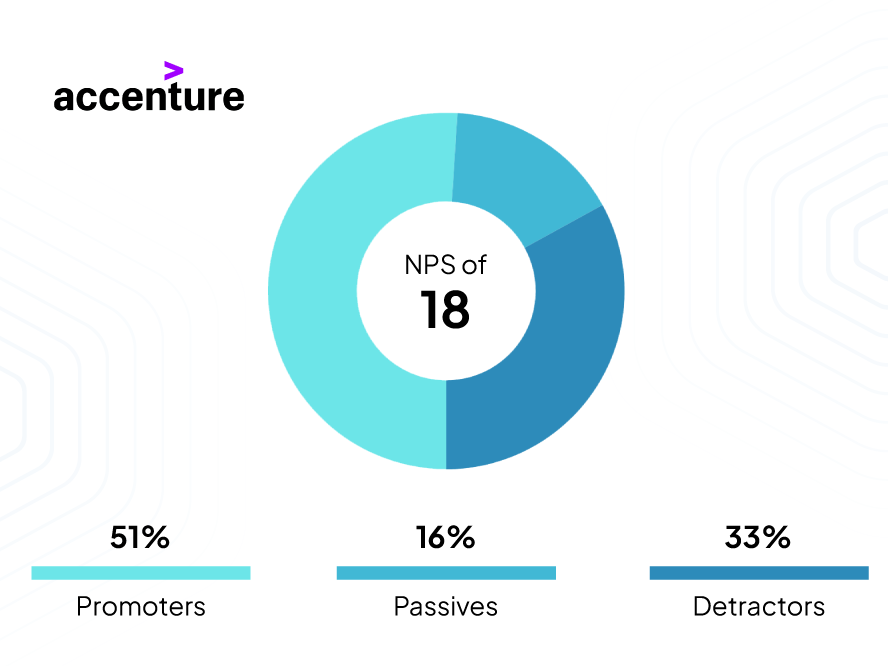
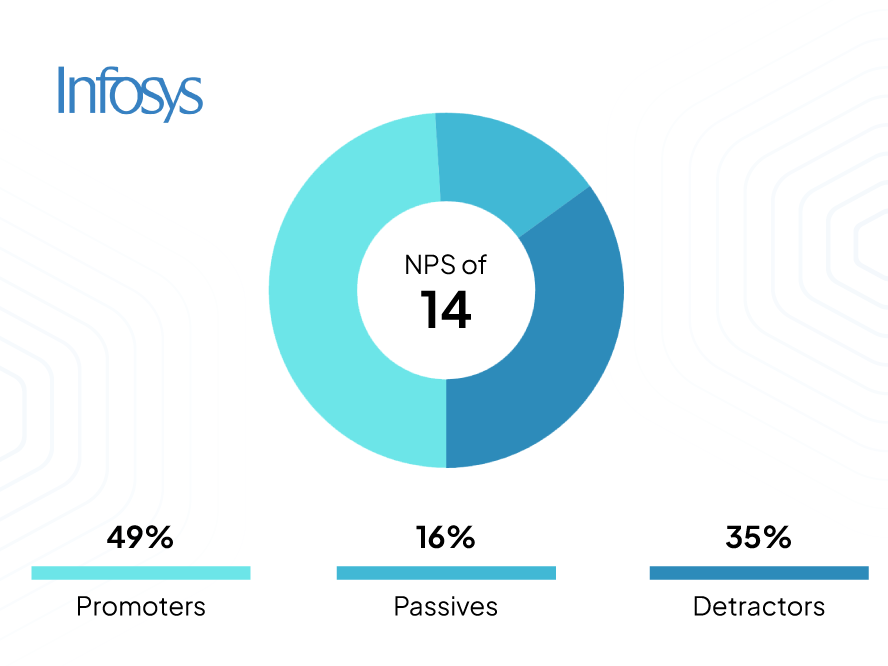
Customer Sentiment: Accenture’s Net Promoter Score (NPS)
Beyond the impressive revenue figures and global reach, understanding how clients truly feel about a service provider offers a deeper insight into their operational strengths and potential friction points. The Net Promoter Score (NPS) is a widely used metric that gauges customer loyalty and satisfaction.
Here’s a look at Accenture’s NPS:
Here’s a look at infosys NPS:
Comparison Table: Accenture vs Infosys at a Glance
This table summarises the core differences in the accenture vs infosys comparison, helping you decide which is better Infosys or Accenture for your specific needs.
| Feature | Accenture | Infosys |
| Primary Focus | High-end Strategy, Consulting, and Digital Transformation | Large-scale Outsourcing, Core Enterprise IT, and Engineering |
| Industry Reputation | Global Consulting Leader (Thought Leader) | Global Delivery and IT Services Leader (Execution Partner) |
| Project Initiation | Begins at the ‘Strategy’ and ‘Why’ phase | Begins at the ‘Delivery’ and ‘How’ phase |
| Typical Cost Model | Premium Rates; High Consulting Overhead | Competitive, Value-driven rates; Efficiency-focused |
| Key Differentiator | Broad, integrated capabilities; Industry-specific knowledge | Deep engineering talent pool; Operational efficiency |
| Best For | Strategic transformations, new business models, major shifts | Maintaining complex systems, large-scale app dev, IT cost reduction |
The Pricing Factor: What You Need to Know
For any business, the cost structure is a deciding factor. When assessing accenture or infosys, their approach to pricing reflects their core business models.
Accenture Pricing
Accenture primarily operates on a Time & Materials (T&M) model for strategy and consulting work, charging premium rates for their senior-level consultants. For large-scale integration and outsourcing, they may use Fixed-Price or Value-Based contracts, but their overall cost base is higher due to their significant investments in global offices and consulting talent.
Infosys Pricing
Infosys is highly competitive in the Software Outsourcing Pricing: Fixed vs T&M vs Retainers space. They often leverage a highly efficient offshore outsourcing model to provide better rates for large-volume, long-term application development and maintenance projects. While they charge market rates for highly specialised skills, their pricing often offers better value for pure engineering and scale.
Pricing & Engagement Models
Choosing between them often comes down to how they bill and contract:
-
- Fixed-Price / Milestones
Best where scope is stable. Accenture often pushes for outcome-based or fixed-fee for core modules.
- Time & Materials (T&M)
When discovery is uncertain, both use T&M. Infosys tends to be more flexible given its global delivery model.
- Outcome / Value-Based Pricing
Accenture is more aggressive in this space for large transformations (you pay based on results rather than inputs).
- UK Cost Drivers
London-based delivery, local compliance, security, visa and labour regulation costs will push rates up. Infosys often offsets that with offshore delivery, but you’ll want clarity on onshore vs offshore mix.
- Fixed-Price / Milestones
Current Market Position & Future Outlook
Accenture
Accenture continues to perform strongly. In Q3 FY25 it posted revenue of ~US $17.7 billion, exceeding estimates. Reuters The firm is restructuring (US $865 million in charges) to reorient toward AI and digital capabilities.
Infosys
Infosys is growing steadily. In its FY26 Q1 results, revenue rose ~4.8 % year-on-year, and large deals reached $3.8 billion. Investing.com UK The Europe region, notably, showed strong performance.
Their sustained focus on operational discipline and steady expansion into consulting helps them stay in the race.
UK / European Trends
-
- Increasing demand for AI-driven software, cloud migration, cyber resilience.
- Clients prefer partners who can deliver end-to-end but also local presence.
- Risk of vendor lock-in or over-budget projects drives demand for more transparent, accountable partners.
- Increasing demand for AI-driven software, cloud migration, cyber resilience.
Project Risk Assessment: A Key Factor in the Infosys vs Accenture Debate
When committing to a large IT project, understanding the inherent risks associated with your partner’s operating model is essential. A great partner minimises these concerns.
The Accenture Risk Profile
Accenture’s consulting-heavy model introduces specific commercial risks.
-
- Scope Creep and Cost Overruns: Their high-touch, premium-rate consultants can quickly expand a project’s scope. This is especially true if the initial strategy phase is vague, which can result in ballooning costs.
- Mitigation: Insist on clear, phased project definitions. Demand Fixed-Price bids for specific, clearly defined deliverables, and be cautious with open-ended T&M contracts.
The Infosys Risk Profile
Infosys’s execution focus creates different potential pitfalls for the client.
-
- Lack of Proactivity: Their focus on process and delivery efficiency sometimes means they stick strictly to the contract. They may not offer proactive, innovative suggestions that fall outside the defined scope, potentially leading to stagnation.
- Cultural Disconnect: While improving, communication in purely outsourced delivery models can sometimes suffer. This can lead to issues in areas like managing scope creep and goal shifts in software development.
- Mitigation: You should insist on a highly competent, local engagement manager who can act as a strategic bridge. Define metrics for innovation and continuous improvement within the contract terms.
Quotable Insight: “The fundamental difference in the infosys vs accenture debate isn’t capability—it’s philosophy. Accenture sells the strategy; Infosys sells the execution. You must decide which is the bottleneck in your business right now.”
Questions to Ask Before Choosing Your Partner
Choosing between infosys or accenture isn’t about finding a “better” company overall—it’s about finding the right company for your project. Use these questions to guide your final decision:
1. Is My Project Strategy-Led or Delivery-Led?
-
- If your project requires high-level business process re-engineering and a complete strategic overhaul, Accenture’s consulting-first approach may be a better fit.
- If you have a clear blueprint and need a reliable, scalable team to execute the build, maintenance, or migration efficiently, Infosys’s engineering focus is often the stronger choice.
2. What is My Budget and Risk Tolerance?
-
- If you have a large budget and value world-class strategy insights, the higher cost of Accenture may be justifiable.
- If you are under pressure to cut IT operational costs or have a project that requires a high volume of skilled developers at a competitive rate, Infosys often provides a better commercial proposal.
3. How Critical is Deep Engineering Expertise?
-
- For bleeding-edge, highly specialised engineering challenges, look closely at which firm has the recent, proven track record in that specific technology. For instance, if you need a specific expert on complex, scalable web apps, you might even consider alternatives like a top laravel developers in the US: 2025’s best picks.
Quotable Insight: “The fundamental difference in the infosys vs accenture debate isn’t capability—it’s philosophy. Accenture sells the strategy; Infosys sells the execution. You must decide which is the bottleneck in your business right now.”
Emvigo: A Nimble Alternative to Global IT Giants
Now we get to the decisive section. When you read this, I want you to see clearly why Emvigo is a smarter, more aligned choice for many UK businesses compared to Accenture or Infosys.
Emvigo’s Strengths & Focus Areas
-
- Specialisation + Agility: We focus on bespoke software, AI, cloud-native solutions, and scalable digital platforms.
- Client-centric delivery: We align our teams to your goals, not the other way around.
- Transparent pricing: You see where every pound is going.
- Post-deployment support: We don’t walk away after go-live — we stay with you.
- Free discovery & demo call: We offer no-cost, zero-obligation evaluations to prove our capability.
- UK compliance & experience: Our UK clients get local SLA, GDPR, and onshore governance.
- Recognition & trust: We’ve featured in Clutch, recognised for software excellence.
- Specialisation + Agility: We focus on bespoke software, AI, cloud-native solutions, and scalable digital platforms.
Emvigo vs Them: A Direct Comparison
| Criteria | Emvigo | Accenture / Infosys |
| Flexibility to pivot mid-project | High | Often rigid |
| Local UK governance & touch | Strong | Good (but bureaucratic) |
| Post-deployment promise | Included | Sometimes extra |
| Risk-sharing in pricing | More negotiable | Harder in fixed models |
| Willingness to serve mid-size clients | Yes | May prefer large enterprises |
When you’re trying to choose between giants like Infosys vs Accenture, the sheer scale can be overwhelming. The better path is to choose a dedicated partner that puts your project first.
We invite you to experience the focused expertise, transparent partnership, and superior post-deployment commitment that Emvigo provides—without the high-consulting overhead.
Ready to Get Dedicated Expertise with UK-Based Quality?
Don’t get lost in the shuffle of a massive global project.
Book Your Free Demo Call Today.
Talk to a senior strategist, assess your project needs, and see exactly how Emvigo’s focused approach provides better results than traditional outsourcing models.
Claim your exclusive introductory offer when you book now!
Frequently Asked Questions (FAQs)
Here are some common questions you or your colleagues may ask. We use “Accenture vs Infosys” and related keywords naturally.
Q1: In Accenture vs Infosys, which is better for UK mid-sized firms?
It depends on your needs. If you want premium consultancy and have a large budget, Accenture may suit. But for agility, value, and closer alignment, Infosys or Emvigo might be better.
Q2: What is the pricing difference between Accenture vs Infosys?
Accenture often commands premium rates (consulting + global brand). Infosys is more competitive, relying on offshore delivery to manage cost. But check transparently the local vs offshore mix.
Q3: How do Infosys or Accenture compare as long-term partners?
Both have large scale and stable operations. But their bureaucratic nature may slow responsiveness. Emvigo’s advantage is that we stay nimble and customer-focused throughout.
Q4: Does Accenture vs Infosys differ in post-launch support?
Yes. Accenture may require extra contracts for ongoing support. Infosys is better but may still charge for extended SLAs. Emvigo includes post-deployment service as part of our commitment.
Q5: Which has stronger innovation in AI, Accenture vs Infosys?
Accenture invests heavily in AI, advanced analytics, and ecosystems. Infosys is catching up rapidly, embedding AI into delivery engines. The real difference lies in how they apply it to your domain.
Conclusion: Making the Right Choice for Your Business
Choosing between Accenture vs Infosys is a significant decision that carries substantial financial and operational weight. Both firms are global leaders and highly capable, but their specialisms are different.
-
- Choose Accenture if your priority is high-level business strategy, management consulting, and creative digital transformation, and you have the budget for a premium, strategy-led engagement.
- Choose Infosys if your priority is cost-effective, reliable execution of large-scale core IT, application development, and long-term outsourcing, and you need a deep bench of engineering talent.
However, if you’re a business looking for the deep expertise, dedicated partnership, competitive pricing, and superior post-deployment service that often gets lost in the sheer scale of the global giants—then a different kind of partner is needed.
Don’t settle for being another small fish in a giant pond.
Ready to partner with a UK-based software specialist that offers the dedication of a boutique firm with the engineering strength of a global leader?
Book your free demo call with Emvigo today.
We’ll discuss your project, your challenges with choosing between accenture or infosys, and show you exactly how our model delivers superior results and better value.
Click here to secure your free consultation and step beyond the limits of massive IT outsourcing.